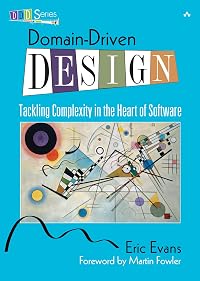
Domain-Driven Design: Tackling Complexity in the Heart of Software
by Eric Evans
On This Page
Description
“Eric Evans has written a fantastic book on how you can make the design of your software match your mental model of the problem domain you are addressing. “His book is very compatible with XP. It is not about drawing pictures of a domain; it is about how you think of it, the language you use to talk about it, and how you organize your software to reflect your improving understanding of it. Eric thinks that learning about your problem domain is as likely to happen at the end of your show more project as at the beginning, and so refactoring is a big part of his technique. “The book is a fun read. Eric has lots of interesting stories, and he has a way with words. I see this book as essential reading for software developers—it is a future classic.” — Ralph Johnson , author of Design Patterns “If you don’t think you are getting value from your investment in object-oriented programming, this book will tell you what you’ve forgotten to do. “Eric Evans convincingly argues for the importance of domain modeling as the central focus of development and provides a solid framework and set of techniques for accomplishing it. This is timeless wisdom, and will hold up long after the methodologies du jour have gone out of fashion.” — Dave Collins , author of Designing Object-Oriented User Interfaces “Eric weaves real-world experience modeling—and building—business applications into a practical, useful book. Written from the perspective of a trusted practitioner, Eric’s descriptions of ubiquitous language, the benefits of sharing models with users, object life-cycle management, logical and physical application structuring, and the process and results of deep refactoring are major contributions to our field.” — Luke Hohmann , author of Beyond Software Architecture “This book belongs on the shelf of every thoughtful software developer.” — Kent Beck “What Eric has managed to capture is a part of the design process that experienced object designers have always used, but that we have been singularly unsuccessful as a group in conveying to the rest of the industry. We've given away bits and pieces of this knowledge...but we've never organized and systematized the principles of building domain logic. This book is important.” — Kyle Brown , author of Enterprise Java™ Programming with IBM ® WebSphere ® The software development community widely acknowledges that domain modeling is central to software design. Through domain models, software developers are able to express rich functi... show lessTags
Recommendations







Member Reviews
For some reason this book is greatly beloved in programming circles. I can't tell if that's because the people doing the beloving are die-hard Java Enterprise programmers, or if I'm just missing something here. But I think it's the former.
Domain-Driven Design is an excessively dry, boring book whose main thesis seems to be "make sure everybody agrees on what terminology is being used." What could have been this one sentence is instead 650 pages, chocked full of UML diagrams and insipid discussions about shipping containers. And that's saying something, coming from a guy who reads excessively dry boring math and engineering books on the regular.
If I had to be charitable, I would say that this book is independently groping towards show more functional programming without knowing it, and trying to shoehorn the ideas into an OOP-mindset. There is a lot of potential here for things to like, but it ultimately falls short. If you've only ever coded in Java, or frequently sketch UML diagrams, this might be the book for you. And if so, may god have mercy on your soul. show less
Domain-Driven Design is an excessively dry, boring book whose main thesis seems to be "make sure everybody agrees on what terminology is being used." What could have been this one sentence is instead 650 pages, chocked full of UML diagrams and insipid discussions about shipping containers. And that's saying something, coming from a guy who reads excessively dry boring math and engineering books on the regular.
If I had to be charitable, I would say that this book is independently groping towards show more functional programming without knowing it, and trying to shoehorn the ideas into an OOP-mindset. There is a lot of potential here for things to like, but it ultimately falls short. If you've only ever coded in Java, or frequently sketch UML diagrams, this might be the book for you. And if so, may god have mercy on your soul. show less
On a topic which most authors would probably tend to evangelize, Eric Evans is conversational. His viewpoint is straightforward: these are the principles he feels he's extracted from putting in many, many hours on many, many projects. But he sort of slip-slides around the principles, approaching them from the back with lots of digressions on things his teams have tried; sometimes they work and sometimes they don't work, and maybe this general principle is sort of, kind of, why the ones that worked, did. Which is a bit of a breather if you're used to the typical snake-oil agile style where JOE USED ALL THE AGILE PRINCIPLES AND BROUGHT IN HIS PROJECT 30% UNDER BUDGET!
But Domain-Driven Design is tricky, much more so than the simple agile show more recipes like test-driven development and pair programming. DDD is much more about finding common ground with the people who use your software, or at least the people who represent those people, and so it's almost more a book on communication than it is on coding. But it isn't. Evans sticks strictly to the coder side of it, and focuses on how one extracts business logic and rules from business people, even when those people aren't completely clear on the rules themselves, which is most of the time.
So if you're the type of developer who just wants a spec to work from, and to be able to tell the boss, "can't change that - it's just like the spec says", feel free to skip this book. If you think domain levels are a waste of time, and you're happy with a UI layer that talks directly to the database layer, go ahead and skip this book.
But if you think that communicating with the people that actually use your software is important, or if you see software as a way to model business functionality, it's a must read. Because without some inkling of these principles, no piece of complicated, useful software could ever come into being. show less
But Domain-Driven Design is tricky, much more so than the simple agile show more recipes like test-driven development and pair programming. DDD is much more about finding common ground with the people who use your software, or at least the people who represent those people, and so it's almost more a book on communication than it is on coding. But it isn't. Evans sticks strictly to the coder side of it, and focuses on how one extracts business logic and rules from business people, even when those people aren't completely clear on the rules themselves, which is most of the time.
So if you're the type of developer who just wants a spec to work from, and to be able to tell the boss, "can't change that - it's just like the spec says", feel free to skip this book. If you think domain levels are a waste of time, and you're happy with a UI layer that talks directly to the database layer, go ahead and skip this book.
But if you think that communicating with the people that actually use your software is important, or if you see software as a way to model business functionality, it's a must read. Because without some inkling of these principles, no piece of complicated, useful software could ever come into being. show less
This work was published in 2004 – a lifetime ago for the field of software design. It tackles issues relevant in 2004 but are standard practice today. Its basic message – learn not just the software but also the domain – is an important one, but most of the insights has been absorbed into computer-programming praxis over the last fifteen years.
Its strength is in delineating how the programmer is to relate to the domain experts who teach the programmer about the application area. He defines the term “ubiquitous language” to describe the language and concepts the two must share. I like this concept, but I think that the chosen wording should be “common language” instead of referring to the concept of ubiquity (whose meaning show more is closer to everywhere than shared or common).
This book had its time and place. However, for the $50 price current on the market, I suggest that its time and place has passed. It has contributed to history, and one should appreciate those effects. Nonetheless, contemporary design concepts – like Agile development or the DevOps movement – certainly deserve more attention from the reader. show less
Its strength is in delineating how the programmer is to relate to the domain experts who teach the programmer about the application area. He defines the term “ubiquitous language” to describe the language and concepts the two must share. I like this concept, but I think that the chosen wording should be “common language” instead of referring to the concept of ubiquity (whose meaning show more is closer to everywhere than shared or common).
This book had its time and place. However, for the $50 price current on the market, I suggest that its time and place has passed. It has contributed to history, and one should appreciate those effects. Nonetheless, contemporary design concepts – like Agile development or the DevOps movement – certainly deserve more attention from the reader. show less
See elsewhere for my more detailed summary.
The short summary is that Domain-Driven Design is a great book for any programmer or software designer who wants to deepen their ability to model application domains. Evans describes why domain modelling is important and sets out a number of patterns for achieving better models. He has a good grasp of real world complexities and, because of that, insists that a model must be implementable if it is to be successful. Any overlap between the model and the implementation should be identical or the model will become obsolete.
Evans provides a number of patterns to help determine the best domain model for an application. These patterns range from the abstract to the concrete, from the brilliant to the show more pedantic. Overall, I highly enjoyed the book although, at just over 500 pages, I am glad that I had a reading group to work through it with. show less
The short summary is that Domain-Driven Design is a great book for any programmer or software designer who wants to deepen their ability to model application domains. Evans describes why domain modelling is important and sets out a number of patterns for achieving better models. He has a good grasp of real world complexities and, because of that, insists that a model must be implementable if it is to be successful. Any overlap between the model and the implementation should be identical or the model will become obsolete.
Evans provides a number of patterns to help determine the best domain model for an application. These patterns range from the abstract to the concrete, from the brilliant to the show more pedantic. Overall, I highly enjoyed the book although, at just over 500 pages, I am glad that I had a reading group to work through it with. show less
This is a great book for domain modeling. It should be required reading for programmers. Little things like using consistent language does make a big difference.
Clever and clear, even if somewhat slow-moving. Eric Evans knows where to lead the reader, and the book is full with plenty of useful insights.
There is a lot of things to learn in here. Probably I should read it again.
Members
- Recently Added By
Lists

Finished in 2025
23 works; 1 member
Author Information

Common Knowledge
- Original publication date
- 2003
Classifications
- Genres
- Technology, Nonfiction, Art & Design
- DDC/MDS
- 005.1 — Computer science, information & general works Computer science, knowledge & systems Artificial Intelligence/Virtual Reality Software development
- LCC
- QA76.76 .D47 .E82 — Science Mathematics Mathematics Instruments and machines Calculating machines Electronic computers. Computer science Computer software
- BISAC
Statistics
- Members
- 867
- Popularity
- 31,455
- Reviews
- 10
- Rating
- (4.21)
- Languages
- English, Portuguese (Portugal)
- Media
- Paper, Ebook
- ISBNs
- 6
- UPCs
- 1
- ASINs
- 3