On This Page
Description
On a planet where violence and vengeance rule, in a galaxy where some are favored by fate, everyone develops a currentgift, a unique power meant to shape the future. While most benefit from their currentgifts, Akos and Cyra do not -- their gifts make them vulnerable to others control. Can they reclaim their gifts, their fates, and their lives, and reset the balance of power in this world? Cyra is the sister of the brutal tyrant who rules the Shotet people. Cyra's currentgift gives her pain show more and power -- something her brother exploits, using her to torture his enemies. But Cyra is much more than just a blade in her brothers hand: she is resilient, quick on her feet, and smarter than he knows. Akos is from the peace-loving nation of Thuvhe, and his loyalty to his family is limitless. Though protected by his unusual currentgift, once Akos and his brother are captured by enemy Shotet soldiers, Akos is desperate to get his brother out alive -- no matter what the cost. When Akos is thrust into Cyra's world, the enmity between their countries and families seems insurmountable. They must decide to help each other to survive -- or to destroy one another. show lessTags
Recommendations

Member Recommendations
Member Reviews
I borrowed Carve the Mark without knowing anything about it - I liked Divergent and was curious about what sort of stories Veronica Roth would tell next. The answer: a story about two teenagers in a world of fates, magical abilities and interplanetary travel.
Akos and Cyra belong to very different societies and very different - albeit both important - families. Akos is the youngest son of Thuvhe’s sitting oracle, while Cyra is the youngest member of the Shotet ruling family; Cyra has an adversarial relationship with her brother, whereas Akos is determined to rescue his no matter what. When Cyra and Akos are forced into each other’s company, they discover their survival could depend on learning to work together.
The title comes from show more the Shotet custom of “carving a mark” in one’s arm after killing someone. If I’d known that beforehand, I might have decided against reading this. I am idiosyncratically (and some have said, illogically) squeamish about some things: certain types of violence, poisons, things that destroy memories. Between this and my empathy for a character dealing with chronic pain, parts of this book made me - uncomfortable. A purely subjective reaction that leaves me doubting my ability to be objective. I don’t think that Carve the Mark is exceptionally dark, or even just darker than other stories I’ve loved - I suspect it’s simply dark in a way that happens to really bother me - but I’m not sure.
Nevertheless, I am really glad I kept reading. The worldbuilding is intriguing, the family dynamics are nuanced, and I became unexpectedly and fiercely attached to the characters.
I especially like the way this is so forcefully Cyra’s story. At first I thought this was an oddly paced book, for the way it begins with Akos, quickly upends his life and then abruptly switches to Cyra’s POV. When we next see Akos, some time - and several traumatic, life-altering experiences - later, it is through Cyra’s eyes.
This seemed like odd pacing because part of me expects that of course this story is going to focus on the teenage boy as he unwillingly leaves home, deals with grief and revelations about his destiny, develops his currentgift, learns to fight and so on. Because that’s what fantasy stories are about, right? Instead we get Cyra dealing with her family and her currentgift and her pain. Akos is important, and the book returns to his POV later on, but the story doesn’t revolve around him the way it so easily could.
I want to reread this, to see if I can look at it more clearly - I feel like it deserves more eloquence and objectivity than I can manage right now.
“Let me cook, okay?” He took the pot from her. The water sloshed, spilling on his shoes. “I guarantee I won’t see anything on fire.”
“That happened one time,” she said. “I’m not a walking, talking hazard.”
Like so much of what she said about herself, it was both a joke and not a joke. show less
Akos and Cyra belong to very different societies and very different - albeit both important - families. Akos is the youngest son of Thuvhe’s sitting oracle, while Cyra is the youngest member of the Shotet ruling family; Cyra has an adversarial relationship with her brother, whereas Akos is determined to rescue his no matter what. When Cyra and Akos are forced into each other’s company, they discover their survival could depend on learning to work together.
The title comes from show more the Shotet custom of “carving a mark” in one’s arm after killing someone. If I’d known that beforehand, I might have decided against reading this. I am idiosyncratically (and some have said, illogically) squeamish about some things: certain types of violence, poisons, things that destroy memories. Between this and my empathy for a character dealing with chronic pain, parts of this book made me - uncomfortable. A purely subjective reaction that leaves me doubting my ability to be objective. I don’t think that Carve the Mark is exceptionally dark, or even just darker than other stories I’ve loved - I suspect it’s simply dark in a way that happens to really bother me - but I’m not sure.
Nevertheless, I am really glad I kept reading. The worldbuilding is intriguing, the family dynamics are nuanced, and I became unexpectedly and fiercely attached to the characters.
I especially like the way this is so forcefully Cyra’s story. At first I thought this was an oddly paced book, for the way it begins with Akos, quickly upends his life and then abruptly switches to Cyra’s POV. When we next see Akos, some time - and several traumatic, life-altering experiences - later, it is through Cyra’s eyes.
This seemed like odd pacing because part of me expects that of course this story is going to focus on the teenage boy as he unwillingly leaves home, deals with grief and revelations about his destiny, develops his currentgift, learns to fight and so on. Because that’s what fantasy stories are about, right? Instead we get Cyra dealing with her family and her currentgift and her pain. Akos is important, and the book returns to his POV later on, but the story doesn’t revolve around him the way it so easily could.
I want to reread this, to see if I can look at it more clearly - I feel like it deserves more eloquence and objectivity than I can manage right now.
“Let me cook, okay?” He took the pot from her. The water sloshed, spilling on his shoes. “I guarantee I won’t see anything on fire.”
“That happened one time,” she said. “I’m not a walking, talking hazard.”
Like so much of what she said about herself, it was both a joke and not a joke. show less
Thuvhe and Shotet are at war. The Thuvhesites, recognized by the galaxy's governing body known as the Assembly, live on their harsh ice planet and worship the current, which goes through all things and people and gives them special gifts and abilities. The Shotet, a militant people also living on the planet known as Thuvhe, want to be recognized as a nation and have their own history and explanations for the conflict between them and Thuvhe. Akos, the Thuvhesite son of a farmer and an oracle, and Cyra, the daughter of the ruling family of Shotet, could not be more different but both their lives are changed when their fates - and those of family and friends - are revealed to all. Because while you can change the future, you can't change show more your fate - or can you?
After the Divergent series exploded on the scene, anything Veronica Roth writes is bound to receive a lot of hype. I had a library hold on this book before I knew anything but the title. I applaud her for creating a completely different world from her first series and really enjoyed learning about the unique people groups, histories, and belief systems that populate this world. Even though there's a lot of world-building to take in, the pacing builds and keeps you turning pages faster and faster. The narrative switches back and forth between Cyra (first person) and Akos (third person). The tropes of the genre - the love story, really evil bad guys - are definitely present, so if you're sick of them you'll probably find this an "okay" read, but fans of this kind of YA fantasy/science fiction will eat it up. I enjoyed it overall, and I'm looking forward to the sequel. show less
After the Divergent series exploded on the scene, anything Veronica Roth writes is bound to receive a lot of hype. I had a library hold on this book before I knew anything but the title. I applaud her for creating a completely different world from her first series and really enjoyed learning about the unique people groups, histories, and belief systems that populate this world. Even though there's a lot of world-building to take in, the pacing builds and keeps you turning pages faster and faster. The narrative switches back and forth between Cyra (first person) and Akos (third person). The tropes of the genre - the love story, really evil bad guys - are definitely present, so if you're sick of them you'll probably find this an "okay" read, but fans of this kind of YA fantasy/science fiction will eat it up. I enjoyed it overall, and I'm looking forward to the sequel. show less
Apparently this book is controversial? I dunno, I liked it well enough.
I thought its presentation of two races at war was clunky, at worst. As I was reading I was under the impression that both Akos and Cyra were from mixed race families. And a lot of other reviewers point out othering language Akos uses in reference to the Shotet but, like. Dude’s gotta have a character arc and realize he’s wrong about them.
Another thing is Cyra’s chronic pain. It seems disingenuous to say that Roth is implying that people with chronic pain can get over it if they just try hard enough. There are enough fantastical elements attached to the origin of Cyra’s chronic pain that make it really hard to find a real life analog.
I thought its presentation of two races at war was clunky, at worst. As I was reading I was under the impression that both Akos and Cyra were from mixed race families. And a lot of other reviewers point out othering language Akos uses in reference to the Shotet but, like. Dude’s gotta have a character arc and realize he’s wrong about them.
Another thing is Cyra’s chronic pain. It seems disingenuous to say that Roth is implying that people with chronic pain can get over it if they just try hard enough. There are enough fantastical elements attached to the origin of Cyra’s chronic pain that make it really hard to find a real life analog.
About 10% of the way into Carve the Mark, I started fishing through friend reviews on Goodreads. I was bored. I wanted to know if other people were bored, too. It seemed like – overwhelmingly – they were! I also learned that there was a lot of controversy surround this book, so I think it’s only fair to point out a little bit of it.
- The publisher sponsored many reviews. This means that they paid prominent bloggers, vloggers, and Goodreads accounts to read the book. This is totally different than simply providing an ARC – there’s so much more pressure to give a good review because you’re receiving actually cash money, which makes it a little more difficult to know who’s being honest about it.
- One of the protagonists show more suffers from chronic pain. I’m going to detail this more in my review later, because this aspect was the one I really thought was poorly handled.
- There’s some problematic racism stuff. I actually didn’t pick up much on this, but a lot of other reviewers saw it loud and clear that there was a pale-skinned diplomatic race, and a violent and corrupt darker-skinned race. I may have missed most the details on skin color here because I was zoning in and out of the audiobook (like I said, bored!) but I think it needs mentioning.
Okay, so now that we’ve addressed these things, let’s talk about Carve the Mark as a book.
The world-building aspects of this book were overwhelmingly slow and bogged down the plot. We are introduced to places and people that make no difference in the story and make the world a lot broader. If this were an epic fantasy novel, I would applaud this type of storytelling, because it fits within the genre. However, Carve the Mark is a YA Science-Fiction Romance and the lallygagging didn’t add anything to the story that my imagination would not have filled in otherwise. There are too many names and too many minor details for the genre, and because of this, a lot of people are DNF-ing this book. I almost did, too. But I wanted to write this review. 😉
In regards to the genre, this very well could have been a fantasy novel and you almost would not have noticed. There’s a section of the story where Cyra and Akos go on a “sojourn” to another planet and Cyra’s brother – the wicked sovereign Risek – brokers an alliance. This whole trip took up a good chunk of the middle of the book and had a lot of potential to be all science-fictiony and spacey and instead there was a lot of focus on the interior. I honestly kept forgetting that this culture had advanced technology because there’s so much conversation about fighting styles and current gifts.
Current gifts are another issue altogether. Cyra Noavek is gifted with pain as her “current gift”… which is basically a coming-of-age magic. I have a few issues with this.
-Current gifts are described as something that defines the character. Cyra is told a couple times that she feels pain because she believes everyone deserves pain. She fights against this at the beginning, but embraces it at the end.
-For someone experiencing chronic pain all over all the time, she functions perfectly well. So even if Roth wanted to use this, she didn’t bother to show how crippling it truly is. There’s a few scenes in the beginning where Cyra is drugging herself endlessly with painkillers, which is a whole additional issue.
- Cyra chooses not only to accept that the pain is a part of her character, but decides that pain is a gift – and pain is never a gift. She says that because she’s in pain, it has made her strong. I see the “you can overcome anything!” message here, but there’s a difference between finding strength in resilience, and deciding that chronic pain is a gift, not a curse.
This is the tip of the iceberg when it comes to both Cyra’s behavior and her gift, but I am exasperated enough that I felt like it needed some outlining. I think there are a lot of ways that Veronica Roth could have taken this character without making her current gift chronic pain, especially since she didn’t even follow through with it, and it was a disappointing thing to read. You can hurt people without pain being your “superpower”.
And there were a lot of unnecessary aspects that came out of the current gift situation. The Oracles, for example. There’s a lot of hullaballoo made about these characters, but ultimately, they just float around being generally useless outside of making people paranoid about their destiny. Cool concept – failure to execute effectively strikes again! With the Oracles and around the other characters, the plot was a bit of a mess. She wanted to do a lot of things, while also building this huge sandbox world where she could tie all of her characters together and say, “look how cleverly everything comes together!” Only, it doesn’t? Sometimes there are too many coincidences and I am utterly unimpressed. And this comes in the details.
Honestly, reading this book was like watching a movie, but with white tissue paper taped over the screen. You can see the lights and shapes and colors, but it’s all a bit blurry and nonsensical. You can sort of see what the story could have been, but ultimately Carve the Mark tries way too hard.
Before I wrap up this rambling review, I want to give you a list of some of the trigger warnings I noticed that I am not widely seeing discussed:
Chronic pain (obviously)
Self-mutilation
Torture
Rape (not in your traditional sense, but the relationship between Risek and Ija screams this to me)
Brainwashing
Racism
Ableism
Everyone will react differently, but I think it’s important that these things are out there so you can make your own educated choice of whether or not to read this based on these elements. Some people are saying that the trigger warnings folks are giving are overdramatic – other people are saying that they aren’t loud enough. Personally, I’d rather have them than not!
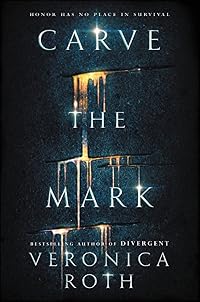
All in all, I felt like this book was a huge waste of my time? I can’t think of a moment where I was roped into the story enough that I lost myself, and with a book this thick, that should have happened. Instead, I found myself making snarky comments at some of the more ridiculous details. I thought the audiobook readers did a fine job with the content and that the cover is beautiful and that this book should have been at least 100 pages shorter, contained more actual science fiction, and made a few different core choices. show less
- The publisher sponsored many reviews. This means that they paid prominent bloggers, vloggers, and Goodreads accounts to read the book. This is totally different than simply providing an ARC – there’s so much more pressure to give a good review because you’re receiving actually cash money, which makes it a little more difficult to know who’s being honest about it.
- One of the protagonists show more suffers from chronic pain. I’m going to detail this more in my review later, because this aspect was the one I really thought was poorly handled.
- There’s some problematic racism stuff. I actually didn’t pick up much on this, but a lot of other reviewers saw it loud and clear that there was a pale-skinned diplomatic race, and a violent and corrupt darker-skinned race. I may have missed most the details on skin color here because I was zoning in and out of the audiobook (like I said, bored!) but I think it needs mentioning.
Okay, so now that we’ve addressed these things, let’s talk about Carve the Mark as a book.
The world-building aspects of this book were overwhelmingly slow and bogged down the plot. We are introduced to places and people that make no difference in the story and make the world a lot broader. If this were an epic fantasy novel, I would applaud this type of storytelling, because it fits within the genre. However, Carve the Mark is a YA Science-Fiction Romance and the lallygagging didn’t add anything to the story that my imagination would not have filled in otherwise. There are too many names and too many minor details for the genre, and because of this, a lot of people are DNF-ing this book. I almost did, too. But I wanted to write this review. 😉
In regards to the genre, this very well could have been a fantasy novel and you almost would not have noticed. There’s a section of the story where Cyra and Akos go on a “sojourn” to another planet and Cyra’s brother – the wicked sovereign Risek – brokers an alliance. This whole trip took up a good chunk of the middle of the book and had a lot of potential to be all science-fictiony and spacey and instead there was a lot of focus on the interior. I honestly kept forgetting that this culture had advanced technology because there’s so much conversation about fighting styles and current gifts.
Current gifts are another issue altogether. Cyra Noavek is gifted with pain as her “current gift”… which is basically a coming-of-age magic. I have a few issues with this.
-Current gifts are described as something that defines the character. Cyra is told a couple times that she feels pain because she believes everyone deserves pain. She fights against this at the beginning, but embraces it at the end.
-For someone experiencing chronic pain all over all the time, she functions perfectly well. So even if Roth wanted to use this, she didn’t bother to show how crippling it truly is. There’s a few scenes in the beginning where Cyra is drugging herself endlessly with painkillers, which is a whole additional issue.
- Cyra chooses not only to accept that the pain is a part of her character, but decides that pain is a gift – and pain is never a gift. She says that because she’s in pain, it has made her strong. I see the “you can overcome anything!” message here, but there’s a difference between finding strength in resilience, and deciding that chronic pain is a gift, not a curse.
This is the tip of the iceberg when it comes to both Cyra’s behavior and her gift, but I am exasperated enough that I felt like it needed some outlining. I think there are a lot of ways that Veronica Roth could have taken this character without making her current gift chronic pain, especially since she didn’t even follow through with it, and it was a disappointing thing to read. You can hurt people without pain being your “superpower”.
And there were a lot of unnecessary aspects that came out of the current gift situation. The Oracles, for example. There’s a lot of hullaballoo made about these characters, but ultimately, they just float around being generally useless outside of making people paranoid about their destiny. Cool concept – failure to execute effectively strikes again! With the Oracles and around the other characters, the plot was a bit of a mess. She wanted to do a lot of things, while also building this huge sandbox world where she could tie all of her characters together and say, “look how cleverly everything comes together!” Only, it doesn’t? Sometimes there are too many coincidences and I am utterly unimpressed. And this comes in the details.
Honestly, reading this book was like watching a movie, but with white tissue paper taped over the screen. You can see the lights and shapes and colors, but it’s all a bit blurry and nonsensical. You can sort of see what the story could have been, but ultimately Carve the Mark tries way too hard.
Before I wrap up this rambling review, I want to give you a list of some of the trigger warnings I noticed that I am not widely seeing discussed:
Chronic pain (obviously)
Self-mutilation
Torture
Rape (not in your traditional sense, but the relationship between Risek and Ija screams this to me)
Brainwashing
Racism
Ableism
Everyone will react differently, but I think it’s important that these things are out there so you can make your own educated choice of whether or not to read this based on these elements. Some people are saying that the trigger warnings folks are giving are overdramatic – other people are saying that they aren’t loud enough. Personally, I’d rather have them than not!
All in all, I felt like this book was a huge waste of my time? I can’t think of a moment where I was roped into the story enough that I lost myself, and with a book this thick, that should have happened. Instead, I found myself making snarky comments at some of the more ridiculous details. I thought the audiobook readers did a fine job with the content and that the cover is beautiful and that this book should have been at least 100 pages shorter, contained more actual science fiction, and made a few different core choices. show less
This beginning of a new series has many elements in common with the "Divergent" series, but in a very different universe. And in fact, Roth spends much of the book on world-building rather than on character-building. In this world, there is a “current” circling the planetary system, and everyone comes into a “gift” from the current when they reach puberty.
Two warring nations on one particular planet are the focus of the story: Shotet and Thuvhe. You will be shocked, shocked to learn there are two attractive 16-year-olds, one from each nation - a boy, Akos, and a girl, Cyra, that are destined to get together.
Cyra Noavek has an unusual “currentgift" - more like a curse, at least at first - she has chronic pain, which she can show more transfer to other people by touching them. It is so intense that prolonged contact with Cyra can kill the other person. Her evil brother Ryzek, now the leader of the Shotet nation, uses Cyra as his “scourge” to punish his enemies.
Cyra’s people, the Shotet, manage to kidnap two Thuvhens, Akos and Eijeh Kereseth, from across the border and bring them to Shotet. Ryzek wanted Eijeh because Eijeh’s gift is to prophesize. Akos is useful since his gift is to disrupt the current of the gifts of others. By touching Cyra, he can control her pain enough for Ryzek to have her to appear in public with him and do his bidding (which usually involves torture).
Akos is desperate to get Eijeh out of Shotet, because the gift Ryzek has is destroying Eijeh. But Ryzek has eyes everywhere, and a gang of thugs to support him. As Cyra and Akos grow closer, they both try to give each other strength and courage to stand up to injustice.
Evaluation: This book has a predictable attraction between two teens from two enemy groups; very evil people trying to take over the government; a resistance group; lots of training in fighting and weaponry; family loyalty questions; heartbreaking loss; a great deal of angst; and some personal growth, even though it’s only book one.
But I was not impressed with the derivative plot, the superficial characterizations - most of which lacked nuance, or the flimsy motivation for Cyra doing Ryzek’s evil bidding.
While I have seen a number of reviews for this book that condemn a perceived dichotomy between evil dark people and good light people, I didn’t think the comparative characteristics of each group was that straightforward. In my view, each had a mix of good and bad people. But adding color to one side or the other didn’t seem to serve any purpose in any event.
While I didn’t hate this book, I can’t see myself seeking out the next installment. show less
Two warring nations on one particular planet are the focus of the story: Shotet and Thuvhe. You will be shocked, shocked to learn there are two attractive 16-year-olds, one from each nation - a boy, Akos, and a girl, Cyra, that are destined to get together.
Cyra Noavek has an unusual “currentgift" - more like a curse, at least at first - she has chronic pain, which she can show more transfer to other people by touching them. It is so intense that prolonged contact with Cyra can kill the other person. Her evil brother Ryzek, now the leader of the Shotet nation, uses Cyra as his “scourge” to punish his enemies.
Cyra’s people, the Shotet, manage to kidnap two Thuvhens, Akos and Eijeh Kereseth, from across the border and bring them to Shotet. Ryzek wanted Eijeh because Eijeh’s gift is to prophesize. Akos is useful since his gift is to disrupt the current of the gifts of others. By touching Cyra, he can control her pain enough for Ryzek to have her to appear in public with him and do his bidding (which usually involves torture).
Akos is desperate to get Eijeh out of Shotet, because the gift Ryzek has is destroying Eijeh. But Ryzek has eyes everywhere, and a gang of thugs to support him. As Cyra and Akos grow closer, they both try to give each other strength and courage to stand up to injustice.
Evaluation: This book has a predictable attraction between two teens from two enemy groups; very evil people trying to take over the government; a resistance group; lots of training in fighting and weaponry; family loyalty questions; heartbreaking loss; a great deal of angst; and some personal growth, even though it’s only book one.
But I was not impressed with the derivative plot, the superficial characterizations - most of which lacked nuance, or the flimsy motivation for Cyra doing Ryzek’s evil bidding.
While I have seen a number of reviews for this book that condemn a perceived dichotomy between evil dark people and good light people, I didn’t think the comparative characteristics of each group was that straightforward. In my view, each had a mix of good and bad people. But adding color to one side or the other didn’t seem to serve any purpose in any event.
While I didn’t hate this book, I can’t see myself seeking out the next installment. show less
Ok, I really liked Divergent, so I was interested in this new series. And I like the science fiction aspect of it -- new worlds, new cultures, imaginative settings. And, honestly, it started out well and I was getting into the Kereseth family. And then.
Well, it all fell apart, and it never really came back together again. That fleeting first couple of chapters was the only real stab at character development. The plot kinda plods along, but I was ok with that -- at least portions of it were pretty. I had a hard time buying most of the Noavek/Shotet motivations, and I really couldn't reconcile the debilitating portion of Cyra's currentgift with her status as an elite warrior. It just seemed to be so random -- most of the time, she's show more incapacitated with pain, but not when she's practicing? Incapacitated with pain is incapacitated with pain. Pain isn't a thing you power through when it's at an incapacitating level. Or at least, that's my opinion and nothing in this book managed to convince me otherwise.
The love story seemed flat, the plot twist was visible from pretty far off, the darn thing is unresolved at the end and I honestly don't care enough to pick up a sequel. Disappointed. It felt like watching a bad movie that never resolved into the truly terrible trainwreck that would make it a cult classic. show less
Well, it all fell apart, and it never really came back together again. That fleeting first couple of chapters was the only real stab at character development. The plot kinda plods along, but I was ok with that -- at least portions of it were pretty. I had a hard time buying most of the Noavek/Shotet motivations, and I really couldn't reconcile the debilitating portion of Cyra's currentgift with her status as an elite warrior. It just seemed to be so random -- most of the time, she's show more incapacitated with pain, but not when she's practicing? Incapacitated with pain is incapacitated with pain. Pain isn't a thing you power through when it's at an incapacitating level. Or at least, that's my opinion and nothing in this book managed to convince me otherwise.
The love story seemed flat, the plot twist was visible from pretty far off, the darn thing is unresolved at the end and I honestly don't care enough to pick up a sequel. Disappointed. It felt like watching a bad movie that never resolved into the truly terrible trainwreck that would make it a cult classic. show less
TRIGGER WARNING - Common sense incoming, for those of you who are easily offended and like being in that state please don't read this or your feelings towards this book might be changed.
I'm leaving my initial response to the "racism" and "ableism" below this review. So first the "racism", there is no valid evidence for the claim that this novel's plot is racist. The argument that I've seen so far is that the Shotets are non-whites and evil but the Thuvhesits are the white heroes, this assumption is false. There is no evidence that all of Shotets are non-whites, they say early on that they have mixed blood, that could mean anything, but the lack of description on most of the characters we meet doesn't support that they all have dark show more skin (only Cyra is described as brown/tan), this applies to the Thuvhesits as well (no evidence they are all white either). Also, the evil in the story comes from one man not the Shotets as a whole, Ryzek Noavek, and even his color isn't really described, I'm assuming brown/tan, but not all of the Shotets like or agree with him, that's why there are exiles and renegades. He is a dictator who doesn't even allow his own people to learn new languages and receive proper medicine, think of it as North Korea, the Korean people are good but they are lead by an evil man. I see this rivalry between the Shotet and Thuvhesit as a simple cultural collision between different perspectives, not race. Both sides did bad things to each other, each side sees the other as bad. It has nothing to do with race. If this book's was truly racist we wouldn't even learn about the Shotet culture, we would just get they are evil savages who should be wiped out, but we spend over 200 pages gradually learning about their culture, no racist learns so much about a culture they hate.
The "ableism" is also pretty simple to break down. I've seen people talk about chronic pain being disrespected because a doctor tells one the main characters that the chronic pain she feels is her choice, that if she changes then the pain will change too. The problem with that is the chronic pain in this book isn't the same as in real life, the chronic pain in this book is a power, not a disease or sickness. I think that if anything this book brings awareness for chronic pain, not disrespect, showing off a character who can do anything even though she has constant pain.
Now that the crap is out of the way I can review this book.
I actually really liked it, the characters were fun to read and I thought the story was interesting. There was a lot humor which was surprising to me, I don't know why but I thought this was going to be a lot more serious than it was.
The only problem I had was the descriptions on pretty much everything left much to be desired. Whether it was people or places most was described poorly. We would get some vague details but not much. For example, every time we meet a new person they were usually described as tall and then one more little detail (like a crooked nose or eyepatch) but that's it. Why is everybody noted as being tall? Tall, tall, tall... what is the average height of people on this planet for it to be such a big deal to be tall? I don't know, but I think a little more details would've made this world blossom more than it did for me.
My review is short mostly because I think I typed enough already, I want to move on but I do recommend this book, and I hope that people don't let the easily manipulated discourage them from reading it. I still stand by my thoughts that the people leaving no stars and a link to a blog post should be ashamed of themselves, it is disgusting. They just parrot what the blog post said with no original thoughts of their own. There is no controversy here, just a bunch of people who get easily triggered.
======================================
(Original post before review)
I'm currently reading this book and I will properly review it when I'm done but first I would like to say that I'm very ashamed of the people on this site. Leaving a blank review and a link to a blog post (which I read), then stating they will not support this book because of the racism and disrespect to disabilities that are presented within its pages. I honestly see this as a disrespect to the art of writing, and the people who are doing this should feel nothing but shame and disgust for themselves.
This is one of those bandwagon moments, where people are jumping on without thinking. Even if there was blatant racism or disrespect to a certain disability in this book (this is something that I shouldn't have to tell people mature enough to read this book) that doesn't mean you should boycott it or leave discouraging messages in place of reviews. Even if there is a white vs. non-white trope here there should be no reason to riot in the review section, this is art, and art sometimes deals with controversial subjects. We should be at a point as a civilization where we don't avoid such things that make us uncomfortable, that's what ignorant people do.
What troubles me the most is that the examples in that article were vague and full of assumptions, and people are blowing it way out of proportion, which with the fad that is happening on the internet it doesn't surprise me. So I would advice people who may be swayed into not reading this just because of the "controversy" to not let a group of people try to manipulate you with their false morality and over sensitivity. If the plot interest you then give it a shot, but this should be your decision.
I offer this different perspective with nothing to gain from it. I've never read anything from this author and don't have any love or hate for her. This is purely for the love I have for the art of writing. show less
I'm leaving my initial response to the "racism" and "ableism" below this review. So first the "racism", there is no valid evidence for the claim that this novel's plot is racist. The argument that I've seen so far is that the Shotets are non-whites and evil but the Thuvhesits are the white heroes, this assumption is false. There is no evidence that all of Shotets are non-whites, they say early on that they have mixed blood, that could mean anything, but the lack of description on most of the characters we meet doesn't support that they all have dark show more skin (only Cyra is described as brown/tan), this applies to the Thuvhesits as well (no evidence they are all white either). Also, the evil in the story comes from one man not the Shotets as a whole, Ryzek Noavek, and even his color isn't really described, I'm assuming brown/tan, but not all of the Shotets like or agree with him, that's why there are exiles and renegades. He is a dictator who doesn't even allow his own people to learn new languages and receive proper medicine, think of it as North Korea, the Korean people are good but they are lead by an evil man. I see this rivalry between the Shotet and Thuvhesit as a simple cultural collision between different perspectives, not race. Both sides did bad things to each other, each side sees the other as bad. It has nothing to do with race. If this book's was truly racist we wouldn't even learn about the Shotet culture, we would just get they are evil savages who should be wiped out, but we spend over 200 pages gradually learning about their culture, no racist learns so much about a culture they hate.
The "ableism" is also pretty simple to break down. I've seen people talk about chronic pain being disrespected because a doctor tells one the main characters that the chronic pain she feels is her choice, that if she changes then the pain will change too. The problem with that is the chronic pain in this book isn't the same as in real life, the chronic pain in this book is a power, not a disease or sickness. I think that if anything this book brings awareness for chronic pain, not disrespect, showing off a character who can do anything even though she has constant pain.
Now that the crap is out of the way I can review this book.
I actually really liked it, the characters were fun to read and I thought the story was interesting. There was a lot humor which was surprising to me, I don't know why but I thought this was going to be a lot more serious than it was.
The only problem I had was the descriptions on pretty much everything left much to be desired. Whether it was people or places most was described poorly. We would get some vague details but not much. For example, every time we meet a new person they were usually described as tall and then one more little detail (like a crooked nose or eyepatch) but that's it. Why is everybody noted as being tall? Tall, tall, tall... what is the average height of people on this planet for it to be such a big deal to be tall? I don't know, but I think a little more details would've made this world blossom more than it did for me.
My review is short mostly because I think I typed enough already, I want to move on but I do recommend this book, and I hope that people don't let the easily manipulated discourage them from reading it. I still stand by my thoughts that the people leaving no stars and a link to a blog post should be ashamed of themselves, it is disgusting. They just parrot what the blog post said with no original thoughts of their own. There is no controversy here, just a bunch of people who get easily triggered.
======================================
(Original post before review)
I'm currently reading this book and I will properly review it when I'm done but first I would like to say that I'm very ashamed of the people on this site. Leaving a blank review and a link to a blog post (which I read), then stating they will not support this book because of the racism and disrespect to disabilities that are presented within its pages. I honestly see this as a disrespect to the art of writing, and the people who are doing this should feel nothing but shame and disgust for themselves.
This is one of those bandwagon moments, where people are jumping on without thinking. Even if there was blatant racism or disrespect to a certain disability in this book (this is something that I shouldn't have to tell people mature enough to read this book) that doesn't mean you should boycott it or leave discouraging messages in place of reviews. Even if there is a white vs. non-white trope here there should be no reason to riot in the review section, this is art, and art sometimes deals with controversial subjects. We should be at a point as a civilization where we don't avoid such things that make us uncomfortable, that's what ignorant people do.
What troubles me the most is that the examples in that article were vague and full of assumptions, and people are blowing it way out of proportion, which with the fad that is happening on the internet it doesn't surprise me. So I would advice people who may be swayed into not reading this just because of the "controversy" to not let a group of people try to manipulate you with their false morality and over sensitivity. If the plot interest you then give it a shot, but this should be your decision.
I offer this different perspective with nothing to gain from it. I've never read anything from this author and don't have any love or hate for her. This is purely for the love I have for the art of writing. show less
Members
- Recently Added By
Lists

Fantasy Fiction
69 works; 3 members

Science Fiction
72 works; 1 member

Adventure and Intrigue
76 works; 2 members

Series
86 works; 2 members

Fate vs. Free Will
63 works; 8 members

Kindle Action/Adventure - Junior and Teenage Re-Read
247 works; 1 member
Author Information

63+ Works 91,318 Members
Veronica Roth was born on August 19, 1988 in New York. She graduated from Northwestern University's creative writing program. She is a full-time author whose books include Divergent, Insurgent, and Allegiant. Divergent was adapted into a movie in 2014. In 2015 Insurgent made The New York Time Best Seller List. She also wrote four short stories show more from Divergent's character, Tobias Eaton's point of view. That book, entitled Four: A Divergent Collection, made the New York Times bestseller list in 2014. She wrote Carve the Mark which made the bestseller list in February 2017. The Fates Divided, which is the sequel to Carve the Mark, was publised April 2018. (Bowker Author Biography) show less
Some Editions
Awards and Honors
Awards
Distinctions
Notable Lists
Series

Work Relationships
Is contained in
Is abridged in
Common Knowledge
- Canonical title*
- Marquer les ombres
- Original title
- Carve the Mark
- Original publication date
- 2014 (Revised, Updated Edition) (Revised, Updated Edition); 2017-01-17
- People/Characters
- Akos Kereseth; Eijeh Kereseth; Cisi Kereseth; Sifa Kereseth; Ryzek Noavek; Cyra Noavek (show all 9); Jorek Kuzar; Teka Surukta; Isae Benesit
- Important places
- Shotet; Thuvhe
- Dedication
- To Ingrid and Karl -
because there is no version of you I don't love - First words
- Hushflowers always bloomed when the night was longest.
- Last words
- (Click to show. Warning: May contain spoilers.)Maybe they were marks of loss, like Cyra said, but standing there with his family, he realized something else. You could get things back.
- Publisher's editor
- Tegen, Katherine
- Original language
- English
*Some information comes from Common Knowledge in other languages. Click "Edit" for more information.
Classifications
Statistics
- Members
- 3,351
- Popularity
- 5,084
- Reviews
- 64
- Rating
- (3.61)
- Languages
- 13 — Czech, Danish, Dutch, English, Finnish, French, German, Italian, Polish, Portuguese, Romanian, Spanish, Swedish
- Media
- Paper, Audiobook, Ebook
- ISBNs
- 57
- ASINs
- 12