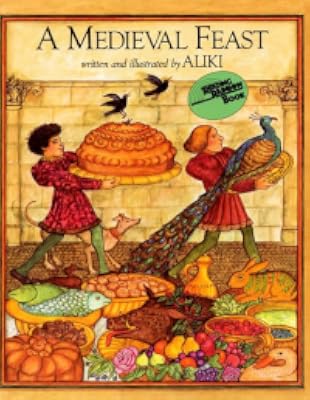
A Medieval Feast (Reading Rainbow Books)
by Aliki
On This Page
Description
Describes the preparation and celebration of a medieval feast held at an English manor house entertaining royal guests.Tags
Recommendations











Member Reviews
This is a beautifully illustrated book that captures life as it was when the King of the land visited a palace in his travels throughout the land. This captures the ambiance of the stress brought upon the castle visited by the king and all his many people who accompanyed him on his journey.
In truth back when this occurred, it brought tremendous stress upon those visited. And, often it caused backruptcy because of the expense of feeding and housing the King, Queen and many members of his entourage.
The lovely book shows the intricacy of hiring staff to travel throughout the land to kill the meat for the feast, to prepare the intricate pastries, the rooms that must to made not only for the King and Queen, but also his knights, squires and show more many mambers of the traveling court. Often, this could be hundreds of mouths to feed, and places to accompany them to sleep.
The manor house had to be cleaned, tents setup for the horsemen and his horses, Primarily, the focus was on the great feast. Among the items for the feast were pheasants, deer, rabbits, pigs and wild boar. In addition, there was a need for eels, salmon and various fish, including a plethora of trout.
Fruits and vegetables where used from the gardens, and often the use of these items meant it would be perhaps another year until these items could be regrown and replenished.
A lot of focus was important for the preperation for the way in which the feast was presented. As the trumpets anounced the arrival of the important guests, the fanfare for the hosting of the King and Queen created a great deal of stress. And while it was considered an honor to host the very important Lord and his Lady, in the end, all was depleted and it was quite a lot of energy and money to be able to accommodate all. show less
In truth back when this occurred, it brought tremendous stress upon those visited. And, often it caused backruptcy because of the expense of feeding and housing the King, Queen and many members of his entourage.
The lovely book shows the intricacy of hiring staff to travel throughout the land to kill the meat for the feast, to prepare the intricate pastries, the rooms that must to made not only for the King and Queen, but also his knights, squires and show more many mambers of the traveling court. Often, this could be hundreds of mouths to feed, and places to accompany them to sleep.
The manor house had to be cleaned, tents setup for the horsemen and his horses, Primarily, the focus was on the great feast. Among the items for the feast were pheasants, deer, rabbits, pigs and wild boar. In addition, there was a need for eels, salmon and various fish, including a plethora of trout.
Fruits and vegetables where used from the gardens, and often the use of these items meant it would be perhaps another year until these items could be regrown and replenished.
A lot of focus was important for the preperation for the way in which the feast was presented. As the trumpets anounced the arrival of the important guests, the fanfare for the hosting of the King and Queen created a great deal of stress. And while it was considered an honor to host the very important Lord and his Lady, in the end, all was depleted and it was quite a lot of energy and money to be able to accommodate all. show less
"Medieval Feast" is a great book that truly takes you back in time and shows you what it would have been like for a village to prepare for the arrival of their king. Aliki uses the different names for the people of the village such as lord and lady of the manor, serfs, and King. Without using many words Aliki also tells the reader what roles each person played in a medieval society. The book discusses the types of foods prepared, how the animals were hunted, how the rooms are prepared, and how the king was received. Even though this is a fictional story most of the information used to tell the story are true facts from the medieval time. This book can be used to supplement a study of medieval times. My six-year-old son read this book show more recently as he was receiving a brief history of medieval times. After reading "The Knight at Dawn" and its non-fictional companion "Knights and Castles" he was delighted to read a picture about some of the things he had been learning about. show less
This book would be fun for a unit on medieval times. The illustratations are done in a way that seems very characteristic of the times they are talking about, and the story is about food. Every child loves hearing about a feast!
This would be a fun book to read aloud, when discussing different time periods. The pictures are fun to look at and the story is very interesting. Foods and customs, unfamiliar to most, are discussed in detail.
This is an informational book that talks about the various preparations involved in throwing a feast during the late 1400's. There is also information about who is throwing the feast and why, as well as food preparation, decor, and various other aspects.
I think this would be a great book to talk about tradition, historical periods, and SES differences. It can also be used to for writing assignments, presentations, and discussions about different traditions.
I think this would be a great book to talk about tradition, historical periods, and SES differences. It can also be used to for writing assignments, presentations, and discussions about different traditions.
The King is coming to visit! The lord and lady of Camdenton Manor must work quickly to prepare for his arrival. It will take weeks to ready rooms, set up tents, and prepare the feast itself. Everyone is busy hunting and hawking, brewing and churning.
Delightful little children's book revealing the pagentry of the grand medieval feasts of the past.
Members
- Recently Added By
Lists

Reading Rainbow
193 works; 10 members

Early Picture Books
467 works; 9 members

The Story of the World: History for the Classical Child: Activity Book Two
415 works; 2 members
Author Information

105+ Works 29,414 Members
Aliki was born Aliki was born on September 3, 1929 in Wildwood Crest, New Jersey and raised in Philadelphia, PA. She graduated from the Philadelphia Museum College of Art in 1951. After college, she worked in the display department at J. C. Penney Co. in New York for a year and then as a free-lance artist and art teacher in Philadelphia. In 1956 show more she spent several months traveling, painting, and sketching in Europe. In 1957, Aliki married Franz Brandenberg, also a writer, and they settled in Switzerland, where she worked as a free-lance artist. In 1960 the Brandenbergs moved to New York City. Aliki continued to write and illustrate children's books, both fiction and nonfiction. As well as illustrating her own works, she has also illustrated over fifty books for others, including those of her husband Franz, Joanna Cole and Paul Showers. Aliki and her family moved to England in 1977 where she continues to write and illustrate. She has been the recipient of many honours including the New York Academy of Sciences Children's Book Award and the Prix du Livre pour Enfants (Geneva). She received the New Jersey Institute of Technology Award for The Listening Walk in 1961 and for Bees and Beelines in 1964, the Boys Club of America Junior Book Award for Three Gold Pieces: A Greek Folk Tale in 1968, and the Children's Book Showcase for At Mary Bloom's in 1977. She also won the New York Academy of Sciences (younger) Award for Corn Is Maize: The Gift of the Indians in 1977 and the Garden State Children's Book Award (younger nonfiction) for Mummies Made In Egypt in 1982. (Bowker Author Biography) show less
Awards and Honors
Awards
Series
Belongs to Publisher Series
Common Knowledge
- Original publication date
- 1983
- Dedication
- for Pat Allen
and for Mother, Helen, Vilma, and Peter -- remembering the annual feast... - First words
- It was announced from the palace that the King would soon make a long journey.
- Canonical DDC/MDS
- 394.1209021
Classifications
- DDC/MDS
- 394.1209021 — Society, government, & culture Customs, etiquette & folklore General customs Eating, drinking, using drugs Eating and drinking standard subdivisions History, geographic treatment, biography By Period 500-1499 6th-15th centuries
- LCC
- GT3933 .A54 — Geography, Anthropology and Recreation Manners and customs (General) Manners and customs (General) Customs relative to public and social life
- BISAC
Statistics
- Members
- 1,315
- Popularity
- 18,469
- Reviews
- 10
- Rating
- (4.50)
- Languages
- English, Spanish
- Media
- Paper, Audiobook
- ISBNs
- 14
- ASINs
- 6