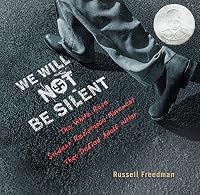
We Will Not Be Silent: The White Rose Student Resistance Movement That Defied Adolf Hitler
by Russell Freedman
On This Page
Description
"In his signature eloquent prose, backed up by thorough research, Russell Freedman tells the story of Austrian-born Hans Scholl and his sister Sophie. They belonged to Hitler Youth as young children, but began to doubt the Nazi regime. As older students, the Scholls and a few friends formed the White Rose, a campaign of active resistance to Hitler and the Nazis. Risking imprisonment or even execution, the White Rose members distributed leaflets urging Germans to defy the Nazi government. show more Their belief that freedom was worth dying for will inspire young readers to stand up for what they believe in. Archival photographs and prints, source notes, bibliography, index. "-- "The true story of the White Rose, a group of students in Nazi Germany who were active undercover agents of the resistance movement against Hitler and his regime"-- show lessTags
Recommendations




Member Reviews
Honestly, as I read this I was thinking how it stacked up against last year's [b:The Boys Who Challenged Hitler: Knud Pedersen and the Churchill Club|25445456|The Boys Who Challenged Hitler Knud Pedersen and the Churchill Club|Phillip M. Hoose|https://d.gr-assets.com/books/1430245146s/25445456.jpg|42246997]. And I was thinking about how those saboteur Churchill Club boys were more exciting than the pamphleteer Scholl siblings. But then I got to the end of this book and BAM. Whoa. I teared up. I felt awful for thinking for even a minute that the White Rose story was tame by comparison. If I had known from the beginning how it ended for Sophie and Hans I think I would've read the story in a different light.
Beyond my personal reaction, I show more think this story is told with admirable precision (I read it in about an hour) which makes it appealing for younger readers. But there are some very rattling, morbid parts of the story that make me think it's generally best for 6th grade and up.
You could definitely have quite a discussion around the themes, particularly how the Scholl siblings both professed to know right from wrong by looking inside themselves. Do human beings have an innate sense of good and evil? Or can we only know what we're taught? Hans Scholl: "I'm searching for myself, just myself, because this much I do know; I'll only find the truth inside me." Sophie Scholl: "We carry all our standards within ourselves, only we don't look for them closely enough. Perhaps because they are the severest standards." show less
Beyond my personal reaction, I show more think this story is told with admirable precision (I read it in about an hour) which makes it appealing for younger readers. But there are some very rattling, morbid parts of the story that make me think it's generally best for 6th grade and up.
You could definitely have quite a discussion around the themes, particularly how the Scholl siblings both professed to know right from wrong by looking inside themselves. Do human beings have an innate sense of good and evil? Or can we only know what we're taught? Hans Scholl: "I'm searching for myself, just myself, because this much I do know; I'll only find the truth inside me." Sophie Scholl: "We carry all our standards within ourselves, only we don't look for them closely enough. Perhaps because they are the severest standards." show less
During Hitler's rise to power, German children got swept up in the patriotic excitement and at first enjoyed the youth groups they could join. However, some of them, like the Scholl children, started to get frustrated with the conformity, the inability to share opinions, and later were very upset by the attacks on Poland and on Jews. This is the story of the Scholls and their friends, from childhood to young adulthood, and how they resisted Hitler's rule in the White Rose student movement.
My thoughts: I love this true story itself, revealing that regular people can be heroic, defying horrifying rules and acts (although not necessarily safely). I also love that this book is written for children, reminding and encouraging them to stand up show more for what they believe. The quotes from the young people were striking and the photos contributed to both understanding and connection with the story. 4.5 stars.
Perhaps a few maps could help children who are new to European and German geography. show less
My thoughts: I love this true story itself, revealing that regular people can be heroic, defying horrifying rules and acts (although not necessarily safely). I also love that this book is written for children, reminding and encouraging them to stand up show more for what they believe. The quotes from the young people were striking and the photos contributed to both understanding and connection with the story. 4.5 stars.
Perhaps a few maps could help children who are new to European and German geography. show less
In the heart of Germany, a student resistance movement called the White Rose took a courageous stand to denounce the Nazis.
“They could have chosen to throw bombs,” but the young members of the White Rose chose to oppose Nazi Germany with printed words. The clandestine student activists, including Hans and Sophie Scholl and Christoph Probst, wrote leaflets decrying Nazi atrocities, urging German citizens to resist the Nazi government, and denouncing the Nazi “dictatorship of evil.” Cranking out thousands of mimeographed leaflets at night in a secret cellar, the students proclaimed to Nazi leaders, “We are your bad conscience,” imperiling their lives. Among the wealth of good Holocaust literature available, Freedman’s volume show more stands out for its focus and concision, effectively placing the White Rose in its historical context, telling the story of Nazi Germany without losing the focus on the White Rose, and doing so in just over 100 pages. Archival photographs are effectively integrated into the text, and the typeface at times resembles the typewriter’s text on mimeographed leaflets, a nice design choice. The selected bibliography includes volumes for young readers and the superb German-language film Sophie Scholl: The Final Days (2005).
A thorough and accessible introduction to the Holocaust and the students who dared to take a stand against evil. (source notes, picture credits, index) (Nonfiction. 10-14)
-Kirkus Review show less
“They could have chosen to throw bombs,” but the young members of the White Rose chose to oppose Nazi Germany with printed words. The clandestine student activists, including Hans and Sophie Scholl and Christoph Probst, wrote leaflets decrying Nazi atrocities, urging German citizens to resist the Nazi government, and denouncing the Nazi “dictatorship of evil.” Cranking out thousands of mimeographed leaflets at night in a secret cellar, the students proclaimed to Nazi leaders, “We are your bad conscience,” imperiling their lives. Among the wealth of good Holocaust literature available, Freedman’s volume show more stands out for its focus and concision, effectively placing the White Rose in its historical context, telling the story of Nazi Germany without losing the focus on the White Rose, and doing so in just over 100 pages. Archival photographs are effectively integrated into the text, and the typeface at times resembles the typewriter’s text on mimeographed leaflets, a nice design choice. The selected bibliography includes volumes for young readers and the superb German-language film Sophie Scholl: The Final Days (2005).
A thorough and accessible introduction to the Holocaust and the students who dared to take a stand against evil. (source notes, picture credits, index) (Nonfiction. 10-14)
-Kirkus Review show less
Fascinating look at the Scholl family and the White Rose movement. I didn't know this story. There were original photographs and information about memorials today. This helped me think about everyday people in Nazi German and the ideas of upstanders and bystanders and the incredible risks those who spoke out took.
We Will Not Be Silent chronicles the lives of brother and sister Hans and Sophie Scholl and their friends, who were instrumental in forming an underground student organization bent on debunking Nazi propaganda and inciting protests against Hitler's regime.
Told in a simple, straightforward manner, the author chronicles the Scholl children's formative years: from their enthusiastic participation in Hilter's youth programs (despite their father's denouncement), to their eventual disillusionment with the Nazi rhetoric, and most importantly, their commitment to be a dissenting, outspoken German voice in spite of the dangers this posed. Their impending deaths are portrayed as noble, even heroic, sacrifices and the aftermath shows that Hans, show more Sophie and their White Rose allies did not die in vain. A somber, but important piece of history that illustrates the power of personal convictions and the brave young people who felt compelled to voice them. Recommended for middle grade readers. AR 7.7, pts. 3 -JF show less
Told in a simple, straightforward manner, the author chronicles the Scholl children's formative years: from their enthusiastic participation in Hilter's youth programs (despite their father's denouncement), to their eventual disillusionment with the Nazi rhetoric, and most importantly, their commitment to be a dissenting, outspoken German voice in spite of the dangers this posed. Their impending deaths are portrayed as noble, even heroic, sacrifices and the aftermath shows that Hans, show more Sophie and their White Rose allies did not die in vain. A somber, but important piece of history that illustrates the power of personal convictions and the brave young people who felt compelled to voice them. Recommended for middle grade readers. AR 7.7, pts. 3 -JF show less
Please visit my blog www.readrantrockandroll.com for reviews on children's books like this regarding the Holocaust and WWII
We Will Not Be Silent by Russell Freedman is a book about The White Rose Student Resistance Movement in Germany. Hans and Sophie were members of Hitler's Youth, until they got wise and learned what was unfolding right in front of them. They decide that they want to expose Hitler and the Nazi regime. Their siblings also became involved. The courage and perseverance of this group is stunning.
The author does an amazing job explaining everything in chronological order and there are tons of pictures. This is a book written for middle schoolers, but It's great for adults too.
Once again, a subject that I knew nothing show more about, and never learned about in school.
This is a book I highly recommend for libraries, schools, and parents who want to educate their children. It's a book for everyone. show less
We Will Not Be Silent by Russell Freedman is a book about The White Rose Student Resistance Movement in Germany. Hans and Sophie were members of Hitler's Youth, until they got wise and learned what was unfolding right in front of them. They decide that they want to expose Hitler and the Nazi regime. Their siblings also became involved. The courage and perseverance of this group is stunning.
The author does an amazing job explaining everything in chronological order and there are tons of pictures. This is a book written for middle schoolers, but It's great for adults too.
Once again, a subject that I knew nothing show more about, and never learned about in school.
This is a book I highly recommend for libraries, schools, and parents who want to educate their children. It's a book for everyone. show less
This book tells the story of the White Rose resistance group during Nazi Germany. Students learn who started the movement, what actions they took, and why their message mattered. Academic vocabulary such as resistance, propaganda, and dictatorship build historical literacy. This text supports instruction on evaluating primary sources and historical nonfiction (TEKS 8.12A). Middle school readers are drawn to the bravery of teens fighting injustice. It belongs in a classroom library because it teaches moral courage and critical thinking about history.
Members
- Recently Added By
Lists

Books Read in 2016
4,666 works; 199 members

Robert F. Sibert Informational Book Medal
102 works; 1 member
Author Information

70+ Works 20,416 Members
Russell Freedman was born in San Francisco, California on October 11, 1929. He received a bachelor's degree in English from the University of California, Berkeley in 1951. After college, he served in the U.S. Counter Intelligence Corps during the Korean War. After his military service, he became a reporter and editor with the Associated Press. In show more 1956, he took a position at the advertising agency J. Walter Thompson in New York, where he did publicity writing for television. In 1965, he became a full-time writer. His first book, Teenagers Who Made History, was published in 1961. He went on to publish more than 60 nonfiction titles for young readers including Immigrant Kids, Cowboys of the Old West, Indian Chiefs, Martha Graham: A Dancer's Life, Confucius: The Golden Rule, Because They Marched: The People's Campaign for Voting Rights That Changed America, Vietnam: A History of the War, and The Sinking of the Vasa. He received the Newbery Medal for Lincoln: A Photobiography and three Newbery Honors for Eleanor Roosevelt: A Life of Discovery, The Wright Brothers: How They Invented the Airplane, and The Voice That Challenged a Nation: Marian Anderson and the Struggle for Equal Rights. He also received the Regina Medal, the May Hill Arbuthnot Lecture Award, the Orbis Pictus Award, the Sibert Medal, a Sibert Honor, the Laura Ingalls Wilder Medal, and the National Humanities Medal. He died on March 16, 2018 at the age of 88. (Bowker Author Biography) show less
Awards and Honors
Awards
Distinctions
Notable Lists
Common Knowledge
- Canonical title
- We Will Not Be Silent: The White Rose Student Resistance Movement That Defied Adolf Hitler
- People/Characters
- Hans Scholl; Sophie Scholl; Christoph Probst; Alexander Schmorell; Willi Graf; Kurt Huber (show all 9); Hans Leipelt; Adolf Hitler; White Rose
- Important places
- Munich, Bavaria, Germany; Ulm, Baden-Württemberg, Germany
- Important events
- World War II (1939 | 1945)
- Dedication
- To Dinah Stevenson
- First words
- In 1942, when World War II was in its third year, leaflets began to appear mysteriously in mailboxes all over Nazi Germany.
Classifications
- Genres
- Nonfiction, Kids, Tween
- DDC/MDS
- 943.086092 — History & geography History of Europe Central Europe: Germany, Austria, Switzerland, Czech, Poland, Hungary Historical periods of Germany Germany 1866- Third Reich 1933-1945 History, geographic treatment, biography Biographies, Diaries And Journals
- LCC
- DD256.3 .F74 — History of Europe, Asia, Africa and Oceania Germany History of Germany History By period Modern, 1519- 19th-20th centuries Revolution and Republic, 1918- Hitler, 1933-1945. National socialism Period of World War II, 1939-1945
- BISAC
Statistics
- Members
- 333
- Popularity
- 95,423
- Reviews
- 18
- Rating
- (4.36)
- Languages
- English
- Media
- Paper, Ebook
- ISBNs
- 3
- ASINs
- 1