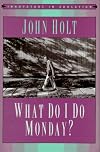
What do I do Monday?
by John Caldwell Holt
On This Page
Description
"This intensely human and caring book is a testament to a life devoted to the possibilities inherent in every one of us. It is, as John Holt writes, 'a book for teachers, for parents, for children or friends of children, for anyone who cares about education. It is about learning and above all some of the ways in which, in school or out, we might help children learn better and perhaps learn better ourselves.' What Do I Do Monday? combines Mr. Holt's theories of education--the idea of learning show more as a growth process, a moving and expanding of the child into the world around him; a belief that we learn best when we feel the wholeness and openness of the world around us, and our own freedom and power and competence in it--with practical, easy-to-use ideas and exercises in reading, writing, and mathematics. By helping us to see the conditions necessary for learning, John Holt has also provided every parent and teacher with a way to begin to make the changes desperately needed in our schools and school systems."--Jacket. For teachers and parents who want to help children learn better. show lessTags
Recommendations














Member Reviews
I have been hearing a lot about John Holt while trawling forums and websites about homeschooling, so I thought I might as well check him out. What Do I Do Monday? is the first book that became available at my local library, so this is the one I read first. Holt soundly condemns methods used in public schools at the time (methods that have improved very little since then!) and I found myself agreeing with the majority of his opinions.
He doesn't just argue against these methods, though. He also provides some alternatives. This book is packed full of great ideas for helping (not making!) children to follow their natural learning inclinations. I particularly love the way he explained certain Maths concepts. Not being mathematically minded show more myself, this is perhaps the first time in my life that I have fully understood some of these concepts!
This book is a must-read for anyone embarking on the homeschool journey, but I also recommend it to parents, grandparents, teachers and anyone else who cares for the children in their life. show less
He doesn't just argue against these methods, though. He also provides some alternatives. This book is packed full of great ideas for helping (not making!) children to follow their natural learning inclinations. I particularly love the way he explained certain Maths concepts. Not being mathematically minded show more myself, this is perhaps the first time in my life that I have fully understood some of these concepts!
This book is a must-read for anyone embarking on the homeschool journey, but I also recommend it to parents, grandparents, teachers and anyone else who cares for the children in their life. show less
Ratings
Members
- Recently Added By
Author Information

19 Works 3,984 Members
Common Knowledge
- Original publication date
- 1971
- Epigraph
- "It came burning hot into my mind, whatever he said and however he flattered, when he got me into his house, he would sell me for a slave."
~John Bunyan
"So you're through with your learning
so go out and start earning."
~From a graduation gift card - First words
- This is a book for teachers, for parents, for children or friends of children, for anyone who cares about education.
- Quotations
- To trust children we must first learn to trust ourselves, and most of us were taught as children that we couldn't be trusted.
A man may cling dsperately to the belief that Jesus loves him because he is certain that nobody else does. This Christianity can all too easily...turn into a religion of hate and despair.
One of the things adults do, and above all in 'schools', is invade in every possible way, the lives and privacy of their students. There are master keys to the students' 'lockers' in schools, so that administrators may search... (show all) them any time they feel like it. There are almost no places in most schools where atudents may talk together. The whole hair battle, which some schools, thank goodness, have given up, was only a way of saying, 'Nothing about you is yours, everything about you is ours, you belong wholly to us, you can withhold nothing'. And I think with deep regret and shame of the times when I, like millions of other adults, scolding a child or ordering him about, have said, 'Take that expression off your face!' It seems now an extraordinary and unforgivable crime against the human person, the human spirit.
Supporting powers is, of course, exactly what we do not do in most schooling. We do not give children extra time to work at what they like and are good at, but only what they do worst and most dislike.
But a man cannot say Yes to something with all his heart unless he has an equal right to say No.
...it is our responsibility as teachers to have in our classrooms what the children need, to make a rich and varied environment for them to live, learn, and grow in. 'The school won't let me get anything' is not an acceptable... (show all) alibi for barren and dreary classrooms.
The transfer, by the parents, of so much of their own authority to the schools is in most ways a cowardly and contemptible business. - Last words
- (Click to show. Warning: May contain spoilers.)The way to begin is - to begin.
Classifications
Statistics
- Members
- 169
- Popularity
- 192,874
- Reviews
- 1
- Rating
- (4.18)
- Languages
- English, German
- Media
- Paper
- ISBNs
- 8
- ASINs
- 7