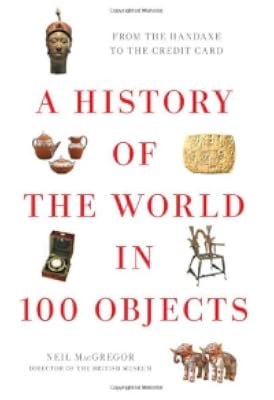
A History of the World in 100 Objects
by Neil MacGregor
On This Page
Description
Traces the stories of one hundred human innovations to explain their pivotal role in shaping civilization, from weapons and the domestication of cows to currency and music.Tags
Recommendations

















Member Recommendations
Member Reviews
I am at a loss for what to rate this. On the one hand, it covers mostly the parts of history I’m interested in: ritual and domestic life, the things that tend not to be covered in Big History Books. And it’s interesting, and offers little bite-sized pieces of information about a lot of history and a lot of the world. But on the other hand, this book made me mad, so mad that I had to take several breaks while reading it to read other books and cool down.
This book has a narrative underlying the many separate chapters, and it is one about the British showing up in a place and taking whatever they wanted, again and again and again. And, I mean, fair! That happened! And, honestly, few countries have any kind of history in that area to show more be proud of. But what is frustrating is how completely MacGregor just — accepts it.
He talks about how people in various areas are building new identites around ancient objects that have deep meaning for them — ancient objects the British Museum has, and plans to keep, even though those people desparately want them back. He talks about how the museum didn’t know what a Japanese mirror was for, or what its history was, until a visiting Japanese scholar explained it, yet never wonders if perhaps the items in question might be better understood, might speak more effectively to the world, in a museum closer to their original home. He mentions how odd it is, in a secular museum, to find offerings in front of statues of gods, and never wonders if perhaps those statues belong in a place of worship instead.
I’m sure he does grapple with those issues in private life — I hope he does — and it’s also very clear that in presenting this all as “isn’t it great that the British Museum has all these things?” he’s toeing the official party line, but GOD was it frustrating to see essentially no acknowledgement of these things in the book.
But, you know, I did read it. (Though it took a month, what with all the breaks I took.) And I did enjoy it. (Albeit with some shrieking of, “It’s more complicated than that!” about the few areas of history I knew something about.) I just also grabbed a friend who is a Hittite scholar and made her justify museums (“I can’t, really”) and ranted at her for probably longer than she wanted. show less
This book has a narrative underlying the many separate chapters, and it is one about the British showing up in a place and taking whatever they wanted, again and again and again. And, I mean, fair! That happened! And, honestly, few countries have any kind of history in that area to show more be proud of. But what is frustrating is how completely MacGregor just — accepts it.
He talks about how people in various areas are building new identites around ancient objects that have deep meaning for them — ancient objects the British Museum has, and plans to keep, even though those people desparately want them back. He talks about how the museum didn’t know what a Japanese mirror was for, or what its history was, until a visiting Japanese scholar explained it, yet never wonders if perhaps the items in question might be better understood, might speak more effectively to the world, in a museum closer to their original home. He mentions how odd it is, in a secular museum, to find offerings in front of statues of gods, and never wonders if perhaps those statues belong in a place of worship instead.
I’m sure he does grapple with those issues in private life — I hope he does — and it’s also very clear that in presenting this all as “isn’t it great that the British Museum has all these things?” he’s toeing the official party line, but GOD was it frustrating to see essentially no acknowledgement of these things in the book.
But, you know, I did read it. (Though it took a month, what with all the breaks I took.) And I did enjoy it. (Albeit with some shrieking of, “It’s more complicated than that!” about the few areas of history I knew something about.) I just also grabbed a friend who is a Hittite scholar and made her justify museums (“I can’t, really”) and ranted at her for probably longer than she wanted. show less
I gave this one a rare five stars, because it's an awesome book. I actually listened to it on audio CD (and suspect reading it might be tough sledding for me), but got the book to enjoy the pictures fairly quickly.
Talk about scope! From protohuman hand tools to a solar powered lamp, MacGregor describes his objects and their histories to us with knowledge, passion, humor, and style. Most of the history here is outside the normal dates-when-generals-did-stuff run of the mill history, so unless you know a lot of art history, you'll probably find it fresh material. It's loosely grouped into larger categories, but each object stands well on its own.
And the details of these many objects flow together to create a very different holistic show more history: not Jared Diamond's tale of migration and ecology, or the more common geopolitics, but something different. It's a tale of the arc of the human experience that deals with technology, religion, and intellectual life as a single seamless story. I am richer for the experience. You will be too. Neil MacGregor rocks! show less
Talk about scope! From protohuman hand tools to a solar powered lamp, MacGregor describes his objects and their histories to us with knowledge, passion, humor, and style. Most of the history here is outside the normal dates-when-generals-did-stuff run of the mill history, so unless you know a lot of art history, you'll probably find it fresh material. It's loosely grouped into larger categories, but each object stands well on its own.
And the details of these many objects flow together to create a very different holistic show more history: not Jared Diamond's tale of migration and ecology, or the more common geopolitics, but something different. It's a tale of the arc of the human experience that deals with technology, religion, and intellectual life as a single seamless story. I am richer for the experience. You will be too. Neil MacGregor rocks! show less
Muy interesante, de cada objeto solo se explican unas paginas y es muy ameno.
El autor insiste y estoy de acuerdo, en que no existe una historia de distintas gentes, sino que esto es la historia de la humanidad.
Vayamos a donde vayamos, estamos donde estamos por lo que ha ocurrido y estos objetos nos ayudan a comprenderlo
El autor insiste y estoy de acuerdo, en que no existe una historia de distintas gentes, sino que esto es la historia de la humanidad.
Vayamos a donde vayamos, estamos donde estamos por lo que ha ocurrido y estos objetos nos ayudan a comprenderlo
This is a companion piece to the History of the World in 100 Objects BBC radio series, first broadcast in 2010. I listened to it back in the day and really enjoyed it, and on an object-by-object level I often did the same here. The lavish illustrations allow for an examination of details that I could only imagine when listening to Neil MacGregor's audio narration. MacGregor writes with a clear affection for and fascination with these objects, all of which belong to the collection of the institution of which he was then the director, the British Museum.
However, MacGregor's position clearly muzzled him from talking about all the deeply hinky things that have been involved in the gathering of that collection, there are some unexamined show more assumptions at play here (more than one pencilled 'hmm' or '!' appear in the margins of my copy now), and some quoted experts whose rep has not aged the best over the last decade or so.
(If I may be allowed a moment of petty chauvinism, it was dryly amusing to see that 11 objects of the 100 were found in/come from what's now the UK, 9 of them from England alone, but not one from Ireland. The English do like to claim us while also ignoring us, and to make "British" a simple synonym for "English.") show less
However, MacGregor's position clearly muzzled him from talking about all the deeply hinky things that have been involved in the gathering of that collection, there are some unexamined show more assumptions at play here (more than one pencilled 'hmm' or '!' appear in the margins of my copy now), and some quoted experts whose rep has not aged the best over the last decade or so.
(If I may be allowed a moment of petty chauvinism, it was dryly amusing to see that 11 objects of the 100 were found in/come from what's now the UK, 9 of them from England alone, but not one from Ireland. The English do like to claim us while also ignoring us, and to make "British" a simple synonym for "English.") show less
Absolutely fascinating. The length may seem daunting but one can always just dip in for an object or two and then resume daily life. At first I thought- for anthropologists only, since many of the earliest items are about the dawn of civilization, as it were. But as one progresses through the book, delighted by MacGregor's lively comments, there is art, history, politics, religion- the whole catastrophe of human habitation. Besides the usual suspects (Elgin Marbles/Rosetta Stone), there are some marvelous eye openers: the Ife head from what is now Nigeria as well as a brass plaque from Benin clearly show the achievements of a well-evolved African culture. My personal favorite was the tughra(calligrahpic monogram)of Suleiman the Magnificent.
Fantastic resource for anyone who loves history, culture and/or museums. Even though the title reads *A* history, it could've been called *The* history, given the sheer breadth of the themes and civilizations this book covers. Loving and serious attention is paid to each object, with at least one gorgeous photograph per item, and to the stories about the past it evokes. This is geared toward a popular audience rather than a scholarly one (as was the original BBC radio series), so the essays aren't long ones, but they're cogent and full of illuminating quotes from scholars and other experts. The only problem I have is that now I want to visit the British Museum and thus have to figure out what to leave out of my luggage so I can fit this show more book in it. show less
I visited the British Museum recently. Due to the shortage of time, I decided to take the one-hour tour suggested by the brochure: a visit to ten objects separated across various galleries, spanning historical space and time. Even though it was a good introduction, and gave me a taste of the museum as a whole, I was strangely dissatisfied: it was rather like cramming for an exam where you end up with a lot of bits of disjointed knowledge.
As we were leaving the museum, I asked my brother-in-law (who is settled in England) what book I should buy from the museum, and he suggested the tome under discussion. He had listened to the original BBC radio series and liked it very much. Well, I have to thank him, because this book opened up a whole show more new vista on how we should view objects in a museum, and why my whirlwind tour left me disappointed.
Well, I will be better informed during my next visit.
How does one look at objects in a museum? I must confess that I had not given much thought to this subject until I read A History of the World in 100 Objects by Neil MacGregor. When I enter a museum, I usually wander around just gawking at the display and reading the info on the more interesting ones. Or, if I know about something specific that the museum is famous for (like the Rosetta Stone in the British Museum or the Narmer Palette in the Cairo Museum), I make a beeline for the object and spend some time gazing in reverential awe at it. After I spend what I consider a sufficient amount of time in the building, I come out, smugly satisfied at having “done” the museum properly.
Neil MacGregor has taught me that I have been doing it all wrong. A museum is a history book (although a taciturn one) and once you have learnt the language of objects, a really fascinating one. Because unlike history written by humans, which can be true, embellished or outright lies, the history told by objects can never be false. But we have to tease it out of them: the effort has to be there on our part. Otherwise, any trip to the museum becomes just a sightseeing tour.
This book is the written from of a series of talks given by the author, Director of the British Museum, on the BBC. In the preface and introduction, the author talks about the many challenges: the main one (absent from the book!) being the medium of the radio, where visual imagery is impossible. But then, he realised that this is also one of the strengths-because the listener is forced to use his imagination, not only for the object, but also for the story behind it.
That is what one has to do while reading this book. Let the imagination roam free across space and time: as MacGregor describes the object, puts it in its historical context, and pulls in experts from various fields like art, literature, history etc. to give their opinions on it, the mind of the reader is engaged in a continuous dialogue with history. As we trace mankind’s origins from the Olduvai gorge in Africa to the interconnected modern world, the sense of linear time slowly disappears history starts looking like a geography of time.
The book is written in small chapters of 5-6 pages each, five chapters (one working week of five days) forming a common theme. This structure is easily accessible, even to the miniscule attention spans engendered by TV shows and the internet. The book can be read through in one sitting, or savoured as small tidbits over a long period. However one does it, it does not lose its efficacy.
MacGregor starts with one of the most popular objects in the museum - the mummy of Hornedjitef –as a curtain raiser. The remaining 99 chapters are largely chronological, spanning countries and continents over defined time bands the author has selected as historical themes. In the earlier chapters, these time bands are large, spanning millenniums: then they narrow down to centuries and finally to decades as history becomes more crowded and compressed. And we see mankind, which has been existing as isolated pockets of civilisation, slowly expand and get connected.
For me, the most fascinating thing about this book was not the stories told by the objects, but what they left unsaid: I found myself musing about the people, long dead and gone, who must have handled these objects, many a time little knowing they would they would be enshrined and viewed by millions. For example, look at the Kilwa pot sherds (Chapter 60) from Tanzania: the housewife or maid who handled them- what might have they been like? What were they thinking as they washed, dried and cooked in these utensils? What would have gone through their minds when they finally threw them away? And (most importantly) the ordinary objects we throw away now – will they carry a similar message in a museum in, say, the year 2500?
Or let’s look at objects from relatively unknown cultures, like the Moche Warrior Pot (Chapter 48) from Peru or the Taino Ritual Seat (Chapter 65) from the Dominican Republic. It is obvious that these are important objects, religiously and culturally; yet the culture remains a mystery to us. Once again, we can only recreate in our mind the ceremonies which might have been conducted with these objects holding positions of importance.
Moche Warrior Pot
Taino Ritual Seat
There are also “famous” objects in these pages, like the Rosetta Stone (Chapter 33), the Parthenon Sculptures (Chapter 27) and India’s own Indus Seal (Chapter 13). Even though these objects are known to any educated person, MacGregor puts them in a new context and new light so that one learns to look at them anew.
The Rosetta Stone
Indus Seal
In the Introduction the author says that this book could have been as well called A History of Objects Through Many Different Worlds. I agree. Each object sings a solitary tune: sometimes happy, sometimes sad, and sometimes even creepy. Put together, they create a beautiful symphony – the song of humanity, separated by time and space, over a million different worlds. This book opened my ears to that music.
Museum visits shall never be the same again! show less
As we were leaving the museum, I asked my brother-in-law (who is settled in England) what book I should buy from the museum, and he suggested the tome under discussion. He had listened to the original BBC radio series and liked it very much. Well, I have to thank him, because this book opened up a whole show more new vista on how we should view objects in a museum, and why my whirlwind tour left me disappointed.
Well, I will be better informed during my next visit.
How does one look at objects in a museum? I must confess that I had not given much thought to this subject until I read A History of the World in 100 Objects by Neil MacGregor. When I enter a museum, I usually wander around just gawking at the display and reading the info on the more interesting ones. Or, if I know about something specific that the museum is famous for (like the Rosetta Stone in the British Museum or the Narmer Palette in the Cairo Museum), I make a beeline for the object and spend some time gazing in reverential awe at it. After I spend what I consider a sufficient amount of time in the building, I come out, smugly satisfied at having “done” the museum properly.
Neil MacGregor has taught me that I have been doing it all wrong. A museum is a history book (although a taciturn one) and once you have learnt the language of objects, a really fascinating one. Because unlike history written by humans, which can be true, embellished or outright lies, the history told by objects can never be false. But we have to tease it out of them: the effort has to be there on our part. Otherwise, any trip to the museum becomes just a sightseeing tour.
This book is the written from of a series of talks given by the author, Director of the British Museum, on the BBC. In the preface and introduction, the author talks about the many challenges: the main one (absent from the book!) being the medium of the radio, where visual imagery is impossible. But then, he realised that this is also one of the strengths-because the listener is forced to use his imagination, not only for the object, but also for the story behind it.
That is what one has to do while reading this book. Let the imagination roam free across space and time: as MacGregor describes the object, puts it in its historical context, and pulls in experts from various fields like art, literature, history etc. to give their opinions on it, the mind of the reader is engaged in a continuous dialogue with history. As we trace mankind’s origins from the Olduvai gorge in Africa to the interconnected modern world, the sense of linear time slowly disappears history starts looking like a geography of time.
The book is written in small chapters of 5-6 pages each, five chapters (one working week of five days) forming a common theme. This structure is easily accessible, even to the miniscule attention spans engendered by TV shows and the internet. The book can be read through in one sitting, or savoured as small tidbits over a long period. However one does it, it does not lose its efficacy.
MacGregor starts with one of the most popular objects in the museum - the mummy of Hornedjitef –as a curtain raiser. The remaining 99 chapters are largely chronological, spanning countries and continents over defined time bands the author has selected as historical themes. In the earlier chapters, these time bands are large, spanning millenniums: then they narrow down to centuries and finally to decades as history becomes more crowded and compressed. And we see mankind, which has been existing as isolated pockets of civilisation, slowly expand and get connected.
For me, the most fascinating thing about this book was not the stories told by the objects, but what they left unsaid: I found myself musing about the people, long dead and gone, who must have handled these objects, many a time little knowing they would they would be enshrined and viewed by millions. For example, look at the Kilwa pot sherds (Chapter 60) from Tanzania: the housewife or maid who handled them- what might have they been like? What were they thinking as they washed, dried and cooked in these utensils? What would have gone through their minds when they finally threw them away? And (most importantly) the ordinary objects we throw away now – will they carry a similar message in a museum in, say, the year 2500?
Or let’s look at objects from relatively unknown cultures, like the Moche Warrior Pot (Chapter 48) from Peru or the Taino Ritual Seat (Chapter 65) from the Dominican Republic. It is obvious that these are important objects, religiously and culturally; yet the culture remains a mystery to us. Once again, we can only recreate in our mind the ceremonies which might have been conducted with these objects holding positions of importance.
Moche Warrior Pot
Taino Ritual Seat
There are also “famous” objects in these pages, like the Rosetta Stone (Chapter 33), the Parthenon Sculptures (Chapter 27) and India’s own Indus Seal (Chapter 13). Even though these objects are known to any educated person, MacGregor puts them in a new context and new light so that one learns to look at them anew.
The Rosetta Stone
Indus Seal
In the Introduction the author says that this book could have been as well called A History of Objects Through Many Different Worlds. I agree. Each object sings a solitary tune: sometimes happy, sometimes sad, and sometimes even creepy. Put together, they create a beautiful symphony – the song of humanity, separated by time and space, over a million different worlds. This book opened my ears to that music.
Museum visits shall never be the same again! show less
Members
- Recently Added By
Lists

Non-Fiction Worth Reading
1,015 works; 261 members

Huxley's reading log 2016
84 works; 3 members

Penguin Random House
458 works; 4 members
Author Information

46+ Works 4,676 Members
Robert Neil MacGregor, OM, FSA (born on June 16, 1946, in Glasgow, Scotland) is an art historian and museum director. He was the Editor of the Burlington Magazine from 1981 to 1987, the Director of the National Gallery, London, from 1987 to 2002, and was appointed Director of the British Museum in 2002. He has presented three television series on show more art and the radio series A History of the World in 100 Objects, which aired in 2010. (Bowker Author Biography) show less
All Editions
Some Editions
Awards and Honors
Awards
Common Knowledge
- Canonical title*
- Une histoire du monde en 100 objets
- Original title
- A History of the World in 100 Objects
- Alternate titles
- A history of the world in one hundred objects
- Original publication date
- 2010
- Important places
- British Museum, London, England, UK
- Related movies
- A History of the World in 100 Objects
- Dedication
- To all my colleagues at the British Museum
- First words
- Telling history through things is what museums are for. (Preface: Mission Impossible)
In this book we travel back in time and across the globe, to see how we humans have shaped our world and been shaped by it over the past two million years. (Introduction) - Last words
- (Click to show. Warning: May contain spoilers.)Whether in stone or paper, gold, feathers or silicon, it is certain we will go on making objects that shape or reflect our world and that will define us to future generations.
- Original language
- English
*Some information comes from Common Knowledge in other languages. Click "Edit" for more information.
Classifications
- Genres
- Anthropology, History, General Nonfiction, Art & Design, Nonfiction
- DDC/MDS
- 930.1 — History & geography History of ancient world (to ca. 499) Ancient History: China, Egypt, Rome, Greece Archaeology
- LCC
- GN740 .M16 — Geography, Anthropology and Recreation Anthropology Anthropology Prehistoric archaeology
- BISAC
Statistics
- Members
- 2,738
- Popularity
- 6,728
- Reviews
- 49
- Rating
- (4.19)
- Languages
- 9 — Chinese, Dutch, English, French, German, Italian, Portuguese, Spanish, Turkish
- Media
- Paper, Audiobook, Ebook
- ISBNs
- 40
- UPCs
- 1
- ASINs
- 26