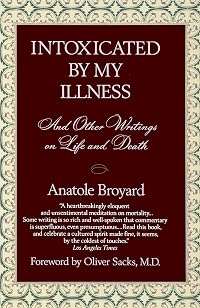
Intoxicated by my illness
by Anatole Broyard
On This Page
Description
Anatole Broyard, long-time book critic, book review editor, and essayist for the New York Times, wants to be remembered. He will be, with this collection of irreverent, humorous essays he wrote concerning the ordeals of life and death--many of which were written during the battle with cancer that led to his death in 1990. A New York Times Notable Book of the Year "A heartbreakingly eloquent and unsentimental meditation on mortality . . . Some writing is so rich and well-spoken that show more commentary is superfluous, even presumptuous. . . . Read this book, and celebrate a cultured spirit made fine, it seems, by the coldest of touches."--Los Angeles Times "Succeeds brilliantly . . . Anatole Broyard has joined his father but not before leaving behind a legacy rich in wisdom about the written word and the human condition. He has died. But he lives as a writer and we are the wealthier for it."--The Washington Post Book World "A virtuoso performance . . . The central essays of Intoxicated By My Illness were written during the last fourteen months of Broyard's life. They are held in a gracious setting of his previous writings on death in life and literature, including a fictionalized account of his own father's dying of cancer. The title refers to his reaction to the knowledge that he had a life-threatening illness. His literary sensibility was ignited, his mind flooded with image and metaphor, and he decided to employ these intuitive gifts to light his way into the darkness of his disease and its treatment. . . . Many other people have chronicled their last months . . . Few are as vivid as Broyard, who brilliantly surveys a variety of books on illness and death along the way as he draws us into his writer's imagination, set free now by what he describes as the deadline of life. . . . [A] remarkable book, a lively man of dense intelligence and flashing wit who lets go and yet at the same time comtains himself in the style through which he remains alive."--The New York Times Book Review "Despite much pain, Anatole Broyard continued to write until the final days of his life. He used his writing to rage, in the words of Dylan Thomas, against the dying of the light. . . . Shocking, no-holds-barred and utterly exquisite."--The Baltimore Sun show lessTags
Recommendations







Member Reviews
An eloquent meditation on mortality and a personal account of a life nearing its end. The book contains several essays on literature and life with a focus on death. Through it all the beauty of Broyard's prose makes one stop to contemplate its beauty and the depth of its meaning. This is a book that I return to from time to time to reinforce the memory of a great writer and reader.
I generally don't think about how I was a gender studies major in college except when reading books like this where I'm trying VERY HARD to really get into it and then I start SEEING HOW HE HATES WOMEN and I really and truly am TRYING to enjoy it but then i can't STOP seeing the misogyny and then I am still TRYING but all that happens is I pull out "Jesus fuckin' fuck, what the fuck is this guy's fucking problem with women?"Good book. Hates girls and probably poors. That's it.
Mentioned in The Princessa: Machiavelli for Women by Harriet Rubin.
Ratings
Members
- Recently Added By
Lists

Deathreads
78 works; 2 members
Author Information

7+ Works 706 Members
Awards and Honors
Notable Lists
Common Knowledge
- Canonical title
- Intoxicated by my illness
- Original publication date
- 1992
- People/Characters
- Anatole Broyard
- Important places
- Brigham Hospital, Brookline, Massachusetts, USA
- Epigraph
- It was the last nostalgia: that he Should understand. WALLACE STEVENS "Esthetique du Mal"
We say that God and the imagination are one . . . How high that highest candle lights the dark.WALLACE STEVENS Final Soliloquy of the "Interior Paramour" - First words
- So much of a writer's life consists of assumed suffering, rhetorical suffering, that I felt something like relief, even elation, when the doctor told me that I had cancer of the prostate.
- Last words
- (Click to show. Warning: May contain spoilers.)It was my job to sift those ashes, and sift them I would, until he rose from them like a phoenix.
- Blurbers
- Bernie Siegel; Harold Brodkey
Classifications
- Genres
- Nonfiction, Biography & Memoir, General Nonfiction, Literature Studies and Criticism
- DDC/MDS
- 362.19699463092 — Society, government, & culture Social problems and social services Social Welfare People with physical illnesses Services to people with specific conditions Diseases Other diseases
- LCC
- PS29 .B76 .A3 — Language and Literature American literature American literature
- BISAC
Statistics
- Members
- 151
- Popularity
- 218,116
- Reviews
- 3
- Rating
- (3.97)
- Languages
- English, Spanish
- Media
- Paper, Ebook
- ISBNs
- 5
- ASINs
- 1