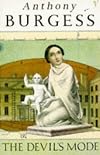
The Devil's Mode: Stories
by Anthony Burgess 
On This Page
Description
For better readers a group of 9 stories that deal with famous people in history like Attila the Hun and Shakespeare.Tags
Recommendations
























Member Reviews
Anthony Burgess - The Devil's Mode
When I was collecting together the unread books from my shelves, I realised I had five by Burgess; which I probably bought in a charity shop as a sort of job lot. The Devil's Mode was the third of the five and the most disappointing. It is a collection of nine short stories, with one of them (Hun) being of novella length and probably the most pointless one of the collection.
They start of well with "A Meeting in Valladolid" where Burgess imagines the 40 year old Shakespeare being a member of a trade and culture delegation sent over to Spain to heal relations between the two countries after the succession to the English throne of James I. Of course it is Shakespeare who suffers most from sea sickness and show more he spends an uncomfortable time in Spain organising shortened productions of his plays as entertainments; choosing Titus Andronicus in the first instance thinking that the Spanish will enjoy the buckets of blood used in the spectacle. He meets Miguel de Cervantes, who is as irascible as his character Don Quixote. From the nuggets of history that are known about Shakespeare, Burgess has made an amusing historical fiction short story (I am not sure that we know that the bard suffered sea sickness or that he went to Spain and met Cervantes). This is a template for several other stories. "The Most Beautiful" imagines a student lecture in Wittenberg at the time of Martin Luther. 'The Cavalier of the Rose' imagines Maria Theresa of Austria in bed with her young lover which develops into a Boccaccio like farce. In "1889 and the Devil's Mode" he imagines certain European poets and musicians visiting England and Ireland: Debussy goes to a brothel in Dublin with Stephan Mallarme and then they meet Browning and Christina Rossetti. These first four historical fiction stories are cleverly worked, but by the time that we get to 'The Devils Mode' it is only Burgesses cleverness that is on show. One could say Story? what Story?
There follows two stories that are set in Malaysia and tell spicy tales of European's sexual relations with native women. These feel like chapters that didn't quite make the cut for Burgesse's previous novels collected as the Malayan trilogy with their casual sexism and racism. Both forgettable if you have read any of his previous books. A curious modern story about a man spending his inheritance on air travel is next and is more original in conception, but this is all too quickly followed by Hun. The Hun is Atilla and Burgess imagines the barbarian hordes conquest of much that was Roman Europe. As an exercise in trying to understand Atilla it makes no sense with Burgess tackling that problem with 20th century hindsight. Christopher Marlowe was much more successful in the late 16th century with his depiction of another Asiatic conqueror Tamburlaine (Tamurlane) in his play Tamburlaine the great. With Burgess we get 15th century warriors speaking like 20th century politicians and descriptions of the barbarities enacted against the towns and cities in their way. This reader had trouble staying awake (but maybe the wine didn't help). The final story is a Sherlock Holmes adventure and this is more successful and fitting perhaps because Holmes is even more clever than Burgess.
These stories were collected and published in 1989 and perhaps with their 'intellectual' dazzle they seemed more original, but reading them today I found that many of them had lost their sparkle and a novella (Hun) has never seemed so long. 3 stars. show less
When I was collecting together the unread books from my shelves, I realised I had five by Burgess; which I probably bought in a charity shop as a sort of job lot. The Devil's Mode was the third of the five and the most disappointing. It is a collection of nine short stories, with one of them (Hun) being of novella length and probably the most pointless one of the collection.
They start of well with "A Meeting in Valladolid" where Burgess imagines the 40 year old Shakespeare being a member of a trade and culture delegation sent over to Spain to heal relations between the two countries after the succession to the English throne of James I. Of course it is Shakespeare who suffers most from sea sickness and show more he spends an uncomfortable time in Spain organising shortened productions of his plays as entertainments; choosing Titus Andronicus in the first instance thinking that the Spanish will enjoy the buckets of blood used in the spectacle. He meets Miguel de Cervantes, who is as irascible as his character Don Quixote. From the nuggets of history that are known about Shakespeare, Burgess has made an amusing historical fiction short story (I am not sure that we know that the bard suffered sea sickness or that he went to Spain and met Cervantes). This is a template for several other stories. "The Most Beautiful" imagines a student lecture in Wittenberg at the time of Martin Luther. 'The Cavalier of the Rose' imagines Maria Theresa of Austria in bed with her young lover which develops into a Boccaccio like farce. In "1889 and the Devil's Mode" he imagines certain European poets and musicians visiting England and Ireland: Debussy goes to a brothel in Dublin with Stephan Mallarme and then they meet Browning and Christina Rossetti. These first four historical fiction stories are cleverly worked, but by the time that we get to 'The Devils Mode' it is only Burgesses cleverness that is on show. One could say Story? what Story?
There follows two stories that are set in Malaysia and tell spicy tales of European's sexual relations with native women. These feel like chapters that didn't quite make the cut for Burgesse's previous novels collected as the Malayan trilogy with their casual sexism and racism. Both forgettable if you have read any of his previous books. A curious modern story about a man spending his inheritance on air travel is next and is more original in conception, but this is all too quickly followed by Hun. The Hun is Atilla and Burgess imagines the barbarian hordes conquest of much that was Roman Europe. As an exercise in trying to understand Atilla it makes no sense with Burgess tackling that problem with 20th century hindsight. Christopher Marlowe was much more successful in the late 16th century with his depiction of another Asiatic conqueror Tamburlaine (Tamurlane) in his play Tamburlaine the great. With Burgess we get 15th century warriors speaking like 20th century politicians and descriptions of the barbarities enacted against the towns and cities in their way. This reader had trouble staying awake (but maybe the wine didn't help). The final story is a Sherlock Holmes adventure and this is more successful and fitting perhaps because Holmes is even more clever than Burgess.
These stories were collected and published in 1989 and perhaps with their 'intellectual' dazzle they seemed more original, but reading them today I found that many of them had lost their sparkle and a novella (Hun) has never seemed so long. 3 stars. show less
This is a fairly lightweight collection of Burgess' stories, a mix of imaginative reconstructions of literary and political events, pastiches and tales from his time in Malaya 'doing a Maugham' - that is, observing very late colonial Brits and the natives.
It is entertaining enough and Burgess cannot write badly but little is going to be truly memorable in a year's time. His Attila the Hun novella reads like the playbook for a Hollywood epic that perhaps he would like to have been in on - a good read but not really quite true to life or history.
He also shows off his intellect far too much ... boondoggling the reader with detailed arcane knowledge and literary 'insider' stuff. We know he is intelligent and talented. He really does not show more need to show off. At times, he is classically too clever by half.
But this was not a disappointing collection only because I was not expecting too much from a rather obvious pulling together of bits and pieces from an illustrious career towards the end of it - a sort of completist collection for fans.
Having said this, the best lies in the two very short Malay stories and both of them gain their strength from a subtle exploration of sexual meaning or rather how meanings are manipulated or misunderstood within the social reality of a dying colonialism.
The theme of 'The Wine of the Country' reminded me a little of Alberto Moravia's exploration of how male and female expectation and assumptions of the correct and appropriate can be so much at odds while 'Snow' is an acute evocation of power shifting as the old colonials lose their place.
Mostly enjoyable, sometimes frustrating, sometimes cavalier or offering writing as intellectual exercise to keep in practice, the book is, as I say, for completists but look out for the two Malay stories if they are anthologised elsewhere and if you are not interested in the collection as a whole. show less
It is entertaining enough and Burgess cannot write badly but little is going to be truly memorable in a year's time. His Attila the Hun novella reads like the playbook for a Hollywood epic that perhaps he would like to have been in on - a good read but not really quite true to life or history.
He also shows off his intellect far too much ... boondoggling the reader with detailed arcane knowledge and literary 'insider' stuff. We know he is intelligent and talented. He really does not show more need to show off. At times, he is classically too clever by half.
But this was not a disappointing collection only because I was not expecting too much from a rather obvious pulling together of bits and pieces from an illustrious career towards the end of it - a sort of completist collection for fans.
Having said this, the best lies in the two very short Malay stories and both of them gain their strength from a subtle exploration of sexual meaning or rather how meanings are manipulated or misunderstood within the social reality of a dying colonialism.
The theme of 'The Wine of the Country' reminded me a little of Alberto Moravia's exploration of how male and female expectation and assumptions of the correct and appropriate can be so much at odds while 'Snow' is an acute evocation of power shifting as the old colonials lose their place.
Mostly enjoyable, sometimes frustrating, sometimes cavalier or offering writing as intellectual exercise to keep in practice, the book is, as I say, for completists but look out for the two Malay stories if they are anthologised elsewhere and if you are not interested in the collection as a whole. show less
An amazing anthology of short stories by Anthony Burgess which demonstrates the man's incredible versatility in writing. Sadly till now, and like so many other people, my appreciation of this great writer has been limited to having read A Clockwork Orange in my youth and nothing else by this notable author.
I happened upon this book by pure chance, and was drawn in by one short Sherlockiana in the back, which I had already placed on my reading list as part of another anthology of stories in which it appears; and although I very much appreciated the joy of reading a great little Holmes and Watson adventure written by Anthony Burgess (a treat in itself), I was quite unprepared for how much I also enjoyed his other offerings; A Meeting in show more Valladolid (between William Shakespeare and Don Quixote's Miguel de Cervantes), a tale of necromancy (and the re-animated corpse of Helen of Troy) in The Most Beautified; or, the opera inspired story of The Cavalier of the Rose (which I am currently reading).
A running theme in many of the stories seems to be a connection with music which tied them all together even though the styles and subject mater were so diverse. show less
I happened upon this book by pure chance, and was drawn in by one short Sherlockiana in the back, which I had already placed on my reading list as part of another anthology of stories in which it appears; and although I very much appreciated the joy of reading a great little Holmes and Watson adventure written by Anthony Burgess (a treat in itself), I was quite unprepared for how much I also enjoyed his other offerings; A Meeting in show more Valladolid (between William Shakespeare and Don Quixote's Miguel de Cervantes), a tale of necromancy (and the re-animated corpse of Helen of Troy) in The Most Beautified; or, the opera inspired story of The Cavalier of the Rose (which I am currently reading).
A running theme in many of the stories seems to be a connection with music which tied them all together even though the styles and subject mater were so diverse. show less
An unbelievable set of short stories, and one novella about the life of Attila the Hun that is the best piece of historical fiction I've ever read. Precisely what Flaubert wanted to achieve with Salambo I would guess, though here Burgess achieves more. Incredible.
Ratings
Members
- Recently Added By
Author Information

120+ Works 48,185 Members
Anthony Burgess was born in 1917 in Manchester, England. He studied language at Xaverian College and Manchester University. He had originally applied for a degree in music, but was unable to pass the entrance exams. Burgess considered himself a composer first, one who later turned to literature. Burgess' first novel, A Vision of Battlements show more (1964), was based on his experiences serving in the British Army. He is perhaps best known for his novel A Clockwork Orange, which was later made into a movie by Stanley Kubrick. In addition to publishing several works of fiction, Burgess also published literary criticism and a linguistics primer. Some of his other titles include The Pianoplayers, This Man and Music, Enderby, The Kingdom of the Wicked, and Little Wilson and Big God. Burgess was living in Monaco when he died in 1993. (Bowker Author Biography) show less
Anthony Burgess has a Legacy Library. Legacy libraries are the personal libraries of famous readers, entered by LibraryThing members from the Legacy Libraries group.
Work Relationships
Contains
Common Knowledge
- Canonical title
- The Devil's Mode: Stories
- Original publication date
- 1989
- People/Characters
- Attila the Hun; Sherlock Holmes; John Watson; Edwin Etheridge; William Shakespeare; Alfonso XIII, King of Spain (show all 11); Arthur Sullivan; Pablo Martin Meliton y Nevasvues Sarasate; Richard Burbage; Miguel de Cervantes; Don Manuel de Pulgar Garganta
- Important places
- 221B Baker Street, London, England, UK; Santander, Spain; St John's Wood Road, London, England, UK
- First words
- The British deligation landed at Santander in filthy weather.
- Last words
- (Click to show. Warning: May contain spoilers.)And so he stood, arranged his music stand, tucked his fiddle beneath his chin and began reverently to saw.
Classifications
Statistics
- Members
- 313
- Popularity
- 102,066
- Reviews
- 5
- Rating
- (3.51)
- Languages
- English, French, Russian, Swedish
- Media
- Paper
- ISBNs
- 11