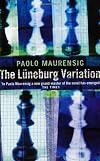
The Luneburg Variation
by Paolo Maurensig
On This Page
Description
Kasparov defined chess as 'the most violent sport in existence'. Part psychological thriller, part allegory, THE LUNEBURG VARIATION tells the story of a duel to the death, of a chess game that remained unfinished over fifty years. When an impeccable German businessman is found shot dead in the garden of his home, without any explanation for his apparent 'suicide', a mystery unfolds which carries the reader to the dead man's roots in pre-war Vienna, to his rivalry with a brilliant young show more Jewish player, and to the terrible secret in their past. show lessTags
Recommendations

























Member Recommendations
Member Reviews
Si tratta di un thriller molto ben congegnato,perché costruito partendo dall'effetto finale e spiegando a ritroso le cause tramite flashback incastrati l'uno nell'altro.
Una costruzione interessantissima.
I protagonisti sono tutti appassionati o addirittura campioni di scacchi e il titolo si riferisce a una mossa particolare di cui viene alla fine spiegata la terribile origine, legata all'olocausto ebraico e ai lager tedeschi.
Mi ha preso molto,anche se lo stile dell'autore per me è un po' pesante e non molto scorrevole.
Buonissima lettura, comunque.
Una costruzione interessantissima.
I protagonisti sono tutti appassionati o addirittura campioni di scacchi e il titolo si riferisce a una mossa particolare di cui viene alla fine spiegata la terribile origine, legata all'olocausto ebraico e ai lager tedeschi.
Mi ha preso molto,anche se lo stile dell'autore per me è un po' pesante e non molto scorrevole.
Buonissima lettura, comunque.
ROMANCING THE HOLOCAUST, AGAIN
The Luneburg Variation is a literary fantasy that ends with a graphic description of the torture and murder of seven prisoners, three men and four women, in the German concentration camp at Bergen-Belsen in Germany during the final months of World War II. Another 24 are killed offstage. They are all killed as forfeits in a tournament between two men who are playing chess for human lives. The incongruity of that juxtaposition between fantasy and the Bergen-Belsen death camp manifests a cardinal failure of moral imagination on the part of the author, Paolo Maurensig. Most one-star reviews are short and dismissive. This one is longer, appropriately for a novel that is clever, readable and utterly show more meretricious.
THE PLOT OF THE LUNEBURG VARIATION
First, an account of the literary fantasy, to put this hostile review in context. The design of The Luneburg Variation is presented with conscious artifice in a series of tales within tales. The novel begins with the gunshot suicide of a German business magnate of apparently impeccable reputation who is known to his family and associates as Dieter Frisch. The chronology is vague, but the suicide seems to have taken place around 1990. Almost half a century previously, during the last years of World War II Frisch, whose real name is never disclosed, was commandant of the Bergen-Belsen concentration camp. Frisch left no explanatory suicide note. The absence of any apparent motive for suicide mystifies his family and the investigating police, all of whom are ignorant of his role at Bergen-Belsen. The sole indication of motive, inscrutable to the police and his family, is an improvised chessboard found on his desk. The board is crudely made of stitched cloth squares with buttons of different sizes to stand for chess pieces, arranged in a mid-game configuration. The arrangement of the pieces was not recorded by the police and it was obliterated when they were dusted for fingerprints.
The Luneburg Variation is narrated by a man who calls himself Tabori. That, too, is a pseudonym adopted after the war. In Bergen-Belsen where he was a prisoner, his name was Rubinstein. Before the war Rubinstein and Frisch, then an exemplary young Nazi of distinguished name and lineage, had been opponents at the highest level in chess tournaments. In those pre-war years the young Rubinstein and his Nazi opponent were potential contenders for the world chess championship. Fate and the German policy of racial extermination would bring them together again at Bergen-Belsen.
Near the beginning of The Luneburg Variation, Tabori describes himself as the ‘executioner’ of Frisch. This long delayed execution is accomplished indirectly, by way of Frisch’s suicide, though the agency of Tabori’s protégé, Hans Mayer.
Tabori begins his tale with a chess game played between Frisch and Baum, a subordinate, on the train journey between Munich and Vienna, where Frisch has his country estate. Frisch, who edits a chess journal, has published a denunciation of a defensive chess opening that was played with considerable success in several tournaments by the brilliant young Hans Mayer, who is otherwise unknown to him. Frisch disparaged the defence in his journal, dubbing it ‘The Luneburg Variation’, and dismissing it as rash, flashy and unsound. On this evening, however, Frisch responds to Baum’s conventional chess opening with the Luneburg defence, to enliven the contest with his competent but dull opponent. They are joined in their compartment by a shabby young man, who will later reveal himself as Mayer. He carries in his pocket the cloth chessboard with its button pieces, a relic of Bergen-Belsen, which had been fashioned there by one of the Jewish prisoners. Frisch loses his game with Baum. His annoyance over the loss is aggravated when the shabby young man offers the gratuitous opinion that he should have won. Frisch challenges the young man to a match but the challenge is rejected. Mayer tells him that he can no longer play chess. He offers instead the tale of his life and apprenticeship with his mentor, Tabori.
So begins the next tale within a tale in which the game of chess is supposed to represent, in microcosm, the contending forces of human cruelty and retribution. Mayer recounts his childhood and adolescence during the post war years when he was a chess prodigy, schooled by Tabori, who taught him the Luneburg Variation but then abandoned him after those initial successes that had attracted Frisch’s interest. Reduced to despair by Tabori’s apparent betrayal, Mayer found that the desire and ability to play chess had deserted him. Frisch responds to this tale by vilifying Tabori as a charlatan who has ruined Mayer’s talent by teaching him the contemptible Luneburg Variation. He asks Mayer whether he has ever seen Tabori again. Mayer tells him that Tabori has returned, exhausted and dying. He has promised to adopt Mayer as his son and bequeath him a priceless collection of paintings. But first he has a task to perform. Tabori will tell Mayer the story of his own life, which Mayer is to repeat without variation, to the man Tabori had been seeking for decades, whose alias is Dieter Frisch.
Baum, a person of no significance who has served his purpose, reaches his destination and leaves the train compartment. Mayer begins to relate Tabori’s tale as the train resumes its journey to Vienna. The contest for chess mastery between Frisch and Rubinstein ended in 1938 when Rubinstein was cheated of victory against Frisch in his last tournament and barred from further competition. As the persecution of Jews worsened, Rubinstein and his parents were arrested and taken to Bergen-Belsen where his father was murdered and his mother was transported to another camp where she died. Rubinstein, however, was singled out for preservation by Frisch, the camp commandant, whose guards and administrators included no-one capable of playing a competent game of chess. Challenged to play by Frisch, Rubenstein contrives skillful losses of the first three games in the mistaken belief that this is the best way to preserve his life. Frisch responds to the three contrived losses by ordering his guards to torture and murder first one, then two and then four prisoners while Rubinstein is compelled to watch this sadistic display which is meant to teach him that he must play to win, if he can. Frisch then challenges Rubinstein to a tournament in which the victor will be the first to win six games. The inducement to play is hideous. Each time Rubinstein loses a game, prisoners will be killed, their numbers increasing in geometric progression for each loss. Close to a 1000 lives are at stake. In the tournament that now takes place Rubinstein, playing with consummate skill, invents the defence that Frisch would later excoriate in his journal as the Luneburg Variation. Their tournament included many drawn games but Rubinstein eventually prevailed, winning six games with only two losses. Those losses, however, result in the murders of 24 more of his fellow prisoners.
This tale, told by Hans Mayer in the train compartment, is the prelude to Dieter Frisch’s suicide on the following day, after he returns to his estate. The expectation that his true identity will be revealed and the devastating consequences that revelation will have is perhaps sufficient motivation for Frisch to take his own life. Tabori and several other Bergen-Belsen survivors could reveal his identify and the past that Frisch has hidden for so long and testify in a trial for war crimes. But the arrangement of the button substitutes on the cloth chess board, undoubtedly a version of the Luneburg Variation, suggests that it is not the threat of criminal punishment that induces Frisch to take his own life. His suicide may have been meant instead to express an admission of defeat in a final contest of wits with Rubinstein/Tabori and Mayer, his protégé and pawn.
For all the intricacies of the plot and the many carefully planted clues and signals, implausibilities are apparent. One can be quickly resolved though it leads to another unresolved question. Why does the Luneburg Variation lead Tabori to identify Frisch, with such inexorable certitude, as the man who was the camp commandant at Bergen-Belsen? Paolo Maurensig, who conceals himself behind Tabori, his narrator, has also concealed this crucial link from an insufficiently curious reader. A quick trawl on the internet reveals that Bergen-Belsen was located on Luneburg Heath, near the provincial city of Luneburg. In 1945 Josef Kramer, the last commandant of Bergen-Belsen, was brought to trial in that city for the murder of Allied prisoners and hanged and it was on Luneburg Heath that Field Marshal Montgomery accepted the surrender of the German forces in Northern Europe in the same year. There is an oblique reference to those peace negotiations in the final lines of novel, as Rubinstein emerges from the camp to freedom and reflects: ‘somewhere, in a dimension beyond my ken, a chess game had been played whose stakes and losses were incalculable’. No-one except the man who played chess with Rubinstein in Bergen-Belsen could have devised this name for the defensive strategy used by Mayer in his tournament successes. But identification is a two-way process. Why, one may ask, did Frisch choose to identify himself in this way, when he wrote the journal column: who is the hunter and who is the quarry in this pursuit? There is the ghostly semblance of another tale beyond Tabori’s narrative, in which Frisch deliberately engineers the final match on the cloth chessboard with Tabori/Rubinstein and Mayer which ends conclusively with the configuration of defeat that the police investigators observed but uncomprehendingly failed to preserve.
ROMANCING THE HOLOCAUST
Holocaust fiction is a demanding genre, for author and reader alike. The murder of millions of men, women and children in German death camps and extermination units during World War II remains raw and recent in the collective memories of the families that suffered those atrocities and, one hopes, of the families of those who perpetrated them. These were the unspeakable crimes of which we must speak if we are to preserve our consciousness of the wrongs that men commit in the pursuit of racial and eugenic ideologies. An appropriate level of moral concern is necessary, when memories of the Holocaust are reopened. Moral concern is a quality notably absent in The Luneburg Variation. Characters of far more substance were required than the lifeless caricatures who play out the tricky variations of Maurensig’s novel. Frisch, elegantly thin, ice-cold, with a floppy lock of fair hair over one temple, is a comic book Nazi. The young Rubinstein is similarly a caricature, a chubby prodigy with dark curly hair. In Tabori’s limp characterization of Rubinstein, ‘I was a Jew and he was an Aryan’, fated ‘to seek each other out, like opposite electrical charges in a raging storm’: White to play Black in a chess contest that is supposed to be ‘a perfect microcosm of a world that seemed poised on the brink of great events’. Forty years later they have aged but remain the same lifeless caricatures. Frisch is ‘stubbornly youthful’ and impeccable as ever, with close cropped iron-grey hair and a slight limp, suffered as a consequence of a fall from one of his stable of thoroughbreds. Tabori, once Rubinstein, is stout and darkly jowled, dresses with ‘some affectation’ and sports a walking stick, which lends him an ‘air of dated refinement’. We are not told what has happened to his hair.
Towards the end Tabori briefly acknowledges the moral depravity at the centre of the novel. He concedes that he was ‘an accomplice in a sickening design’ in which prisoners’ lives were wagered to enhance a contest between two men playing chess. The moment passes quickly. Tabori is too lacking in substance for any serious engagement with issues of moral responsibility. Though Tabori describes himself as the ‘executioner’ of Frisch, that self-inflicted death is neither redemptive nor retributive. Frisch has even less substance than Tabori. His suicide has no deeper moral significance than the conventional concession of an impending checkmate by a losing player, who picks up his King and lays the piece on its side.
The publisher’s cover selection of excerpts from favourable reviews of The Luneburg Variation reassures prospective readers that knowledge of the game of chess is not necessary in order to enjoy the entertainment. Ignorance of the Holocaust or a willing suspension of knowledge of its horrors is, however, a prerequisite. show less
The Luneburg Variation is a literary fantasy that ends with a graphic description of the torture and murder of seven prisoners, three men and four women, in the German concentration camp at Bergen-Belsen in Germany during the final months of World War II. Another 24 are killed offstage. They are all killed as forfeits in a tournament between two men who are playing chess for human lives. The incongruity of that juxtaposition between fantasy and the Bergen-Belsen death camp manifests a cardinal failure of moral imagination on the part of the author, Paolo Maurensig. Most one-star reviews are short and dismissive. This one is longer, appropriately for a novel that is clever, readable and utterly show more meretricious.
THE PLOT OF THE LUNEBURG VARIATION
First, an account of the literary fantasy, to put this hostile review in context. The design of The Luneburg Variation is presented with conscious artifice in a series of tales within tales. The novel begins with the gunshot suicide of a German business magnate of apparently impeccable reputation who is known to his family and associates as Dieter Frisch. The chronology is vague, but the suicide seems to have taken place around 1990. Almost half a century previously, during the last years of World War II Frisch, whose real name is never disclosed, was commandant of the Bergen-Belsen concentration camp. Frisch left no explanatory suicide note. The absence of any apparent motive for suicide mystifies his family and the investigating police, all of whom are ignorant of his role at Bergen-Belsen. The sole indication of motive, inscrutable to the police and his family, is an improvised chessboard found on his desk. The board is crudely made of stitched cloth squares with buttons of different sizes to stand for chess pieces, arranged in a mid-game configuration. The arrangement of the pieces was not recorded by the police and it was obliterated when they were dusted for fingerprints.
The Luneburg Variation is narrated by a man who calls himself Tabori. That, too, is a pseudonym adopted after the war. In Bergen-Belsen where he was a prisoner, his name was Rubinstein. Before the war Rubinstein and Frisch, then an exemplary young Nazi of distinguished name and lineage, had been opponents at the highest level in chess tournaments. In those pre-war years the young Rubinstein and his Nazi opponent were potential contenders for the world chess championship. Fate and the German policy of racial extermination would bring them together again at Bergen-Belsen.
Near the beginning of The Luneburg Variation, Tabori describes himself as the ‘executioner’ of Frisch. This long delayed execution is accomplished indirectly, by way of Frisch’s suicide, though the agency of Tabori’s protégé, Hans Mayer.
Tabori begins his tale with a chess game played between Frisch and Baum, a subordinate, on the train journey between Munich and Vienna, where Frisch has his country estate. Frisch, who edits a chess journal, has published a denunciation of a defensive chess opening that was played with considerable success in several tournaments by the brilliant young Hans Mayer, who is otherwise unknown to him. Frisch disparaged the defence in his journal, dubbing it ‘The Luneburg Variation’, and dismissing it as rash, flashy and unsound. On this evening, however, Frisch responds to Baum’s conventional chess opening with the Luneburg defence, to enliven the contest with his competent but dull opponent. They are joined in their compartment by a shabby young man, who will later reveal himself as Mayer. He carries in his pocket the cloth chessboard with its button pieces, a relic of Bergen-Belsen, which had been fashioned there by one of the Jewish prisoners. Frisch loses his game with Baum. His annoyance over the loss is aggravated when the shabby young man offers the gratuitous opinion that he should have won. Frisch challenges the young man to a match but the challenge is rejected. Mayer tells him that he can no longer play chess. He offers instead the tale of his life and apprenticeship with his mentor, Tabori.
So begins the next tale within a tale in which the game of chess is supposed to represent, in microcosm, the contending forces of human cruelty and retribution. Mayer recounts his childhood and adolescence during the post war years when he was a chess prodigy, schooled by Tabori, who taught him the Luneburg Variation but then abandoned him after those initial successes that had attracted Frisch’s interest. Reduced to despair by Tabori’s apparent betrayal, Mayer found that the desire and ability to play chess had deserted him. Frisch responds to this tale by vilifying Tabori as a charlatan who has ruined Mayer’s talent by teaching him the contemptible Luneburg Variation. He asks Mayer whether he has ever seen Tabori again. Mayer tells him that Tabori has returned, exhausted and dying. He has promised to adopt Mayer as his son and bequeath him a priceless collection of paintings. But first he has a task to perform. Tabori will tell Mayer the story of his own life, which Mayer is to repeat without variation, to the man Tabori had been seeking for decades, whose alias is Dieter Frisch.
Baum, a person of no significance who has served his purpose, reaches his destination and leaves the train compartment. Mayer begins to relate Tabori’s tale as the train resumes its journey to Vienna. The contest for chess mastery between Frisch and Rubinstein ended in 1938 when Rubinstein was cheated of victory against Frisch in his last tournament and barred from further competition. As the persecution of Jews worsened, Rubinstein and his parents were arrested and taken to Bergen-Belsen where his father was murdered and his mother was transported to another camp where she died. Rubinstein, however, was singled out for preservation by Frisch, the camp commandant, whose guards and administrators included no-one capable of playing a competent game of chess. Challenged to play by Frisch, Rubenstein contrives skillful losses of the first three games in the mistaken belief that this is the best way to preserve his life. Frisch responds to the three contrived losses by ordering his guards to torture and murder first one, then two and then four prisoners while Rubinstein is compelled to watch this sadistic display which is meant to teach him that he must play to win, if he can. Frisch then challenges Rubinstein to a tournament in which the victor will be the first to win six games. The inducement to play is hideous. Each time Rubinstein loses a game, prisoners will be killed, their numbers increasing in geometric progression for each loss. Close to a 1000 lives are at stake. In the tournament that now takes place Rubinstein, playing with consummate skill, invents the defence that Frisch would later excoriate in his journal as the Luneburg Variation. Their tournament included many drawn games but Rubinstein eventually prevailed, winning six games with only two losses. Those losses, however, result in the murders of 24 more of his fellow prisoners.
This tale, told by Hans Mayer in the train compartment, is the prelude to Dieter Frisch’s suicide on the following day, after he returns to his estate. The expectation that his true identity will be revealed and the devastating consequences that revelation will have is perhaps sufficient motivation for Frisch to take his own life. Tabori and several other Bergen-Belsen survivors could reveal his identify and the past that Frisch has hidden for so long and testify in a trial for war crimes. But the arrangement of the button substitutes on the cloth chess board, undoubtedly a version of the Luneburg Variation, suggests that it is not the threat of criminal punishment that induces Frisch to take his own life. His suicide may have been meant instead to express an admission of defeat in a final contest of wits with Rubinstein/Tabori and Mayer, his protégé and pawn.
For all the intricacies of the plot and the many carefully planted clues and signals, implausibilities are apparent. One can be quickly resolved though it leads to another unresolved question. Why does the Luneburg Variation lead Tabori to identify Frisch, with such inexorable certitude, as the man who was the camp commandant at Bergen-Belsen? Paolo Maurensig, who conceals himself behind Tabori, his narrator, has also concealed this crucial link from an insufficiently curious reader. A quick trawl on the internet reveals that Bergen-Belsen was located on Luneburg Heath, near the provincial city of Luneburg. In 1945 Josef Kramer, the last commandant of Bergen-Belsen, was brought to trial in that city for the murder of Allied prisoners and hanged and it was on Luneburg Heath that Field Marshal Montgomery accepted the surrender of the German forces in Northern Europe in the same year. There is an oblique reference to those peace negotiations in the final lines of novel, as Rubinstein emerges from the camp to freedom and reflects: ‘somewhere, in a dimension beyond my ken, a chess game had been played whose stakes and losses were incalculable’. No-one except the man who played chess with Rubinstein in Bergen-Belsen could have devised this name for the defensive strategy used by Mayer in his tournament successes. But identification is a two-way process. Why, one may ask, did Frisch choose to identify himself in this way, when he wrote the journal column: who is the hunter and who is the quarry in this pursuit? There is the ghostly semblance of another tale beyond Tabori’s narrative, in which Frisch deliberately engineers the final match on the cloth chessboard with Tabori/Rubinstein and Mayer which ends conclusively with the configuration of defeat that the police investigators observed but uncomprehendingly failed to preserve.
ROMANCING THE HOLOCAUST
Holocaust fiction is a demanding genre, for author and reader alike. The murder of millions of men, women and children in German death camps and extermination units during World War II remains raw and recent in the collective memories of the families that suffered those atrocities and, one hopes, of the families of those who perpetrated them. These were the unspeakable crimes of which we must speak if we are to preserve our consciousness of the wrongs that men commit in the pursuit of racial and eugenic ideologies. An appropriate level of moral concern is necessary, when memories of the Holocaust are reopened. Moral concern is a quality notably absent in The Luneburg Variation. Characters of far more substance were required than the lifeless caricatures who play out the tricky variations of Maurensig’s novel. Frisch, elegantly thin, ice-cold, with a floppy lock of fair hair over one temple, is a comic book Nazi. The young Rubinstein is similarly a caricature, a chubby prodigy with dark curly hair. In Tabori’s limp characterization of Rubinstein, ‘I was a Jew and he was an Aryan’, fated ‘to seek each other out, like opposite electrical charges in a raging storm’: White to play Black in a chess contest that is supposed to be ‘a perfect microcosm of a world that seemed poised on the brink of great events’. Forty years later they have aged but remain the same lifeless caricatures. Frisch is ‘stubbornly youthful’ and impeccable as ever, with close cropped iron-grey hair and a slight limp, suffered as a consequence of a fall from one of his stable of thoroughbreds. Tabori, once Rubinstein, is stout and darkly jowled, dresses with ‘some affectation’ and sports a walking stick, which lends him an ‘air of dated refinement’. We are not told what has happened to his hair.
Towards the end Tabori briefly acknowledges the moral depravity at the centre of the novel. He concedes that he was ‘an accomplice in a sickening design’ in which prisoners’ lives were wagered to enhance a contest between two men playing chess. The moment passes quickly. Tabori is too lacking in substance for any serious engagement with issues of moral responsibility. Though Tabori describes himself as the ‘executioner’ of Frisch, that self-inflicted death is neither redemptive nor retributive. Frisch has even less substance than Tabori. His suicide has no deeper moral significance than the conventional concession of an impending checkmate by a losing player, who picks up his King and lays the piece on its side.
The publisher’s cover selection of excerpts from favourable reviews of The Luneburg Variation reassures prospective readers that knowledge of the game of chess is not necessary in order to enjoy the entertainment. Ignorance of the Holocaust or a willing suspension of knowledge of its horrors is, however, a prerequisite. show less
Suddenly, at p. 78 this book is transformed. Instead of being a typically inadequate book on the nature of chess, it is transported to the horrors of Nazi Germany and is profoundly moving thereafter.
If you know nothing of chess this will be a great advantage as the first half of the book is really rather irritating if you do.
The three stars I've given this are for pp. 78-140. My advice: skip the first 77 pages. They are absolutely unnecessary to the best of this novel.
If you know nothing of chess this will be a great advantage as the first half of the book is really rather irritating if you do.
The three stars I've given this are for pp. 78-140. My advice: skip the first 77 pages. They are absolutely unnecessary to the best of this novel.
Eons ago, when I was in my late teens ands early twenties, I was quite an avid chess player. A group of us used to go To North Ave. beach where they has a chess pavilion and either watch the games or if there was a free table, play. Three of four nights a week, we would go to each others houses and play against each other for quite a few hours.
I was of course never as obsessed as are the participants in this novel. Written by the author, his first book mind you, at the age of fifty-four, this is novel of obsession, of patience, and the long reach of the past. It opens with an apparent suicide, and then traces the victim into his past. A train ride that turns into something more, when a young man comes into the car usually only occupied show more by our victim and his friend, who play chess until they arrive at their prospective stations. Our victim you see is a chess critic.
This is a tightly constructed novel, not a word is wasted, they all have meaning and one must pay attention. The past is never past and the Holocaust and its memories never lose their impact, not when lives are at stake.
Unfortunately although this author has written others, I can only find one other novel translated into English. show less
I was of course never as obsessed as are the participants in this novel. Written by the author, his first book mind you, at the age of fifty-four, this is novel of obsession, of patience, and the long reach of the past. It opens with an apparent suicide, and then traces the victim into his past. A train ride that turns into something more, when a young man comes into the car usually only occupied show more by our victim and his friend, who play chess until they arrive at their prospective stations. Our victim you see is a chess critic.
This is a tightly constructed novel, not a word is wasted, they all have meaning and one must pay attention. The past is never past and the Holocaust and its memories never lose their impact, not when lives are at stake.
Unfortunately although this author has written others, I can only find one other novel translated into English. show less
Suddenly, at p. 78 this book is transformed. Instead of being a typically inadequate book on the nature of chess, it is transported to the horrors of Nazi Germany and is profoundly moving thereafter.
If you know nothing of chess this will be a great advantage as the first half of the book is really rather irritating if you do.
The three stars I've given this are for pp. 78-140. My advice: skip the first 77 pages. They are absolutely unnecessary to the best of this novel.
If you know nothing of chess this will be a great advantage as the first half of the book is really rather irritating if you do.
The three stars I've given this are for pp. 78-140. My advice: skip the first 77 pages. They are absolutely unnecessary to the best of this novel.
Beautifully written and well paced. Sadly the final section disappoints, reaching an obvious conclusion and then grinding to a halt. Regardless, this is a highly recommendable novel.
This is another 2.5-star book that I'm giving 3 stars to for generosity's sake. Or maybe it's the holiday spirit.
It had potential though: a chess mystery told in 3 parts, and through 2 stories told within the main story.
So what went wrong?
The style, the flow (or lack thereof). In a book that's about magic, in a way -- the magic of chess, the game as art and life -- it's the magic that's missing. That fluidity that keeps you going and keeps you in, hooked and haunted...
It had potential though: a chess mystery told in 3 parts, and through 2 stories told within the main story.
So what went wrong?
The style, the flow (or lack thereof). In a book that's about magic, in a way -- the magic of chess, the game as art and life -- it's the magic that's missing. That fluidity that keeps you going and keeps you in, hooked and haunted...
Members
- Recently Added By
Lists

Italian Literature
558 works; 42 members
Author Information

33 Works 1,664 Members
Some Editions
Awards and Honors
Awards
Series
Belongs to Publisher Series
Fabula [Adelphi] (70)
suhrkamp taschenbuch (2970)
Common Knowledge
- Canonical title
- The Luneburg Variation
- Original title
- La variante di Lüneburg
- Original publication date
- 1993
- People/Characters*
- Dieter Frisch; Hans Mayer; Tabori
- Important places
- Italy
- First words*
- Die Erfindung des Schachspiels ist wahrscheinlich verbunden mit einer Bluttat.
- Last words*
- (Click to show. Warning: May contain spoilers.)Zum ersten Mal verdunkelte der Rauch der Krematoriumsöfen nicht mehr die Sonne, und eine Brise ordnete die spärlichen Erikabüschel zwischen den niedrigen Sanddünen der Lüneburger Heide.
- Original language
- Italiano
*Some information comes from Common Knowledge in other languages. Click "Edit" for more information.
Classifications
- Genres
- Fiction and Literature, General Fiction
- DDC/MDS
- 853.914 — Literature & rhetoric Italian, Romanian & related literatures Italian fiction 1900- 20th Century 1945-1999
- LCC
- PQ4873 .A8974 .V3713 — Language and Literature French, Italian, Spanish and Portuguese literatures Italian literature Individual authors, 1961-2000
- BISAC
Statistics
- Members
- 724
- Popularity
- 39,156
- Reviews
- 18
- Rating
- (3.56)
- Languages
- 13 — Danish, Dutch, English, French, German, Greek, Hungarian, Italian, Norwegian (Bokmål), Norwegian, Portuguese, Serbian, Spanish
- Media
- Paper, Ebook
- ISBNs
- 25
- ASINs
- 3