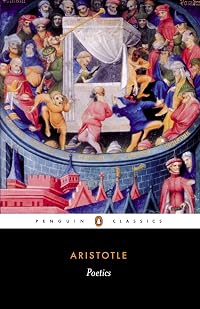
Poetics
by Aristotle
On This Page
Description
Aristotle's Poetics is best known for its definitions and analyses of tragedy and comedy, but it also applies to truth and beauty as they are manifested in the other arts. In our age, when the natural and social sciences have dominated the quest for truth, it is helpful to consider why Aristotle claimed poetry is more philosophical and more significant than history. Like so many other works by Aristotle, the Poetics has dominated the way we have thought about all forms of dramatic show more performance in Europe and America ever since. The essence of poetry lies in its ability to transcend the particulars of everyday experience and articulate universals, not merely what has happened but what might happen and what ought to happen. © Agora Publications. show lessTags
Recommendations



Member Reviews
This little book looks to address the different kinds of poetry, the structure of a good poem, and the division of a poem into its component parts.
Aristotle defines poetry as a 'medium of imitation' that seeks to represent or duplicate life through character, emotion, or action, he defines poetry very broadly, including epic poetry, tragedy, comedy, dithyrambic poetry, and even some kinds of music; however it also serves as the basis from which all literary criticism arose and it is apparent that some of his ideas have survived the centuries when reading reviews from well respected personage in this field.
Not my usual book review but I feel that all lovers, be they readers or writers, of literature could benefit from reading this show more short treatise on literature, rather than it being reserved and known only to those who are studying English Literature at whatever level.
It is not an easy read, but it wasn’t so hard that I felt I was drowning in syrup and, although I did not pick this up for enjoyment I did find myself enjoying most everything in it. Whilst reading through it it made me begin to examine the yardstick I use for my own review of books, and also the reasoning behind my choice as to whether I read a certain book or not. From reading this I have come away with the feeling my scope is too narrow, and I need to broaden my reading horizons. As much as this little book made me think, I can only give it a 3 thumbs rating as there were times when, as much as I liked Aristotle’s point of view, I wanted to choke him like a chicken.
This is a must read for anyone studying literature and literary criticism, but also for those who write as it may open a new direction and thought process to them that they can then apply into their works.
Originally reviewed on: http://catesbooknuthut.com/2015/02/02/review-poetics-aristotle/
This work is licensed under a Creative Commons Attribution-NonCommercial-NoDerivs 3.0 Unported License. show less
Aristotle defines poetry as a 'medium of imitation' that seeks to represent or duplicate life through character, emotion, or action, he defines poetry very broadly, including epic poetry, tragedy, comedy, dithyrambic poetry, and even some kinds of music; however it also serves as the basis from which all literary criticism arose and it is apparent that some of his ideas have survived the centuries when reading reviews from well respected personage in this field.
Not my usual book review but I feel that all lovers, be they readers or writers, of literature could benefit from reading this show more short treatise on literature, rather than it being reserved and known only to those who are studying English Literature at whatever level.
It is not an easy read, but it wasn’t so hard that I felt I was drowning in syrup and, although I did not pick this up for enjoyment I did find myself enjoying most everything in it. Whilst reading through it it made me begin to examine the yardstick I use for my own review of books, and also the reasoning behind my choice as to whether I read a certain book or not. From reading this I have come away with the feeling my scope is too narrow, and I need to broaden my reading horizons. As much as this little book made me think, I can only give it a 3 thumbs rating as there were times when, as much as I liked Aristotle’s point of view, I wanted to choke him like a chicken.
This is a must read for anyone studying literature and literary criticism, but also for those who write as it may open a new direction and thought process to them that they can then apply into their works.
Originally reviewed on: http://catesbooknuthut.com/2015/02/02/review-poetics-aristotle/
This work is licensed under a Creative Commons Attribution-NonCommercial-NoDerivs 3.0 Unported License. show less
A primeira vista, acho que não tenho o que acrescentar eu a um livro dessa estatura, apenas umas breves colocações além-conteúdo: bati várias edições brasileiras e portuguesas para decidir qual leria (conclui, agora, no fim, que lerei todas, principalmente os comentários e paratextos), e para minha surpresa, a que melhor fluiu o texto, mais fez sentido, mais apresentou bons comentários, justificativas e apresentação de outras traduções, não foi a Poética recente (e cara) da Editora 34, nem de qualquer outra editora, e sim uma tese de mestrado de 2006, gratuita, disponível à qualquer um no google, do Fernando Maciel Gazoni.
Teve, inclusive, um momento curioso lá pelas tantas na leitura: quem bater o olho nessa show more tradução, perceberá que as páginas são tomadas por notas, e eu sem querer dei zoom (sim, leio pdf e tenho zero astigmatismo, como descobriu?), e por algumas páginas, eu passei a ler o texto da Poética, o texto do Aristóteles, achando que se tratava das notas do tradutor. Isso foi bastante significativo para mim, porque ficou claro a maneira límpida e didática (no bom sentido) com que o Aristóteles escreve. Eu esperava uma escrita completamente diferente, mas, ao longo de páginas e páginas, eu li um coroa de dois mil e quinhentos anos atrás, achando se tratar de um tradutor/anotador de 2006, e sem que a maneira de escrever desse pistas de que fosse algo escrito num tempo tão longínquo; fisguei até umas anotações sobre Cinema e a decadência do Terror/Horror hoje em dia.
Enfim, cravo aqui que nesse ano de 2022, COM CERTEZA, eu li artigos de assuntos MUITO mais simples, que eram mais confusas, mais mal escritas, e que não tocam na unha dum cara que viveu antes de cristo. É uma obra soberba; e, sinceramente, não digo isso forçadamente, com a extensiva fortuna crítica e importância cultural me nublando: do próprio texto do Aristóteles exala uma lucidez, e emana uma consciência artística surpreendente, de deixar de queixo caído.
Procure a melhor edição para você, e veja por si só.
(se não ficou claro, é a primeira obra que leio do Aristóteles, sou meio analfabeto filósofico, então talvez eu volte aqui depois de ler as outras edições e anotações, provavelmente fazendo interpretação freestyle™) show less
Teve, inclusive, um momento curioso lá pelas tantas na leitura: quem bater o olho nessa show more tradução, perceberá que as páginas são tomadas por notas, e eu sem querer dei zoom (sim, leio pdf e tenho zero astigmatismo, como descobriu?), e por algumas páginas, eu passei a ler o texto da Poética, o texto do Aristóteles, achando que se tratava das notas do tradutor. Isso foi bastante significativo para mim, porque ficou claro a maneira límpida e didática (no bom sentido) com que o Aristóteles escreve. Eu esperava uma escrita completamente diferente, mas, ao longo de páginas e páginas, eu li um coroa de dois mil e quinhentos anos atrás, achando se tratar de um tradutor/anotador de 2006, e sem que a maneira de escrever desse pistas de que fosse algo escrito num tempo tão longínquo; fisguei até umas anotações sobre Cinema e a decadência do Terror/Horror hoje em dia.
Enfim, cravo aqui que nesse ano de 2022, COM CERTEZA, eu li artigos de assuntos MUITO mais simples, que eram mais confusas, mais mal escritas, e que não tocam na unha dum cara que viveu antes de cristo. É uma obra soberba; e, sinceramente, não digo isso forçadamente, com a extensiva fortuna crítica e importância cultural me nublando: do próprio texto do Aristóteles exala uma lucidez, e emana uma consciência artística surpreendente, de deixar de queixo caído.
Procure a melhor edição para você, e veja por si só.
(se não ficou claro, é a primeira obra que leio do Aristóteles, sou meio analfabeto filósofico, então talvez eu volte aqui depois de ler as outras edições e anotações, provavelmente fazendo interpretação freestyle™) show less
Reading it again after more than 20 years makes me realize the kind of classic it is. The first half remains a masterclass in all kinds of storytelling though Aristotle calls it poetry as per the Greek tradition of his time. If you can master the principles in the first half, it is very unlikely to falter in the metastructure of storytelling.
We have come a long way and there are reasons to disagree with the strict binary paradigm of tragedy vs comedy. However, it must be confessed that all popular fiction generally conforms to the principle of structure and elements of storytelling explained in these forty-odd pages of the first three-quarters of this little treatise.
We have come a long way and there are reasons to disagree with the strict binary paradigm of tragedy vs comedy. However, it must be confessed that all popular fiction generally conforms to the principle of structure and elements of storytelling explained in these forty-odd pages of the first three-quarters of this little treatise.
I was surprised at how readable this was. Artistotle's world was very different that ours is today. He talks of poetry and drama, which we think of as separate, as being the same thing. And of the addition of a second player in that drama as being an innovation. But his talk of the use of spectacle in poetry/drama made me think of the sometimes tiresome CGI spectacles in our modern movie dramas. His observations applied equally to his time and to our most current entertainment.
He was the first to write down many of the principles of plot and character that sometimes seem so obvious as to not need mentioning. And then he'll use that obvious observation to provide an insight that might not otherwise be quite so clear.
Some parts are just show more as relevant now as they ever were. Some parts are fascinating from an historical perspective, and made me wish I were more familiar with his chosen exemplars, like Aeschylus, Homer, and Euripides. Some parts are just cool, like his dissertation on metaphors, and how to construct them. And Some parts are more wholely of his time than ours.
Readable, for the most part, and anyone who professes a love of writing should read this. show less
He was the first to write down many of the principles of plot and character that sometimes seem so obvious as to not need mentioning. And then he'll use that obvious observation to provide an insight that might not otherwise be quite so clear.
Some parts are just show more as relevant now as they ever were. Some parts are fascinating from an historical perspective, and made me wish I were more familiar with his chosen exemplars, like Aeschylus, Homer, and Euripides. Some parts are just cool, like his dissertation on metaphors, and how to construct them. And Some parts are more wholely of his time than ours.
Readable, for the most part, and anyone who professes a love of writing should read this. show less
This little book looks to address the different kinds of poetry, the structure of a good poem, and the division of a poem into its component parts.
Aristotle defines poetry as a 'medium of imitation' that seeks to represent or duplicate life through character, emotion, or action, he defines poetry very broadly, including epic poetry, tragedy, comedy, dithyrambic poetry, and even some kinds of music; however it also serves as the basis from which all literary criticism arose and it is apparent that some of his ideas have survived the centuries when reading reviews from well respected personage in this field.
Not my usual book review but I feel that all lovers, be they readers or writers, of literature could benefit from reading this show more short treatise on literature, rather than it being reserved and known only to those who are studying English Literature at whatever level.
It is not an easy read, but it wasn’t so hard that I felt I was drowning in syrup and, although I did not pick this up for enjoyment I did find myself enjoying most everything in it. Whilst reading through it it made me begin to examine the yardstick I use for my own review of books, and also the reasoning behind my choice as to whether I read a certain book or not. From reading this I have come away with the feeling my scope is too narrow, and I need to broaden my reading horizons. As much as this little book made me think, I can only give it a 3 thumbs rating as there were times when, as much as I liked Aristotle’s point of view, I wanted to choke him like a chicken.
This is a must read for anyone studying literature and literary criticism, but also for those who write as it may open a new direction and thought process to them that they can then apply into their works.
Originally reviewed on: http://catesbooknuthut.com/2015/02/02/review-poetics-aristotle/
This work is licensed under a Creative Commons Attribution-NonCommercial-NoDerivs 3.0 Unported License. show less
Aristotle defines poetry as a 'medium of imitation' that seeks to represent or duplicate life through character, emotion, or action, he defines poetry very broadly, including epic poetry, tragedy, comedy, dithyrambic poetry, and even some kinds of music; however it also serves as the basis from which all literary criticism arose and it is apparent that some of his ideas have survived the centuries when reading reviews from well respected personage in this field.
Not my usual book review but I feel that all lovers, be they readers or writers, of literature could benefit from reading this show more short treatise on literature, rather than it being reserved and known only to those who are studying English Literature at whatever level.
It is not an easy read, but it wasn’t so hard that I felt I was drowning in syrup and, although I did not pick this up for enjoyment I did find myself enjoying most everything in it. Whilst reading through it it made me begin to examine the yardstick I use for my own review of books, and also the reasoning behind my choice as to whether I read a certain book or not. From reading this I have come away with the feeling my scope is too narrow, and I need to broaden my reading horizons. As much as this little book made me think, I can only give it a 3 thumbs rating as there were times when, as much as I liked Aristotle’s point of view, I wanted to choke him like a chicken.
This is a must read for anyone studying literature and literary criticism, but also for those who write as it may open a new direction and thought process to them that they can then apply into their works.
Originally reviewed on: http://catesbooknuthut.com/2015/02/02/review-poetics-aristotle/
This work is licensed under a Creative Commons Attribution-NonCommercial-NoDerivs 3.0 Unported License. show less
What is poetry, how many kinds of it are there, and what are their specific effects? These are questions that Aristotle’s Poetics, one of his most influential books, attempts to answer. While it has been an important aspect outside philosophical circles it is doubtful that it can be fully appreciated outside Aristotle’s philosophical system as a whole.
A theme common to all Aristotle’s philosophy is the claim that nothing can be understood apart from its end or purpose (telos). This is certainly true for the Poetics which seeks to discover the end or purpose of all the poetic arts, and especially of tragic drama. Aristotle argues that generally, the goal of poetry is to provide pleasure of a particular kind. For comparison the show more Metaphysics begins, “All men desire to know by nature,” and the Nicomachean Ethics repeatedly says that the satisfaction of natural desires is the greatest source of lasting pleasure. The Poetics combines these two approaches with the idea of imitation. All people by nature enjoy a good imitation (that is, a picture or drama) because they enjoy learning, and imitations help them to learn.
Of particular interest to Aristotle is the pleasure derived from tragic drama, namely, the kind of pleasure that comes from the purging or cleansing (catharsis) of the emotions of fear and pity. Though the emotions of fear and pity are not to be completely eliminated, excessive amounts of these emotions are not characteristic of a flourishing individual. Vicariously experiencing fear and pity in a good tragedy cleanses the soul of ill humors.
Though there are many elements of a good tragedy, the most important, according to Aristotle, is the plot. The centrality of plot once again follows from central doctrines of the Metaphysics and the Nichomachean Ethics. In the former, Aristotle argues that all knowledge is knowledge of universals; in the latter, he states that it is through their own proper activity that humans discover fulfillment.
For a plot to work, it must be both complete and coherent. That means that it must constitute a whole with a beginning, middle, and end, and that the sequence of events must exhibit some sort of necessity. A good dramatic plot is unlike history. History has no beginning, middle, and end, and thus it lacks completeness. Furthermore, it lacks coherence because many events in history happen by accident. In a good dramatic plot, however, everything happens for a reason. This difference makes tragedy philosophically more interesting than history. Tragedy focuses on universal causes and effects and thus provides a kind of knowledge that history, which largely comprises accidental happenings, cannot.
While literary styles have changed over the centuries, the observations of Aristotle still contain value both for writers and readers today. show less
A theme common to all Aristotle’s philosophy is the claim that nothing can be understood apart from its end or purpose (telos). This is certainly true for the Poetics which seeks to discover the end or purpose of all the poetic arts, and especially of tragic drama. Aristotle argues that generally, the goal of poetry is to provide pleasure of a particular kind. For comparison the show more Metaphysics begins, “All men desire to know by nature,” and the Nicomachean Ethics repeatedly says that the satisfaction of natural desires is the greatest source of lasting pleasure. The Poetics combines these two approaches with the idea of imitation. All people by nature enjoy a good imitation (that is, a picture or drama) because they enjoy learning, and imitations help them to learn.
Of particular interest to Aristotle is the pleasure derived from tragic drama, namely, the kind of pleasure that comes from the purging or cleansing (catharsis) of the emotions of fear and pity. Though the emotions of fear and pity are not to be completely eliminated, excessive amounts of these emotions are not characteristic of a flourishing individual. Vicariously experiencing fear and pity in a good tragedy cleanses the soul of ill humors.
Though there are many elements of a good tragedy, the most important, according to Aristotle, is the plot. The centrality of plot once again follows from central doctrines of the Metaphysics and the Nichomachean Ethics. In the former, Aristotle argues that all knowledge is knowledge of universals; in the latter, he states that it is through their own proper activity that humans discover fulfillment.
For a plot to work, it must be both complete and coherent. That means that it must constitute a whole with a beginning, middle, and end, and that the sequence of events must exhibit some sort of necessity. A good dramatic plot is unlike history. History has no beginning, middle, and end, and thus it lacks completeness. Furthermore, it lacks coherence because many events in history happen by accident. In a good dramatic plot, however, everything happens for a reason. This difference makes tragedy philosophically more interesting than history. Tragedy focuses on universal causes and effects and thus provides a kind of knowledge that history, which largely comprises accidental happenings, cannot.
While literary styles have changed over the centuries, the observations of Aristotle still contain value both for writers and readers today. show less
During the golden age of ancient Greece bards roamed the countryside mesmerizing crowds by reciting the epics of Homer. Thousands of men and women gathered and were moved to tears by tragedies performed outside in amphitheaters during sacred festivals. Such an amazingly powerful and profound experience for an entire population. What was going on here; why were people so deeply affected? Well, one of the sharpest, most analytic minds in the history of the West set himself the task of answering just this question - his name was Aristotle.
Indeed, Aristotle's Poetics is one of the greatest philosophical works ever written. For over two thousand years, philosophers, scholars and thinkers have been pouring over each phrase and sentence of the show more master's words as if they were nuggets of gold. There are enough commentaries to fill several thick volumes in a university library. Quite something since the entire Poetics is a mere twenty pages. But what coverage! To list several: plot, character, language and two concepts supercharged with meaning: mimesis (imitation) and catharsis (inspiring pity or fear).
Of course, in our contemporary world we don't listen to bards recite epics or go to amphitheaters to watch tragedies, but we have abundant experience of these dramatic elements since we, among other things, read novels and watch films. So, to provide a taste of Aristotle's work, I offer my modest comments along with quotes from the text. Please take this as an invitation to explore the Poetics on your own. Below is a link to a fine translation and a second link to an extraordinarily clear, brief, easy-to follow commentary.
"Poetry in general seems to have sprung from two causes, each of them lying deep in our nature. First, the instinct of imitation is implanted in man from childhood, one difference between him and other animals being that he is the most imitative of living creatures, and through imitation learns his earliest lessons; and no less universal is the pleasure felt in things imitated. . . . to learn gives the liveliest pleasure, not only to philosophers but to men in general" ---------- Ah, pleasure! And pleasure in learning about life through imitation/fiction. Even if the story involves a Siberian prison camp or an insane chase of a white whale, there is a kind of pleasure in identifying with a character and living through the character's plight. Our humanness is enriched.
"Tragedy, then, is an imitation of an action that is serious, complete, and of a certain magnitude." ---------- The Maltese Falcon begins with very serious action: a murder. And the story is complete since at the end the case is solved and the criminals answer for their crimes. How many novels and films follow this formula? Round to the nearest million.
"Now as tragic imitation implies persons acting, it necessarily follows in the first place, that Spectacular equipment will be a part of Tragedy." ---------- Even back in ancient Greece, Aristotle acknowledge how special effects can really juice the action.
"The most powerful elements of emotional interest in Tragedy- Peripeteia or Reversal of the Situation, and Recognition scenes- are parts of the plot." ---------- I don't know about you, but I recall with the film Gone Girl my interest would ratchet up a few notches with every reversal and recognition. I can just imagine Gillian Flynn pouring over her Aristotle.
"The greater the length, the more beautiful will the piece be by reason of its size, provided that the whole be perspicuous." ---------- When I go to a three hour movie or pick up a nine hundred page novel, my first thought: this had better be good. And when it is good, a great pay-off for time spent.
"Tragedy is an imitation not only of a complete action, but of events inspiring fear or pity." ---------- Admit it, we remember most those times when we are emotionally wrenched.
Poetics, on line: http://classics.mit.edu/Aristotle/poetics.1.1.html
Commentary: http://www.english.hawaii.edu/criticalink/aristotle/gloss/gloss1.html show less
Members
- Recently Added By
Lists

100 Books to Read in a Lifetime (That Are Older Than 200 Years)
415 works; 175 members

Literary Theory and Criticism: What Happens and Why
37 works; 5 members

Harold Bloom - The Western Canon: A. The Theocratic Age
97 works; 13 members

Filosofía - Clásicos
217 works; 1 member

Trinity College Booklist (1951): Class Seven, Fine Arts and Music
46 works; 3 members

Books You Read During High School (For School)
301 works; 53 members

Books and authors mentioned by Le Clézio in his Nobel Prize speech
87 works; 3 members

Book wishlist
78 works; 1 member

New Lifetime Reading Plan by Fadiman and Major
225 works; 5 members

readingList
38 works; 1 member

sotiris' favourites circa january 2023
43 works; 2 members

Well-Educated Mind
150 works; 3 members

The Well-Educated Mind, Susan Wise Bauer, 2016
179 works; 3 members

Recommended Reading : 600 Classics Reviewed, Editors of Salem Press, 2015
634 works; 6 members

In Our Time books
4,934 works; 2 members
Abridged Western Canon
14 works; 1 member

Greatest Books, allegedly
484 works; 9 members
Books I Wrote Essays on
34 works; 1 member
How to Read a Book's Recommended Reading List
309 works; 10 members

Shaykh Hamza's Book Recommendations
439 works; 3 members

A Reading List
100 works; 3 members

Books Read in College
80 works; 5 members
The Well-Educated Mind Reading Challenge
75 works; 7 members

1964 College Preparatory Reading List
202 works; 8 members

Kilobook
19 works; 1 member

100 Most Recommended Works
100 works; 11 members
Favourite Greek Books
97 works; 1 member

Favourite Books
1,819 works; 308 members
Truly old classics
63 works; 6 members

CCE 100 Great Books List
145 works; 8 members

bound
100 works; 1 member
Author Information

Some Editions
Awards and Honors
Series
Belongs to Publisher Series
Work Relationships
Is contained in
The Works of Aristotle, Volume IV: Rhetoric, Poetics and Nicomachean Ethics of Aristotle by Aristotle
Common Knowledge
- Canonical title
- Poetics
- Original title
- Περὶ ποιητικῆς (Peri poietikês) (Peri poietikê | s); Περὶ ποιητικῆς
- Alternate titles
- On the Art of Poetry; Ars Poetica; Aristotle's Poetics
- Original publication date
- c. 350 B.C.
- People/Characters
- Aristotle
- Important places
- Ancient Greece; Greece
- Important events
- Classical Antiquity; 4th century BCE
- First words
- Von der Dichtkunst selbst und von ihren Gattungen, welche Wirkung eine jede hat und wie man die Handlungen zusammenfügen muß, wenn die Dichtung gut sein soll, ferner aus wie vielen und was für Teilen eine Dichtung besteht,... (show all) und ebenso auch von den anderen Dingen, die zu demselben Thema gehören, wollen wir hier handeln, indem wir der Sache gemäß zuerst das untersuchen, was das erste ist.
Although Aristotle's Poetics appears to have had little impact on literary criticism in antiquity, critics and scholars since the Renaissance have placed this brief work at the very center of the criticism of poetry an... (show all)d drama.
--Preface (Norton edition, 1982)
Aristotle composed the Poetics with the Greek tradition of poetry alive before his eyes.
--Introduction (Norton edition, 1982)
The art of poetry, both in its general nature and in its various specific forms, is the subject here proposed for discussion.
--Body text (Norton edition, 1982)
What is poetry, how many kinds of it are there, and what are their specific effects?
[Anthony Kenny translation] - Last words
- (Click to show. Warning: May contain spoilers.)Let this then be our account of Tragedy and Epic Poetry--their general nature; the number and variety of their species and constituent parts; the causes of success or failure; and critical problems with their solutions...
Norton edition, 1982
(Click to show. Warning: May contain spoilers.)So much, then, about tragedy and epic, their kinds and parts, and the differences between them; so much also for the causes of their success and failure, and how to answer the criticisms made of them.
[Anthony Kenny translation] - Original language
- Greek (Ancient) (Ancient)
Classifications
Statistics
- Members
- 5,900
- Popularity
- 2,190
- Reviews
- 58
- Rating
- (3.77)
- Languages
- 34 — Arabic, Catalan, Czech, Danish, Dutch, English, Estonian, Finnish, French, German, Galician, Greek (Ancient), Greek, Hebrew, Hungarian, Icelandic, Italian, Japanese, Latin, Latvian, Macedonian, Multiple languages, Norwegian (Bokmål), Norwegian, Polish, Portuguese, Romanian, Russian, Serbian, Croatian, Spanish, Swedish, Turkish, Ukrainian
- Media
- Paper, Audiobook, Ebook
- ISBNs
- 272
- UPCs
- 2
- ASINs
- 89