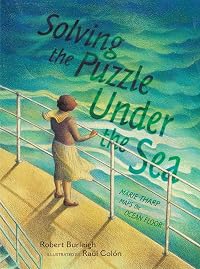
Solving the Puzzle Under the Sea: Marie Tharp Maps the Ocean Floor
by Robert Burleigh
On This Page
Description
"This illustrated biography shares the story of female scientist, Marie Tharp, a pioneering woman scientist and the first person to ever successfully map the ocean floor"--Tags
Recommendations






Member Reviews
The daughter of a traveling surveyor, Marie Tharp grew up with a keen interest in maps and cartography, eventually going on to earn degrees in music, English, mathematics and geology. Despite the resistance to women participating fully in the sciences in the 1940s, she went on to get a job at the Lamont Geological Laboratory at Columbia University. Although not permitted to join oceanographic voyages - it was considered bad luck to have women on board, even at that late date! - she was the cartographer who used the data collected on such voyages to map the surface of the Atlantic Ocean. Her work helped to open up a hidden part of the earth, and, through the discovery of the Mid-Atlantic Ridge, helped prove the theory of plate show more tectonics.
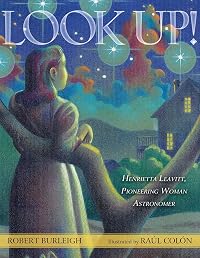
An engaging picture-book biography from author Robert Burleigh and illustrator Raúl Colón, whose previous collaboration in the same vein was Look Up! The Story of the First Woman Astronomer, Solving the Puzzle Under the Sea follows the story of a determined woman - Marie Tharp - who never let adversity and prejudice deter her, and whose ultimate triumph came in her contribution to the human understanding of how our planet works. I thought it was telling that, rather than protest at the unfair state of affairs that confronted her, when first entering her chosen field, Tharp instead set out to show others what she could do, demonstrating by example that stereotypes should be abandoned. I imagine that this was sometimes a very discouraging course of action for her, but her perseverance paid off. Indeed, there is now a scholarship named in her honor for women entering science at her erstwhile laboratory. As expected, the artwork here is every bit as appealing as the tale, with lovely blue, green and brown tones capturing and contrasting the watery and earth-bound scenes nicely. Recommended to anyone looking for picture-books featuring the scientific process, the oceanographic sciences, and/or women scientists. show less
An engaging picture-book biography from author Robert Burleigh and illustrator Raúl Colón, whose previous collaboration in the same vein was Look Up! The Story of the First Woman Astronomer, Solving the Puzzle Under the Sea follows the story of a determined woman - Marie Tharp - who never let adversity and prejudice deter her, and whose ultimate triumph came in her contribution to the human understanding of how our planet works. I thought it was telling that, rather than protest at the unfair state of affairs that confronted her, when first entering her chosen field, Tharp instead set out to show others what she could do, demonstrating by example that stereotypes should be abandoned. I imagine that this was sometimes a very discouraging course of action for her, but her perseverance paid off. Indeed, there is now a scholarship named in her honor for women entering science at her erstwhile laboratory. As expected, the artwork here is every bit as appealing as the tale, with lovely blue, green and brown tones capturing and contrasting the watery and earth-bound scenes nicely. Recommended to anyone looking for picture-books featuring the scientific process, the oceanographic sciences, and/or women scientists. show less
Working in a time when women were still unwelcome in her field, Marie Tharp mapped the ocean floor and provided convincing evidence for the previously rejected hypothesis of continental drift.
Burleigh's choice to write in Tharp’s voice makes the determined geologist’s story feel immediate, focusing tightly on her map that revealed the spreading Atlantic sea floor. He notes obstacles she overcame: a peripatetic childhood; gender discrimination; the superstition, still prevalent in 1948, that women were unlucky on ships; and disagreements about the drift theory even with her friend and colleague Bruce Heezen. There’s a short description of Tharp’s mapmaking process and a triumphant conclusion when the final, color version is show more published. But it’s Colón's watercolor-and-pencil illustrations that bring her story alive. Readers see the map-loving child, ships taking the soundings that provided her data, the cartographer with pencil in hand, both graphing and drawing, and, in a wordless double-page spread, the exciting revelation of the rift in the middle of the Mid-Atlantic Ridge. The distinctive combed swirls of Colón's art masterfully suggest light on a seascape, and people are realistically depicted. Backmatter includes more of Tharp’s story, useful vocabulary, bibliography and Internet links, and even “things to wonder about and do.”
An ideal introduction to a lesser-known scientist and an important understanding about how the Earth works. (Informational picture book. 5-9) show less
Burleigh's choice to write in Tharp’s voice makes the determined geologist’s story feel immediate, focusing tightly on her map that revealed the spreading Atlantic sea floor. He notes obstacles she overcame: a peripatetic childhood; gender discrimination; the superstition, still prevalent in 1948, that women were unlucky on ships; and disagreements about the drift theory even with her friend and colleague Bruce Heezen. There’s a short description of Tharp’s mapmaking process and a triumphant conclusion when the final, color version is show more published. But it’s Colón's watercolor-and-pencil illustrations that bring her story alive. Readers see the map-loving child, ships taking the soundings that provided her data, the cartographer with pencil in hand, both graphing and drawing, and, in a wordless double-page spread, the exciting revelation of the rift in the middle of the Mid-Atlantic Ridge. The distinctive combed swirls of Colón's art masterfully suggest light on a seascape, and people are realistically depicted. Backmatter includes more of Tharp’s story, useful vocabulary, bibliography and Internet links, and even “things to wonder about and do.”
An ideal introduction to a lesser-known scientist and an important understanding about how the Earth works. (Informational picture book. 5-9) show less
I read this after my 8 year old read it. Honestly, it was really good! Great illustrations, great writing and incredibly informative. I can't wait to get and read the grown-up version of this book!
Author Robert Burleigh and illustrator Raúl Colón, the team that brought us the story of Henrietta Swan Leavitt, the pioneering astronomer, now tell the story of another remarkable woman, Marie Tharp (1920-2006), who helped to map the ocean floor.
The book is written in the first person, as if Marie Tharp herself were telling the story. Marie explains that her father’s job was to travel all over the U.S. making soil classification maps to aid farmers. This led to her own lifelong love of maps.
In college, she received a master’s degree in geology (as well as degrees in English, music, and mathematics). She also began to wonder what was at the bottom of the sea.
She had a rough path to overcome because of the prejudices against women show more scientists, but she was determined, and was eventually given the assignment (along with a male colleague, Bruce Heezen) of mapping the bottom of the ocean. This large project took twenty years.
Although not mentioned in the book, for the first eighteen years of her collaboration with Heezen, Marie was not allowed to work on board a ship because of her gender, and so she drew maps from the data provided by Heezen and data she collected from other research ships. Through her achievements, she helped convince the geoscientific community of plate-tectonic theory.
Eventually, Marie Tharp received recognition and honors for her accomplishments.
At the back of the book, the author includes a brief biography of Tharp with references to other books and articles about her, a glossary, a list of “interesting Internet Links to Explore” about oceanography, and some suggested activities.
The prose is rather pedestrian, but the illustrations by Raúl Colón, done in his trademark style of watercolor washes, colored pencils and lithograph pencils, are lovely, and convey the enormity of the task undertaken by Tharp.
Evaluation: Once again Burleigh introduces to children a woman who made important discoveries through a combination of dreams, talent, and persistence. The beautiful illustrations add immeasurably to the story, and will aid the understanding of the target audience, ages 4-8. Older children will no doubt get even more out of this book. show less
The book is written in the first person, as if Marie Tharp herself were telling the story. Marie explains that her father’s job was to travel all over the U.S. making soil classification maps to aid farmers. This led to her own lifelong love of maps.
In college, she received a master’s degree in geology (as well as degrees in English, music, and mathematics). She also began to wonder what was at the bottom of the sea.
She had a rough path to overcome because of the prejudices against women show more scientists, but she was determined, and was eventually given the assignment (along with a male colleague, Bruce Heezen) of mapping the bottom of the ocean. This large project took twenty years.
Although not mentioned in the book, for the first eighteen years of her collaboration with Heezen, Marie was not allowed to work on board a ship because of her gender, and so she drew maps from the data provided by Heezen and data she collected from other research ships. Through her achievements, she helped convince the geoscientific community of plate-tectonic theory.
Eventually, Marie Tharp received recognition and honors for her accomplishments.
At the back of the book, the author includes a brief biography of Tharp with references to other books and articles about her, a glossary, a list of “interesting Internet Links to Explore” about oceanography, and some suggested activities.
The prose is rather pedestrian, but the illustrations by Raúl Colón, done in his trademark style of watercolor washes, colored pencils and lithograph pencils, are lovely, and convey the enormity of the task undertaken by Tharp.
Evaluation: Once again Burleigh introduces to children a woman who made important discoveries through a combination of dreams, talent, and persistence. The beautiful illustrations add immeasurably to the story, and will aid the understanding of the target audience, ages 4-8. Older children will no doubt get even more out of this book. show less
This is a wonderful biography of a woman who combined science and art to make a name for herself. Her discoveries helped prove they were mountains under the water, and that continental drift was a real thing. This book is lovingly done and well illustrated. For a children’s picture book it’s done in the first person which is highly unusual but very effective. This is a great biography for any library collection.
This book outlines the scientific discoveries of Marie Tharp, an oceanographer. She was one of the key people who mapped out the ocean floor, providing evidence for the existence of tectonic plates. This book goes through her life, from a young girl who developed her father's passion for maps, to a young woman who struggled to earn her place in a man's world of science. She later found a way to become one of the first people to map out the ocean floor. I like this book because it can subtly address misconceptions regarding tectonic plates, the ocean floor, and the life of a scientist. I would use this book as a read-aloud, because the format of the book lends itself well to being read aloud. I could also do a unit about the life and show more discoveries of different scientists throughout history and have this book as one of the options/parts. show less
Solving the Puzzle Under the Sea is a biography that tells the tale of American geologist and oceanographic cartographer Marie Tharp in language that is student friendly towards younger readers. The book is written in the vivid image perspective of Marie Tharp in her love and desire to read and draw maps. The book includes how Marie Tharp examines maps from all over the world such as France, South Africa, and China however, Marie Tharp is shown within the booked to have an increased curiosity towards how the ocean would look like on maps regarding to only land maps being available at the time. Throughout Marie Tharp’s life, the book portrays how Marie Tharp was underestimated as a geologist due to her being a woman. As Marie Tharp show more continues her career, the author includes how Marie Tharp began with her mission on mapping the ocean floor. This book is an interesting book that can be correlated towards science, history, and geography content areas as it covers a historical figure that was the first person and the first woman to map the ocean floor. This book also covers oceanography and geology as it includes topics as plate tectonics or continental drift. This book can be used within a 6th grade classroom when covering the unit plate tectonics on how the continents drift every year. Additionally, since it is a biography, it can also be implemented within content areas such as language arts to portray the types of narratives such as first person, third person, etc. In the end, the book also contains important phrases to know with the definitions to serve as a reference for young readers. As an educator, I would recommend this book to my students to help them gain an understanding of plate tectonics and how the ocean came to be mapped. show less
Members
- Recently Added By
Lists

Children's Books About Science and Math
461 works; 12 members

Children's Picture Books
188 works; 1 member
Author Information

61+ Works 6,553 Members
All Editions
Awards and Honors
Awards
Distinctions
Notable Lists
Common Knowledge
- Original publication date
- 2016
- People/Characters
- Marie Tharp
- Dedication
- For Paula Wiseman, great editor and friend
--R. B.
For Gavin
--R. C. - First words
- Maps. I love them!
- Last words
- (Click to show. Warning: May contain spoilers.)We're only moving about an inch or two each year!
Classifications
- Genres
- Picture Books, Nonfiction
- DDC/MDS
- 526.092 — Natural sciences & mathematics Astronomy Mathematical geography History, geographic treatment, biography Biography
- LCC
- GA407 .T43 .B87 — Geography, Anthropology and Recreation Mathematical geography. Cartography Mathematical geography. Cartography Cartography Maps. By region or country
- BISAC
Statistics
- Members
- 230
- Popularity
- 141,677
- Reviews
- 12
- Rating
- (4.14)
- Languages
- English
- Media
- Paper, Ebook
- ISBNs
- 3
- ASINs
- 1