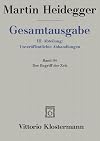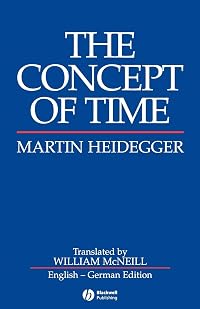
The Concept of Time
by Martin Heidegger
On This Page
Description
Available in English for the first time, this first draft of Heidegger's opus, Being and Time, provides a unique insight into Heidegger's Phenomenology.Tags
Recommendations


















Member Reviews
Continuum have recently published a number of new English translations of Martin Heidegger’s work. This is, in effect, the first draft of his masterpiece, ‘Being and Time’. ‘Being and Time’ is a very difficult work and this early version is no piece of cake.
However, although incomplete in its thinking, it is a surprisingly clear account of the core of his philosophy as early as 1924 and it can be recommended (with care) as a decent bridge between a general textbook account of his philosophy and his larger work.
The ‘care’ resides in the advice to the non-academic reader to accept that they are not going to get very much out of the highly detailed and difficult Third Chapter on ‘Dasein and Temporality’.
The translator show more states at the beginning that it ‘makes few concessions to the reader’ - that is an understatement. Having said this, Chapter 2 on ‘The Original Ontological Characteristics of Dasein’ is remarkably useful.
The essence of Heidegger’s radical adoption of a phenomenological approach to our Being-in-the-World is here and it is an exciting read for anyone who ‘gets’ that this philosophical genius changed forever the way we can and should think about ourselves and the world.
While Nietzsche is a polemicist of existentialism against Christian and Hegelian essentialism, it is Heidegger who thinks through why essentialism is absurd and who presents us with a model for the individual human condition (Dasein) that places it firmly in a context of Time, of Heraclitean flux.
After Heidegger, it is no longer possible to consider any situation or person as fixed or essential nor to see a person as not embedded not merely in the material but in the social, constructed by their circumstances until that point when they become conscious of their being constructed.
The philosophy cannot be summarised without failing to do justice to Heidegger’s insights and the care with which he builds up his anti-system. Heidegger moves us beyond the idea of pure individualism and of socialisms into entirely new territory (at least in 1924).
There is no being in the world that is not experienced phenomenologically by the individual in relation to the world.
Such an individual is not fully created as person until the moment before they cease to exist. Death is central to Heidegger’s philosophy because it is a culmination of a process.
However, the world of the individual is created not only within brute material existence but also through the constructed phenomenal reality of many other individuals now and in the past so that history becomes a formative part of the process of ‘becoming’ until death.
At one point, Heidegger writes with brilliance about how generations construct their world and suggests how some individuals can think outside their generation just as they can think outside of their society.
His interest in history, of course, is to some extent a response to both Hegelian process and to German historicism. He recasts history not as forces with an essence of their own but simply as the phenomena of the ‘deals’ (my term) that are struck between people simply to get from A to B.
We are thrown into the world with a pre-existent history, we make our history as we move along our trajectory towards death and we leave behind a ‘given’ history for others to accept or change as consciousness and will permit. What this history is not is a thing outside the people who create it.
The book is primarily about time as the title suggests and how time and death at the end of personal time dictate what we are – a process that can never allow us to be a thing-in-itself unlike those things in the world that we make use of in our own process of becoming.
The world is to hand in this sense and this helps us to see how we use people as objects as if they were hammers while having relationships where our loneliness is assuaged by attempting to see persons as like us, things not in themselves but as others who are Dasein.
This is a rethinking of our old Kantian friends – the subject and the object – but it helps us to see that the imaginative universalist construction of humanity as a thing-in-itself is nonsensical. It is an aspiration that speaks of our anxieties but says nothing about the world.
A person who is Dasein can only relate to others as Dasein on an individual level of connectedness and, even then, the engagement is relative and not absolute. We cannot, as Heidegger rightly insists, live another person’s life because we can never live their death.
It is not accidental that some people with a strong universalist attitude to humanity find it difficult to engage in a direct and passionate relationship with others on an unconditional and non-exploitative way. The two attitudes – essentialist and existentialist – crowd each other out.
Being in the world (this is the concept of Dasein) is very much being in the world together with others. This social construction of self through time is at the heart of this short book.
Perhaps Heidegger over-privileges language over non-verbal communication (he was of his time and of the text-based culture of Western Europe) but, whether linguistic or non-verbal, the interplay of oneself with others and both with matter creates what we understand by culture and society.
Heidegger himself is conservative in orientation but there are no necessary conservative conclusions to be drawn from this (as Sartre attempted to demonstrate but then became trapped in his own Cartesianism and assumed Marxism).
The individual consciousness has to understand the material and social limitations of its position and the fact that there is no escaping final extinction but the process of steering oneself through the material and social in order to create the ‘right’ self might be a truly radical one.
Humanity in general is faced with anxiety (according to Heidegger) over its own dissolution, a dissolution without meaning, so it tends to construct false meaning and to adopt (Sartre extended this) a social role to avoid ‘being’.
'Becoming’ and process are frightening so the tendency is to fix things as essences.
In practice, avoidance of dealing with anxiety, death and lack of meaning merely creates a ‘false consciousness’ (Sartre again, not Heidegger) which embeds the anxious state so that the person never becomes anything other than their own historical or social construction.
Material limitations are real but history and social limitations are more or less flexible. The question is then whether the person not only understands how to manage matter ('scientia') but also how to manage and command the social and move beyond one’s past.
We have moved decades beyond Heidegger’s master work into Sartrean territory but the importance of this book and of “Being and Time” itself is that they create the possibility for individual liberation and choice without diminishing the power of the material, the social and the historical.
Adolescent irrational assertion of pure individualism and a cowed submission to the social and to the past become two sides of the same coin of incomprehension about the world and our place in it.
In addition, once death and anxiety are faced, they, like the bully, lose their power – if the knowledge does not send you insane or to suicide, it liberates in precisely the way proposed by Nietzsche even if it was not an outcome for him.
It is possible, of course, to be a Christian or a Marxist or a Liberal or whatever and accept this world view but the acceptance of such ideology or belief is then undertaken in a wholly different spirit.
There is the Kierkegaardian leap of faith or a simple acceptance of ‘what one is’ or of ‘what one chooses to be in the context of society and history’ - what it is not any more possible is a simple acceptance of what others choose one to be.
To construct meaning as a ‘leap’ is certainly very different from constructing meaning out of anxiety without further thought or curiosity. It may still be a leap derived from anxiety but one leaps knowing that this anxiety must be alleviated in this way.
For others, this no-meaning is the liberation and death is simply the last of many successive presents.
This general review fails to do justice to an excellent translation with exceptional academic support.
To read Chapter 2 of this book, supported by Chapters 1 and 4, is to see the world in an entirely different way. A difficult but recommended text – one which you might read and then return to later for more insights. show less
However, although incomplete in its thinking, it is a surprisingly clear account of the core of his philosophy as early as 1924 and it can be recommended (with care) as a decent bridge between a general textbook account of his philosophy and his larger work.
The ‘care’ resides in the advice to the non-academic reader to accept that they are not going to get very much out of the highly detailed and difficult Third Chapter on ‘Dasein and Temporality’.
The translator show more states at the beginning that it ‘makes few concessions to the reader’ - that is an understatement. Having said this, Chapter 2 on ‘The Original Ontological Characteristics of Dasein’ is remarkably useful.
The essence of Heidegger’s radical adoption of a phenomenological approach to our Being-in-the-World is here and it is an exciting read for anyone who ‘gets’ that this philosophical genius changed forever the way we can and should think about ourselves and the world.
While Nietzsche is a polemicist of existentialism against Christian and Hegelian essentialism, it is Heidegger who thinks through why essentialism is absurd and who presents us with a model for the individual human condition (Dasein) that places it firmly in a context of Time, of Heraclitean flux.
After Heidegger, it is no longer possible to consider any situation or person as fixed or essential nor to see a person as not embedded not merely in the material but in the social, constructed by their circumstances until that point when they become conscious of their being constructed.
The philosophy cannot be summarised without failing to do justice to Heidegger’s insights and the care with which he builds up his anti-system. Heidegger moves us beyond the idea of pure individualism and of socialisms into entirely new territory (at least in 1924).
There is no being in the world that is not experienced phenomenologically by the individual in relation to the world.
Such an individual is not fully created as person until the moment before they cease to exist. Death is central to Heidegger’s philosophy because it is a culmination of a process.
However, the world of the individual is created not only within brute material existence but also through the constructed phenomenal reality of many other individuals now and in the past so that history becomes a formative part of the process of ‘becoming’ until death.
At one point, Heidegger writes with brilliance about how generations construct their world and suggests how some individuals can think outside their generation just as they can think outside of their society.
His interest in history, of course, is to some extent a response to both Hegelian process and to German historicism. He recasts history not as forces with an essence of their own but simply as the phenomena of the ‘deals’ (my term) that are struck between people simply to get from A to B.
We are thrown into the world with a pre-existent history, we make our history as we move along our trajectory towards death and we leave behind a ‘given’ history for others to accept or change as consciousness and will permit. What this history is not is a thing outside the people who create it.
The book is primarily about time as the title suggests and how time and death at the end of personal time dictate what we are – a process that can never allow us to be a thing-in-itself unlike those things in the world that we make use of in our own process of becoming.
The world is to hand in this sense and this helps us to see how we use people as objects as if they were hammers while having relationships where our loneliness is assuaged by attempting to see persons as like us, things not in themselves but as others who are Dasein.
This is a rethinking of our old Kantian friends – the subject and the object – but it helps us to see that the imaginative universalist construction of humanity as a thing-in-itself is nonsensical. It is an aspiration that speaks of our anxieties but says nothing about the world.
A person who is Dasein can only relate to others as Dasein on an individual level of connectedness and, even then, the engagement is relative and not absolute. We cannot, as Heidegger rightly insists, live another person’s life because we can never live their death.
It is not accidental that some people with a strong universalist attitude to humanity find it difficult to engage in a direct and passionate relationship with others on an unconditional and non-exploitative way. The two attitudes – essentialist and existentialist – crowd each other out.
Being in the world (this is the concept of Dasein) is very much being in the world together with others. This social construction of self through time is at the heart of this short book.
Perhaps Heidegger over-privileges language over non-verbal communication (he was of his time and of the text-based culture of Western Europe) but, whether linguistic or non-verbal, the interplay of oneself with others and both with matter creates what we understand by culture and society.
Heidegger himself is conservative in orientation but there are no necessary conservative conclusions to be drawn from this (as Sartre attempted to demonstrate but then became trapped in his own Cartesianism and assumed Marxism).
The individual consciousness has to understand the material and social limitations of its position and the fact that there is no escaping final extinction but the process of steering oneself through the material and social in order to create the ‘right’ self might be a truly radical one.
Humanity in general is faced with anxiety (according to Heidegger) over its own dissolution, a dissolution without meaning, so it tends to construct false meaning and to adopt (Sartre extended this) a social role to avoid ‘being’.
'Becoming’ and process are frightening so the tendency is to fix things as essences.
In practice, avoidance of dealing with anxiety, death and lack of meaning merely creates a ‘false consciousness’ (Sartre again, not Heidegger) which embeds the anxious state so that the person never becomes anything other than their own historical or social construction.
Material limitations are real but history and social limitations are more or less flexible. The question is then whether the person not only understands how to manage matter ('scientia') but also how to manage and command the social and move beyond one’s past.
We have moved decades beyond Heidegger’s master work into Sartrean territory but the importance of this book and of “Being and Time” itself is that they create the possibility for individual liberation and choice without diminishing the power of the material, the social and the historical.
Adolescent irrational assertion of pure individualism and a cowed submission to the social and to the past become two sides of the same coin of incomprehension about the world and our place in it.
In addition, once death and anxiety are faced, they, like the bully, lose their power – if the knowledge does not send you insane or to suicide, it liberates in precisely the way proposed by Nietzsche even if it was not an outcome for him.
It is possible, of course, to be a Christian or a Marxist or a Liberal or whatever and accept this world view but the acceptance of such ideology or belief is then undertaken in a wholly different spirit.
There is the Kierkegaardian leap of faith or a simple acceptance of ‘what one is’ or of ‘what one chooses to be in the context of society and history’ - what it is not any more possible is a simple acceptance of what others choose one to be.
To construct meaning as a ‘leap’ is certainly very different from constructing meaning out of anxiety without further thought or curiosity. It may still be a leap derived from anxiety but one leaps knowing that this anxiety must be alleviated in this way.
For others, this no-meaning is the liberation and death is simply the last of many successive presents.
This general review fails to do justice to an excellent translation with exceptional academic support.
To read Chapter 2 of this book, supported by Chapters 1 and 4, is to see the world in an entirely different way. A difficult but recommended text – one which you might read and then return to later for more insights. show less
This book is a good recommendation for those struggling with understanding Sein und Zeit. Most of the important concepts are introduced with rather practical examples - yes, this is possible, even for Heidegger. The first part of the book is an overview of the essential concepts in Heidegger's Daseinsanalytik. The second part is a shorter public lecture, which sort of distills his thinking about Time in the first part.
Heidegger is both amazing and frustrating here, as always. His argument is presented rather authoritatively, with little for discussion on the reader's side. Even more so here than in his other works. However, following him in his thinking is, as almost always, worth the while. The biggest achievement of this lecture is show more that Heidegger knows how to pave the path to an authentic understanding of Time, which does not coincide with measurable time, but rather 'lived' Time. show less
Heidegger is both amazing and frustrating here, as always. His argument is presented rather authoritatively, with little for discussion on the reader's side. Even more so here than in his other works. However, following him in his thinking is, as almost always, worth the while. The biggest achievement of this lecture is show more that Heidegger knows how to pave the path to an authentic understanding of Time, which does not coincide with measurable time, but rather 'lived' Time. show less
Ratings
Members
- Recently Added By
Author Information

462+ Works 23,566 Members
Martin Heidegger was born in Messkirch, Baden, Germany on September 22, 1889. He studied Roman Catholic theology and philosophy at the University of Frieburg before joining the faculty at Frieburg as a teacher in 1915. Eight years later Heidegger took a teaching position at Marburg. He taught there until 1928 and then went back to Frieburg as a show more professor of philosophy. As a philosopher, Heidegger developed existential phenomenology. He is still widely regarded as one of the most original philosophers of the 20th century. Influenced by other philosophers of his time, Heidegger wrote the book, Being in Time, in 1927. In this work, which is considered one of the most important philosophical works of our time, Heidegger asks and answers the question "What is it, to be?" Other books written by Heidegger include Basic Writings, a collection of Heidegger's most popular writings; Nietzsche, an inquiry into the central issues of Friedrich Nietzsche's philosophy; On the Way to Language, Heidegger's central ideas on the origin, nature and significance of language; and What is Called Thinking, a systematic presentation of Heidegger's later philosophy. Since the 1960s, Heidegger's influence has spread beyond continental Europe and into a number of English-speaking countries. Heidegger died in Messkirch on May 26, 1976. (Bowker Author Biography) show less
Series
Belongs to Publisher Series
Common Knowledge
- Original publication date
- 1924 (original German) (original German); 1992 (English: McNeill) (English: McNeill)
Classifications
Statistics
- Members
- 183
- Popularity
- 179,310
- Reviews
- 2
- Rating
- (3.83)
- Languages
- 5 — English, German, Italian, Portuguese, Spanish
- Media
- Paper, Ebook
- ISBNs
- 19
- ASINs
- 3