The House in Paris
by Elizabeth Bowen
On This Page
Description
One of Elizabeth Bowen's most artful and psychologically acute novels, The House in Paris is a timeless masterpiece of nuance and atmosphere, and represents the very best of Bowen's celebrated oeuvre. When eleven-year-old Henrietta arrives at the Fishers' well-appointed house in Paris, she is prepared to spend her day between trains looked after by an old friend of her grandmother's. Henrietta longs to see a few sights in the foreign city; little does she know what fascinating secrets the show more Fisher house itself contains. For Henrietta finds that her visit coincides with that of Leopold, an intense child who has come to Paris to be introduced to the mother he has never known. In the course of a single day, the relations between Leopold, Henrietta's agitated hostess Naomi Fisher, Leopold's mysterious mother, his dead father, and the dying matriarch in bed upstairs, come to light slowly and tantalizingly. And when Henrietta leaves the house that evening, it is in possession of the kind of grave knowledge usually reserved only for adults. show lessTags
Recommendations





















Member Reviews
Dešava mi se da knjige koje me ostave „bez teksta“ nisu neke popularne visoko ocijenjene knjige koje čita jako mnogo ljudi na našim prostorima. Na čudne načine dolazim do tih knjiga, ili one dolaze do mene?? Ovu knjigu sam odabrala jer sam željela čitati na engleskom (britanskom mada je spisateljica Irkinja), bez previše slenga (ja ipak nisam studirala engleski), nezahtjevno i ne previše moderno i bez previše stranica. I na svojoj TBR listi, koja je ogromna (želje veće od mogućnosti) sam odabrala ovu knjigu i pronašla dragulj.
Predivan roman s mnogo fascinatnih likova. Djelo satkano od tajni, bola, strasti, razočarenja, izdaje i ljubavi. Ono što me fascinira je to što se o osjećajima ne piše ali oni izbijaju iz show more svake riječi, iz svakog opisa kuće, prirode, sveprisutni su. Knjiga počinje i završava u kući u Parizu koju sam doživjela mračnom, bez zraka, klaustrofobičnom. Ta kuća je ustvari pozornica na kojoj glavne uloge imaju stanovnice te kuće gospođa Fisher, diktator koji vuče konce, i gospođica Fisher jako pasivna osoba.
Jezik kojim je pisano je posebna priča. Uživala sam u svakoj riječi kao što gurman uživa u svom omiljenom jelu i podsjetila sam se kakvo je to zadovoljstvo čitati sporo i pažljivo a bez razmišljanja što će se desiti na kraju knjige. Uživanje u riječima radi riječi. show less
Predivan roman s mnogo fascinatnih likova. Djelo satkano od tajni, bola, strasti, razočarenja, izdaje i ljubavi. Ono što me fascinira je to što se o osjećajima ne piše ali oni izbijaju iz show more svake riječi, iz svakog opisa kuće, prirode, sveprisutni su. Knjiga počinje i završava u kući u Parizu koju sam doživjela mračnom, bez zraka, klaustrofobičnom. Ta kuća je ustvari pozornica na kojoj glavne uloge imaju stanovnice te kuće gospođa Fisher, diktator koji vuče konce, i gospođica Fisher jako pasivna osoba.
Jezik kojim je pisano je posebna priča. Uživala sam u svakoj riječi kao što gurman uživa u svom omiljenom jelu i podsjetila sam se kakvo je to zadovoljstvo čitati sporo i pažljivo a bez razmišljanja što će se desiti na kraju knjige. Uživanje u riječima radi riječi. show less
"Meetings that do not come off keep a character of their own."
The first word people have used to describe for me Elizabeth Bowen's writing is often "difficult". I now see they are wrong. Where some minds find difficulty, those of us with clearer vision see rare intelligence. Bowen was a younger member of the Bloomsbury Group, often defined as a generational link between Virginia Woolf and Muriel Spark. She toys with the fragmented modernism of the former, while sinking her teeth into the detached British realism of the latter. It is the frisson of this combination that gives her work its unique voice.
The House in Paris takes place over one day, as 11-year-old Henrietta and 9-year-old Leopold pass through the home of Miss Naomi Fisher show more and her ailing mother. The children do not know each other; the orphaned Henrietta is en route to visit her grandmother, and needs a place to stop, while Leopold is to meet his mother for the first time today, after having been raised by family friends in Italy. Both children's unusual circumstances are joined by their respective mothers' friendships with Miss Fisher. In the repressive atmosphere of the house, secrets unfold amongst these four unnerved characters and their ultimate guest.
Bowen's style is perhaps best described as "detached", somewhere on that mid-20th century spectrum of writers whom I adore so, whose characters are financially "comfortable" but often on a downward trajectory, and whose speech - clipped yet romantic - invites the reader to fill in the silences. If you have tasted the sweet delights of Murdoch and Durrell, of Penelope Fitzgerald and Barbara Pym, seek comfort here. If your preferences lean in the other direction, Bowen may not be for you! Says one of the characters: "I cannot live in a love affair, I am busy and grasping. I am not English; you know I am nervous the whole time. I could not endure being conscious of anyone. Naomi is like furniture or the dark. I should pity myself if I did not marry her."
"The Present" takes up about half of this short novel, but the meat of Bowen's story is in the central section, "The Past". The true details of Naomi Fisher's youth, of Leopold's provenance, of Madame Fisher in her prime, are interspersed in the details of a love affair as delicate as a hothouse flower. Bowen tears at the fragile stitches of these characters, revealing flesh that is bruised and sore. The content of the book - and, in truth, sometimes its individual moments - could be found in a lesser soft romance novel of the period. But Bowen's prose refuses to be cowed. She slips between tenses, surprises us with changes in narrative voice and tone, and generally keeps the atmosphere on the thinnest ice.
Unsettling, but beautiful. show less
The first word people have used to describe for me Elizabeth Bowen's writing is often "difficult". I now see they are wrong. Where some minds find difficulty, those of us with clearer vision see rare intelligence. Bowen was a younger member of the Bloomsbury Group, often defined as a generational link between Virginia Woolf and Muriel Spark. She toys with the fragmented modernism of the former, while sinking her teeth into the detached British realism of the latter. It is the frisson of this combination that gives her work its unique voice.
The House in Paris takes place over one day, as 11-year-old Henrietta and 9-year-old Leopold pass through the home of Miss Naomi Fisher show more and her ailing mother. The children do not know each other; the orphaned Henrietta is en route to visit her grandmother, and needs a place to stop, while Leopold is to meet his mother for the first time today, after having been raised by family friends in Italy. Both children's unusual circumstances are joined by their respective mothers' friendships with Miss Fisher. In the repressive atmosphere of the house, secrets unfold amongst these four unnerved characters and their ultimate guest.
Bowen's style is perhaps best described as "detached", somewhere on that mid-20th century spectrum of writers whom I adore so, whose characters are financially "comfortable" but often on a downward trajectory, and whose speech - clipped yet romantic - invites the reader to fill in the silences. If you have tasted the sweet delights of Murdoch and Durrell, of Penelope Fitzgerald and Barbara Pym, seek comfort here. If your preferences lean in the other direction, Bowen may not be for you! Says one of the characters: "I cannot live in a love affair, I am busy and grasping. I am not English; you know I am nervous the whole time. I could not endure being conscious of anyone. Naomi is like furniture or the dark. I should pity myself if I did not marry her."
"The Present" takes up about half of this short novel, but the meat of Bowen's story is in the central section, "The Past". The true details of Naomi Fisher's youth, of Leopold's provenance, of Madame Fisher in her prime, are interspersed in the details of a love affair as delicate as a hothouse flower. Bowen tears at the fragile stitches of these characters, revealing flesh that is bruised and sore. The content of the book - and, in truth, sometimes its individual moments - could be found in a lesser soft romance novel of the period. But Bowen's prose refuses to be cowed. She slips between tenses, surprises us with changes in narrative voice and tone, and generally keeps the atmosphere on the thinnest ice.
Unsettling, but beautiful. show less
Two children, unrelated and unknown to each other, arrive at a house in Paris for the day. One is merely on a journey to see her grandmother. The other is there to meet the mother he has never met.
The children's eye view of life, people, and each other is wonderful, although the younger child ultimately strikes me as more precocious in thought and language than I can quite believe.
The central story, of how the younger child came to be, is hypnotic, with protagonists of startling passivity and denial, but with passion and acute powers of observation. These qualities sound like contradictions, but are not - these people are helpless in their passions even as they observe their actions.
Beautiful writing, with strikingly creative use of show more language without any confusion of meaning.
Note: my book circle was quite divided about this book, some feeling the writing was awful and the book soppy and sentimental, some feeling more as I do. Although one of the members called this 'a woman's book', there were women who hated it and men who loved it.
eta:
I had read this book about three years ago, and initially had no memory of it whatsoever. How did that happen? As soon as I began listening to the audio, it all came back in technicolor - or as much technicolor as could sift into this particular house.
Bowen sandwiches the story of a young upper-class Englishwoman, Karen, andher coming-into-awareness, between two sections on what came after, a curious inside-out approach. We are first introduced to two children, 11 year old Henrietta and 9 year old Leopold, whose paths cross for a day in a particular house in Paris. Both have lost parents, and both are traveling with strangers. In this house, it happens, the pivotal events that precipitated Leopold's existence began. Madame Fisher, once active but now sequestered upstairs in her bed, and Miss Naomi Fisher, her daughter, who knew Leopold's parents, are poised in a tense expectation, waiting for the scheduled appearance of Leopold's mother.
And then we are in the past, the past of Karen, becoming aware of others, Ray, her fiance, Naomi, her friend from a time when she boarded at the house in Paris when younger, and Max, a presence in this house, half-Jewish and thus half-alien, somehow mesmerized by Madame Fisher, eventually engaged to Naomi. What happens to these people is the center of the book.
I'm glad I chose to listen instead of read my second round. The narrator is excellent, and the language is so particular, so lush at times, that I could not stop listening. Knowing the outline allowed me to focus on the details, and they are devastating.
One of my f2f reading groups discussed this book last week, and I was very surprised by how many of us did not like it, and all for different reasons. It was one of the more lively, noisy discussions, but I felt it was frequently misdirected. The choices that Karen made struck some as selfish. The children were seen by some as too knowing, by others as incredibly revealing of the view a child would have in a strange environment, with nothing to do but wait and observe.
Death is all through this story, and betrayal, and secrets, full of depth, sadness, and ultimately hope. I loved it. show less
The children's eye view of life, people, and each other is wonderful, although the younger child ultimately strikes me as more precocious in thought and language than I can quite believe.
The central story, of how the younger child came to be, is hypnotic, with protagonists of startling passivity and denial, but with passion and acute powers of observation. These qualities sound like contradictions, but are not - these people are helpless in their passions even as they observe their actions.
Beautiful writing, with strikingly creative use of show more language without any confusion of meaning.
Note: my book circle was quite divided about this book, some feeling the writing was awful and the book soppy and sentimental, some feeling more as I do. Although one of the members called this 'a woman's book', there were women who hated it and men who loved it.
eta:
I had read this book about three years ago, and initially had no memory of it whatsoever. How did that happen? As soon as I began listening to the audio, it all came back in technicolor - or as much technicolor as could sift into this particular house.
Bowen sandwiches the story of a young upper-class Englishwoman, Karen, andher coming-into-awareness, between two sections on what came after, a curious inside-out approach. We are first introduced to two children, 11 year old Henrietta and 9 year old Leopold, whose paths cross for a day in a particular house in Paris. Both have lost parents, and both are traveling with strangers. In this house, it happens, the pivotal events that precipitated Leopold's existence began. Madame Fisher, once active but now sequestered upstairs in her bed, and Miss Naomi Fisher, her daughter, who knew Leopold's parents, are poised in a tense expectation, waiting for the scheduled appearance of Leopold's mother.
And then we are in the past, the past of Karen, becoming aware of others, Ray, her fiance, Naomi, her friend from a time when she boarded at the house in Paris when younger, and Max, a presence in this house, half-Jewish and thus half-alien, somehow mesmerized by Madame Fisher, eventually engaged to Naomi. What happens to these people is the center of the book.
I'm glad I chose to listen instead of read my second round. The narrator is excellent, and the language is so particular, so lush at times, that I could not stop listening. Knowing the outline allowed me to focus on the details, and they are devastating.
One of my f2f reading groups discussed this book last week, and I was very surprised by how many of us did not like it, and all for different reasons. It was one of the more lively, noisy discussions, but I felt it was frequently misdirected. The choices that Karen made struck some as selfish. The children were seen by some as too knowing, by others as incredibly revealing of the view a child would have in a strange environment, with nothing to do but wait and observe.
Death is all through this story, and betrayal, and secrets, full of depth, sadness, and ultimately hope. I loved it. show less
Dešava mi se da knjige koje me ostave „bez teksta“ nisu neke popularne visoko ocijenjene knjige koje čita jako mnogo ljudi na našim prostorima. Na čudne načine dolazim do tih knjiga, ili one dolaze do mene?? Ovu knjigu sam odabrala jer sam željela čitati na engleskom (britanskom mada je spisateljica Irkinja), bez previše slenga (ja ipak nisam studirala engleski), nezahtjevno i ne previše moderno i bez previše stranica. I na svojoj TBR listi, koja je ogromna (želje veće od mogućnosti) sam odabrala ovu knjigu i pronašla dragulj.
Predivan roman s mnogo fascinatnih likova. Djelo satkano od tajni, bola, strasti, razočarenja, izdaje i ljubavi. Ono što me fascinira je to što se o osjećajima ne piše ali oni izbijaju iz show more svake riječi, iz svakog opisa kuće, prirode, sveprisutni su. Knjiga počinje i završava u kući u Parizu koju sam doživjela mračnom, bez zraka, klaustrofobičnom. Ta kuća je ustvari pozornica na kojoj glavne uloge imaju stanovnice te kuće gospođa Fisher, diktator koji vuče konce, i gospođica Fisher jako pasivna osoba.
Jezik kojim je pisano je posebna priča. Uživala sam u svakoj riječi kao što gurman uživa u svom omiljenom jelu i podsjetila sam se kakvo je to zadovoljstvo čitati sporo i pažljivo a bez razmišljanja što će se desiti na kraju knjige. Uživanje u riječima radi riječi. show less
Predivan roman s mnogo fascinatnih likova. Djelo satkano od tajni, bola, strasti, razočarenja, izdaje i ljubavi. Ono što me fascinira je to što se o osjećajima ne piše ali oni izbijaju iz show more svake riječi, iz svakog opisa kuće, prirode, sveprisutni su. Knjiga počinje i završava u kući u Parizu koju sam doživjela mračnom, bez zraka, klaustrofobičnom. Ta kuća je ustvari pozornica na kojoj glavne uloge imaju stanovnice te kuće gospođa Fisher, diktator koji vuče konce, i gospođica Fisher jako pasivna osoba.
Jezik kojim je pisano je posebna priča. Uživala sam u svakoj riječi kao što gurman uživa u svom omiljenom jelu i podsjetila sam se kakvo je to zadovoljstvo čitati sporo i pažljivo a bez razmišljanja što će se desiti na kraju knjige. Uživanje u riječima radi riječi. show less
There are several beautiful passages in the book. The use of oxymorons in the description of atmosphere helps to bring scenes out beautifully. And the way the plot unfolds, you wonder who Leopold is. However, I am not sure what the story is really about. And the characters are almost all unlikeable, like the sly and plotting Mrs Fisher, nervy Ms Fisher, and arrogant Leopold.
Rating: 2.75* of five
The Book Report: Henrietta and Leopold, two young people in transit, come together at the Paris house of Miss Fisher, a mousy spinster, and her formidable mother Madame Fisher. Henrietta is the granddaughter of an old frenemy of Madame's; Leopold has a less well-explained, more painful connection to the Fishers. He is there in the Fisher house to meet, for the first time, his mother. She gave him up for adoption because he was the product of a fling, a casual passion indulged with serious consequences. Many of them, in fact, and they continue to reverberate through the house in Paris...the lives of each person in the house start out the day without any portentous signs that, by the end of the day, there will be no show more one left standing unchanged.
My Review: Oh dear, oh dear, it's just no use. I can't like this book. It's sentimental, it's melodramatic, and I just didn't get off to a good start with it, since I detested Harriet the prim, smug little dumpling and abhorred wet, sniveling, spineless Miss Fisher.
The subtext of Harriet's grandmother's Sapphic affair with the invalid Madame Fisher, and the Big Reveal of Leopold's true connection to the Fishers, were not enough to make me change my low opinion of the book. Perhaps if I'd read it in 1935 I'd've been more enrapt. Here in 2011, not so much. I don't think Bowen was all that as a prose stylist, frankly, but I don't think the novel is her form. Her short fiction is far more limpidly written, and lucidly plotted. But still and all, the book isn't the worst I've ever read. I just wish it had been either shorter or longer. The middle section set in the past is awkwardly placed in the narrative, and the present-day bits don't really need it to make sense, so it should either be snipped out like an appendix or expanded to be a full narrative of its own.
Not recommended, but no travelers' advisories posted about it either. (Male readers take note, if while reading this book you feel an uncomfortable fullness in your abdomen, that's a uterus growing in response to your new, higher estrogen levels.) show less
The Book Report: Henrietta and Leopold, two young people in transit, come together at the Paris house of Miss Fisher, a mousy spinster, and her formidable mother Madame Fisher. Henrietta is the granddaughter of an old frenemy of Madame's; Leopold has a less well-explained, more painful connection to the Fishers. He is there in the Fisher house to meet, for the first time, his mother. She gave him up for adoption because he was the product of a fling, a casual passion indulged with serious consequences. Many of them, in fact, and they continue to reverberate through the house in Paris...the lives of each person in the house start out the day without any portentous signs that, by the end of the day, there will be no show more one left standing unchanged.
My Review: Oh dear, oh dear, it's just no use. I can't like this book. It's sentimental, it's melodramatic, and I just didn't get off to a good start with it, since I detested Harriet the prim, smug little dumpling and abhorred wet, sniveling, spineless Miss Fisher.
The subtext of Harriet's grandmother's Sapphic affair with the invalid Madame Fisher, and the Big Reveal of Leopold's true connection to the Fishers, were not enough to make me change my low opinion of the book. Perhaps if I'd read it in 1935 I'd've been more enrapt. Here in 2011, not so much. I don't think Bowen was all that as a prose stylist, frankly, but I don't think the novel is her form. Her short fiction is far more limpidly written, and lucidly plotted. But still and all, the book isn't the worst I've ever read. I just wish it had been either shorter or longer. The middle section set in the past is awkwardly placed in the narrative, and the present-day bits don't really need it to make sense, so it should either be snipped out like an appendix or expanded to be a full narrative of its own.
Not recommended, but no travelers' advisories posted about it either. (Male readers take note, if while reading this book you feel an uncomfortable fullness in your abdomen, that's a uterus growing in response to your new, higher estrogen levels.) show less
I was lucky enough to win a copy of this through the literary blog hop giveaway in June. I think I may have read it before – but I am not sure – I happened to read a couple of reviews of it on other book blogs and both times the description of the book resonated strongly. The title was also very familiar and I knew I had read The Death of the Heart by Elizabeth Bowen before I re-read it in July – so it’s possible I also read this one around the same time – probably twenty years ago now. I was so looking forward to reading The House in Paris – I decided to start reading it just days after it arrived from the USA.
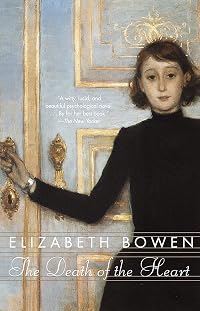
This is the third Elizabeth Bowen novel that I have read so far in 2012, and I think I love her. I loved this show more novel as much as The Death of the Heart – which I adored.
The House in Paris is almost mesmerizingly beautiful, at once haunting and quietly powerful. Elizabeth Bowen’s sentences are works of art, creating a mood and atmosphere that is actually tangible. This is the kind of book that is written to be read slowly and never at a gallop, it is a master class in understatement.
The first and third section of the book takes place over one strange day in Paris, where two children meet in a house in Paris. The house is that belonging to Mme Fisher, where once young ladies from England and America came to be “finished”, and where she now lives alone with her daughter Naomi. The Children are Henrietta and Leopold, Henrietta, travelling to her grandmother is eleven, and must wait out the day between trains at the home of her grandmother’s friend. Leopold a precocious nine year old is at the house to meet his mother, whom he has never met. Henrietta, travelling with her soft toy monkey Charles, is delighted to be in Paris, longs to see the Trocadero, but only gets to view the city from a taxi.
“They crossed the river while Miss Fisher was speaking. In a sort of slow flash, Henrietta had her first open view of Paris –watery sky, wet light, light water, frigid, dark inky buildings, spans of bridges, trees. This open light gash across Paris faded at each end. It was not exactly raining. Then passing long grinding trams, their taxi darted uphill: the boulevard was wide, in summer there would be shade here.”
In the house while Mme Fisher the ageing matriarch is dying upstairs, the children begin to get to know one another, watched over by an anxious Miss Fisher when she isn’t rushing away to her mother. Within the narrative which takes place in the present, not an awful lot happens, but the atmosphere of the house and its inhabitants is built up beautifully, and remains present throughout. Over the course of that one day, much is due to be revealed, the relationships between Henrietta, Leopold, Mme and Miss Fisher, Leopold’s dead father and absent mother are explored and slowly fully revealed through the larger middle section of the book which takes place ten years earlier.
The story of Leopold’s mother, Karen Michaelis a great friend of Naomi Fisher’s is a familiar one in some ways, and yet as told by Elizabeth Bowen it is entirely new. I don’t want to reveal this story here – as there may be people wanting to read it themselves. Leopold’s parents are seen at a distance of ten years, with the image of a waiting child in an unfriendly house always in the back of the readers mind. Some of Bowen’s most beautiful writing is in the story of the lovers and their brief affair, which results in Leopold’s existence.
“At nine they went out and stood on the canal bridge; the band pavilion was empty, the chairs stacked up. Hearing the sea creep on the far beach, they walked that way, along the Ladies’ Walk. Along this tunnel of trees lights hung quenched under arching branches, rain glittering past, no June moths. On a bench back from the walk another couple of lovers blotted out, faceless, sheltered by the unfrequented night. On the embanked sea-front a house with a tower stood up; next door, in the lodging-house, someone played a piano, but then stopped.”
There is timelessness to this desperately touching story that captures perfectly the loneliness of childhood. Leopold and Henrietta yearn to be loved, they are innocent but with a burgeoning awareness of what is happening around them, nothing is yet fully understood. This is a novel that will live on in my mind for a long time, and also one I can imagine re-reading with as much pleasure as I read it this time. show less
This is the third Elizabeth Bowen novel that I have read so far in 2012, and I think I love her. I loved this show more novel as much as The Death of the Heart – which I adored.
The House in Paris is almost mesmerizingly beautiful, at once haunting and quietly powerful. Elizabeth Bowen’s sentences are works of art, creating a mood and atmosphere that is actually tangible. This is the kind of book that is written to be read slowly and never at a gallop, it is a master class in understatement.
The first and third section of the book takes place over one strange day in Paris, where two children meet in a house in Paris. The house is that belonging to Mme Fisher, where once young ladies from England and America came to be “finished”, and where she now lives alone with her daughter Naomi. The Children are Henrietta and Leopold, Henrietta, travelling to her grandmother is eleven, and must wait out the day between trains at the home of her grandmother’s friend. Leopold a precocious nine year old is at the house to meet his mother, whom he has never met. Henrietta, travelling with her soft toy monkey Charles, is delighted to be in Paris, longs to see the Trocadero, but only gets to view the city from a taxi.
“They crossed the river while Miss Fisher was speaking. In a sort of slow flash, Henrietta had her first open view of Paris –watery sky, wet light, light water, frigid, dark inky buildings, spans of bridges, trees. This open light gash across Paris faded at each end. It was not exactly raining. Then passing long grinding trams, their taxi darted uphill: the boulevard was wide, in summer there would be shade here.”
In the house while Mme Fisher the ageing matriarch is dying upstairs, the children begin to get to know one another, watched over by an anxious Miss Fisher when she isn’t rushing away to her mother. Within the narrative which takes place in the present, not an awful lot happens, but the atmosphere of the house and its inhabitants is built up beautifully, and remains present throughout. Over the course of that one day, much is due to be revealed, the relationships between Henrietta, Leopold, Mme and Miss Fisher, Leopold’s dead father and absent mother are explored and slowly fully revealed through the larger middle section of the book which takes place ten years earlier.
The story of Leopold’s mother, Karen Michaelis a great friend of Naomi Fisher’s is a familiar one in some ways, and yet as told by Elizabeth Bowen it is entirely new. I don’t want to reveal this story here – as there may be people wanting to read it themselves. Leopold’s parents are seen at a distance of ten years, with the image of a waiting child in an unfriendly house always in the back of the readers mind. Some of Bowen’s most beautiful writing is in the story of the lovers and their brief affair, which results in Leopold’s existence.
“At nine they went out and stood on the canal bridge; the band pavilion was empty, the chairs stacked up. Hearing the sea creep on the far beach, they walked that way, along the Ladies’ Walk. Along this tunnel of trees lights hung quenched under arching branches, rain glittering past, no June moths. On a bench back from the walk another couple of lovers blotted out, faceless, sheltered by the unfrequented night. On the embanked sea-front a house with a tower stood up; next door, in the lodging-house, someone played a piano, but then stopped.”
There is timelessness to this desperately touching story that captures perfectly the loneliness of childhood. Leopold and Henrietta yearn to be loved, they are innocent but with a burgeoning awareness of what is happening around them, nothing is yet fully understood. This is a novel that will live on in my mind for a long time, and also one I can imagine re-reading with as much pleasure as I read it this time. show less
Members
- Recently Added By
Lists

1001 Books You Must Read Before You Die
1,448 works; 1,134 members

Boarding House and Hotel Fiction
73 works; 25 members

In or About the 1930s
198 works; 27 members

20th Century Literature
1,161 works; 54 members

Best books read in 2011
200 works; 51 members

Novels set over the course of a single day (or less)
72 works; 8 members

A Novel Cure
742 works; 23 members

1930s
262 works; 5 members

Paris, City of Lights
103 works; 17 members

I Could Live There
185 works; 12 members
Author Information

74+ Works 9,059 Members
Elizabeth Bowen, distinguished Anglo-Irish novelist, was born in Dublin in 1899, traveled extensively, lived in London, and inherited the family estate-Bowen's Court, in County Cork. Her account of the house, Bowen's Court (1942), with a detailed fictionalized history of the family in Ireland through three centuries, has charm, warmth, and show more insight. Seven Winters is a fragment of autobiography published in England in 1942. The "Afterthoughts" of the original edition are critical essays in which she discusses and analyzes, among others, such literary figures as Virginia Woolf, E. M. Forster, Katherine Mansfield, Anthony Trollope, and Eudora Welty. Bowen's stories, mostly about people of the British upper middle class, portray relationships that are never simple, except, perhaps, on the surface. Her concern with time and memory is a major theme. Beautifully and delicately written, her stories, with their oblique psychological revelations, are symbolic, subtle, and terrifying. A Time in Rome (1960) is her brilliant evocation of that city and its layered past. In 1948, Bowen was made a Commander of the British Empire. Bowen died in 1973. (Bowker Author Biography) show less
Some Editions
Awards and Honors
Notable Lists
Series
Belongs to Publisher Series
Work Relationships
Is abridged in
Common Knowledge
- Canonical title*
- Talo Pariisissa
- Original title
- The House in Paris
- Original publication date
- 1935
- People/Characters
- Henrietta; Leopold; Naomi Fisher
- Important places
- Paris, France
- First words
- In a taxi skidding away from the Gare du Nord, one dark greasy February morning before the shutters were down, Henrietta sat beside Miss Fisher.
*Some information comes from Common Knowledge in other languages. Click "Edit" for more information.
Classifications
Statistics
- Members
- 995
- Popularity
- 26,304
- Reviews
- 19
- Rating
- (3.74)
- Languages
- 8 — Danish, English, Finnish, French, German, Italian, Portuguese, Spanish
- Media
- Paper, Audiobook, Ebook
- ISBNs
- 19
- ASINs
- 22