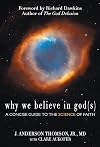
Why We Believe in God(s): A Concise Guide to the Science of Faith
by J. Anderson Thomson
On This Page
Description
In this groundbreaking volume, J. Anderson Thomson, Jr., MD, with Clare Aukofer, offers a succinct yet comprehensive study of how and why the human mind generates religious belief. Dr. Thomson, a highly respected practicing psychiatrist with credentials in forensic psychiatry and evolutionary psychology, methodically investigates the components and causes of religious belief in the same way any scientist would investigate the movement of astronomical bodies or the evolution of life over show more time--that is, as a purely natural phenomenon. Providing compelling evidence from psychology, the cognitive neurosciences, and related fields, he, with Ms. Aukofer, presents an easily accessible and exceptionally convincing case that god(s) were created by man--not vice versa. With this slim volume, Dr. Thomson establishes himself as a must-read thinker and leading voice on the primacy of reason and science over superstition and religion. show lessTags
Recommendations






























Member Reviews
This very concise book provides a great introduction to the evolutionary psychology of why the human brain seems so predisposed to a belief in the supernatural. While I would prefer footnotes to endnotes, that is simply a style preference. The material is well presented, and the endnotes do contain a large number of valuable references, some of which I will be adding to my reading list.
This book is written in an extremely readable, simple manner, which made me feel patronized rather than informed or convinced. The arguments are considerably streamlined, although the author provides some endnotes for those who wish to read further research. Although the effort in producing an approachable, non-inflammatory work is commendable, the brevity (144 pages) hinders rather than recommends this book.
While appearing to argue for a more scientific theory of religion, the author unfortunately makes a habit of waxing philosophical on long tangents based on only a vaguely related piece of empirical evidence. In some cases, the evidence is not even from a scientific study, but is merely a common stereotype. In other words, if you came to this text seeking empirical sources and well supported arguments, you might find a few in the endnotes, but the main text is mostly a long monologue of philosophical opinion, unfortunately not very different from any other religious philosopher.
Ratings
Members
- Recently Added By
Lists

Books Do Furnish a Life
43 works; 1 member
Author Information
2 Works 156 Members
Common Knowledge
- Original publication date
- 2011
Classifications
- Genres
- Nonfiction, Religion & Spirituality, General Nonfiction
- DDC/MDS
- 200.19 — Religion The Bible & Christianity Religion Systems, scientific principles, psychology of religion, philosophy and religion Psychological principles
- LCC
- BL53 .T46 — Philosophy, Psychology and Religion Religions. Mythology. Rationalism Religions. Mythology. Rationalism Philosophy of religion. Psychology of religion. Religion
- BISAC
Statistics
- Members
- 156
- Popularity
- 205,887
- Reviews
- 3
- Rating
- (3.67)
- Languages
- English, German, Polish, Spanish
- Media
- Paper, Ebook
- ISBNs
- 9
- ASINs
- 4