
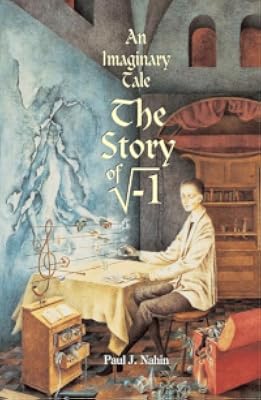
An Imaginary Tale: The Story of √-1
by Paul J. Nahin
On This Page
Description
Today complex numbers have such widespread practical use--from electrical engineering to aeronautics--that few people would expect the story behind their derivation to be filled with adventure and enigma. In An Imaginary Tale, Paul Nahin tells the 2000-year-old history of one of mathematics' most elusive numbers, the square root of minus one, also known as i. He recreates the baffling mathematical problems that conjured it up, and the colorful characters who tried to solve them. In 1878, show more when two brothers stole a mathematical papyrus from the ancient Egyptian burial site in the Valley of Kings, they led scholars to the earliest known occurrence of the square root of a negative number. The papyrus offered a specific numerical example of how to calculate the volume of a truncated square pyramid, which implied the need for i. In the first century, the mathematician-engineer Heron of Alexandria encountered I in a separate project, but fudged the arithmetic; medieval mathematicians stumbled upon the concept while grappling with the meaning of negative numbers, but dismissed their square roots as nonsense. By the time of Descartes, a theoretical use for these elusive square roots--now called "imaginary numbers"--was suspected, but efforts to solve them led to intense, bitter debates. The notorious i finally won acceptance and was put to use in complex analysis and theoretical physics in Napoleonic times. Addressing readers with both a general and scholarly interest in mathematics, Nahin weaves into this narrative entertaining historical facts and mathematical discussions, including the application of complex numbers and functions to important problems, such as Kepler's laws of planetary motion and ac electrical circuits. This book can be read as an engaging history, almost a biography, of one of the most evasive and pervasive "numbers" in all of mathematics. Some images inside the book are unavailable due to digital copyright restrictions. show lessTags
Recommendations






Member Reviews
Very technical for a popular book, though admittedly most of my reference points are pop science rather than pop maths. (It's certainly no [b:The Road to Reality: A Complete Guide to the Laws of the Universe|10638|The Road to Reality A Complete Guide to the Laws of the Universe|Roger Penrose|https://images.gr-assets.com/books/1386924912s/10638.jpg|1077395], but it's far more mathematical than any other pop science book I can think of, and it's much more demanding than, say, Ellenberg's excellent [b:How Not to Be Wrong: The Power of Mathematical Thinking|18693884|How Not to Be Wrong The Power of Mathematical Thinking|Jordan Ellenberg|https://images.gr-assets.com/books/1387726285s/18693884.jpg|26542434], which is the only pop maths book I show more can think of off the top of my head.) In any case, I found it heavy going, and had to accept that a fair portion would go over my head unless I was willing to spend a huge amount of time and effort. So I'm not in a position to judge whether it would be enjoyable for readers with the background & intelligence to follow it closely (though I suspect that it would be).
For me it was worthwhile in parts & frustrating in others. Mostly that's simply the result of my own ignorance/laziness/stupidity, but I did sometimes feel that Nahin wasn't quite sure who he was writing for: he would occasionally pause to explain a very basic concept, then in the next breath launch into a torrent of formal mathematics with little in the way of verbal guidance. (Mostly, though, he was clearly aiming at people with a fairly solid mathematical background.) There were some sections that I could have grasped a lot more quickly & easily with just slightly more hand-holding; sometimes a logical leap that would be obvious to a mathematician took me an embarassingly long time to understand. I assume something similar is true of some of the proofs I gave up on following, though others were genuinely too hard for me, and by the final chapter I was doing a lot of skim-reading.
Anyway, I suspect I might have loved this book had I been a bit smarter or better educated. In reality, it was probably worth reading, but only just. show less
For me it was worthwhile in parts & frustrating in others. Mostly that's simply the result of my own ignorance/laziness/stupidity, but I did sometimes feel that Nahin wasn't quite sure who he was writing for: he would occasionally pause to explain a very basic concept, then in the next breath launch into a torrent of formal mathematics with little in the way of verbal guidance. (Mostly, though, he was clearly aiming at people with a fairly solid mathematical background.) There were some sections that I could have grasped a lot more quickly & easily with just slightly more hand-holding; sometimes a logical leap that would be obvious to a mathematician took me an embarassingly long time to understand. I assume something similar is true of some of the proofs I gave up on following, though others were genuinely too hard for me, and by the final chapter I was doing a lot of skim-reading.
Anyway, I suspect I might have loved this book had I been a bit smarter or better educated. In reality, it was probably worth reading, but only just. show less
I spent years studying university mathematics, but I can't say that I really ever understood imaginary numbers. I was hoping to gain a much better understanding from this book, but I was disappointed. I'm not really sure what its target audience is. You're not going to have any chance of understanding its mathematical formalism unless you've read advanced university mathematics. But on the other hand, if you have done such studies, then this book just puts some formulas into historical perspective. I don't think it really helps you understand complex numbers better than before.
The author goes through a great number of mostly 15th - 19th century mathematical derivations where imaginary numbers played an important role. This is show more interesting and illuminating in the first chapters where he presents authors who were puzzled by complex numbers and tried to come to terms with their meaning. It becomes less interesting when he goes on to present (in meticulous detail) a great number of proofs: "look, this problem, too, can be tackled by assuming a complex function, and it leads us to this amazing formula". This may help readers appreciate the utility of complex numbers, but I don't think it improves their understanding very much.
In the end, this book might be most pleasurable for people who have a very serious interest in the history of mathematics. The author seems to have done his own research in many original sources, and the stories are often far more interesting than the mathematical proofs. Too bad that the book's emphasis is 55% on formalism, 40% on stories and only 5% on explaining what complex numbers really mean in practice. show less
The author goes through a great number of mostly 15th - 19th century mathematical derivations where imaginary numbers played an important role. This is show more interesting and illuminating in the first chapters where he presents authors who were puzzled by complex numbers and tried to come to terms with their meaning. It becomes less interesting when he goes on to present (in meticulous detail) a great number of proofs: "look, this problem, too, can be tackled by assuming a complex function, and it leads us to this amazing formula". This may help readers appreciate the utility of complex numbers, but I don't think it improves their understanding very much.
In the end, this book might be most pleasurable for people who have a very serious interest in the history of mathematics. The author seems to have done his own research in many original sources, and the stories are often far more interesting than the mathematical proofs. Too bad that the book's emphasis is 55% on formalism, 40% on stories and only 5% on explaining what complex numbers really mean in practice. show less
This was not an easy book to read. But, as maths books go, It was certainly not the most difficult that I’ve attempted. And I did learn, along the way, a lot about how mathematicians approach maths problems.
It is basically a history of the developments in understanding and interpreting the square root of minus one. And, in this respect, I think Nahin does a pretty good job. But I’ve been back over the basic story a number of times and realise that I’m still struggling with the basic ideas behind it. I get it that when you multiply by √-1 then you basically rotate the point in space, counter-clockwise, by 90 degrees. But that is about the limit of my understanding.
Nahin, clearly delights in the ability of complex numbers to deal show more with complex mathematical problems and a large section of the book is devoted to real world problems. I kind of followed the logic but when it comes to some complex equation or a lot of messy numbers, I just take it on faith that Nahin is right when he says stuff like “ And this reduces quite simply, with a bit of algebraic manipulation, to x”. I just don't have the time or patience to work through it.
At one point he employs an equation and justifies it on the grounds that he knows it actually works, rather than deriving the solution from first principles. An, I found it interesting that he says this is a common procedure among mathematicians. Somewhere I’ve read an explanation of the complex plane that involves a Riemann sphere and I think that explains things a bit better than Nahin manages to do. (I don’t think he mentions this at all).
I was also fascinated to read that the problem of √-1 was solved by Caspar Wessel, a surveyor in 1797 though his paper in Danish was overlooked by the mainstream mathematicians. And, I’ve wondered whether he developed his ideas based around the fact that , with a dumpy level, used in surveying that you are constantly looking a numbers above and below a standard level....so constantly dealing with negative numbers in your charts and having to do trigonometry with them.
Anyway, t he following are a few extracts that I’ve taken from the book, that I though would be helpful to me in any future revision of the book or it’s observations. I’ve tried to use Cambria Math as the font and I’m hopeful that I can actually publish it with the fonts intact because it’s rather difficult without access to math symbols.
"We find the square root of a negative quantity appearing for the first time in the Stereometria of Heron of Alexandria... After having given a correct formula for the determination of the volume of a frustum of a pyramid with square base and applied it successfully to the case where the side of the lower base is 10, of the upper 2, and the edge 9, the author endeavours to solve the problem where the side of the lower base is 28, of the upper 4, and the edge 15. Instead of the square root of 81 - 144 required by the formula, he takes the square root of 144 - 81..., i.e., he replaces √-1 by 1, and fails to observe that the problem as stated is impossible. Whether this mistake was due to Heron or to the ignorance of some copyist cannot be determined.
While Heron almost surely had to be aware of the appearance of the square root of a negative number in the frustum problem, his fellow Alexandrian two centuries later, Diophantus, seems to have completely missed a similar event when he chanced upon it. Diophantus is honoured today as having played the same role in algebra that Euclid did in geometry. Euclid gave us his Elements, and Diophantus presented posterity with the Arithmetica. In both of these cases, the information contained was almost certainly the results of many previous, anonymous mathematicians whose identities are now lost forever to history. It was Euclid and Diophantus, however, who collected and organized this mathematical heritage in coherent form in their great works.
In my opinion, Euclid did the better job because Elements is a logical theory of plane geometry. Arithmetica, or at least the several chapters or books that have survived of the original thirteen, is, on the other hand, a collection of specific numerical solutions to certain problems, with no generalized, theoretical development of methods.
Six hundred years later (circa 850 A.) the Hindu mathematician Mahaviacarya wrote on this issue, but then only to declare what Heron and Diophantus had practiced so long before: "The square of a positive as well as a negative (quantity) is positive; and the square roots of those (square quantities) are positive and negative in order. As in the nature of things a negative (quantity) is not a square (quantity), it has therefore no square root. More centuries would pass before opinion would change.
Bombelli's insight into the nature of the Cardan formula in the irreducible case broke the mental logjam concerning √-1. With his work, it became clear that manipulating √-1 using the ordinary rules of arithmetic leads to perfectly correct results. Much of the mystery, the near-mystical aura, of √-1 was cleared away with Bombelli's analyses. There did remain one last intellectual hurdle to leap, however, that of determining the physical meaning of √-1 (and that will be the topic of the next two chapters), but Bombell's work had unlocked what had seemed to be an unpassable barrier.
When the early mathematicians ran into x2+ 1 = 0 and other such quadratics they simply shut their eyes and called them "impossible." They certainly did not invent a solution for them. The breakthrough for √ -1 came not from quadratic equations, but rather from cubics which clearly had real solutions but for which the Cardan formula produced formal answers with imaginary components. The basis for the breakthrough was in a clearer-than-before understanding of the idea of the conjugate of a complex number.
The big difference now is that the points B and B' do not lie on the base AD, but rather above it. Wallis had stumbled on the idea that, in some sense, the geometrical manifestation of imaginary numbers is vertical movement in the plane. Wallis himself made no such statement, however, and this is really a retrospective comment made with the benefit of three centuries of hindsight.
It would be another century before the now "obvious" representation of complex numbers as points in the plane, with the horizontal and vertical directions being the real and imaginary directions, respectively, would be put forth, but Wallis came very close.
There is, however, one caveat concerning the polar form of representing complex numbers that is most important to keep in mind. A common error made by students who are first learning about the polar form is a failure to appreciate that the tangent function is periodic with period 180°, not 360°. That is, the tangent function goes through its complete interval of values (-∞ to ∞) as the polar angle 0 varies from - 90° to 90°. Or, if we express angles in units of radians (one radian = 180°/ π = 57.296o), then the tangent function goes through its complete interval of values as the polar angle varies from -π/2 to π/2 radians. This means that blindly plugging values of a and b into 0 = tan- (b/a) may lead to mistakes.
Wessel began his paper by describing what today is called vector addition. That is, if we have two directed line segments both lying along the X-axis (but perhaps in opposite directions), then we add them by positioning the starting point of one at the terminal point of the other, and the sum is the net resulting directed line segment extending from the initial point of the first segment to the terminal point of the second. Wessel said the sum of two nonparallel segments should obey the same rule..... So far there is nothing new here, as Wallis had expressed quite similar ideas on how to add directed line segments. Wessel's original contribution was to see how to multiply such segments.
Wessel discovered how to multiply line segments by making a clever generalization from the behavior of real numbers. He observed that the product of two numbers (say, 3 and -2, with a product of - 6) has the same ratio to each
factor as the other factor has to 1. That is, - 6/3 = -2 = - 2/1, and -6/-2 =3 = 3/1. So, assuming there exists a unit directed line segment, Wessel argued that the product of two directed line segments should have two properties.
First, and immediately analogous to real numbers, the length of the product should be the product of the lengths of the individual line segments.
But what of the direction of the product? This second property is Wessel's seminal contribution: by analogy with all that has gone before, he said the line segment product should differ in direction from each line segment factor by the same angular amount as the other line segment factor differs in direction When compared to the unit directed line segment.
Ever since Wessel, then, multiplying two directed line segments together has meant the two-step operation of multiplying the two lengths, with length always taken to be a positive value, and adding the two direction angles....These two operations determine the length and direction angle of the product, and it is this definition of a product that gives us the explanation for what √-1 means geometrically. That is, suppose that there is a directed line segment that represents √-1, and that its length is l and its direction angle θ.
Mathematically, then, we have √-1 = l ∠θ. Multiplying this statement by itself, i.e., squaring both sides, we have -1 = l ∠2 θ or, as -1 = 1 ∠180°, then l2 ∠2θ = 1 ∠180°. Thus, l2 = 1 and 2 θ = 180°, and so l = 1 and θ = 90°. This says √-1 is the directed line segment of length one pointing straight up along the vertical axis or, at long last,.......i = √-1 = 1 ∠90°
This is so important a statement that it is the only mathematical expression in the entire book that I have enclosed.
An imaginary number to an imaginary power can be real! Who could even have made up such an astonishing conclusion? As you will see in chapter 6 this isn't the end of the story, either — in fact, ii has infinitely many real values, of which e^-π/2- is only one.
If, Kasner wrote, one allows y(x) to be a complex-valued function then the limit of arc length to chord length can be less than one! The old adage that "a straight line is the shortest path between two points" is not necessarily true for complex-valued curves. I can't draw a complex-valued curve for you on a piece of paper, of course-how would you draw y(x) = x2 + ix, for example? —but we can still do the formal calculations.
There are, of course, more than just two distinct masses in the universe. The problem of calculating the motion of N gravitationally interacting masses became known as the N-body problem of celestial mechanics, and the myth has spread among most physicists that it remains unsolved for N ≥ 3. This is true only if one demands closed-form, exact equations. In fact, the Finnish mathematical astronomer Karl F. Sundman (1873-1949) solved the three-body problem during the period 1907-19, and in 1991 a Chinese student, Quidong Wang, solved the N-body problem for any N. These solutions are in the form of infinite convergent series, however, which unfortunately converge far too Slowly to be of any practical use. use. Of course, with the development of super-computers, physicists can now directly calculate the future motions of hundreds, even thousands, of interacting masses, as far into the future as one would like, using Newton's equations of motion and gravity. Solving the N-body problem analytically is no longer of any practical importance.
The ancient astronomers could "explain" these mysterious retrograde motions with Ptolemy's crystal spheres, but in fact these motions are simply illusions caused by watching one moving thing (a planet) from another moving thing (the Earth). Kepler knew this, and was the first to explain the illusion using diagrams to illustrate his qualitative reasoning. Complex exponentials, however, make the mathematics of what is happening easy to understand as well.
Amazingly, the quite formal and "mysterious formula" of π = (2/i) In(i), as
Benjamin Peirce called it, can be used to calculate the numerical value of π (pi).
That might seem like getting something out of thin air, but this astonishing fact was pointed out long ago by the German mathematician and educator Karl Heinrich Schellbach (1809-90) in 1832...... The Leibniz-Gregory series is, while beautifully elegant in appearance, utterly worthless for numerical calculations since it converges very slowly. Using the first fifty-three terms, for example, is not sufficient to give even just two correct, stable decimal digits....... Now, what Schellbach went on to show was how his method gives other series for π that converge much faster than does the Leibniz-Gregory series.
So what’s my overall take on the book? Actually, it’s quite fascinating. Rather difficult for a non mathematician but there is enough there that a non-mathematician (such as myself) can find it interesting and learn from it. Four stars from me. show less
It is basically a history of the developments in understanding and interpreting the square root of minus one. And, in this respect, I think Nahin does a pretty good job. But I’ve been back over the basic story a number of times and realise that I’m still struggling with the basic ideas behind it. I get it that when you multiply by √-1 then you basically rotate the point in space, counter-clockwise, by 90 degrees. But that is about the limit of my understanding.
Nahin, clearly delights in the ability of complex numbers to deal show more with complex mathematical problems and a large section of the book is devoted to real world problems. I kind of followed the logic but when it comes to some complex equation or a lot of messy numbers, I just take it on faith that Nahin is right when he says stuff like “ And this reduces quite simply, with a bit of algebraic manipulation, to x”. I just don't have the time or patience to work through it.
At one point he employs an equation and justifies it on the grounds that he knows it actually works, rather than deriving the solution from first principles. An, I found it interesting that he says this is a common procedure among mathematicians. Somewhere I’ve read an explanation of the complex plane that involves a Riemann sphere and I think that explains things a bit better than Nahin manages to do. (I don’t think he mentions this at all).
I was also fascinated to read that the problem of √-1 was solved by Caspar Wessel, a surveyor in 1797 though his paper in Danish was overlooked by the mainstream mathematicians. And, I’ve wondered whether he developed his ideas based around the fact that , with a dumpy level, used in surveying that you are constantly looking a numbers above and below a standard level....so constantly dealing with negative numbers in your charts and having to do trigonometry with them.
Anyway, t he following are a few extracts that I’ve taken from the book, that I though would be helpful to me in any future revision of the book or it’s observations. I’ve tried to use Cambria Math as the font and I’m hopeful that I can actually publish it with the fonts intact because it’s rather difficult without access to math symbols.
"We find the square root of a negative quantity appearing for the first time in the Stereometria of Heron of Alexandria... After having given a correct formula for the determination of the volume of a frustum of a pyramid with square base and applied it successfully to the case where the side of the lower base is 10, of the upper 2, and the edge 9, the author endeavours to solve the problem where the side of the lower base is 28, of the upper 4, and the edge 15. Instead of the square root of 81 - 144 required by the formula, he takes the square root of 144 - 81..., i.e., he replaces √-1 by 1, and fails to observe that the problem as stated is impossible. Whether this mistake was due to Heron or to the ignorance of some copyist cannot be determined.
While Heron almost surely had to be aware of the appearance of the square root of a negative number in the frustum problem, his fellow Alexandrian two centuries later, Diophantus, seems to have completely missed a similar event when he chanced upon it. Diophantus is honoured today as having played the same role in algebra that Euclid did in geometry. Euclid gave us his Elements, and Diophantus presented posterity with the Arithmetica. In both of these cases, the information contained was almost certainly the results of many previous, anonymous mathematicians whose identities are now lost forever to history. It was Euclid and Diophantus, however, who collected and organized this mathematical heritage in coherent form in their great works.
In my opinion, Euclid did the better job because Elements is a logical theory of plane geometry. Arithmetica, or at least the several chapters or books that have survived of the original thirteen, is, on the other hand, a collection of specific numerical solutions to certain problems, with no generalized, theoretical development of methods.
Six hundred years later (circa 850 A.) the Hindu mathematician Mahaviacarya wrote on this issue, but then only to declare what Heron and Diophantus had practiced so long before: "The square of a positive as well as a negative (quantity) is positive; and the square roots of those (square quantities) are positive and negative in order. As in the nature of things a negative (quantity) is not a square (quantity), it has therefore no square root. More centuries would pass before opinion would change.
Bombelli's insight into the nature of the Cardan formula in the irreducible case broke the mental logjam concerning √-1. With his work, it became clear that manipulating √-1 using the ordinary rules of arithmetic leads to perfectly correct results. Much of the mystery, the near-mystical aura, of √-1 was cleared away with Bombelli's analyses. There did remain one last intellectual hurdle to leap, however, that of determining the physical meaning of √-1 (and that will be the topic of the next two chapters), but Bombell's work had unlocked what had seemed to be an unpassable barrier.
When the early mathematicians ran into x2+ 1 = 0 and other such quadratics they simply shut their eyes and called them "impossible." They certainly did not invent a solution for them. The breakthrough for √ -1 came not from quadratic equations, but rather from cubics which clearly had real solutions but for which the Cardan formula produced formal answers with imaginary components. The basis for the breakthrough was in a clearer-than-before understanding of the idea of the conjugate of a complex number.
The big difference now is that the points B and B' do not lie on the base AD, but rather above it. Wallis had stumbled on the idea that, in some sense, the geometrical manifestation of imaginary numbers is vertical movement in the plane. Wallis himself made no such statement, however, and this is really a retrospective comment made with the benefit of three centuries of hindsight.
It would be another century before the now "obvious" representation of complex numbers as points in the plane, with the horizontal and vertical directions being the real and imaginary directions, respectively, would be put forth, but Wallis came very close.
There is, however, one caveat concerning the polar form of representing complex numbers that is most important to keep in mind. A common error made by students who are first learning about the polar form is a failure to appreciate that the tangent function is periodic with period 180°, not 360°. That is, the tangent function goes through its complete interval of values (-∞ to ∞) as the polar angle 0 varies from - 90° to 90°. Or, if we express angles in units of radians (one radian = 180°/ π = 57.296o), then the tangent function goes through its complete interval of values as the polar angle varies from -π/2 to π/2 radians. This means that blindly plugging values of a and b into 0 = tan- (b/a) may lead to mistakes.
Wessel began his paper by describing what today is called vector addition. That is, if we have two directed line segments both lying along the X-axis (but perhaps in opposite directions), then we add them by positioning the starting point of one at the terminal point of the other, and the sum is the net resulting directed line segment extending from the initial point of the first segment to the terminal point of the second. Wessel said the sum of two nonparallel segments should obey the same rule..... So far there is nothing new here, as Wallis had expressed quite similar ideas on how to add directed line segments. Wessel's original contribution was to see how to multiply such segments.
Wessel discovered how to multiply line segments by making a clever generalization from the behavior of real numbers. He observed that the product of two numbers (say, 3 and -2, with a product of - 6) has the same ratio to each
factor as the other factor has to 1. That is, - 6/3 = -2 = - 2/1, and -6/-2 =3 = 3/1. So, assuming there exists a unit directed line segment, Wessel argued that the product of two directed line segments should have two properties.
First, and immediately analogous to real numbers, the length of the product should be the product of the lengths of the individual line segments.
But what of the direction of the product? This second property is Wessel's seminal contribution: by analogy with all that has gone before, he said the line segment product should differ in direction from each line segment factor by the same angular amount as the other line segment factor differs in direction When compared to the unit directed line segment.
Ever since Wessel, then, multiplying two directed line segments together has meant the two-step operation of multiplying the two lengths, with length always taken to be a positive value, and adding the two direction angles....These two operations determine the length and direction angle of the product, and it is this definition of a product that gives us the explanation for what √-1 means geometrically. That is, suppose that there is a directed line segment that represents √-1, and that its length is l and its direction angle θ.
Mathematically, then, we have √-1 = l ∠θ. Multiplying this statement by itself, i.e., squaring both sides, we have -1 = l ∠2 θ or, as -1 = 1 ∠180°, then l2 ∠2θ = 1 ∠180°. Thus, l2 = 1 and 2 θ = 180°, and so l = 1 and θ = 90°. This says √-1 is the directed line segment of length one pointing straight up along the vertical axis or, at long last,.......i = √-1 = 1 ∠90°
This is so important a statement that it is the only mathematical expression in the entire book that I have enclosed.
An imaginary number to an imaginary power can be real! Who could even have made up such an astonishing conclusion? As you will see in chapter 6 this isn't the end of the story, either — in fact, ii has infinitely many real values, of which e^-π/2- is only one.
If, Kasner wrote, one allows y(x) to be a complex-valued function then the limit of arc length to chord length can be less than one! The old adage that "a straight line is the shortest path between two points" is not necessarily true for complex-valued curves. I can't draw a complex-valued curve for you on a piece of paper, of course-how would you draw y(x) = x2 + ix, for example? —but we can still do the formal calculations.
There are, of course, more than just two distinct masses in the universe. The problem of calculating the motion of N gravitationally interacting masses became known as the N-body problem of celestial mechanics, and the myth has spread among most physicists that it remains unsolved for N ≥ 3. This is true only if one demands closed-form, exact equations. In fact, the Finnish mathematical astronomer Karl F. Sundman (1873-1949) solved the three-body problem during the period 1907-19, and in 1991 a Chinese student, Quidong Wang, solved the N-body problem for any N. These solutions are in the form of infinite convergent series, however, which unfortunately converge far too Slowly to be of any practical use. use. Of course, with the development of super-computers, physicists can now directly calculate the future motions of hundreds, even thousands, of interacting masses, as far into the future as one would like, using Newton's equations of motion and gravity. Solving the N-body problem analytically is no longer of any practical importance.
The ancient astronomers could "explain" these mysterious retrograde motions with Ptolemy's crystal spheres, but in fact these motions are simply illusions caused by watching one moving thing (a planet) from another moving thing (the Earth). Kepler knew this, and was the first to explain the illusion using diagrams to illustrate his qualitative reasoning. Complex exponentials, however, make the mathematics of what is happening easy to understand as well.
Amazingly, the quite formal and "mysterious formula" of π = (2/i) In(i), as
Benjamin Peirce called it, can be used to calculate the numerical value of π (pi).
That might seem like getting something out of thin air, but this astonishing fact was pointed out long ago by the German mathematician and educator Karl Heinrich Schellbach (1809-90) in 1832...... The Leibniz-Gregory series is, while beautifully elegant in appearance, utterly worthless for numerical calculations since it converges very slowly. Using the first fifty-three terms, for example, is not sufficient to give even just two correct, stable decimal digits....... Now, what Schellbach went on to show was how his method gives other series for π that converge much faster than does the Leibniz-Gregory series.
So what’s my overall take on the book? Actually, it’s quite fascinating. Rather difficult for a non mathematician but there is enough there that a non-mathematician (such as myself) can find it interesting and learn from it. Four stars from me. show less
On occasion, I find myself in the math/science section of the bookstore. Having a very thorough background in mathematics, I find it interesting to read books written by notable professionals in their fields on certain subjects. This one caught my eye (pun unintended), and I just had to get it!
The book chronicles the history and usage of the imaginary number, i (or j, if you're an electrical engineer), or √-1.
For those of you who have taken a few math classes, you'll realize that i cannot possibly exist in the realm of Real numbers, as with respect to that set of numbers, it simply does not make any sense! Thus, Numbers are broken down into two sets: Real and Imaginary. And when a number contains both of these values, it is considered show more Complex, or a+bi. Complex numbers work very well as Cartesian coordinates.
But enough about math! Let's discuss Nahin's book. While not having the target audience of The Da Vinci Code in mind, Nahin paints a picture of a 2,000 year old known history of complex numbers, complete with the masterminds who tried to solve problems involving it.
So, if you've ever wondered why we make such a big deal about imaginary number, or how they came to be used in all the different technologies in which they're used, you might find this book interesting. If you think math is boring, but you have an acute case of insomnia, you may also enjoy this book, but for different reasons. The only instance in which I would recommend you avoid this book is if you hate mat and have no intentions of improving your intellect or knowledge of mathematical subjects. show less
The book chronicles the history and usage of the imaginary number, i (or j, if you're an electrical engineer), or √-1.
For those of you who have taken a few math classes, you'll realize that i cannot possibly exist in the realm of Real numbers, as with respect to that set of numbers, it simply does not make any sense! Thus, Numbers are broken down into two sets: Real and Imaginary. And when a number contains both of these values, it is considered show more Complex, or a+bi. Complex numbers work very well as Cartesian coordinates.
But enough about math! Let's discuss Nahin's book. While not having the target audience of The Da Vinci Code in mind, Nahin paints a picture of a 2,000 year old known history of complex numbers, complete with the masterminds who tried to solve problems involving it.
So, if you've ever wondered why we make such a big deal about imaginary number, or how they came to be used in all the different technologies in which they're used, you might find this book interesting. If you think math is boring, but you have an acute case of insomnia, you may also enjoy this book, but for different reasons. The only instance in which I would recommend you avoid this book is if you hate mat and have no intentions of improving your intellect or knowledge of mathematical subjects. show less
great historical perspective on i.
Yeah, this one was beyond me.
Members
- Recently Added By
Lists

HS Mathematics class library
79 works; 6 members
Author Information

31+ Works 3,014 Members
Paul J. Nahin is the author of many popular math books, including How to Fall Slower Than Gravity and An Imaginary Tale (both Princeton). He is professor emeritus of electrical engineering at the University of New Hampshire.
Some Editions
Series
Belongs to Publisher Series
Common Knowledge
- Canonical title
- An Imaginary Tale: The Story of √-1
- Original title
- An Imaginary Tale: The Story of √-1
- Original publication date
- 1998
- Dedication
- Dedicated to my mother
Katherine Dorothy Markfelder
And to the memory of my father
Paul Gilbert Nahin (1916 - 1990) - First words
- Long ago, in a year so far in the past (1954) that my life then as a high school freshman now seems like a dream, my father gave me the gift of a subscription to a new magazine called Popular Electronics. • • P... (show all)reface
In 1878 Pair of brothers, the soon-to-become-infamous thieves Ahmed and Mohammed Abd er-Rassul, stumbled upon the ancient Egyptian burial site in the Valley of Kings, at Deir el-Bahri. • • Introduction - Last words
- (Click to show. Warning: May contain spoilers.)But now, as you close this book, you can appreciate the ironic truth in the fact that there is nothing at all imaginary about √-1.
- Blurbers
- Maor, Eli; Pickover, Clifford; Lines, Malcolm E.; Sangalli, Arturo
- Original language
- English
Classifications
Statistics
- Members
- 1,003
- Popularity
- 25,967
- Reviews
- 6
- Rating
- (3.73)
- Languages
- English, Spanish
- Media
- Paper, Ebook
- ISBNs
- 10
- ASINs
- 8