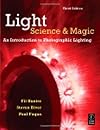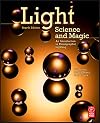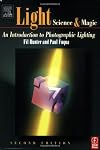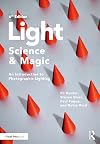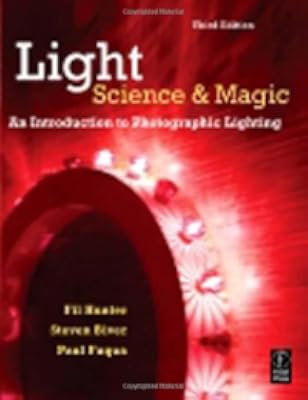
Light: Science and Magic
by Fil Hunter
On This Page
Description
Photographic lighting is a topic that will never go out of style, no matter how sophisticated cameras and other technology get. Even with the most high-tech gear, photographers still need to put a lot of thought and vision into lighting their photographs in order to get great results. Mastering this key skill has the power to dramatically and quickly improve your photographs as well as your efficiency. Light, Science & Magic provides you with a comprehensive theory of the nature and show more principles of light, with examples and instructions for practical application. Featuring photographs, diagrams, and step-by-step instructions, this book speaks to photographers of varying levels. It provides invaluable information on how to light the most difficult subjects, such as surfaces, metal, glass, liquids, extremes (black-on-black and white-on-white), and portraits. This new edition includes: Expanded chapters on portraiture and lighting equipment; Chapters on necessary equipment when working on location versus in the studio; An updated appendix of reliable photo gear sources; Over 100 new photographs and informational sidebars; Updated information about advances in flash equipment, LED panels, and fluorescent lights. Lighting styles will evolve, but the science of light will always remain the same. Once photographers understand the basic physics of lighting (without having to become physicists), they can apply that knowledge to a broad range of photographic styles. show lessTags
Recommendations





Member Reviews
One of the best photography books I've read. It's helped me understand the *science* behind photography, instead of just the art, and it's literally altered the way I see the world. (I now walk around and think, "Look! There's a direct reflection off my boot. To photograph that well, I need to move the light over there, or get a light large enough to completely fill the family of angles...")
The drawback for me right now is I don't do studio photography, nor with a 20-month-old will I be able to do studio photography any time soon. So it's a bit overkill for the photos I take everyday.
The drawback for me right now is I don't do studio photography, nor with a 20-month-old will I be able to do studio photography any time soon. So it's a bit overkill for the photos I take everyday.
Very useful introduction to the properties of light, reflection and photographic lighting
Best reading about lighting..and eye opener
The 2nd edition was great. I expect this to be just as good.
Indeholder "Dedications", "Introduction", "Chapter 1. How to learn lighting", " What are 'The Principles'?", " Why are the Principles Important?", " How were the Example Subjects Chosen for This Book?", " Do I Need to Do These Exercises?", " What Kind of Camera Do I Need?", " Should I Shoot Film or Digital?", " What Lighting Equipment Do I Need?", " What Else Do I Need to Know to Use This Book?", "Chapter 2. Light: The Raw Material of Photography", " What Is Light?", " How Photographers Describe Light", " Brightness", " Color", " Contrast", " How the Subject Affects the Lighting", " Transmission", " Direct and Diffuse Transmission", " Absorption", " Reflection", "Chapter 3. The Management of Reflection and the Family of Angles", " Types show more of Reflection", " Diffuse Reflection", " The Inverse Square Law", " Direct Reflection", " Breaking the Inverse Square Law", " The Family of Angles", " Polarized Direct Reflection", " Is It Polarized Reflection or Ordinary Direct Reflection?", " Turning Ordinary Direct Reflection into Polarized Reflection", " Applying the Theory", "Chapter 4. Surface Appearances", " The Photographer as Editor", " Capitalizing on Diffuse Reflection", " The Angle of Light", " The Success and Failure of the General Rule", " The Distance of Light", " Doing the Impossible", " Using Diffuse Reflection and Shadow to Reveal Texture", " Capitalizing on Direct Reflection", " Competing Surfaces", " Try a Lens Polarizing Filter", " Use a Still Larger Light", " Use More Than One Light", " Use a Gobo", " Complex Surfaces", "Chapter 5. Revealing Shape and Contour", " Depth Clues", " Perspective Distortion", " Distortion as a Clue to Depth", " Manipulating Distortion", " Tonal Variation", " The Size of the Light", " Large Lights versus Small Lights", " Distance from the Subject", " The Direction of the Light", " Light on Side", " Light above the Subject", " Fill Light", " Adding Depth to the Background", " How Much Tonal Variation Is Ideal?", " Photographing Buildings: Decreasing Tonal Variation", " Photographing Cylinders: Increasing Tonal Variation", " Remember Surface Detail", " The Glossy Box", " Use a Dark Background", " Eliminate Direct Reflection from the Box Top", " Eliminate Direct Reflection from the Box Sides", " Finish with Other Resources", " Use Direct Reflection?", "Chapter 6. Metal", " Flat Metal", " Bright or Dark?", " Finding the Family of Angles", " Lighting the Metal", " Keeping the Metal Bright", " What Is a 'Normal' Exposure for Metal?", " Keeping the Metal Dark", " The Elegant Compromise", " Controlling the Effective Size of the Light", " Keeping the Metal Square", " Metal Boxes", " A Light Background", " A Transparent Background", " A Glossy Background", " Round Metal", " Camouflage", " Keeping the Light off the Camera", " Using a Tent", " Other Resources", " Polarizing Filters", " Black Magic", " Dulling Spray", " Where Else Do These Techniques Apply?", "Chapter 7. The Case of the Disappearing Glass", " The Principles", " The Problems", " The Solutions", " Two Attractive Opposites", " Bright-Field Lighting", " Dark-Field Lighting", " The Best of Both Worlds", " Some Finishing Toucheds", " Defining the Surface of Glassware", " Illuminating the Background", " Minimizing the Horizon", " Stopping Flare", " Eliminating Extraneous Reflections", " Complications from Nonglass Subjects", " Liquids in Glass", " Secondary Opaque Subjects", " Recognizing the Principal Subject", "Chapter 8. An Arsenal of Lights", " The Single-Light Setup", " The Basic Setup", " Light Size", " Skin Texture", " Where to Put the Main Light", " Left Side? Right Side?", " Broad Lighting or Short Lighting", " Eyeglasses", " Additional Lights", " Fill Lights", " Background Lights", " Hair Lights", " Kickers", " Rim Lights", " Mood and Key", " Low-Key Lighting", " High-Key Lighting", " Staying in Key", " Dark Skin", " Available-Light Portraiture", " A Window as a Main Light", " The Sun as a Hair Light", " Combining Studio and Environmental Light", " Keeping the Light Appropriate", " Setting Rules?", "Chapter 9. The Extremes", " The Characteristic Curve", " The Perfect 'Curve'", " A Bad Camera", " Overexposure", " Underexposure", " A Real CCD", " Using Every Resource", " White-on-White", " Exposing White-on-White Scenes", " Lighting White-on-White Scenes", " Subject and Background", " Using an Opaque White Background", " Using a Translucent White Background", " Using a Mirror Background", " In Any Case, Keep the Background Small", " Black-on-Black", " Exposing Black-on-Black Scenes", " Lighting Black-on-Black Scenes", " Subject and Background", " Using an Opaque Black Background", " Using a Glossy Black Surface", " Keep the Subject away from the Background", " The Histogram", " Preventing Problems", " Overmanipulation", " Curves", " New Principles?", "Chapter 10. Traveling Light", " Choosing the Right Strobe", " Getting the Exposure Right", " Letting the Strobe Determine the Exposure", " Using a Flash Meter", " Calculating the Exposure", " Calculating the Guide Number", " Using the Guide Number", " Getting More Light", " Focused Flash", " Multiple Strobes", " Multiple Flash", " Improving the Quality of Light", " Bounce Flash", " Feathering the Light", " Lights of Different Colors", " Why Is the Color of the Light Important?", " Nonstandard Light Sources", " Do the Colors Mix?", " The Remedies", " Lights of Different Duration", " Is Studio Lighting Possible on Location?", "Index".
En hel stor bog alene om lyssætning! Super! show less
En hel stor bog alene om lyssætning! Super! show less
Jan 6, 2014 (Edited)Danish
Ratings
Members
- Recently Added By
Published Reviews
"There are numerous photography books available and often it is difficult to make the right choice. 'Light Science and Magic' definitely stands out from the bunch.. This book can get very technical covering scientific end of how light works in all sorts of situations. Do not expect to read this resource like a novel, unless you are like me and thrive on technical end of photography. However show more the book is not created for photography rocket scientists only. It's designed the way that even complex concepts are illustrated in diagrams that any visual folks can understand easily. 'Light Science and Magic' fourth edition was just released at the end of 2011. All the info is up to date!" show less
added by thebookpile
"I have used the 3rd edition of this book when I teach. The 4th Edition improves on the earlier version and brings one "up-to-date." This is a text I'll continue to recommend. This is a book that all photographers should have in their library."
added by thebookpile
"This new edition of the book is based on the behavior of light, and its principles that will not change because the fundamental physics does not. Light: Science & Magic is a book to deal adequately with how light behaves when it reflects from a surface and how the material making the subject determines the appearance of this reflection. This important understanding is not intended to enable show more photographer to shoot good pictures like those in this book but rather to transfer those images to any subject matter, using any equipment." show less
added by thebookpile
Author Information
13+ Works 570 Members
Fil Hunter, has worked for such clients as US News & World Report, Time Life Books, and National Geographic
Some Editions
Common Knowledge
- Canonical title
- Light: Science and Magic
- Original publication date
- 2011-09-08 (4th Edition) (4th Edition)
Classifications
Statistics
- Members
- 487
- Popularity
- 62,520
- Reviews
- 5
- Rating
- (4.17)
- Languages
- English, German, Spanish
- Media
- Paper, Ebook
- ISBNs
- 22