
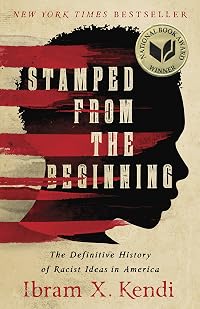
Stamped from the Beginning: The Definitive History of Racist Ideas in America
by Ibram X. Kendi
On This Page
Description
Americans like to insist that we are living in a postracial, color-blind society. In fact, racist thought is alive and well; it has simply become more sophisticated and more insidious. And as historian Ibram X. Kendi argues, racist ideas in this country have a long and lingering history, one in which nearly every great American thinker is complicit. Kendi chronicles the entire story of anti-Black racist ideas and their staggering power over the course of American history. Stamped from the show more Beginning uses the lives of five major American intellectuals to offer a window into the contentious debates between assimilationists and segregationists and between racists and antiracists. From Puritan minister Cotton Mather to Thomas Jefferson, from fiery abolitionist William Lloyd Garrison to brilliant scholar W.E.B. Du Bois to legendary anti-prison activist Angela Davis, Kendi shows how and why some of our leading proslavery and pro-civil rights thinkers have challenged or helped cement racist ideas in America. As Kendi provocatively illustrates, racist thinking did not arise from ignorance or hatred. Racist ideas were created and popularized in an effort to defend deeply entrenched discriminatory policies and to rationalize the nation's racial inequities in everything from wealth to health. While racist ideas are easily produced and easily consumed, they can also be discredited--From publisher's website. show lessTags
Recommendations































Member Reviews
An accomplished history of racist thought and practice in the United States from the Puritans to the present.
Anyone who thought that the 2008 election of President Barack Obama marked the emergence of post-racial America has been sorely disillusioned in the subsequent years with seemingly daily reminders of the schism wrought by racism and white supremacy. And yet anyone with even a cursory understanding of this country’s tortured history with race should have known better. In this tour de force, Kendi (African-American History/Univ. of Florida; The Black Campus Movement: Black Students and the Racial Reconstitution of Higher Education, 1965-1972, 2012) explores the history of racist ideas—and their connection with racist show more practices—across American history. The author uses five main individuals as “tour guides” to investigate the development of racist ideas throughout the history of the U.S.: the preacher and intellectual Cotton Mather, Founding Father Thomas Jefferson, ardent abolitionist William Lloyd Garrison, scholar W.E.B. Du Bois, and activist Angela Davis. Kendi also poses three broad schools of thought regarding racial matters throughout American history: segregationist, assimilationist, and anti-racist. Although this trio can be reductionist, it provides a solid framework for understanding the interplay between racist ideas, anti-racism, and the attempts to synthesize them—“assimilationism,” which the author ultimately identifies as simply another form of racism, even when advocated by African-Americans. The subtitle of the book promises a “definitive history,” but despite the book’s more than 500 pages of text, its structure and its viewing of racial ideas through the lens of five individuals means that it is almost necessarily episodic. Although it is a fine history, the narrative may best be read as an extended, sophisticated, and sometimes (justifiably) angry essay.
Racism is the enduring scar on the American consciousness. In this ambitious, magisterial book, Kendi reveals just how deep that scar cuts and why it endures, its barely subcutaneous pain still able to flare.
-Kirkus Review show less
Anyone who thought that the 2008 election of President Barack Obama marked the emergence of post-racial America has been sorely disillusioned in the subsequent years with seemingly daily reminders of the schism wrought by racism and white supremacy. And yet anyone with even a cursory understanding of this country’s tortured history with race should have known better. In this tour de force, Kendi (African-American History/Univ. of Florida; The Black Campus Movement: Black Students and the Racial Reconstitution of Higher Education, 1965-1972, 2012) explores the history of racist ideas—and their connection with racist show more practices—across American history. The author uses five main individuals as “tour guides” to investigate the development of racist ideas throughout the history of the U.S.: the preacher and intellectual Cotton Mather, Founding Father Thomas Jefferson, ardent abolitionist William Lloyd Garrison, scholar W.E.B. Du Bois, and activist Angela Davis. Kendi also poses three broad schools of thought regarding racial matters throughout American history: segregationist, assimilationist, and anti-racist. Although this trio can be reductionist, it provides a solid framework for understanding the interplay between racist ideas, anti-racism, and the attempts to synthesize them—“assimilationism,” which the author ultimately identifies as simply another form of racism, even when advocated by African-Americans. The subtitle of the book promises a “definitive history,” but despite the book’s more than 500 pages of text, its structure and its viewing of racial ideas through the lens of five individuals means that it is almost necessarily episodic. Although it is a fine history, the narrative may best be read as an extended, sophisticated, and sometimes (justifiably) angry essay.
Racism is the enduring scar on the American consciousness. In this ambitious, magisterial book, Kendi reveals just how deep that scar cuts and why it endures, its barely subcutaneous pain still able to flare.
-Kirkus Review show less
Stamped from the Beginning by Dr. Ibram X. Kendi is the book you didn’t know you needed to read if you are working towards being an antiracist. At times dense with history and more than a bit confusing, its overlying message of racism as the founding sentiment of the country is as uncomfortable as it is important. The care with which Dr. Kendi presents his findings and the honesty he expresses about uncovering his own racist ideas provide the means for you to begin your own journey of antiracism.
Dr. Kendi divides American history into five sections, with each section lead by one key figure who was highly influential in the ongoing racism battle. In each section, he takes care to provide the necessary political, economic, and show more sociological ideologies that define that time period so that readers get a fuller picture of racism as it existed at that time and the lengths people went to protect their racist ideas.
One of the more impressive aspects about Stamped from the Beginning is not just the fact that Dr. Kendi provides a list of all of his reference documents for each point he makes. It is also the fact that he is unafraid to call out the nation’s heroes for their own complicity in promoting racist ideology. Thomas Jefferson, George Washington, Abraham Lincoln, John Kennedy, and Barack Obama are just a few of those on the list of people this country tends to admire and who all did nothing to eradicate racism in the country. He draws attention to the problems of such beloved, supposedly anti-racist, novels as To Kill a Mockingbird. Even more, he highlights famous movies that have their basis in racist imagery, whether you realized it or not. In short, he opens your eyes to even the most buried aspects of racism.
Stamped from the Beginning is not an easy read. Not only is it dense with fact and history, but it also is infuriating at all of the ways politicians and other people of power maintained the racist status quo throughout the centuries. The modern section that highlights all of the ongoing issues inherited by Bush one and two, Clinton, and Obama, are particularly infuriating if only because it proves that racists don’t care about science or fact – something we are still beginning to discover as 2020 ends.
In the end, what truly makes Stamped from the Beginning so powerful, and therefore uncomfortable, is all the times in which Dr. Kendi shows how racist thought permeates every aspect of society. I felt shame at having held certain beliefs, not understanding their racist underpinnings. At the same time, I had more than one epiphany as something Dr. Kendi states resonated with me and shifted my perspective. Therefore, since being an antiracist is an ongoing journey, you can’t go wrong in starting your journey with Stamped from the Beginning. show less
Dr. Kendi divides American history into five sections, with each section lead by one key figure who was highly influential in the ongoing racism battle. In each section, he takes care to provide the necessary political, economic, and show more sociological ideologies that define that time period so that readers get a fuller picture of racism as it existed at that time and the lengths people went to protect their racist ideas.
One of the more impressive aspects about Stamped from the Beginning is not just the fact that Dr. Kendi provides a list of all of his reference documents for each point he makes. It is also the fact that he is unafraid to call out the nation’s heroes for their own complicity in promoting racist ideology. Thomas Jefferson, George Washington, Abraham Lincoln, John Kennedy, and Barack Obama are just a few of those on the list of people this country tends to admire and who all did nothing to eradicate racism in the country. He draws attention to the problems of such beloved, supposedly anti-racist, novels as To Kill a Mockingbird. Even more, he highlights famous movies that have their basis in racist imagery, whether you realized it or not. In short, he opens your eyes to even the most buried aspects of racism.
Stamped from the Beginning is not an easy read. Not only is it dense with fact and history, but it also is infuriating at all of the ways politicians and other people of power maintained the racist status quo throughout the centuries. The modern section that highlights all of the ongoing issues inherited by Bush one and two, Clinton, and Obama, are particularly infuriating if only because it proves that racists don’t care about science or fact – something we are still beginning to discover as 2020 ends.
In the end, what truly makes Stamped from the Beginning so powerful, and therefore uncomfortable, is all the times in which Dr. Kendi shows how racist thought permeates every aspect of society. I felt shame at having held certain beliefs, not understanding their racist underpinnings. At the same time, I had more than one epiphany as something Dr. Kendi states resonated with me and shifted my perspective. Therefore, since being an antiracist is an ongoing journey, you can’t go wrong in starting your journey with Stamped from the Beginning. show less
Ibram Kendi's book takes the long view on race in the United States: from late medieval racist texts that were produced to justify the slave trade, to the Civil War and Reconstruction, to the election of Barack Obama and the murder of Trayvon Martin. Rather than portraying this history as a simple binary (racist vs non-racist), Kendi describes it as a three-part conflict, segregationists vs assimilationists vs anti-racists. Segregationists are racists because they want to keep a group whom they consider inferior away from them, but assimilationists are also racist in that they think that black people just need to improve themselves, to do more, in order for white people to accept them. Kendi writes that "the only thing wrong with Black show more people is that we think something is wrong with Black people", and the devastating evidence he lays out in this lengthy, challenging book makes that conclusion difficult to argue with.
The book is divided into five main parts, each centred on a different important figure: Cotton Mather, a colonial theologian who provided a Christian justification for slavery; Thomas Jefferson, American president and moral coward; William Garrison, an abolitionist and assimiliationist; W.E.B. Du Bois, who overcame internalized anti-Blackness to champion a true anti-racist agenda; and Angela Davis, who has spent much of her life fighting a racist and corrupt criminal justice system that has resulted in the mass incarceration and economic and political disenfranchisement of black people. Any one of these chapters provides fodder for years' worth of discussion.
This is a book well worth reading, and very deserving of its National Book Award win. That said, as I got closer to the end of it, I did wonder if Kendi had been running up against publication deadlines that meant Stamped by the Beginning is perhaps not as polished as it could have been. Angela Davis seems oddly absent from the section of the book that's named for her; Kendi's prose is mostly precise and a pleasure to read, but every so often there was a sentence that was downright clunky if not difficult to parse. Those are minor quibbles, however, with what is an illuminating and essential piece of intellectual history. show less
The book is divided into five main parts, each centred on a different important figure: Cotton Mather, a colonial theologian who provided a Christian justification for slavery; Thomas Jefferson, American president and moral coward; William Garrison, an abolitionist and assimiliationist; W.E.B. Du Bois, who overcame internalized anti-Blackness to champion a true anti-racist agenda; and Angela Davis, who has spent much of her life fighting a racist and corrupt criminal justice system that has resulted in the mass incarceration and economic and political disenfranchisement of black people. Any one of these chapters provides fodder for years' worth of discussion.
This is a book well worth reading, and very deserving of its National Book Award win. That said, as I got closer to the end of it, I did wonder if Kendi had been running up against publication deadlines that meant Stamped by the Beginning is perhaps not as polished as it could have been. Angela Davis seems oddly absent from the section of the book that's named for her; Kendi's prose is mostly precise and a pleasure to read, but every so often there was a sentence that was downright clunky if not difficult to parse. Those are minor quibbles, however, with what is an illuminating and essential piece of intellectual history. show less
This book is exactly what it purports to be - the Definitive History of Racist Ideas. The author masterfully walks the reader through the entire history of racism in America. There is so much to be absorbed in the single volume that it is quite overwhelming by the end. He does not stop at examining events, but peels back the layers upon layers of philosophies, messaging, and ideas that have been so intricately woven throughout American history. He thereby answers the question that I hadn't even thought to ask - where does racism come from? What is the philosophical root and why was it invented?
This book is a fascinating and deeply upsetting look into the horrors of man's inhumanity to man.
This book is a fascinating and deeply upsetting look into the horrors of man's inhumanity to man.
Honestly I don't even know how to review or rate something like this. But I'll give it a shot.
This is an extremely comprehensive and definitive history of racist ideas in America, as the subtitle accurately announces. Spanning 6 centuries from 15th century all the way to present day, this book does not skimp on anything.
It's slow. It's dense. It's long. It's well written, but not entirely enjoyable to read. That being said, I'd recommend it to anyone, because it's incredibly insightful.
It breaks up race relations into 3 main groups across history: segregationists, assimilationists, and anti-racists, and virtually all people, policies, or ideas can be grouped this way. This book made me realize that many beliefs that I used to have show more were inherently segregationist, or assimilationist, and inherently racist.
It details the myriad of racist policies in America. Time after time, the policies in America kept the black population oppressed, to the point that it is almost unbelievable (I had to Google a few things to confirm, because it was so hard to believe). And any time there were any policies that helped Black Americans, it was done trepidatiously, and only to help White America, or the American Government with regards to foreign policy. show less
This is an extremely comprehensive and definitive history of racist ideas in America, as the subtitle accurately announces. Spanning 6 centuries from 15th century all the way to present day, this book does not skimp on anything.
It's slow. It's dense. It's long. It's well written, but not entirely enjoyable to read. That being said, I'd recommend it to anyone, because it's incredibly insightful.
It breaks up race relations into 3 main groups across history: segregationists, assimilationists, and anti-racists, and virtually all people, policies, or ideas can be grouped this way. This book made me realize that many beliefs that I used to have show more were inherently segregationist, or assimilationist, and inherently racist.
It details the myriad of racist policies in America. Time after time, the policies in America kept the black population oppressed, to the point that it is almost unbelievable (I had to Google a few things to confirm, because it was so hard to believe). And any time there were any policies that helped Black Americans, it was done trepidatiously, and only to help White America, or the American Government with regards to foreign policy. show less
I don't think I need to go into what this book is about. If you're uncertain, I'm sure a million other reviews explain.
I was pleasantly surprised at how readable I found this. History books, by and large, are dry enough that, even though I want to learn what they contain, I have to do so in doses. I'll read other books before and after a "daily dip" of a nonfiction chapter. Stamped from the Beginning held my attention for daily reading without task-switching to something lighter.
In general, I'd use adjectives such as eye-opening and compelling. More than one previously held notion of history got overturned ... or at least, fleshed out with a broader perspective. It would be hard to walk away from this book without understanding that the show more picture of reality we are expected to consume and the actual reality don't jibe.
I would note that the "History of Racist Ideas in America" subtitle seems a little too broad. The book is 99.99% about racism directed at Black people. If you're interested in prejudice toward Native Americans, or anti-Semitism, or the treatment of those having Japanese ancestry around World War II, or any other flavor of American racism, you'll have to look elsewhere. I'll leave the "Definitive" part of the subtitle to those more expert in the field to judge—for me, it was comprehensive enough.
However, it doesn't mean I didn't have some problems with the book. At times, Kendi makes assertions without providing or referencing an underlying factual basis for them. Since this is exactly what he accuses racists of and castigates them for, this seems ... to put it charitably ... negligent. As a lay person in the field of racial history and politics, there is the issue of trust: I have to trust that the expert is being impartial. There were times when I felt uncertain that I could do so, when specifics turned into sweeping generalities and there was no study/data/argument train substantiating that leap.
This was deepened when extraordinary amounts of interpretation seemed to be applied by the author (q.v. Newton/Boyle/"white" light vis-à-vis "white" race). As the reader, I then started to wonder whether the author was tailoring facts to fit the narrative. (Again, exactly a "crime" he accuses racists of committing.)
Do the endnote citations address these issues? I have no idea. Reading them would be far too dry for me.
I also question the tunnel vision approach that all disparities are solely the result of racism. To claim that they are primarily or even overwhelmingly a result of racism seems a reasonable argument to put forth. To claim solely seems implausible and, therefore, not only obfuscatory but contributing to the sense of "there's an agenda here."
The "recommend" rating I give this book is in spite of that, because of the discourse it opens up and because of the extremely high number of valid points it makes. You don't have to agree with all of Kendi's aims to find it worthwhile—you can exercise a line item veto. For example, I can agree that having a de facto standard religion is undesirable without agreeing that a de facto standard language is also undesirable.
Worth reading. show less
I was pleasantly surprised at how readable I found this. History books, by and large, are dry enough that, even though I want to learn what they contain, I have to do so in doses. I'll read other books before and after a "daily dip" of a nonfiction chapter. Stamped from the Beginning held my attention for daily reading without task-switching to something lighter.
In general, I'd use adjectives such as eye-opening and compelling. More than one previously held notion of history got overturned ... or at least, fleshed out with a broader perspective. It would be hard to walk away from this book without understanding that the show more picture of reality we are expected to consume and the actual reality don't jibe.
I would note that the "History of Racist Ideas in America" subtitle seems a little too broad. The book is 99.99% about racism directed at Black people. If you're interested in prejudice toward Native Americans, or anti-Semitism, or the treatment of those having Japanese ancestry around World War II, or any other flavor of American racism, you'll have to look elsewhere. I'll leave the "Definitive" part of the subtitle to those more expert in the field to judge—for me, it was comprehensive enough.
However, it doesn't mean I didn't have some problems with the book. At times, Kendi makes assertions without providing or referencing an underlying factual basis for them. Since this is exactly what he accuses racists of and castigates them for, this seems ... to put it charitably ... negligent. As a lay person in the field of racial history and politics, there is the issue of trust: I have to trust that the expert is being impartial. There were times when I felt uncertain that I could do so, when specifics turned into sweeping generalities and there was no study/data/argument train substantiating that leap.
This was deepened when extraordinary amounts of interpretation seemed to be applied by the author (q.v. Newton/Boyle/"white" light vis-à-vis "white" race). As the reader, I then started to wonder whether the author was tailoring facts to fit the narrative. (Again, exactly a "crime" he accuses racists of committing.)
Do the endnote citations address these issues? I have no idea. Reading them would be far too dry for me.
I also question the tunnel vision approach that all disparities are solely the result of racism. To claim that they are primarily or even overwhelmingly a result of racism seems a reasonable argument to put forth. To claim solely seems implausible and, therefore, not only obfuscatory but contributing to the sense of "there's an agenda here."
The "recommend" rating I give this book is in spite of that, because of the discourse it opens up and because of the extremely high number of valid points it makes. You don't have to agree with all of Kendi's aims to find it worthwhile—you can exercise a line item veto. For example, I can agree that having a de facto standard religion is undesirable without agreeing that a de facto standard language is also undesirable.
Worth reading. show less
As advertised, a history of racist ideas in America, prominently featuring Cotton Mather, Thomas Jefferson, William Lloyd Garrison, W.E.B. DuBois, and Angela Davis.
The author sets forth an unrelenting parade of white supremacy constantly justifying its premises of black inferiority, finding ways to blame black people for their conditions and station, without a hint of self-reflection. For a person of European heritage it is an extremely difficult read: one is made to recognize just how much of the foundation of America is rooted in white supremacy, and how pervasive it has proven throughout time.
The author does well at proving many of his main theses:
(1) Racism and white supremacy were functional: they came about to justify first show more colonial expansion of Western Europeans, and then their enslavement of Africans, then the inferiority of black people, and now finally maintaining blame for difficulties in the black community on black people.
(2) Racism and white supremacy proved predominant and all-pervasive in American society. Everyone "knew" that white people were superior to black people, that Africa was a wild and savage continent, and that Western Europeans represented the highest level of civilization and worthy of emulation. Religion was used to justify the premises; it was also always considered good science. One of the longest running arguments in American history was monogenesis vs. polygenesis, thus, whether Africans were even of the same species as Europeans. It is hard not to see this same theme present, in more coded language, since 1969: the association of black people with criminality, the expectation that there must be "something wrong" with black people or in the black community which is leading to its current state, and never questioning the construct.
(3) Since racism and white supremacy were functional, "uplift suasion" was always a myth: white people were never reasoned into white supremacy and racism, and therefore, they would not be reasoned out of it by seeing black people display all the fruits of civilization. Such led to the "extraordinary Negro" condition, by which black people who achieved levels of standing and education in white society were considered "different" from the stereotypical "inferior" black people.
(4) Anti-black racism was not limited to the South, or to white people; plenty of black people internalized white supremacist and racist principles, and Northerners have proven equally as racist, and often worse in behavior, as Southerners.
(5) The equation of American civilization with the culture and civilization of Western Europe, the belief that any other culture/civilization is inferior or less civilized, and the fear that any kind of culture/civilization to develop in the United States which is not based/rooted in western European civilization would be degenerate and barbaric, is the most pronounced form of American white supremacy/racism, and remains to this day.
I have a couple of forms of hesitation with the work. There's a bit of a mischaracterization of New Testament evidence regarding the Apostle Paul and slavery: yes, he did expect a slave to remain in that condition, but in that same passage (1 Corinthians 7), Paul said that if a slave could get his freedom, he should. Paul believes in more than the equality of "souls" in Galatians 3:28: Philemon displays the Paul's full embrace of Onesimus' humanity. From all evidence the Apostle Paul believed in the full equality of value of all humans in the sight of God in Christ, but still recognized that people would have different roles/responsibilities/form of social standing, and it could be argued that this emphasis on the equality of man is what led to the reduction of slavery in Christendom in the medieval era, and a main driver of religious sentiment to abolition in the modern era.
I look forward to reading Kendi's work on "antiracism" and getting a bit more explanation, because it seems a very easily and a bit too clean-cut distinction being cut not only throughout the work, but even through individuals and individual speeches. The racist/antiracist framework is one through which one can look at history, and even see within people the different directions they might be pulled, and it might well be a very important and valid framework through which to see history...but it is piled on thick in this book, and is of extremely modern coinage.
None of these criticisms should detract from the magisterial monument Kendi has established here, and the importance for all Americans, especially those of European heritage, to come to grips with what he has said. The time is long past for the descendants of those who so firmly insisted on their own "superiority," and the "inferiority" of those who did not look like them, to have to stare into the ugliness, sit in it, and for once in American history, have to reflect on what it means about them, their heritage, and all they have inherited. show less
The author sets forth an unrelenting parade of white supremacy constantly justifying its premises of black inferiority, finding ways to blame black people for their conditions and station, without a hint of self-reflection. For a person of European heritage it is an extremely difficult read: one is made to recognize just how much of the foundation of America is rooted in white supremacy, and how pervasive it has proven throughout time.
The author does well at proving many of his main theses:
(1) Racism and white supremacy were functional: they came about to justify first show more colonial expansion of Western Europeans, and then their enslavement of Africans, then the inferiority of black people, and now finally maintaining blame for difficulties in the black community on black people.
(2) Racism and white supremacy proved predominant and all-pervasive in American society. Everyone "knew" that white people were superior to black people, that Africa was a wild and savage continent, and that Western Europeans represented the highest level of civilization and worthy of emulation. Religion was used to justify the premises; it was also always considered good science. One of the longest running arguments in American history was monogenesis vs. polygenesis, thus, whether Africans were even of the same species as Europeans. It is hard not to see this same theme present, in more coded language, since 1969: the association of black people with criminality, the expectation that there must be "something wrong" with black people or in the black community which is leading to its current state, and never questioning the construct.
(3) Since racism and white supremacy were functional, "uplift suasion" was always a myth: white people were never reasoned into white supremacy and racism, and therefore, they would not be reasoned out of it by seeing black people display all the fruits of civilization. Such led to the "extraordinary Negro" condition, by which black people who achieved levels of standing and education in white society were considered "different" from the stereotypical "inferior" black people.
(4) Anti-black racism was not limited to the South, or to white people; plenty of black people internalized white supremacist and racist principles, and Northerners have proven equally as racist, and often worse in behavior, as Southerners.
(5) The equation of American civilization with the culture and civilization of Western Europe, the belief that any other culture/civilization is inferior or less civilized, and the fear that any kind of culture/civilization to develop in the United States which is not based/rooted in western European civilization would be degenerate and barbaric, is the most pronounced form of American white supremacy/racism, and remains to this day.
I have a couple of forms of hesitation with the work. There's a bit of a mischaracterization of New Testament evidence regarding the Apostle Paul and slavery: yes, he did expect a slave to remain in that condition, but in that same passage (1 Corinthians 7), Paul said that if a slave could get his freedom, he should. Paul believes in more than the equality of "souls" in Galatians 3:28: Philemon displays the Paul's full embrace of Onesimus' humanity. From all evidence the Apostle Paul believed in the full equality of value of all humans in the sight of God in Christ, but still recognized that people would have different roles/responsibilities/form of social standing, and it could be argued that this emphasis on the equality of man is what led to the reduction of slavery in Christendom in the medieval era, and a main driver of religious sentiment to abolition in the modern era.
I look forward to reading Kendi's work on "antiracism" and getting a bit more explanation, because it seems a very easily and a bit too clean-cut distinction being cut not only throughout the work, but even through individuals and individual speeches. The racist/antiracist framework is one through which one can look at history, and even see within people the different directions they might be pulled, and it might well be a very important and valid framework through which to see history...but it is piled on thick in this book, and is of extremely modern coinage.
None of these criticisms should detract from the magisterial monument Kendi has established here, and the importance for all Americans, especially those of European heritage, to come to grips with what he has said. The time is long past for the descendants of those who so firmly insisted on their own "superiority," and the "inferiority" of those who did not look like them, to have to stare into the ugliness, sit in it, and for once in American history, have to reflect on what it means about them, their heritage, and all they have inherited. show less
Members
- Recently Added By
Lists

Top Five Books of 2020
982 works; 348 members

Top Five Books of 2019
387 works; 111 members

Black Authors
384 works; 29 members

School library books removed after TX state legislator inquiry
429 works; 6 members

VBL YA
49 works; 1 member

Books Read in 2017
4,249 works; 130 members

List of Removed Books from Nimitz Library
353 works; 1 member

United States
35 works; 1 member
Author Information

25+ Works 15,773 Members
Ibram Xolani Kendi was born in New York City in 1982. He received undergraduate degrees in journalism and African American studies from Florida A&M University in 2004. He worked as a journalist before receiving a doctoral degree in African American studies from Temple University in 2010. He is currently an assistant professor of African American show more history at the University of Florida. He has published fourteen essays in books and academic journals including The Journal of African American History, Journal of Social History, Journal of Black Studies, Journal of African American Studies, and The Sixties: A Journal of History, Politics and Culture. His first book, The Black Campus Movement: Black Students and the Racial Reconstitution of Higher Education, 1965-1972, was written under the pen name Ibram H. Rogers. His second book, Stamped from the Beginning: The Definitive History of Racist Ideas in America, won the National Book Award for Nonfiction in 2016. (Bowker Author Biography) show less
Some Editions
Awards and Honors
Awards
Distinctions
Notable Lists
Work Relationships
Common Knowledge
- Canonical title
- Stamped from the Beginning: The Definitive History of Racist Ideas in America
- Original publication date
- 2016-04-12
- People/Characters
- Cotton Mather; Thomas Jefferson; William Lloyd Garrison; W. E. B. Du Bois; Angela Davis
- Dedication
- To the lives they said don't matter.
- First words
- Every historian writes in -- and is impacted by -- a precise historical moment.
- Quotations
- The 1688 Germantown Petition Against Slavery was the inaugural antiracist tract among European settlers in colonial America.
Benjamin Rush (demanded) that America “put a stop to slavery!” …Rush's words consolidated the forces that in 1774 organized the Pennsylvania Abolition Society, the first known antislavery society of non-Africans in Nort... (show all)h America.
On April 12, 1860, (Jefferson) Davis objected to appropriating funds for educating Blacks in Washington, DC. “This Government was not founded by negroes nor for negroes, he said, but “ by white men for white men.” The b... (show all)ill was based on the false assertion of racial equality, he stated. The “inequality of the white and black races” was “stamped from the beginning.” - Last words
- (Click to show. Warning: May contain spoilers.)Maybe, just maybe, that time is now.
- Blurbers
- Giddings, Paula J.; Joseph, Penniel; Touré; Williams, Yohuru; Rickford, Russell
- Original language
- English US
- Canonical DDC/MDS
- 305.800973
- Canonical LCC
- E185.61
Classifications
- Genres
- History, General Nonfiction, Nonfiction
- DDC/MDS
- 305.800973 — Society, government, & culture Social sciences, sociology & anthropology Social group - Age, Gender, Ethnicity Ethnic and national groups standard subdivisions / Ethnic and national groups with ethnic origins from more than one continent, of European descent standard subdivisions Biography And History North America United States
- LCC
- E185.61 — History of the United States United States Elements in the population Afro-Americans Status and development since emancipation
- BISAC
Statistics
- Members
- 4,025
- Popularity
- 3,858
- Reviews
- 80
- Rating
- (4.47)
- Languages
- English, French, German, Spanish
- Media
- Paper, Audiobook, Ebook
- ISBNs
- 23
- ASINs
- 8