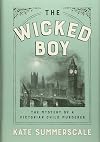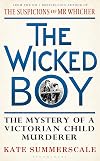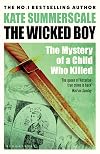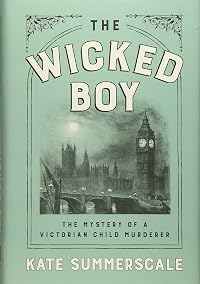
The Wicked Boy: The Mystery of a Victorian Child Murderer
by Kate Summerscale
On This Page
Description
In East London in the summer of 1895, Robert Coombes (age thirteen) and his brother Nattie (age twelve) were arrested for matricide and sent for trial at the Old Bailey. Robert confessed to having stabbed his mother, but his lawyers argued that he was insane. The judge sentenced him to detention in Broadmoor, the most infamous criminal lunatic asylum in the land. Shockingly, Broadmoor turned out to be the beginning of a new life for Robert. At a time of great tumult and uncertainty, Robert show more Coombes's case crystallized contemporary anxieties about the education of the working classes, the dangers of pulp fiction, and evolving theories of criminality, childhood, and insanity. With riveting detail and rich atmosphere, Summerscale re-creates this terrible crime and its aftermath, uncovering an extraordinary story of man's capacity to overcome the past. -- show lessTags
Recommendations




Member Reviews
"The Plaistow Horror"
Absolutely fascinating account of 13 year old Robert Coombes, who in 1895 stabbed his mother to death. Shutting the bedroom door on the body, he and his 12 year old brother spent ten days at leisure, attending cricket games and the theatre and hanging out with a simple-minded adult friend. But as money starts running short, relatives become suspicious, especially when neighbours start to complain about an unpleasant smell...
There is so much more to this than just the tale of an apparent psychopath, and the author takes us through the court case, Robert's subsequent lengthy stay in Broadmoor - and his ultimate proving of himself as a heroic Anzac soldier in WW1, and his noble life thereafter in Australia.
The court show more made much of Robert's 'unhealthy' predeliction for 'penny dreadful' novels, much as we blame dodgy movies and computer games for similar crimes today. But Summerscale queries the children's upbringing and what their mother was truly like - while their father was away at sea for long spells, it seems she may have been of a violent temperament.
Sometimes the author seems to go off on a bit of a tangent - when describing Robert's time in Broadmoor for example, we hear potted biographies of many of his fellow inmates - but it's all so interesting that it in no way detracts from the writing.
Absolute page-turner. Includes b/w photos. show less
Absolutely fascinating account of 13 year old Robert Coombes, who in 1895 stabbed his mother to death. Shutting the bedroom door on the body, he and his 12 year old brother spent ten days at leisure, attending cricket games and the theatre and hanging out with a simple-minded adult friend. But as money starts running short, relatives become suspicious, especially when neighbours start to complain about an unpleasant smell...
There is so much more to this than just the tale of an apparent psychopath, and the author takes us through the court case, Robert's subsequent lengthy stay in Broadmoor - and his ultimate proving of himself as a heroic Anzac soldier in WW1, and his noble life thereafter in Australia.
The court show more made much of Robert's 'unhealthy' predeliction for 'penny dreadful' novels, much as we blame dodgy movies and computer games for similar crimes today. But Summerscale queries the children's upbringing and what their mother was truly like - while their father was away at sea for long spells, it seems she may have been of a violent temperament.
Sometimes the author seems to go off on a bit of a tangent - when describing Robert's time in Broadmoor for example, we hear potted biographies of many of his fellow inmates - but it's all so interesting that it in no way detracts from the writing.
Absolute page-turner. Includes b/w photos. show less
This book, this case of a boy killing his mother (or boys), is more proof that playing violent video games shapes young minds in ways that lead to violen – Sorry? Oh, it's not 1995, but 1895? Oh. Right.
This book, this case of a boy killing his mother, is more proof that reading sensational literature shapes young minds in ways that lead to violence and depravity. As Louisa May Alcott said, "'She is too fond of books, and it has turned her brain."
The killing at the center of this book is extremely disturbing. The older of the brothers is even moreso. Don't get me wrong, the younger brother is creepy – but the older one … "Robert was taken back to Holloway gaol. He was laughing as he got into the cab." It's the sort of thing show more that's always pointed out with salacious horror in coverage of trials – the defendant and his lawyer were seen laughing during a break in the harrowing testimony, that sort of thing. It's not how a kid should … be.
"Be as careful of the books you read, as of the company you keep; for your habits and character will be as much influenced by the former as the latter."
- Paxton Hood
I've often heard of Broadmoor prison; in fact, there is an apartment complex around the corner from me which I thought about, but honestly couldn't seriously consider because of the name. Come to find out, the place that has lived in my mind as a rather horrific insane asylum ("'Broadmoor!' as R. J. Tucknor wrote in a short story for Reynolds Newspaper: 'What visions of horror, ruined lives, and blasted aspirations, of madness and despair, does that single word conjure up!'") was … kind of a nice place to live. I won't spoil it, but it basically amounted to a place where one didn't have to worry about keeping a roof over one's head or feeding oneself, with no mundane worries or responsibilities, where one was surrounded by wholesome recreation opportunities and could even find oneself contributing to dictionary creation. If you were a man you even got an ounce of tobacco each week. There are days (and not a few of them) when I'd love to be an inmate at Broadmoor. (The good part. There was a bad part.) Oh, and there were interesting neighbors: "One elderly inmate, said to have killed his mother in 1849, would inform passersby that he had great mysteries, comets, suns and fires fastened to his shoulders."
"In every other age and class man is held responsible for his reading, and not reading responsible for man. The books a man or woman reads are less the making of character than the expression of it."
- The Pall Mall Gazette
I was entertained to read about "the sour, urinous scent of the Bryant & May match works"… That's much the way I now feel about the Bryand and May mystery series after its author's recent remarks.
It was a fascinating examination of the specific case and its setting – and its aftermath. Well-researched, well-written – and well recommended.
The usual disclaimer: I received this book via Netgalley for review. show less
This book, this case of a boy killing his mother, is more proof that reading sensational literature shapes young minds in ways that lead to violence and depravity. As Louisa May Alcott said, "'She is too fond of books, and it has turned her brain."
The killing at the center of this book is extremely disturbing. The older of the brothers is even moreso. Don't get me wrong, the younger brother is creepy – but the older one … "Robert was taken back to Holloway gaol. He was laughing as he got into the cab." It's the sort of thing show more that's always pointed out with salacious horror in coverage of trials – the defendant and his lawyer were seen laughing during a break in the harrowing testimony, that sort of thing. It's not how a kid should … be.
"Be as careful of the books you read, as of the company you keep; for your habits and character will be as much influenced by the former as the latter."
- Paxton Hood
I've often heard of Broadmoor prison; in fact, there is an apartment complex around the corner from me which I thought about, but honestly couldn't seriously consider because of the name. Come to find out, the place that has lived in my mind as a rather horrific insane asylum ("'Broadmoor!' as R. J. Tucknor wrote in a short story for Reynolds Newspaper: 'What visions of horror, ruined lives, and blasted aspirations, of madness and despair, does that single word conjure up!'") was … kind of a nice place to live. I won't spoil it, but it basically amounted to a place where one didn't have to worry about keeping a roof over one's head or feeding oneself, with no mundane worries or responsibilities, where one was surrounded by wholesome recreation opportunities and could even find oneself contributing to dictionary creation. If you were a man you even got an ounce of tobacco each week. There are days (and not a few of them) when I'd love to be an inmate at Broadmoor. (The good part. There was a bad part.) Oh, and there were interesting neighbors: "One elderly inmate, said to have killed his mother in 1849, would inform passersby that he had great mysteries, comets, suns and fires fastened to his shoulders."
"In every other age and class man is held responsible for his reading, and not reading responsible for man. The books a man or woman reads are less the making of character than the expression of it."
- The Pall Mall Gazette
I was entertained to read about "the sour, urinous scent of the Bryant & May match works"… That's much the way I now feel about the Bryand and May mystery series after its author's recent remarks.
It was a fascinating examination of the specific case and its setting – and its aftermath. Well-researched, well-written – and well recommended.
The usual disclaimer: I received this book via Netgalley for review. show less
Though ostensibly about the case of juvenile murderer Robert Coombes, that's really a guide rope for Kate Summerscale to explore some often-neglected aspects of late Victorian society.
It's a period we see or read about so often in films, television series and novels that we probably think we know it quite well, but those depictions are fifth or sixth generation copies, most of the banalities of the period boiled off until all you've got is the cultural signifiers.
And I love all that stuff, but it's also interesting to find out more of the real-world – the sensational murder cases, the poor neighbourhoods that were neither slum nor respectable, the tourism boom, blimey even the transatlantic cattle trade – that would have given show more context to the adventures of Sherlock Holmes and the rest when they were first published.
It's a cliché but one of the most striking things is to realise how much was actually the same then as it was now. No great switch was thrown circa 1935 for the world to become modern. There's the particular media combination of outrage and morbidity ("Corr, look at the moral depravity on that!"), the tortured economics of international trade, controversy over the treatment of prisoners – even moral outrage about the sort of stuff kids amuse themselves with in their bedrooms.
The murder case itself is gruesomely fascinating in its particulars but wouldn't have sustained a book by itself, and The Wicked Boy does feel less focused as it moves away from the turn of the last century.By the time Summerscale gets to the First World War, the descriptions of Robert's activities are very broad (surmises based on his service record) and her attempts to find some symmetry in his life were unconvincing; history doesn't oblige with a neat ending.
The Wicked Boy is a great read for anyone interested in the social history of the late Victorian era. Fans of true crime may drift after the first 100 pages or so. show less
It's a period we see or read about so often in films, television series and novels that we probably think we know it quite well, but those depictions are fifth or sixth generation copies, most of the banalities of the period boiled off until all you've got is the cultural signifiers.
And I love all that stuff, but it's also interesting to find out more of the real-world – the sensational murder cases, the poor neighbourhoods that were neither slum nor respectable, the tourism boom, blimey even the transatlantic cattle trade – that would have given show more context to the adventures of Sherlock Holmes and the rest when they were first published.
It's a cliché but one of the most striking things is to realise how much was actually the same then as it was now. No great switch was thrown circa 1935 for the world to become modern. There's the particular media combination of outrage and morbidity ("Corr, look at the moral depravity on that!"), the tortured economics of international trade, controversy over the treatment of prisoners – even moral outrage about the sort of stuff kids amuse themselves with in their bedrooms.
The murder case itself is gruesomely fascinating in its particulars but wouldn't have sustained a book by itself, and The Wicked Boy does feel less focused as it moves away from the turn of the last century.
The Wicked Boy is a great read for anyone interested in the social history of the late Victorian era. Fans of true crime may drift after the first 100 pages or so. show less
I received an ARC of this book from the publisher in exchange for an honest review. This did not affect my opinion of the book or my review itself.
Kate Summerscale's The Suspicions of Mr. Whicher is one of my all-time favorite true crime books. I was beyond excited when I heard she was writing The Wicked Boy, and while it didn't quite live up to Mr. Whicher (I'm honestly not sure most could for me), it was a good, well-written, well-researched read.
The Wicked Boy tells the true tale of Robert Coombes, a young boy who murdered his mother, a crime he and his younger brother hid for days. Summerscale expertly explores not only the crime itself, and the purported motives behind it, but a wide range of other historical, social, and cultural show more themes: boyhood in the 1800s, the rise of penny dreadfuls and their possible influence on young minds, mental illness, asylums, war, and redemption.
Trust Summerscale as a writer and researcher. While this may not be her best work ever, it is very good, and keeps her among the best true crime writers of our time. show less
Kate Summerscale's The Suspicions of Mr. Whicher is one of my all-time favorite true crime books. I was beyond excited when I heard she was writing The Wicked Boy, and while it didn't quite live up to Mr. Whicher (I'm honestly not sure most could for me), it was a good, well-written, well-researched read.
The Wicked Boy tells the true tale of Robert Coombes, a young boy who murdered his mother, a crime he and his younger brother hid for days. Summerscale expertly explores not only the crime itself, and the purported motives behind it, but a wide range of other historical, social, and cultural show more themes: boyhood in the 1800s, the rise of penny dreadfuls and their possible influence on young minds, mental illness, asylums, war, and redemption.
Trust Summerscale as a writer and researcher. While this may not be her best work ever, it is very good, and keeps her among the best true crime writers of our time. show less
In 1895 Robert and Nattie Coombs spent a week fishing, playing cards, taking day trips and basically enjoying themselves while their mother, Emily, lay dead in an upstairs bedroom in their East London home. Eventually, the death was discovered and Robert confessed to the crime, his reason being her cruelty towards his younger brother, Nattie. A lengthy trial ensued and the remainder of the book covers what happened to Robert and to a lesser degree, Nattie. Kate Summerscale has done an extensive amount of research for her book on this crime and the subsequent trial, which was quite sensationalized in the press at the time. The Wicked Boy: The Mystery of a Victorian Child Murderer is written in a rather dry, journalistic style that I show more found a bit off-putting at times. Some recent nonfiction books read like novels; this book definitely does not. I guess, as far as a recommendation is concerned, it depends how you like your books. I was struck by the nature vs. nurture discussions that took place at the time and are still taking place today. Was Robert’s crime due to the environment he grew up in (East London poverty) or his mother’s presumed brutality? Also, much was made of the penny dreadful’s influence on Robert and I was reminded of the conversations today regarding television/movie/video game’s effect on the minds and behavior of the young and perhaps the cause of violent crimes. Taking this into account, I viewed the book as much a social commentary as a well-researched version of a Victorian murder. show less
The Wicked Boy: The Mystery of a Victorian Child Murderer by Kate Summerscale is a very well-written look at the true crime case of Robert Coombes, who murdered his mother in 1895 at the age of 13.
This book looks at everything from the crime and immediate aftermath to Coombes' life after incarceration in a mental institution. There is something here for every fan of true crime, especially cases from the past. The crime is covered and a possible motivation is put forth; the trial never touched on motive. The manner in which Coombes was treated once in the system is looked at and the contrasts with contemporary judicial procedures is quite interesting. Summerscale also looks at whether or not rehabilitation was effective by sharing the show more rest of the killer's life with us.
The writing is superb and the research is thorough and balanced. I would recommend this wholeheartedly to anyone with an interest in true crime and readers of historical fiction would likely find much to enjoy as well.
Reviewed from an ARC made available by the publisher via NetGalley. show less
This book looks at everything from the crime and immediate aftermath to Coombes' life after incarceration in a mental institution. There is something here for every fan of true crime, especially cases from the past. The crime is covered and a possible motivation is put forth; the trial never touched on motive. The manner in which Coombes was treated once in the system is looked at and the contrasts with contemporary judicial procedures is quite interesting. Summerscale also looks at whether or not rehabilitation was effective by sharing the show more rest of the killer's life with us.
The writing is superb and the research is thorough and balanced. I would recommend this wholeheartedly to anyone with an interest in true crime and readers of historical fiction would likely find much to enjoy as well.
Reviewed from an ARC made available by the publisher via NetGalley. show less
The epilogue contains an explanation of how the author came across the story of Robert Coombes, who at age 13 was found "guilty but insane" for the murder of his mother. She researched the case and the rest of his life as best she could, but not a lot of information existed. She was able to track down where he ended up after leaving the asylum at age 30, moving to Australia, serving in the AIF during WWI and being a productive member of society. The main body of the book contains a lot of her historical research about the area where Robert lived, the other events of that summer, the lawyers and others involved in the case, the asylum and other places Robert lived, etc. Most of the information was interesting, but a little dry and not show more always completely relevant to the main narrative. I wish the book would have been shorter and more focused. show less
Members
- Recently Added By
Lists

Books Read in 2016
4,666 works; 199 members

Edgar Award
418 works; 15 members
Author Information

7+ Works 6,199 Members
Kate Summerscale is the former literary editor of the Daily Telegraph and the author of The Queen of Whale Cay, which won the Somerset Maugham Award and was shortlisted for the Whitbread biography award. She lives in London.
Awards and Honors
Awards
Common Knowledge
- Canonical title*
- Un singulier garçon
- Original title
- The Wicked Boy: The Mystery of a Victorian Child Murderer
- Alternate titles
- The Wicked Boy; The Wicked Boy An Infamous Murder In Victorian London
- Original publication date
- 2016-07-12
- People/Characters
- Robert Coombes, Jr.; Nathaniel Coombes (Nattie); Emily Harrison Coombes; W.G. Grace; John Fox; William White (show all 54); William Richards; Florence Dennis; James Canham Read; Harry Read; Ernest Baggallay; Mary Jane Burrage; George Gilbert; George Hardy; Keir Hardie; Harriet Hayward; Alfred Kennedy; Edward Leggatt; Charles Carne Lewis; George Mellish; Robert Twort; George Waldie; John Lawrence; George Walker; Charles Crank Sharman; Sherlock Hare; William Chester Minor; Charles Coleman; Reginald Saunderson; Patrick Knowles; Richard Brayn; John Baker; Samuel Smith; Ike Cundy; Bertha Mulville; Charles Mulville; Harry Mulville; Harold Smith; Belle Mulville; John Hewson; James Robertson; Amelia England; George Burrage; Mary Coombes; Mary Ann Brecht; Robert Coombes, Sr.; Rosina Robertson; Joseph Horlock; Charles Gill; Horace Avory; Richard Brayn; David Nicolson; Frank Rodgers; Captain "Granny" Burnage
- Important places
- West Ham, London, England, UK; Limehouse, London, England, UK; Lord's Cricket Ground; London, England, UK; St. John's Wood, London, England, UK; Southend-on-Sea, Essex, England, UK (show all 18); HM Prison Holloway, Holloway, London, England, UK; Stratford, London, England, UK; Liverpool, England, UK; New York, New York, USA; Old Bailey, London, England, UK; Newark, New Jersey, USA; Hadleigh, Suffolk, UK; Broadmoor Hospital, Crowthorne, Berkshire, England, UK; Cairo, Egypt; Nana Glen, New South Wales, Australia; New South Wales, Australia; 35 Cave Road, Plaistow, London, England, UK
- Important events
- World War I (1914 | 1918); Children's Act (1889); Criminal Lunatics Act (1884); Battle of Gallipolli
- Dedication
- For Miranda and Keith
- First words
- Early in the morning of Monday 8 July 1895, Robert and Nathaniel Coombes dressed themselves, collected the family's rent book from a room downstairs, and went out to the back yard.
- Quotations
- You can lie [down and die, if you like, but it is cowardly, most cowardly to allow helpless children to do so. - Charles Lewis
- Last words
- (Click to show. Warning: May contain spoilers.)I hoped that he did, and had loved Robert anyway.
- Original language
- English
- Canonical DDC/MDS
- 364.1523092
- Canonical LCC
- HV9067.H6
*Some information comes from Common Knowledge in other languages. Click "Edit" for more information.
Classifications
- Genre
- Nonfiction
- DDC/MDS
- 364.1523092 — Society, government, & culture Social problems and social services Crime Criminal offenses Offenses against the person Homicide Murder History, geographic treatment, biography Biography
- LCC
- HV9067 .H6 — Social sciences Social pathology. Social and public welfare. Criminology Social pathology. Social and public welfare. Criminal justice administration Penology. Prisons. Corrections The juvenile offender. Juvenile delinquency.
- BISAC
Statistics
- Members
- 685
- Popularity
- 41,842
- Reviews
- 40
- Rating
- (3.72)
- Languages
- 5 — Dutch, English, French, Italian, Portuguese
- Media
- Paper, Audiobook, Ebook
- ISBNs
- 27
- ASINs
- 6