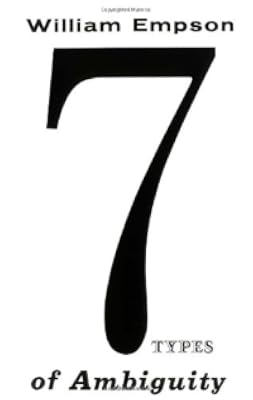
Seven Types of Ambiguity
by William Empson
On This Page
Description
First published in 1930, Seven Types of Ambiguity has long been recognized as a landmark in the history of English literary criticism.Tags
Recommendations












Member Reviews
I've had this on my shelves for years, but never had time when I was a student to read it all the way through. I'm glad I did take the opportunity now: it's worth following Empson's argument through from beginning to end.
It is very much a young man's book: sometimes he gets quite arrogant and dogmatic, but he usually catches himself in time and turns it into a joke. Sometimes there's a footnote added in the second edition where he castigates himself for jumping to the wrong conclusion first time round.
The analysis itself is often exciting and eye-opening, and there's an interesting background discussion going on about the nature of poetry and the role of criticism, especially of analysis of the quasi-scientific type Empson is doing. show more Do we reduce a poem to nothing if we calculate all the permutations of things the words could mean or suggest? Do we just formalise the things we already have in our minds when we read the poem subjectively?
Although he uses a lot of scientific images himself, Empson isn't really suggesting that a "scientific" approach to language is the key to understanding poetry. But he is arguing that we can often get a better idea of how the different ideas in a poem work together if we have a proper look at the language. At least some of his examples seem to bear this out, and point out quite surprising things in the language that I, at least, had never spotted. And his technique is presented so clearly that this is a book that you can read quite happily without having a background in literary theory: it should be perfectly accessible to anyone who reads English poetry for pleasure. show less
It is very much a young man's book: sometimes he gets quite arrogant and dogmatic, but he usually catches himself in time and turns it into a joke. Sometimes there's a footnote added in the second edition where he castigates himself for jumping to the wrong conclusion first time round.
The analysis itself is often exciting and eye-opening, and there's an interesting background discussion going on about the nature of poetry and the role of criticism, especially of analysis of the quasi-scientific type Empson is doing. show more Do we reduce a poem to nothing if we calculate all the permutations of things the words could mean or suggest? Do we just formalise the things we already have in our minds when we read the poem subjectively?
Although he uses a lot of scientific images himself, Empson isn't really suggesting that a "scientific" approach to language is the key to understanding poetry. But he is arguing that we can often get a better idea of how the different ideas in a poem work together if we have a proper look at the language. At least some of his examples seem to bear this out, and point out quite surprising things in the language that I, at least, had never spotted. And his technique is presented so clearly that this is a book that you can read quite happily without having a background in literary theory: it should be perfectly accessible to anyone who reads English poetry for pleasure. show less
I got off to a very rocky start with this book — beginning with the first sentence!
"An ambiguity, in ordinary speech, means something very pronounced, and as a rule witty or deceitful."
Skipping over "in ordinary speech" for the moment, I was not aware that ambiguity was "as a rule witty or deceitful." This sentence sent me to two different dictionaries and ultimately — when I was at the library the other day anyway — to the 20-volume Oxford English Dictionary. None of these sources contradicted my presumed definition of "ambiguous" or "ambiguity," but interestingly and as an aside, the OED actually quotes this very sentence in its section of historical usage. For the sake of brevity, let me quote the Concise Oxford English show more Dictionary:
ambiguous: having more than one meaning; open to different interpretations.
Nowhere in any of my sources — the third being Merriam-Webster's Collegiate Dictionary, Eleventh Edition (2008) — were the words "witty" or "deceitful" to be found.
While Empson's presumably working definition invokes "ordinary speech," his book deals almost exclusively with an analysis of poetry — hardly anybody's concept of ordinary speech. But let us forget about this unfortunate phraseology because it merely detracts from what turns out to be a very useful and important book.
Empson has conceived of seven main types of literary ambiguity along with innumerable subtypes and variations, all of which he illustrates with detailed exegesis of poems, especially from Shakespeare, John Donne and John Dryden. Some of Empson's types are easier to absorb than others, but his explanation of individual poems are highly enlightening and worth the investment of time to understand and overlook his sometimes obscure language.
For example, the first type is so complicated that a complete definition is difficult to sum up and state succinctly, but a single line from Shakespeare will serve to illustrate the idea that "a word or a grammatical structure is effective in several ways at once":
Bare ruined choirs, where late the sweet birds sang
—Sonnet LXXII
". . . because ruined monastery choirs are places in which to sing, because they involve sitting in a row, because they are made of wood, are carved in knots and so forth, because they used to be surrounded by a sheltering building crystallized out of the likeness of a forest, and colored with stained glass and painting like flowers and leaves, because they are now abandoned by all but the gray walls colored like the skies of winter . . . all combine to give the line its beauty, and there is a sort of ambiguity in not knowing which of them to hold most clearly in mind. Clearly this is involved in all such richness and heightening of effect, and the machinations of ambiguity are among the very roots of poetry."
How powerful is that?
Here is another example, the third type of ambiguity, in which two ideas "can be given in one word simultaneously":
Delilah,
That specious monster, my accomplished snare.
—Milton, Samson Agonistes, line 230
The operative word here is specious, which in its original definition meant "beautiful," and only later acquired the meaning of "having deceptive attraction or allure." If you know both meanings, you feel the hidden power of "That specious monster."
Empson refers to these words with double meanings as puns, and technically perhaps they are. Shakespeare's poetry — both sonnets and plays — is full of them, as Empson demonstrates again and again. He directly says that most of the ambiguities he has considered seem beautiful to him — again, not our customary notion of a pun.
The many ambiguities seen in poem after poem make us conscious of the tensions raised by the contradictions if we can see them. The more prominent the contradiction, the greater the tension.
Some critics have argued that Empson's ambiguities are not that at all but merely demonstrate the many creative uses of language in poetry. I see in his analysis something akin to hermeneutics, which originated among Biblical scholars in identifying different levels of interpretation and later made more generally familiar in literary criticism by Norbert Fry. However, one wishes to look at it, Empson's analysis opens us up to a deep understanding of the complexity of poetry. show less
"An ambiguity, in ordinary speech, means something very pronounced, and as a rule witty or deceitful."
Skipping over "in ordinary speech" for the moment, I was not aware that ambiguity was "as a rule witty or deceitful." This sentence sent me to two different dictionaries and ultimately — when I was at the library the other day anyway — to the 20-volume Oxford English Dictionary. None of these sources contradicted my presumed definition of "ambiguous" or "ambiguity," but interestingly and as an aside, the OED actually quotes this very sentence in its section of historical usage. For the sake of brevity, let me quote the Concise Oxford English show more Dictionary:
ambiguous: having more than one meaning; open to different interpretations.
Nowhere in any of my sources — the third being Merriam-Webster's Collegiate Dictionary, Eleventh Edition (2008) — were the words "witty" or "deceitful" to be found.
While Empson's presumably working definition invokes "ordinary speech," his book deals almost exclusively with an analysis of poetry — hardly anybody's concept of ordinary speech. But let us forget about this unfortunate phraseology because it merely detracts from what turns out to be a very useful and important book.
Empson has conceived of seven main types of literary ambiguity along with innumerable subtypes and variations, all of which he illustrates with detailed exegesis of poems, especially from Shakespeare, John Donne and John Dryden. Some of Empson's types are easier to absorb than others, but his explanation of individual poems are highly enlightening and worth the investment of time to understand and overlook his sometimes obscure language.
For example, the first type is so complicated that a complete definition is difficult to sum up and state succinctly, but a single line from Shakespeare will serve to illustrate the idea that "a word or a grammatical structure is effective in several ways at once":
Bare ruined choirs, where late the sweet birds sang
—Sonnet LXXII
". . . because ruined monastery choirs are places in which to sing, because they involve sitting in a row, because they are made of wood, are carved in knots and so forth, because they used to be surrounded by a sheltering building crystallized out of the likeness of a forest, and colored with stained glass and painting like flowers and leaves, because they are now abandoned by all but the gray walls colored like the skies of winter . . . all combine to give the line its beauty, and there is a sort of ambiguity in not knowing which of them to hold most clearly in mind. Clearly this is involved in all such richness and heightening of effect, and the machinations of ambiguity are among the very roots of poetry."
How powerful is that?
Here is another example, the third type of ambiguity, in which two ideas "can be given in one word simultaneously":
Delilah,
That specious monster, my accomplished snare.
—Milton, Samson Agonistes, line 230
The operative word here is specious, which in its original definition meant "beautiful," and only later acquired the meaning of "having deceptive attraction or allure." If you know both meanings, you feel the hidden power of "That specious monster."
Empson refers to these words with double meanings as puns, and technically perhaps they are. Shakespeare's poetry — both sonnets and plays — is full of them, as Empson demonstrates again and again. He directly says that most of the ambiguities he has considered seem beautiful to him — again, not our customary notion of a pun.
The many ambiguities seen in poem after poem make us conscious of the tensions raised by the contradictions if we can see them. The more prominent the contradiction, the greater the tension.
Some critics have argued that Empson's ambiguities are not that at all but merely demonstrate the many creative uses of language in poetry. I see in his analysis something akin to hermeneutics, which originated among Biblical scholars in identifying different levels of interpretation and later made more generally familiar in literary criticism by Norbert Fry. However, one wishes to look at it, Empson's analysis opens us up to a deep understanding of the complexity of poetry. show less
I have never believed that the critic is the rival of the poet, but I do believe that criticism is a genre of literature or it does not exist. - Harold Bloom
I enjoyed this book of literary criticism immensely. Empson is an erudite and widely-read critic, which certainly surprised me, as the first edition of this book came out when he was 24. I have a few minor criticisms of the book, but mostly it satisfied my urge for cogent, intelligent literary criticism. It brilliantly realises its premise of elucidating the ambiguity of English poetry, and does so with style and wit.
To illustrate Empson’s general understanding of the – ahem – ambiguous term, ‘ambiguity’, here he is on the slippery subject in the first chapter:
The show more fundamental situation, whether it deserves to be called ambiguous or not, is that a word or a grammatical structure is effective in several ways at once. To take a famous example, there is no pun, double syntax, or dubiety of feeling, in
Bare ruined choirs, where late the sweet birds sang,
but the comparison holds for many reasons; because ruined monastery choirs are places in which to sing, because they involve sitting in a row, because they are made of wood, are carved into knots and so forth, because they used to be surrounded by a sheltering building crystallised out of the likeness of a forest, and coloured with stained glass and painting like flowers and leaves, because they are now abandoned by all but the grey walls coloured like the skies of winter… and for various sociological and historical reasons (the Protestant destruction of the monasteries, etc.)… these reasons, and many more relating the simile to its place in the Sonnet, must all combine to give the line its beauty, and there is a sort of ambiguity in not knowing which of them to hold most clearly in mind… the machinations of ambiguity are among the very roots of poetry.
Sorry for the long quotation, but it helpfully exemplifies Empson’s meaning, his style, and his general approach. Empson is brilliant at teasing out multiple interpretations of any ‘ambiguous’ word or phrase in a poem, and does this throughout the book to illustrate his types of ambiguity. He also brilliantly defends himself from the reasonable criticism that some of his interpretations are trivial or irrelevant.
Empson has fascinating things to say concerning Shakespeare and the Elizabethans. For instance, here he is considering the importance of multiple meanings of words to Shakespeare and his contemporaries:
One must consider… that the Elizabethans minded very little about spelling and punctuation; that this must have given them an attitude to the written page entirely different from ours… that from the comparative slowness, of reading as of speaking, that this entailed, the reader was prepared to assimilate words with a completeness which is now lost… and that it is Shakespeare’s normal method to use a newish, apparently irrelevant word, which spreads the attention thus attracted over a wide map of the ways in which it may be justified.
Some of this is speculation of course, but Empson makes an interesting point; our standardised spelling and punctuation limits the amount of ambiguity we experience when reading a poem or drama, while the Elizabethans had to puzzle out the meanings of written texts. Of course, Shakespeare’s dramas were written to be performed, and Empson notes that the pronunciation of the actors would have influenced the meaning of words (as he says, ‘The words are intended for the stage; they certainly convey something to the audience; and there is no time for them to convey anything more definite before the soliloquy has swept on…’). Shakespeare, however, is incredible in that he may very well have intended many (if not all) the various meanings that his ambiguous words or phrases could accommodate. Empson also complains about Shakespeare’s unlimited propensity for puns, and has an interesting section on his use of the method: ‘the (noun) and (noun) of (noun)’ (e.g. ‘The slings and arrows of outrageous fortune’). Empson claims that, whereas we normally scan across these lines, assuming that the first two nouns are merely synonyms, Shakespeare usually intends us to pay more attention to both words, and their combined effect on the final noun.
I disliked Empson’s somewhat disparaging remarks towards nineteenth century poetry, especially as he usually does not deign to back up these remarks by actually quoting from these poets. To be fair, he does sometimes have good things to say about the Romantics, and even about Tennyson and Swinburne, though one suspects that he reluctantly admits to a grudging respect for only some of their work. I am myself not so blinkered as to love everything these poets wrote, but I would prefer him not to set up straw men that he can easily knock down. I also disliked his editorial comments in the form of footnotes. In these notes, which were added to the third edition of the book, Empson often retracts things that he says in the main text. On several occasions, he claims that he is not quite happy with the main text, but does not know how to improve it. These notes often seemed pedantic and self-indulgent. Admittedly, they occasionally added something to the book. Mostly, however, they seemed like unnecessary grumbles.
Empson’s approach is daring and speaks of a real degree of genius. Can I remember the exact definitions of his seven types of ambiguity? No, but that is not really the point of the book. As Empson says, ‘I call the types useful… because, in complicated matters, any distinction between cases, however irrelevant, may serve to heighten one’s consciousness of the cases themselves.’ Empson’s book, despite being densely written and nominally ‘difficult’, certainly heightened my consciousness. It enriches one’s reading of poetry, and justifies the analysis thereof. Some people dislike poetry analysis, as they see it as a vivisection of a beautiful poem. Empson, however, shows that literary criticism can itself be an art form. Highly recommended. show less
I enjoyed this book of literary criticism immensely. Empson is an erudite and widely-read critic, which certainly surprised me, as the first edition of this book came out when he was 24. I have a few minor criticisms of the book, but mostly it satisfied my urge for cogent, intelligent literary criticism. It brilliantly realises its premise of elucidating the ambiguity of English poetry, and does so with style and wit.
To illustrate Empson’s general understanding of the – ahem – ambiguous term, ‘ambiguity’, here he is on the slippery subject in the first chapter:
The show more fundamental situation, whether it deserves to be called ambiguous or not, is that a word or a grammatical structure is effective in several ways at once. To take a famous example, there is no pun, double syntax, or dubiety of feeling, in
Bare ruined choirs, where late the sweet birds sang,
but the comparison holds for many reasons; because ruined monastery choirs are places in which to sing, because they involve sitting in a row, because they are made of wood, are carved into knots and so forth, because they used to be surrounded by a sheltering building crystallised out of the likeness of a forest, and coloured with stained glass and painting like flowers and leaves, because they are now abandoned by all but the grey walls coloured like the skies of winter… and for various sociological and historical reasons (the Protestant destruction of the monasteries, etc.)… these reasons, and many more relating the simile to its place in the Sonnet, must all combine to give the line its beauty, and there is a sort of ambiguity in not knowing which of them to hold most clearly in mind… the machinations of ambiguity are among the very roots of poetry.
Sorry for the long quotation, but it helpfully exemplifies Empson’s meaning, his style, and his general approach. Empson is brilliant at teasing out multiple interpretations of any ‘ambiguous’ word or phrase in a poem, and does this throughout the book to illustrate his types of ambiguity. He also brilliantly defends himself from the reasonable criticism that some of his interpretations are trivial or irrelevant.
Empson has fascinating things to say concerning Shakespeare and the Elizabethans. For instance, here he is considering the importance of multiple meanings of words to Shakespeare and his contemporaries:
One must consider… that the Elizabethans minded very little about spelling and punctuation; that this must have given them an attitude to the written page entirely different from ours… that from the comparative slowness, of reading as of speaking, that this entailed, the reader was prepared to assimilate words with a completeness which is now lost… and that it is Shakespeare’s normal method to use a newish, apparently irrelevant word, which spreads the attention thus attracted over a wide map of the ways in which it may be justified.
Some of this is speculation of course, but Empson makes an interesting point; our standardised spelling and punctuation limits the amount of ambiguity we experience when reading a poem or drama, while the Elizabethans had to puzzle out the meanings of written texts. Of course, Shakespeare’s dramas were written to be performed, and Empson notes that the pronunciation of the actors would have influenced the meaning of words (as he says, ‘The words are intended for the stage; they certainly convey something to the audience; and there is no time for them to convey anything more definite before the soliloquy has swept on…’). Shakespeare, however, is incredible in that he may very well have intended many (if not all) the various meanings that his ambiguous words or phrases could accommodate. Empson also complains about Shakespeare’s unlimited propensity for puns, and has an interesting section on his use of the method: ‘the (noun) and (noun) of (noun)’ (e.g. ‘The slings and arrows of outrageous fortune’). Empson claims that, whereas we normally scan across these lines, assuming that the first two nouns are merely synonyms, Shakespeare usually intends us to pay more attention to both words, and their combined effect on the final noun.
I disliked Empson’s somewhat disparaging remarks towards nineteenth century poetry, especially as he usually does not deign to back up these remarks by actually quoting from these poets. To be fair, he does sometimes have good things to say about the Romantics, and even about Tennyson and Swinburne, though one suspects that he reluctantly admits to a grudging respect for only some of their work. I am myself not so blinkered as to love everything these poets wrote, but I would prefer him not to set up straw men that he can easily knock down. I also disliked his editorial comments in the form of footnotes. In these notes, which were added to the third edition of the book, Empson often retracts things that he says in the main text. On several occasions, he claims that he is not quite happy with the main text, but does not know how to improve it. These notes often seemed pedantic and self-indulgent. Admittedly, they occasionally added something to the book. Mostly, however, they seemed like unnecessary grumbles.
Empson’s approach is daring and speaks of a real degree of genius. Can I remember the exact definitions of his seven types of ambiguity? No, but that is not really the point of the book. As Empson says, ‘I call the types useful… because, in complicated matters, any distinction between cases, however irrelevant, may serve to heighten one’s consciousness of the cases themselves.’ Empson’s book, despite being densely written and nominally ‘difficult’, certainly heightened my consciousness. It enriches one’s reading of poetry, and justifies the analysis thereof. Some people dislike poetry analysis, as they see it as a vivisection of a beautiful poem. Empson, however, shows that literary criticism can itself be an art form. Highly recommended. show less
I should have read this sixty years ago. I bought a copy thirty years ago. Now I finally read it. Better late than never?
Sixty years ago, I entered college, and its English department was a bastion of what’s still referred to as the New Criticism, a century after that movement began. This book was already a classic text and was on the syllabus for many courses. Thirty years ago, I revisited the campus and picked up a copy at the bookstore there. Now at last I can say I’ve read it.
My reading experience was mixed. It took me a while to get into it. The first chapter was daunting in that, for several pages, it was hard to know what the author was getting at. I supposed that was only to be expected in a book with the word show more “ambiguity” in its title. But that is not the kind of ambiguity Empson meant.
Finally, after what Empson concedes “has grown too long and too portentous,” he begins dealing with specific examples from the full range of English-language poetry, from Chaucer to Empson’s contemporary, T. S. Eliot. The author’s insights enriched my understanding, even though they were couched in the port-and-pipe tones of a college common room after dinner.
Not all of this has aged well. Empson’s repeated reference to “feminine” as an undesirable trait in a poet, for instance. I’m not even sure that it wasn't risible at the time.
For those looking for a summary of the seven types, there are plenty of videos online that cover them better than I can. I’ll mention one takeaway that stayed with me: the need to recalibrate one’s reading to account for the time a poem was written. A reader can’t read an Elizabethan sonnet in the same way as a lyric from the Romantic era, nor would either approach help one appreciate Dryden or Pope.
Despite being a slow read, I’m glad I finally got around to this. Although the New Criticism is no longer new, and certainly not the last word, this remains a valuable work. show less
Sixty years ago, I entered college, and its English department was a bastion of what’s still referred to as the New Criticism, a century after that movement began. This book was already a classic text and was on the syllabus for many courses. Thirty years ago, I revisited the campus and picked up a copy at the bookstore there. Now at last I can say I’ve read it.
My reading experience was mixed. It took me a while to get into it. The first chapter was daunting in that, for several pages, it was hard to know what the author was getting at. I supposed that was only to be expected in a book with the word show more “ambiguity” in its title. But that is not the kind of ambiguity Empson meant.
Finally, after what Empson concedes “has grown too long and too portentous,” he begins dealing with specific examples from the full range of English-language poetry, from Chaucer to Empson’s contemporary, T. S. Eliot. The author’s insights enriched my understanding, even though they were couched in the port-and-pipe tones of a college common room after dinner.
Not all of this has aged well. Empson’s repeated reference to “feminine” as an undesirable trait in a poet, for instance. I’m not even sure that it wasn't risible at the time.
For those looking for a summary of the seven types, there are plenty of videos online that cover them better than I can. I’ll mention one takeaway that stayed with me: the need to recalibrate one’s reading to account for the time a poem was written. A reader can’t read an Elizabethan sonnet in the same way as a lyric from the Romantic era, nor would either approach help one appreciate Dryden or Pope.
Despite being a slow read, I’m glad I finally got around to this. Although the New Criticism is no longer new, and certainly not the last word, this remains a valuable work. show less
A landmark in the history of criticism, Seven Types of Ambiguity was published in 1930, when Empson was only twenty-four, and was immediately hailed as a masterpiece. Although critics had previously noted the indeterminate and playful aspect of 'ambiguity' in literary language, the term itself only entered into the critical lexicon after the publication of Empson's landmark study. In his enjoyable readings of ambiguity, puns and paradox, Empson draws on a variety of authors from Chaucer to Eliot, illuminating the strategies of individual writers and creating a brilliant general theory of poetic practice: wide-ranging, witty and still controversial today.
'Provocations on every page-such a book has a very unusual importance' F. R. Leavis
'Provocations on every page-such a book has a very unusual importance' F. R. Leavis
Here, William Empson introduces a classification scheme for understanding the types of ambiguity to be found in literature. There is a focus on poetry among the types of literature, as it is a better source of effective uses of ambiguity. However, what he says implies to all written content.
What this book does best is to increase the readers’ awareness of ambiguity, and appreciation of how writers can use it in different ways to do different things.
Really a masterpiece of literary criticism, and it should be required reading for those studying English literature.
What this book does best is to increase the readers’ awareness of ambiguity, and appreciation of how writers can use it in different ways to do different things.
Really a masterpiece of literary criticism, and it should be required reading for those studying English literature.
I found this book to contain much sensitive analysis and a pleasant style, but I traversed it with the sense that I lacked the patience and refinement to take much away from it. Ultimately, the ending cheered me and serves as a better review than anything I could write:
"I should claim, then, that for those who find this book contains novelties, it will make poetry more beautiful, without their ever having to remember the novelties, or endeavor to apply them. It seems a sufficient apology for many niggling pages."
"I should claim, then, that for those who find this book contains novelties, it will make poetry more beautiful, without their ever having to remember the novelties, or endeavor to apply them. It seems a sufficient apology for many niggling pages."
Members
- Recently Added By
Lists

Best non-science books for scientists
11 works; 7 members

Literature and Criticism
12 works; 1 member
Author Information

18+ Works 1,696 Members
Some Editions
Awards and Honors
Series
Belongs to Publisher Series
Common Knowledge
- Original title
- Seven types of ambiguity
- Original publication date
- 1930
- Quotations
- “Ambiguity” itself can mean an indecision as to what you mean, an intention to mean several things, a probability that one or other or both of two things has been meant, and the fact that a statement has several meanings.... (show all) It is useful to be able to separate these if you wish, but it is not obvious that in separating them at any particular point you will not be raising more problems than you solve.
- Original language
- English
Classifications
- Genres
- Literature Studies and Criticism, Nonfiction
- DDC/MDS
- 809 — Literature & rhetoric Literature, rhetoric & criticism History, description, critical appraisal of more than two literatures
- LCC
- PN1031 .E5 — Language and Literature Literature (General) Literature (General) Poetry Theory, philosophy, relations, etc.
- BISAC
Statistics
- Members
- 926
- Popularity
- 28,916
- Reviews
- 13
- Rating
- (3.65)
- Languages
- English, Italian
- Media
- Paper, Ebook
- ISBNs
- 16
- ASINs
- 16