On This Page
Description
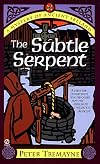
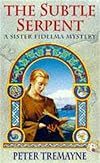
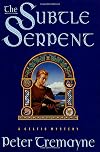
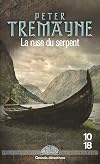
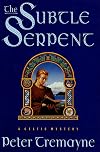
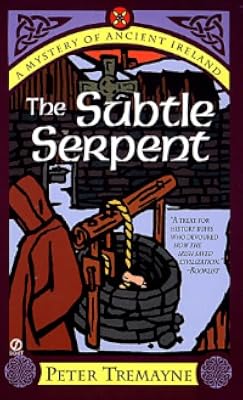
In the year 666 A.D., a headless female corpse is found in the drinking well of a remote abbey in southwest Ireland: clasped in one hand is a crucifix; tied to the other arm is a pagan death symbol. Sister Fidelma—sister to the king of Muman, a religieuse, and an advocate of the Brehon law courts—is sent to investigate. En route, she encounters a Gaulish merchant ship under full sail off the Irish coast—one whose crew and cargo have vanished without a trace.Faced with a tense local show more situation, Fidelma must discover first the identity of the body in the well and uncover who was responsible, then find out what happened to the missing crew of the adrift merchant ship, and, finally, determine how these bizarre events are connected. For these events are more than simply disturbing—the peace of the entire kingdom rests upon their solution.
. show less
Tags
Recommendations




























Member Reviews
4th in the Sister Fidelma series.
Fidelma is summoned to the abbey of The Salmon of the Three Wells when the corpse of a headless female is found in the abbey’s well. While on her way to the abbey by ship, Fidelma and her companions encounter a merchant ship that is completely empty of crew AND cargo. All that is left is puzzling traces of reddish earth. In addition, Fidelma discovers evidence that one of the passengers was her former investigative colleague, Brother Eadulf. Not only does she have the mystery of the empty ship but also the worry that something has happened to Eadulf, to whom she is attracted. The mystery takes on political overtones, as the abbess is in conflict with the local chieftain, who turns out to be her show more brother. Other murders are uncovered as well.
With this installment, the Fidelma series finally seems to get off the stuck point of mediocre writing that plagues Tremayne’s earlier works. It does so by dint of plotting that is an order of magnitude better than has occurred before. There are some really nice aspects to this book—the mystery of an empty ship, ancient Celtic laws about salvage, the intriguing workings of a water clock, and the introduction of ‘modern’, at-a-distance weapons of war to a culture that has heretofore known only hand-to-hand combat, and what that portends.
The characterization is better handled in this book as well. It’s actually a very nice treatment of the insidiousness of hatred through well-placed lies. In fact, I was reminded of that absolutely wonderful aria in the opera, The Barber of Seville, when Don Basilio sings “Calumny is a little breeze”, describing the uses of the gossipy lie to worm its way, like a subtle serpent, through a community and destroy a reputation. The aria is hysterically funny, but the message is sobering. The book has several very nice twists to the plot, and has an exciting denouement.
Definitely better than the three preceeding. Recommended. show less
Fidelma is summoned to the abbey of The Salmon of the Three Wells when the corpse of a headless female is found in the abbey’s well. While on her way to the abbey by ship, Fidelma and her companions encounter a merchant ship that is completely empty of crew AND cargo. All that is left is puzzling traces of reddish earth. In addition, Fidelma discovers evidence that one of the passengers was her former investigative colleague, Brother Eadulf. Not only does she have the mystery of the empty ship but also the worry that something has happened to Eadulf, to whom she is attracted. The mystery takes on political overtones, as the abbess is in conflict with the local chieftain, who turns out to be her show more brother. Other murders are uncovered as well.
With this installment, the Fidelma series finally seems to get off the stuck point of mediocre writing that plagues Tremayne’s earlier works. It does so by dint of plotting that is an order of magnitude better than has occurred before. There are some really nice aspects to this book—the mystery of an empty ship, ancient Celtic laws about salvage, the intriguing workings of a water clock, and the introduction of ‘modern’, at-a-distance weapons of war to a culture that has heretofore known only hand-to-hand combat, and what that portends.
The characterization is better handled in this book as well. It’s actually a very nice treatment of the insidiousness of hatred through well-placed lies. In fact, I was reminded of that absolutely wonderful aria in the opera, The Barber of Seville, when Don Basilio sings “Calumny is a little breeze”, describing the uses of the gossipy lie to worm its way, like a subtle serpent, through a community and destroy a reputation. The aria is hysterically funny, but the message is sobering. The book has several very nice twists to the plot, and has an exciting denouement.
Definitely better than the three preceeding. Recommended. show less
Still early in the series, Peter Tremayne's The Subtle Serpent gives us a not-yet-fully developed Sister Fidelma, and a strange intermingling of Brother Eadulf. Something is definitely amiss at the Abbey of the Salmon of the Three Wells, one of which has recently hosted a beheaded corpse! The whodunit aspects stretch out a bit longer than necessary, and the twists and turns feel a bit more like loose threads, but it is a solid installment in the series. Most enjoyable is Sister Fidelma's facing off with the cantankerous (that's generous) Abbess Draigen. There are rather a lot of sisters to keep track of, and so empathy for some of the characters doesn't really have a chance to develop. As always, however, Tremayne weaves in medieval show more Irish history of both pagan and early Christian origins and it is well worth allowing yourself to be lured in to a land of yesteryear wherein the contexts may be old, but the motives are just as relevant today. show less
When a naked, headless body is found in a female religious sisterhood's well, Sister Fidelma is called in to investigate. On the way a deserted, drifting ship is found with a few bloodstains on board and a book belonging to Sister Fidelma's friend Brother Eadulf.
Another intriguing mystery set against a fascinating picture of 7th century Ireland.
Another intriguing mystery set against a fascinating picture of 7th century Ireland.
I was really interested in the premise and setting of this series (a nun in ancient Ireland) before I read The Subtle Serpent. However, I couldn't get past some of Tremayne's annoying writing quirks. For example, he spends far too much time describing characters' facial expressions, including how they blink. Sometimes I also get the feeling that he includes minutiae of ancient Irish life just to show off. There is a subplot about a ship that runs aground, which gives the protagonist (and the author) the opportunity to demonstrate their knowledge of 7th century Irish maritime salvage laws. Who cares? Maybe some of the other books in the series are better, but I doubt it.
If you're a fan of historical mysteries (Brother Cadfael, etc) definitely check out this one. It's a nice change, having a story set in a society where there can be a female detective lead. Like most historical mysteries, a little "thick" reading at times, which is to be expected when the author has to describe so many details of the character's world.
Enjoyable characters, though - certainly ones I'd like meet again. Decent mystery as well - sometimes the author loses the mystery in describing the historical world, but this happily remains a mystery first.
For more, check out the blog: http://theknittingpenguin.blogspot.com/2008/06/review-subtle-serpent.html
Enjoyable characters, though - certainly ones I'd like meet again. Decent mystery as well - sometimes the author loses the mystery in describing the historical world, but this happily remains a mystery first.
For more, check out the blog: http://theknittingpenguin.blogspot.com/2008/06/review-subtle-serpent.html
Love the history contained in the story. The story itself felt a bit contrived in a few places, as though the author was trying a bit too hard to drag things out. Why Fidelma wasn't told some things earlier wasn't really clear. Some of them you would have thought would have been mentioned quite early on. Still enjoyed the book, though.
This was very fun, if a little over plotted. I am not sure I could tell you who murdered who and why, but I liked the ambiance. Plus, I am sucker for nuns.
I'd read more in the series.
I'd read more in the series.
Members
- Recently Added By
Author Information

148+ Works 14,988 Members
Peter Tremayne is the fiction writing pseudonym of the Celtic scholar and author Peter Berresford Ellis, who was born in Coventry, Warwickshire, England on March 10, 1943. Even though he received a BA and an MA in Celtic Studies, he decided to become a journalist and worked at numerous weekly newspapers throughout England and Ireland. In 1968, he show more published is first book, Wales: A Nation Again, about the Welsh struggle for political independence. He became a full-time writer in 1975 and has published over 90 books under his own name and the pseudonyms Peter Tremayne and Peter MacAlan. One of his best known works under his real name is The Cornish Language and its Literature, which is considered the definitive history of the language. In 1988, he received an Irish Post Award in recognition of his services to Irish historical studies. Under the pseudonym Peter Tremayne, he writes the Sister Fidelma Mystery series. He received the French Prix Historia for the best historical mystery novel of 2010 for Le Concile des Maudits (The Council of the Cursed). (Bowker Author Biography) show less
Some Editions
Series

Belongs to Publisher Series
Aufbau Taschenbuch (1525)
Work Relationships
Common Knowledge
- Canonical title
- The Subtle Serpent
- Original title
- The Subtle Serpent
- Original publication date
- 1996-07 (Headline Book Publishing|London) (Headline Book Publishing | London)
- People/Characters
- Sister Fidelma (dalaigh); Brother Eadulf (Saxon); Admar (bo-aire); Sister Almu (assistant librarian); Barr (farmer); Beccan (chief Brehon) (show all 19); Sister Berrach; Sister Bronach (doirseor); Brother Cillin; Sister Comnat (librarian); Abbess Draigen; Brother Febal; Sister Lerben; Mail (warrior); Odar (sailor); Olcan; Ross (ship captain); Sister Siomha (rechtaire); Torcan
- Important places
- Ireland
- Epigraph
- "Now the serpent was ore subtle than any beast of the field which the Lord God had made." (Genesis 3:1)
- Dedication
- For Penny and David Durell of Beal na Carraige, Beara, West Cork, in appreciation of their warm and generous hospitality and Penny's advice.
- First words
- The gong was struck twelve times, its vibration rousing Sister Bronach from her contemplation.
- Last words*
- (Click to show. Warning: May contain spoilers.)"Ich freue mich, dass Ihr mit nach Cashel kommt, Eadulf", antwortete sie.
- Original language
- English
*Some information comes from Common Knowledge in other languages. Click "Edit" for more information.
Classifications
Statistics
- Members
- 557
- Popularity
- 53,102
- Reviews
- 17
- Rating
- (3.70)
- Languages
- 9 — Czech, Dutch, English, Estonian, French, German, Italian, Japanese, Spanish
- Media
- Paper, Audiobook, Ebook
- ISBNs
- 31
- ASINs
- 10