On This Page
Description
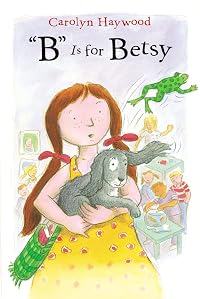
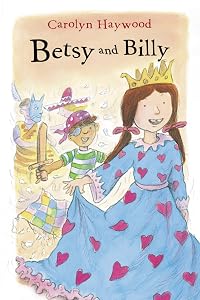
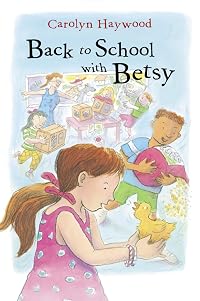
Betsy experiences an interesting first year in school and looks forward to summer vacation at her grandfather's farm.Tags
Recommendations










Member Reviews
More dated than some in the series; read Kathryn's careful review for details. I think it would be great to read these together and discuss the problematic bits... after all, when your children are independent readers, they'll encounter references to Indian braves, organ grinders' monkeys, etc. There are bits to love, too... I agree with Kathryn that the chapter where Betsy is naughty and picks violets without permission is delightful.
This is a perfectly simple and easy book for young children. Nothing special, but a solid school-and-everyday-life story.
I just have one problem with it, and that's chapter four, where they learn about How The Indians Lived.
Now, before I go further, I think I'll address some of the usual complaints here. No, I don't believe the author intended to be inaccurate or offensive. No, I don't believe you're a bad person if this is a beloved book from your childhood and you read it with your kids in the same way that your grandmother used to read it to you when you were sick. Yes, I am aware that this book was written in a different time.
However, we're not reading this book to children 60 years ago, we're reading it to children today. And even show more though the author probably didn't intend to say anything rude, she actually did.
Now, I'll give credit where it's due. Carolyn Haywood was careful to have the students in her book learn that the Native Americans were not one monolithic group that all live the same way. We're told that they learn that "some lived" in this sort of home and others lived in that sort of home and others still lived in a third sort of home.
This is all well and good. However, this emphasis on the past is the sort of thing that gives children the impression that the Native Americans all generously went away in the past and there aren't any left... or that there ARE some left, still living the way they did 500 years ago. If it were just this one book, that wouldn't matter, but virtually every time children see Native Americans in the media that's the message they get, and that's a problem. (I've even heard people relate anecdotes where somebody else told them they thought that "Indians" were just made up entirely!)
Also of note is the fact that the children are explicitly taught that the appropriate term for a Native American woman is "squaw" and their babies are "papooses". This, we're told, is the "Indian word".
Well, "squaw" is now (and possibly even then, my limited research is unclear on this) considered an offensive term in English, and papoose may or may not be. Personally, I find it unnecessarily dehumanizing to use a special term to refer to people of another race instead of just using the normal English word we use for everybody else.
So what are you going to do about it? Well, that probably depends on how you're using this book. If you're using it in the classroom, I suggest you just stop. Among other things, you cannot assume that your students are all the same as you. Either you're miseducating them or, worse, you have a Native American student in your class who may not appreciate this sort of stereotyping and language, no matter how unintentional. This is a nice little book, but it's not really one of the classics of children's literature that every child must read. You might make the argument for Little House on the Prairie, but this book isn't nearly so interesting or useful.
If you still want to read it - perhaps it's your favorite book from your own childhood, I can see that - and you're reading it aloud, you might just skip that chapter. It's not crucial to the story. Or you could skim over the relevant passages. Alternatively (and this would work if your child is reading the book to themselves) you might just give a warning before the fourth chapter that what you're saying is VERY old-fashioned and NOW we know it's inaccurate and impolite. This isn't ideal, but it's better than letting it stand uncommented upon.
All that aside, as I said before, it's really only an okay book. There are plenty of others at the same level of quality or better that have drifted out of print, and I'm not sure why this series is so beloved as to still be in print decades after it was first written. Unless this is, as said before, a dear and cherished book from your own childhood, you might want to pass it by. It's nothing special. show less
I just have one problem with it, and that's chapter four, where they learn about How The Indians Lived.
Now, before I go further, I think I'll address some of the usual complaints here. No, I don't believe the author intended to be inaccurate or offensive. No, I don't believe you're a bad person if this is a beloved book from your childhood and you read it with your kids in the same way that your grandmother used to read it to you when you were sick. Yes, I am aware that this book was written in a different time.
However, we're not reading this book to children 60 years ago, we're reading it to children today. And even show more though the author probably didn't intend to say anything rude, she actually did.
Now, I'll give credit where it's due. Carolyn Haywood was careful to have the students in her book learn that the Native Americans were not one monolithic group that all live the same way. We're told that they learn that "some lived" in this sort of home and others lived in that sort of home and others still lived in a third sort of home.
This is all well and good. However, this emphasis on the past is the sort of thing that gives children the impression that the Native Americans all generously went away in the past and there aren't any left... or that there ARE some left, still living the way they did 500 years ago. If it were just this one book, that wouldn't matter, but virtually every time children see Native Americans in the media that's the message they get, and that's a problem. (I've even heard people relate anecdotes where somebody else told them they thought that "Indians" were just made up entirely!)
Also of note is the fact that the children are explicitly taught that the appropriate term for a Native American woman is "squaw" and their babies are "papooses". This, we're told, is the "Indian word".
Well, "squaw" is now (and possibly even then, my limited research is unclear on this) considered an offensive term in English, and papoose may or may not be. Personally, I find it unnecessarily dehumanizing to use a special term to refer to people of another race instead of just using the normal English word we use for everybody else.
So what are you going to do about it? Well, that probably depends on how you're using this book. If you're using it in the classroom, I suggest you just stop. Among other things, you cannot assume that your students are all the same as you. Either you're miseducating them or, worse, you have a Native American student in your class who may not appreciate this sort of stereotyping and language, no matter how unintentional. This is a nice little book, but it's not really one of the classics of children's literature that every child must read. You might make the argument for Little House on the Prairie, but this book isn't nearly so interesting or useful.
If you still want to read it - perhaps it's your favorite book from your own childhood, I can see that - and you're reading it aloud, you might just skip that chapter. It's not crucial to the story. Or you could skim over the relevant passages. Alternatively (and this would work if your child is reading the book to themselves) you might just give a warning before the fourth chapter that what you're saying is VERY old-fashioned and NOW we know it's inaccurate and impolite. This isn't ideal, but it's better than letting it stand uncommented upon.
All that aside, as I said before, it's really only an okay book. There are plenty of others at the same level of quality or better that have drifted out of print, and I'm not sure why this series is so beloved as to still be in print decades after it was first written. Unless this is, as said before, a dear and cherished book from your own childhood, you might want to pass it by. It's nothing special. show less
This was a very quick read. Written in 1939 it has a nice old fashioned feeling to it. It reminded me of my growing up in the late 50s. I remember reading it as a child, but don't really remember my reactions to it. I would have read it in my first years at school. I think I would have liked the small town feel and the fact that Betsy was always looked after. Fun things happen, but nothing too scary or dangerous. Sweet.
School is terrible. Betsy doesn't know much, but she knows that. It's the first day of first grade, and Old Ned has told her stories about how horrible school was for him. But it turns out Old Ned is wrong: Betsy's teacher, Miss Grey, is nice, and the friends Betsy makes, Ellen and Billy, are even nicer. What with all the fun Betsy has and the things she learns - about tadpoles and the true meaning of Thanksgiving and much more - school might turn out to be one of her very favorite places!
Unfortunately dated, in some ways. But one star was for the mature way(I thought) that it handled anxiety.
Betsy is scared about going to first grade, but it turns out school is a great place. She learns about tadpoles and the true meaning of Thanksgiving, makes new friends, and has more fun than she'd ever imagined.
I loved these books as a school girl. - 2nd - 4th grade
Members
- Recently Added By
Lists

Favorite Childhood Books
1,651 works; 519 members

Childhood Favorites
427 works; 24 members

Best School Stories
219 works; 22 members

Sonlight Books
1,487 works; 25 members
Honey For a Child's Heart
1,152 works; 25 members

Before Austen Comes Aesop
318 works; 9 members
Children's Literature 1900 - 1950 in order
413 works; 8 members

Books We Loved As Children
603 works; 253 members

4th Grade Books
312 works; 5 members
Author Information

57+ Works 6,973 Members
Author and illustrator Carolyn Haywood was born in Philadelphia, Pennsylvania on January 3, 1898. She graduated from the Philadelphia High School for Girls and the Philadelphia Normal School in 1922. After teaching one year at the Friends Central School, she received a scholarship to the Pennsylvania Academy of Fine Arts. While there, she studied show more portrait painting for three years, spent one year studying in Europe, and came back to study illustration. Her first children's book, When I Grow Up, was published in 1931. She is best known for her books in the Betsy and Eddie series. The first book, B Is for Betsy, was published in 1939. Her other works include Snowbound with Betsy, Hello, Star, and Eddie's Friend, Boddles. Besides writing and illustrating her own books, she also painted children's portraits and painted murals in banks and schools in the Philadelphia area. She received the distinction of a Distinguished Daughter of Pennsylvania in 1969 and received the Pennsylvania Librarians Outstanding Pennsylvania Author Award in 1970. She stopped illustrating her own books in the 1970's, but started writing adult books including Book of Honor, a collection of biographies of famous Pennsylvanian women. She died of a stroke on January 11, 1990 at the age of 92. (Bowker Author Biography) show less
Series

Common Knowledge
- Canonical title
- B Is for Betsy
- Original publication date
- 1939
- People/Characters
- Betsy; Ellen
- Dedication
- To My Friend Who Owns Koala Bear This Book Is Lovingly Enscribed.
- First words
- Betsy lay in her little white bed.
- Last words
- (Click to show. Warning: May contain spoilers.)"Yes, school is lovely," said Betsy. "Gee up, Priscilla!"
Classifications
- Genres
- Children's Books, Fiction and Literature
- DDC/MDS
- 813.52 — Literature & rhetoric American literature in English American fiction in English 1900-1999 1900-1945
- LCC
- PZ7 .H31496 .B — Language and Literature Fiction and juvenile belles lettres Fiction and juvenile belles lettres Juvenile belles lettres
- BISAC
Statistics
- Members
- 1,047
- Popularity
- 24,697
- Reviews
- 10
- Rating
- (3.88)
- Languages
- English
- Media
- Paper, Audiobook, Ebook
- ISBNs
- 18
- ASINs
- 6