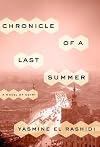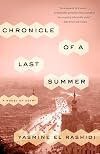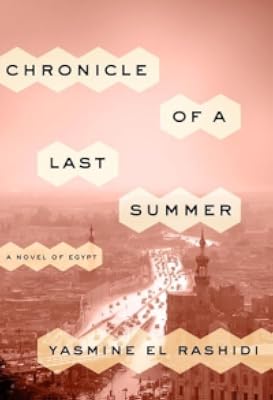
Chronicle of a Last Summer: A Novel of Egypt
by Yasmine El Rashidi
On This Page
Description
A young Egyptian woman recounts her personal and political coming of age in this brilliant debut novel.Cairo, 1984. A blisteringly hot summer. A young girl in a sprawling family house. Her days pass quietly: listening to a mother's phone conversations, looking at the Nile from a bedroom window, watching the three state-sanctioned TV stations with the volume off, daydreaming about other lives. Underlying this claustrophobic routine is mystery and loss. Relatives mutter darkly about the show more newly-appointed President Mubarak. Everyone talks with melancholy about the past. People disappear overnight. Her own father has left, too—why, or to where, no one will say.
We meet her across three decades, from youth to adulthood: As a six-year old absorbing the world around her, filled with questions she can't ask; as a college student and aspiring filmmaker pre-occupied with love, language, and the repression that surrounds her; and then later, in the turbulent aftermath of Mubarak's overthrow, as a writer exploring her own past. Reunited with her father, she wonders about the silences that have marked and shaped her life.
At once a mapping of a city in transformation and a story about the shifting realities and fates of a single Egyptian family, Yasmine El Rashidi's Chronicle of a Last Summer traces the fine line between survival and complicity, exploring the conscience of a generation raised in silence.
— Included in Wall Street Journal's "Summer's Top Ten Fiction Titles" in summer books preview
— Longlisted for PEN Open Book Award
— NPR's Book Concierge (2016's Great Reads.) show less
Tags
Recommendations


Member Reviews
"..to be a witness to history is a burden.," is what the narrator's uncle tells her. He also encourages her to write, to chronicle, to keep records. This is an evocative novel of a time and place, of coming of age, and blistering hot summers.. The people of Egypt, because of past memories, history and education as well as the weather, become languid, passive full of despair and inaction. Listless. Friends and family disappear. Her father is imprisoned. Her mother becomes depressed. Education goes down the drain. Everyone stops thinking. The colors of the walls in the apartment get darker. One summer, youths in kufiyyahs, dust curling around their knees, throw rocks, angry because all opportunity for future generations has evaporated and show more merged with the humidity of the languid polluted Nile. Those young men end up in morgues with phone numbers scrawled on their arms; the phone numbers of their mothers; they themselves scratched the numbers on their arms when they left their houses, knowing they might not return.
The writing of the novel itself is noteworthy. In the first 25% of the pages, the writer Yasmine El Rashidi, uses very short sentences. At times the simplicity is annoying. But the sentence structure eventually blossoms into more complex sentence structures, which embrace increasingly complex ideas about revolution, family, and Egyptian politics. In the end the mind, ideas and maturity of the narrator evolve full force in this paean to the value of life in country unable to accommodate those who live in it. We can thank El Rashidi for her artistic investigation and of the problems, both personal and political, in the modern world, as presented in this noteworthy first novel.
I look forward to her future works. show less
The writing of the novel itself is noteworthy. In the first 25% of the pages, the writer Yasmine El Rashidi, uses very short sentences. At times the simplicity is annoying. But the sentence structure eventually blossoms into more complex sentence structures, which embrace increasingly complex ideas about revolution, family, and Egyptian politics. In the end the mind, ideas and maturity of the narrator evolve full force in this paean to the value of life in country unable to accommodate those who live in it. We can thank El Rashidi for her artistic investigation and of the problems, both personal and political, in the modern world, as presented in this noteworthy first novel.
I look forward to her future works. show less
 This review was written for LibraryThing Early Reviewers.
"Chronicle of a Last Summer" records the impressions of the narrator during three pivotal summers in Egypt, 1984 when she is eight years old, 1998 and 2014. The prose captures the fundamental feelings and limits to her expression (especially at eight) without being painful to read. More importantly Rashidi expertly illustrates the interlaced emotional journey of the narrator as her opinions about what loyalty, country and home juxtaposed with a culture that values stability above most everything else.
I loved this book. The language was easy to read, but I think I'll be grappling with it's meaning for years to come. It's a beautiful look into a world I'd never seen before. I encourage you to check it out!
(cross-posted at my blog)
I loved this book. The language was easy to read, but I think I'll be grappling with it's meaning for years to come. It's a beautiful look into a world I'd never seen before. I encourage you to check it out!
(cross-posted at my blog)
This review was written for LibraryThing Early Reviewers.I received an ARC of this book through LibraryThing's Early Reviewers program.
Yasmine El Rashidi brings us this unique perspective into the chronic instability and uncertainty of middle class family life in Cairo. We see through the narrator's fearful lens three significant events in domestic Egyptian history, and the devastating consequences launched - deliberately or otherwise - by each. Assassination, military/police brutality, the Arab Spring: they're all trigger points that profoundly influence our narrator. Yasmine writes at times with floral prose, at others with fizzing pace, but always with vivid depiction of the raw emotional toll these effects on the narrator, her family and friends.
I thought the story ended rather show more abruptly and the initial scene-building less than optimal. Overall, though, a very thought-provoking read. Thank you! show less
Yasmine El Rashidi brings us this unique perspective into the chronic instability and uncertainty of middle class family life in Cairo. We see through the narrator's fearful lens three significant events in domestic Egyptian history, and the devastating consequences launched - deliberately or otherwise - by each. Assassination, military/police brutality, the Arab Spring: they're all trigger points that profoundly influence our narrator. Yasmine writes at times with floral prose, at others with fizzing pace, but always with vivid depiction of the raw emotional toll these effects on the narrator, her family and friends.
I thought the story ended rather show more abruptly and the initial scene-building less than optimal. Overall, though, a very thought-provoking read. Thank you! show less
This review was written for LibraryThing Early Reviewers.This tiny powerhouse of a first novel has a quiet, forceful personality. Through it, El Rashidi sets the reader within Egypt's tumultuous recent history, giving a glimpse of what Cairo is like in between the news stories, and what surviving and living in the city means to its long-suffering residents. This is not a historical novel that provides a lot of context or linear plot--rather, it focuses on providing a sense of place and a sense of temporal change.
This review was written for LibraryThing Early Reviewers.I found this book hard to get in to at first, though this often happens when the narration is given from the point of view of a child, which the first part of the novel is. Like the young narrator, I felt frustrated by my obvious lack of understanding of what other, adult characters were talking about and referring to, exacerbated greatly by my own non-existent knowledge of Egyptian history and politics.
However, once the second part of the novel got underway, when she is a young adult in university, I began to warm up to the book and was more able to connect with the protagonist. It is here that the narrator is beginning to contemplate her own complicity and responsibility in the future of her country--how does she work to remedy the show more problems she sees and make the country a better place for herself and her family, and those that will come after? It was this theme that made my interest perk up, as this is a question that many people in the U.S. are thinking in the wake of the most recent election.
"I also think of Uncle, warning Dido and me that in life we have to assess things and always take a position. It's all relative, he told us. I wonder if my position is often too ambiguous. A position of trying to weigh things and assess and be objective is sometimes a clear position, and sometimes no position at all. I think a lot about what it means to be a witness, the responsibility of it. I wonder about my writing, if fiction is a political statement or simply no position. Is the silence of objectivity and being an observer, witness, the same as complicity?"
I believe that it is important to look outwards from ourselves, from our own homes and countries, and seek connections and similarity in people unlike us in so many ways. The history of humanity is varied and immense, but it is also remarkably homogeneous and I think we could learn from our similarities and use them as tools to make the world better and more whole.
That being said, however, this is a book review, and as it comes to form and structure and narrative, themes the protagonist herself grapples with, I think this book falls short. Though the development of the narrator's consciousness through the separation of sections by age helped bring the reader into the action in a very effective way, I felt it did so too slowly. The writing was not terribly inviting or accessible or intriguing, even in its simplicity. Then again, perhaps that was El Rashidi's intention--to have us bear witness to the slow, interminable ways that countries fall apart and revolutions born of hope dissolve into the status quo. Like the way in which the Nile, which used to be so visible from the narrator's family home's balcony and from the street, slowly becomes hidden from view by ugly buildings and putrefies into undrinkable water, the reader slowly absorbs and becomes accustomed to the sadness we reconcile ourselves to, the price we pay to bear witness. show less
However, once the second part of the novel got underway, when she is a young adult in university, I began to warm up to the book and was more able to connect with the protagonist. It is here that the narrator is beginning to contemplate her own complicity and responsibility in the future of her country--how does she work to remedy the show more problems she sees and make the country a better place for herself and her family, and those that will come after? It was this theme that made my interest perk up, as this is a question that many people in the U.S. are thinking in the wake of the most recent election.
"I also think of Uncle, warning Dido and me that in life we have to assess things and always take a position. It's all relative, he told us. I wonder if my position is often too ambiguous. A position of trying to weigh things and assess and be objective is sometimes a clear position, and sometimes no position at all. I think a lot about what it means to be a witness, the responsibility of it. I wonder about my writing, if fiction is a political statement or simply no position. Is the silence of objectivity and being an observer, witness, the same as complicity?"
I believe that it is important to look outwards from ourselves, from our own homes and countries, and seek connections and similarity in people unlike us in so many ways. The history of humanity is varied and immense, but it is also remarkably homogeneous and I think we could learn from our similarities and use them as tools to make the world better and more whole.
That being said, however, this is a book review, and as it comes to form and structure and narrative, themes the protagonist herself grapples with, I think this book falls short. Though the development of the narrator's consciousness through the separation of sections by age helped bring the reader into the action in a very effective way, I felt it did so too slowly. The writing was not terribly inviting or accessible or intriguing, even in its simplicity. Then again, perhaps that was El Rashidi's intention--to have us bear witness to the slow, interminable ways that countries fall apart and revolutions born of hope dissolve into the status quo. Like the way in which the Nile, which used to be so visible from the narrator's family home's balcony and from the street, slowly becomes hidden from view by ugly buildings and putrefies into undrinkable water, the reader slowly absorbs and becomes accustomed to the sadness we reconcile ourselves to, the price we pay to bear witness. show less
This review was written for LibraryThing Early Reviewers.Yasmine El Rashidi's novel spans thirty years of summers in Cario, a lengthy mediation on revolution and the functioning of a capriciously repressive society but also a sad and beautiful story of change and loss and family. El Rashidi's Egypt is a place of beauty and wonder but also of confusion, privation, fear, and change, largely for the worse. Her writing is gorgeous, particularly in the first section, where it captures the curiosity and limited understanding of a child in perfect diction and tone. So much in her protagonist's world, then, and as it moves forward in time, is not talked about and cannot be talked about, and what emerges on the inside of that surrounding silence is a confusion about the past, under constant revision show more from all directions, and a profound lack of hope or even thought for the future. One of the recurring ideas is that revolution is a regular event but never changes anything; the events of the narrative undercut that to some degree but the overwhelming sense of the pointlessness of it all pervades the narrative. Notably missing is any sense particular of the hope that filled the West after the 2011 revolution - only the fear for friends and family, and, again, a sense of changelessness, a sense that everything is about connections and that it is only which connections matter that changes. It's a beautiful and very quick read, fascinating and sad and wonderful. I'd absolutely recommend it. show less
This review was written for LibraryThing Early Reviewers.Chronicle of a Last Summer is a small book about a big time in modern Egypt. The novel spans from 1984 to 2014, but only as small chapters in the life of a young woman living with her family in Cairo. In 1984 she is six and her father has recently left, but the reason is never made clear. Even when she is older there never seem to be answers. In this way author Yasmine El Rashidi sets a tone of disconnect that affects each of the remaining characters differently. Her mother withdraws, but a cousin becomes an activist and when the narrator gets older she goes to film school and writes.
The lack of answers that are the norm for a child’s life do not dissipate as the narrator gets older. Instead, she moves through her life with a silent show more mother who hardly leaves their house and only a male cousin to discuss with her what is happening within their country. As she starts to document life in the abstract he pushes her to become an active voice in the struggle for change. El Rashidi summarizes her mindset
Ours wasn’t a culture used to change. Permanency was valued. We lived in the same places we were born in. We married and moved around the corner. A job was held for decades. The less change, the less movement, the better.
The biggest thing I took away from Chronicle of a Last Summer was how little I knew of Egypt. I thought it was a more modern, progressive country, but in the novel daily power outages, unclean water and even ration books are facts of life.
The sense of ennui doesn’t change even after the Arab Spring when her cousin is arrested. The novel continues to be permeated with an enervating sense of no answers or accountability and meant that Chronicle left me with an oddly deflated feeling. From halfway around the world these felt like tumultuous times of great change, but the novel felt like the opposite—sad and small events with little or no impact. show less
The lack of answers that are the norm for a child’s life do not dissipate as the narrator gets older. Instead, she moves through her life with a silent show more mother who hardly leaves their house and only a male cousin to discuss with her what is happening within their country. As she starts to document life in the abstract he pushes her to become an active voice in the struggle for change. El Rashidi summarizes her mindset
Ours wasn’t a culture used to change. Permanency was valued. We lived in the same places we were born in. We married and moved around the corner. A job was held for decades. The less change, the less movement, the better.
The biggest thing I took away from Chronicle of a Last Summer was how little I knew of Egypt. I thought it was a more modern, progressive country, but in the novel daily power outages, unclean water and even ration books are facts of life.
The sense of ennui doesn’t change even after the Arab Spring when her cousin is arrested. The novel continues to be permeated with an enervating sense of no answers or accountability and meant that Chronicle left me with an oddly deflated feeling. From halfway around the world these felt like tumultuous times of great change, but the novel felt like the opposite—sad and small events with little or no impact. show less
This review was written for LibraryThing Early Reviewers.Members
- Recently Added By
Published Reviews
This well-wriiten book covers three bits of life of a young Egyptian girl. The first part is a summer when she is six, and trying to understand what is going on in her world. She only has a vague sense of what is happening, and the adults in her life aren't very forthcoming. Her father has disappeared, and she doesn't know where he is or if he is coming back.
In the second section, she is in show more college, a film student, but still restricted by the laws of her ever-changing country.
The last section is when she is a young adult, working as a writer. Her father returns, but we are never told where he was or why he came back. Her father doesn't come to the family home, and never comes to see his wife, but there's no real explanation of why he doesn't want to see her.
The book was well-written and very descriptive, but at the same time, I felt like I was missing something. It was very short, a quick and easy read, but I felt there should have been more details about the people involved. It left me with a lot of unanswered questions.
Overall, I liked it. I don't know much history of that part of the world during that time, and I feel I need to brush up on that history. Maybe that will give me a better understanding of some of the incidents in the book. show less
In the second section, she is in show more college, a film student, but still restricted by the laws of her ever-changing country.
The last section is when she is a young adult, working as a writer. Her father returns, but we are never told where he was or why he came back. Her father doesn't come to the family home, and never comes to see his wife, but there's no real explanation of why he doesn't want to see her.
The book was well-written and very descriptive, but at the same time, I felt like I was missing something. It was very short, a quick and easy read, but I felt there should have been more details about the people involved. It left me with a lot of unanswered questions.
Overall, I liked it. I don't know much history of that part of the world during that time, and I feel I need to brush up on that history. Maybe that will give me a better understanding of some of the incidents in the book. show less
added by BetseyG23
Lists

Books Read in 2016
4,666 works; 199 members

Africa
109 works; 8 members
Author Information

5+ Works 228 Members
Awards and Honors
Awards
Distinctions
Notable Lists
Common Knowledge
- Original publication date
- 2016
- Important places
- Egypt, Cairo
- Dedication
- for Seif, and for Julie
- First words
- The house was blistering.
- Last words
- (Click to show. Warning: May contain spoilers.)I watch as she then turns her neck, puts her hand on the side of her chair, as if seeking support, and looks in the direction of the Nile.
Classifications
Statistics
- Members
- 211
- Popularity
- 155,283
- Reviews
- 67
- Rating
- (3.35)
- Languages
- English
- Media
- Paper, Audiobook, Ebook
- ISBNs
- 5
- ASINs
- 2