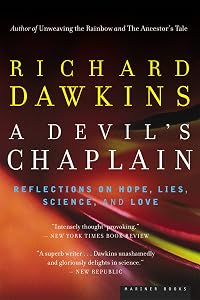
A Devil's Chaplain: Reflections on Hope, Lies, Science, and Love
by Richard Dawkins
On This Page
Description
The first collection of essays from renowned scientist and best-selling author Richard Dawkins is an enthusiastic declaration, a testament to the power of rigorous scientific examination to reveal the wonders of the world. In these essays Dawkins revisits the meme, the unit of cultural information that he named and wrote about in his groundbreaking work The Selfish Gene. Here also are moving tributes to friends and colleagues, including a eulogy for novelist Douglas Adams, author of The show more Hitchhiker's Guide to the Galaxy; correspondence with the evolutionary biologist Stephen Jay Gould; and visits with the famed paleoanthropologists Richard and Maeve Leakey at their African wildlife preserve. The collection ends with a vivid note to Dawkins's ten-year-old daughter, reminding her to remain curious, to ask questions, and to live the examined life.. show less
Tags
Recommendations





Member Reviews
It would no doubt discomfit Dawkins to know that I revere the words he writes with an almost religious zeal. I love his belligerence, I love his conviction, I love his passion. And I believe he's correct in his science. The closing essay is a letter to his daughter about how to decide what to believe, and it's brilliant. I liked learning more about the alleged feud between Dawkins and Stephen Jay Gould. I found myself taking notes about books mentioned in passing. A delightful book which reinforces all my prejudices.
Richard Dawkins more often than not is labeled arrogant, whther in print, in lecture or in person. Having read, listened and talked to Dawkins, I would be hard pressed to argue the contrary. Nevertheless, I still like him and what he has to say, even if I don't understand everything.
The Devil’s Chaplain is a collection of essays published in 2003, that according to the backleaf of the paperback, is “an enthusiastic declaration, a testament to the powers of rigorous scientific examination to reveal the wonders of the world.” Well, I think it is a wonderful collection ranging from the pedantic to the candid, from righteous to humble (if you look close, you’ll see this). He can be wittily entertaining and maddeningly academic, but show more never boring. And he doesn’t pull punches (no expects that anyway).
Dawkins grouped his essays into six (actually seven) sections and provides a foreword to each, explaining his choices for inclusion.
In “Science and Sensibility” he talks about Darwin (of course). He examines the relativity of truth as related to perspective, with science as the only real truth. He looks at the human ape family tree, ethics in genetic studies, relates his experiences as a jury member (prompting me to rethink the jury concept). Two of my favorite essays in this section look at quackery of new age crystal proponents and a brilliant review of “Intellectual Impostures” by Alan Sokal and Jean Bricmont (published in the US as “Fashionable Nonsense”)offering Dawkins’ Law of Conservation of Difficulty and a web link to a hilarious site: The Postmodernism Generator (http://www.elsewhere.org/cgi-bin/postmodern/” that “will spontaneously generate for you, using faultless grammatical principles, a spanking new postmodern discourse, never before seen.”
In “Light Will Be Thrown”, the chapters look at Darwinism’s effect outside biology and Darwinism as a universal truth. He also relates with palpable distaste his experience with the “murky underworld of creationist propaganda.” Within that chapter is a fascinating look at information transfer, one of the best, if dry, reads in the book.
In “The Infected Mind”, Dawkins concentrates all barrels on religion. He revisits memes and his view of religions as viruses of the mind. He dismisses claims of the convergence of science and religion, and does a number on the tendency to afford religious spokesmen a “privileged platform”, such as including their opinions in scientific discussions where they have no place.
“They Told Me, Heraclitus” is a collection of tributes and eulogies to Douglas Adams, W.D. Hamilton and John Diamond, the last exposing some of the snake oil masquerading as “alternative medicine.”
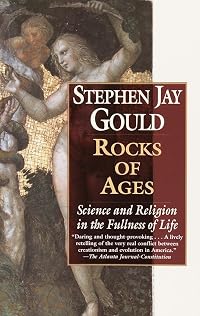
“Even the Ranks of Tuscany” blows the lid off the exaggerated conflict between Dawkins and Stephen Jay Gould. Dawkins freely admits he was neither close friends with Gould nor in agreement on their respective views of evolution, but he was highly respectful of Gould’s scientific approach and laudatory of Gould’s writing. The chapter contains some reviews of Gould’s books, both favorable and unfavorable, and concludes with a sad recounting of a final collaborative effort against the intelligent design movement that was cut short before publication by Gould’s death.
After a chapter on Africa, he concludes with a moving letter to his (then) ten year old daughter entitled "Good and Bad Reasons for Believing" show less
The Devil’s Chaplain is a collection of essays published in 2003, that according to the backleaf of the paperback, is “an enthusiastic declaration, a testament to the powers of rigorous scientific examination to reveal the wonders of the world.” Well, I think it is a wonderful collection ranging from the pedantic to the candid, from righteous to humble (if you look close, you’ll see this). He can be wittily entertaining and maddeningly academic, but show more never boring. And he doesn’t pull punches (no expects that anyway).
Dawkins grouped his essays into six (actually seven) sections and provides a foreword to each, explaining his choices for inclusion.
In “Science and Sensibility” he talks about Darwin (of course). He examines the relativity of truth as related to perspective, with science as the only real truth. He looks at the human ape family tree, ethics in genetic studies, relates his experiences as a jury member (prompting me to rethink the jury concept). Two of my favorite essays in this section look at quackery of new age crystal proponents and a brilliant review of “Intellectual Impostures” by Alan Sokal and Jean Bricmont (published in the US as “Fashionable Nonsense”)offering Dawkins’ Law of Conservation of Difficulty and a web link to a hilarious site: The Postmodernism Generator (http://www.elsewhere.org/cgi-bin/postmodern/” that “will spontaneously generate for you, using faultless grammatical principles, a spanking new postmodern discourse, never before seen.”
In “Light Will Be Thrown”, the chapters look at Darwinism’s effect outside biology and Darwinism as a universal truth. He also relates with palpable distaste his experience with the “murky underworld of creationist propaganda.” Within that chapter is a fascinating look at information transfer, one of the best, if dry, reads in the book.
In “The Infected Mind”, Dawkins concentrates all barrels on religion. He revisits memes and his view of religions as viruses of the mind. He dismisses claims of the convergence of science and religion, and does a number on the tendency to afford religious spokesmen a “privileged platform”, such as including their opinions in scientific discussions where they have no place.
“They Told Me, Heraclitus” is a collection of tributes and eulogies to Douglas Adams, W.D. Hamilton and John Diamond, the last exposing some of the snake oil masquerading as “alternative medicine.”
“Even the Ranks of Tuscany” blows the lid off the exaggerated conflict between Dawkins and Stephen Jay Gould. Dawkins freely admits he was neither close friends with Gould nor in agreement on their respective views of evolution, but he was highly respectful of Gould’s scientific approach and laudatory of Gould’s writing. The chapter contains some reviews of Gould’s books, both favorable and unfavorable, and concludes with a sad recounting of a final collaborative effort against the intelligent design movement that was cut short before publication by Gould’s death.
After a chapter on Africa, he concludes with a moving letter to his (then) ten year old daughter entitled "Good and Bad Reasons for Believing" show less
I really wanted to like this book. Richard Dawkins has contributed some terrific ideas to the field of biology, evolution and the philosophy of mind and is a well-known advocate for a number of very sensible and sadly unsung positions in an age of new-age hooey and post-modernist balderdash. In times such as ours it is all the more important for people who speak common sense to be heard, and there are few common sense speakers with a higher profile than Richard Dawkins.
While many of Dawkins' conclusions are laudable, his means of getting to some of them are not. Great physical scientists often make bad philosophers (witness Roger Penrose's embarrassing ramblings on the AI debate) and on the strength of these collected works, Dawkins show more falls squarely into this camp.
Dawkins has a bee in his bonnet about two things: post-modernism/relativism and religion. As intellectual positions, relativist and religious thought tend not to have much in common, yet Dawkins is wholeheartedly agin them both. Make note of that irony, because irony is the order of the day.
It is certainly easy enough to find examples of post-modernism to laugh at, and Dawkins indulges in some healthy banter of this sort. But the underlying premise on which relativism is based is sound: There *is* no such thing as "truth": our perception of the world *is* coloured by cultural and linguistic filters which mean that the same set of circumstances can present different "realities" to different observers. Whether Dawkins likes it or not, this isn't new age hooey.
Curiously, Dawkins actually makes this very point in the context of a discussion on crystals intended to undermine the relativist cause: the atoms in a crystalline structure, he tells us, are relatively huge distances from each other, so by volume most of a crystalline structure is composed of nothing. Yet, thanks to evolution, we don't see it that way: "You might think that out sense organs would be shaped to give us a 'true' picture of the world as it 'really' is. It is safer to assume that they have been shaped to give us a *useful* picture of the world, to help us survive." This inability to see the true picture, in Dawkins' very own example, has profound and (for a moral objectivist like Dawkins) unsettling implications for our world view.
It doesn't undermine science, however; it simply converts science from a process which purports to provide indubitable truths about the universe to one which claims only to provide the best explanation for the data we have to hand. Again, in philosophical circles this is hardly controversial - it's a consequence of the inductive nature of empirical reasoning. As Dawkins himself notes, the practical difference between these two positions ("objective truth" vs. "best explanation we've got for the time being") is not always great, but as a perspective it distinguishes science from dogma. It may be vanishingly unlikely, as Dawkins claims, that anyone will falsify the tenets of cell biology - but they probably said that about Newton's laws of motion until fairly recently too.
In rejecting all relativism, Dawkins comes across as extremely dogmatic. Given his views on religion, this is no small irony. Worse, it opens him - and, as its self-appointed spokesperson, science - to the now familiar criticism that science is just another religion, competing with creationism, and is no more defendable.
That's a bad mistake. Even on a relativist reading, evolution is far more defendable (there's not any evidence which flatly contradicts evolution, whereas there's not much evidence that *doesn't* flatly contradict creationism) and, because thanks to his profile Dawkins is frequently read as a proxy for "the scientific community" he is doing his community a big disservice.
As he is a committed atheist and evolutionist, I was surprised to read recently that Dawkins intended to vote Liberal Democrat (a left-of-centre political party in the UK) at the last election. I would have thought, of all people, Richard Dawkins would appreciate the elegance and efficiency of laissez-faire politics: it is laissez-faire biology, after all, which has provided us with this staggering universe; by contrast, Dawkins labels the creationist view "petty, small minded, parochial, unimaginative, unpoetic and downright boring compared to the staggering, mind expanding truth". Now a centrally planned economy, you would think, would tend to be similarly "parochial and small-minded" compared with an economy free to continually rejuvenate itself at the well-spring of supply and demand (and so, many economists would say, has been proven repeatedly in the last 90 years). But Dawkins cautions that to smell such an inconsistency or even contradiction would be a mistake: "there is no inconsistency in favouring Darwinism as an academic scientist while opposing it as a human being".
Well, I'm not so sure about that. And I'm not so sure that Richard Dawkins' isn't a little too defensive about some of his other cherished beliefs, either. show less
While many of Dawkins' conclusions are laudable, his means of getting to some of them are not. Great physical scientists often make bad philosophers (witness Roger Penrose's embarrassing ramblings on the AI debate) and on the strength of these collected works, Dawkins show more falls squarely into this camp.
Dawkins has a bee in his bonnet about two things: post-modernism/relativism and religion. As intellectual positions, relativist and religious thought tend not to have much in common, yet Dawkins is wholeheartedly agin them both. Make note of that irony, because irony is the order of the day.
It is certainly easy enough to find examples of post-modernism to laugh at, and Dawkins indulges in some healthy banter of this sort. But the underlying premise on which relativism is based is sound: There *is* no such thing as "truth": our perception of the world *is* coloured by cultural and linguistic filters which mean that the same set of circumstances can present different "realities" to different observers. Whether Dawkins likes it or not, this isn't new age hooey.
Curiously, Dawkins actually makes this very point in the context of a discussion on crystals intended to undermine the relativist cause: the atoms in a crystalline structure, he tells us, are relatively huge distances from each other, so by volume most of a crystalline structure is composed of nothing. Yet, thanks to evolution, we don't see it that way: "You might think that out sense organs would be shaped to give us a 'true' picture of the world as it 'really' is. It is safer to assume that they have been shaped to give us a *useful* picture of the world, to help us survive." This inability to see the true picture, in Dawkins' very own example, has profound and (for a moral objectivist like Dawkins) unsettling implications for our world view.
It doesn't undermine science, however; it simply converts science from a process which purports to provide indubitable truths about the universe to one which claims only to provide the best explanation for the data we have to hand. Again, in philosophical circles this is hardly controversial - it's a consequence of the inductive nature of empirical reasoning. As Dawkins himself notes, the practical difference between these two positions ("objective truth" vs. "best explanation we've got for the time being") is not always great, but as a perspective it distinguishes science from dogma. It may be vanishingly unlikely, as Dawkins claims, that anyone will falsify the tenets of cell biology - but they probably said that about Newton's laws of motion until fairly recently too.
In rejecting all relativism, Dawkins comes across as extremely dogmatic. Given his views on religion, this is no small irony. Worse, it opens him - and, as its self-appointed spokesperson, science - to the now familiar criticism that science is just another religion, competing with creationism, and is no more defendable.
That's a bad mistake. Even on a relativist reading, evolution is far more defendable (there's not any evidence which flatly contradicts evolution, whereas there's not much evidence that *doesn't* flatly contradict creationism) and, because thanks to his profile Dawkins is frequently read as a proxy for "the scientific community" he is doing his community a big disservice.
As he is a committed atheist and evolutionist, I was surprised to read recently that Dawkins intended to vote Liberal Democrat (a left-of-centre political party in the UK) at the last election. I would have thought, of all people, Richard Dawkins would appreciate the elegance and efficiency of laissez-faire politics: it is laissez-faire biology, after all, which has provided us with this staggering universe; by contrast, Dawkins labels the creationist view "petty, small minded, parochial, unimaginative, unpoetic and downright boring compared to the staggering, mind expanding truth". Now a centrally planned economy, you would think, would tend to be similarly "parochial and small-minded" compared with an economy free to continually rejuvenate itself at the well-spring of supply and demand (and so, many economists would say, has been proven repeatedly in the last 90 years). But Dawkins cautions that to smell such an inconsistency or even contradiction would be a mistake: "there is no inconsistency in favouring Darwinism as an academic scientist while opposing it as a human being".
Well, I'm not so sure about that. And I'm not so sure that Richard Dawkins' isn't a little too defensive about some of his other cherished beliefs, either. show less
A collection of essays, some scathing - an attack on 9/11 fundamentalism so much more pointed than in the God Delusion - , some poignant - a eulogy for his dead friend Douglas Adams. His letter to Tony Blair - "you can't have it both ways" - is a brilliantly rationalist argument for common sense. His disdain for postmodernist mumbo jumbo is as hilarious as it is revealing. Everybody should read this book.
A Devil's Chaplain is an eclectic collection of Dawkins essays, ranging from a rant against postmodernism, to insightful criticism of lifelong academic opponent Stephen Jay Gould, to haunting yet relevant conversations about the majestic beauty that is Africa.
The collection's strong point is precisely it's compartmentalism. Dawkins is a gifted writer: intelligent, funny, and poignant; but at times he can also be a bit much. With page lengths varying from 2 to 20, the essays in Devil's Chaplain are nice bite-sized chunks of Dawkins which allow you to walk away after 15 or 30 minutes if you've had enough for now.
High points of the collection include Postmodernism Disrobed, which is exactly what it sounds like, a beautiful and heartfelt show more discourse on the importance and meaning of a real education (The Joy of Living Dangerously), and some of the more science-heavy essays, which are great for an evolutionary-biology-virgin such as myself in terms of accessibility and informativity. Low points include a heavy-handedness which could often be done without, a clearly overly-inflated sense of self-importance (brought out by his repeated self-reference when pretending to sing the praises of others), and a chapter on Douglas Adams which I found to be self-indulgent.
Heartily recommended for newcomers to evolutionary biology or Richard Dawkins himself, but with a cautionary note that not all of the essays included in this volume necessarily deserved to be. show less
The collection's strong point is precisely it's compartmentalism. Dawkins is a gifted writer: intelligent, funny, and poignant; but at times he can also be a bit much. With page lengths varying from 2 to 20, the essays in Devil's Chaplain are nice bite-sized chunks of Dawkins which allow you to walk away after 15 or 30 minutes if you've had enough for now.
High points of the collection include Postmodernism Disrobed, which is exactly what it sounds like, a beautiful and heartfelt show more discourse on the importance and meaning of a real education (The Joy of Living Dangerously), and some of the more science-heavy essays, which are great for an evolutionary-biology-virgin such as myself in terms of accessibility and informativity. Low points include a heavy-handedness which could often be done without, a clearly overly-inflated sense of self-importance (brought out by his repeated self-reference when pretending to sing the praises of others), and a chapter on Douglas Adams which I found to be self-indulgent.
Heartily recommended for newcomers to evolutionary biology or Richard Dawkins himself, but with a cautionary note that not all of the essays included in this volume necessarily deserved to be. show less
It's always a pleasure to read Dawkins, who thinks for himself and thinks well. The last chapter alone makes the book worthwhile. It is a letter to his 10-year-old daughter about how to start deciding whether or not to believe something she is told. Man, could 100 million Americans profit from it today (2021) if they ever read from this kind of book! I saw news today about renewed interest in UFOs and so expect stories again from people who claim they got ushered into one and probed, just like people swore to in the 1950s.
A Devil's Chaplain is a collection of short prose selections by Richard Dawkins, most of which have been published previously. It includes book reviews, essays, op-eds, in memoriams, and forewords to others' works.
Dawkins' writing here is for the most part less highly polished than it is in his long works. Somewhat annoyingly, many of the arguments set forth in A Devil's Chaplain are recycled from Dawkins' earlier books, or have since been recycled in his later ones. As always, Dawkins' biological arguments are first rate, but his forays into religion, law, politics, and even the non-biological sciences tend to run long on pith and short on substance. For instance, Dawkins' critique of the Anglo-American jury system (pp. show more 38-41)—comparing it unfavorably with the scientific method—is utterly fallacious. One doesn't empanel a jury as a means to extrapolate the universal laws that govern the universe; one empanels a jury to suss out what happened on a particular occasion. The methods employed vary according to the ends to be achieved.
Likewise, Dawkins makes the questionable assertion that the reason we perceive solid objects as solid objects, even though they are actually composed largely of the empty space between atoms, is a result of evolution by natural selection (p. 46). I'm neither a physicist nor a biologist, but pending further investigation, I'm more inclined to believe that the reason I perceive such objects as solid is because, whatever their internal structure, the photons that make up the visible spectrum don't pass through them to strike my retinas.
In short, there's plenty here to quibble about. There's also plenty to admire. There's a lovely lament for Douglas Adams. There are four book reviews on various works by Stephen Jay Gould. (These, by the way, lack some of the fire I had anticipated, though they do build steam towards the end). And the true jewel of this collection is an open letter to the author's young daughter, explaining simply and without rancor the reasons to cultivate a skepticism with respect to religious claims. It's the sort of essay that really could calm the weary soul of many a troubled young freethinker. It could have calmed mine. show less
Dawkins' writing here is for the most part less highly polished than it is in his long works. Somewhat annoyingly, many of the arguments set forth in A Devil's Chaplain are recycled from Dawkins' earlier books, or have since been recycled in his later ones. As always, Dawkins' biological arguments are first rate, but his forays into religion, law, politics, and even the non-biological sciences tend to run long on pith and short on substance. For instance, Dawkins' critique of the Anglo-American jury system (pp. show more 38-41)—comparing it unfavorably with the scientific method—is utterly fallacious. One doesn't empanel a jury as a means to extrapolate the universal laws that govern the universe; one empanels a jury to suss out what happened on a particular occasion. The methods employed vary according to the ends to be achieved.
Likewise, Dawkins makes the questionable assertion that the reason we perceive solid objects as solid objects, even though they are actually composed largely of the empty space between atoms, is a result of evolution by natural selection (p. 46). I'm neither a physicist nor a biologist, but pending further investigation, I'm more inclined to believe that the reason I perceive such objects as solid is because, whatever their internal structure, the photons that make up the visible spectrum don't pass through them to strike my retinas.
In short, there's plenty here to quibble about. There's also plenty to admire. There's a lovely lament for Douglas Adams. There are four book reviews on various works by Stephen Jay Gould. (These, by the way, lack some of the fire I had anticipated, though they do build steam towards the end). And the true jewel of this collection is an open letter to the author's young daughter, explaining simply and without rancor the reasons to cultivate a skepticism with respect to religious claims. It's the sort of essay that really could calm the weary soul of many a troubled young freethinker. It could have calmed mine. show less
Members
- Recently Added By
Lists

Atheism, humanism, freethought, &c. — Best nonfiction books in favour of
167 works; 14 members
Author Information

76+ Works 64,053 Members
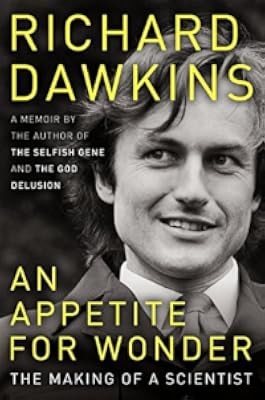
Richard Dawkins was educated at Oxford University and taught zoology at the University of California and Oxford University, holding the position of the Charles Simonyi Professor of the Public Understanding of Science. He writes about such topics as DNA and genetic engineering, virtual reality, astronomy, and evolution. His books include The show more Selfish Gene, The Extended Phenotype, The Blind Watchmaker, River Out of Eden, Climbing Mount Improbable, The God Delusion, and An Appetite for Wonder: The Making of a Scientist. (Bowker Author Biography) show less
Some Editions
Awards and Honors
Distinctions
Notable Lists
Common Knowledge
- Canonical title*
- Il cappellano del diavolo
- Original title
- A devil's chaplain : selected essays by Richard Dawkins (UK) (UK); A devil's chaplain : reflections on hope, lies, science, and love
- Original publication date
- 2003
- Dedication
- For Juliet on her Eighteenth Birthday
- Blurbers
- Eldredge, Niles; Ahlstrom, Dick; Harries, Richard; Carey, John; Lambton, Christopher; Pagel, Mark (show all 16); Simons, Geoff; Coyne, Jerry; Maddox, John, Sir; Fogg, Claire; Malik, Kenan; McKie, Robin; Macfarlane, Robert; Holloway, Richard; Fernyhough, Charles; Grayling, A. C.
- Original language
- English UK
*Some information comes from Common Knowledge in other languages. Click "Edit" for more information.
Classifications
Statistics
- Members
- 1,840
- Popularity
- 11,796
- Reviews
- 20
- Rating
- (3.89)
- Languages
- 11 — Chinese, Dutch, English, Greek, Hungarian, Italian, Polish, Portuguese, Russian, Spanish, Turkish
- Media
- Paper, Ebook
- ISBNs
- 17
- UPCs
- 2
- ASINs
- 14