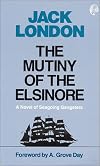
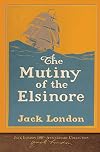
The Mutiny of the Elsinore
by Jack London
On This Page
Description
Life has lost its savor for Mr. Pathurst. New York, fame, women, and the arts have all become tedious. Searching for excitement, he books passage on a cargo vessel sailing from Baltimore to Seattle on a route that travels around the treacherous Cape Horn. Pathurst encounters more than he ever expected in rough seas, turbulent storms, and a mutinous crew. His epic struggles aboard the sailing ship Elsinore have given him a new love for life, but will he survive to profit from it?Everyone who show more remembers The Sea Wolf with pleasure will enjoy this vigorous narrative. The Mutiny of the Elsinore is the same kind of tale as its famous predecessor, and it has been pronounced even more stirring by those who have read it. Jack London writes of scenes and types of people with which he is very familiar: the sea and ships and those who live in ships. In addition to the adventure element, of which there is an abundance of the usual London kind, there is a thread of romance. The play of incident-on the one hand the ship's amazing crew and on the other the lovers-results in a story that demonstrates anew what a master of his art the author is. show lessTags
Recommendations


























Member Reviews
Really this is a botched job with some unpleasant overtones, however there are plenty of chapters (there are over fifty) when London does create some excitement and the whole thing is drenched in an atmosphere peculiarly its own.
Published in 1914 just two years before Jack London’s death the book has the feel of being written by an author who only had half a mind on the story. A very rich American (Mr Pathurst) has hired a passage on the Elsinore; a large cargo sailing ship. Apart from the captains daughter he and his servant are the only passengers and his accommodation is a suite of rooms second only to the state rooms occupied by the Captain. The crew of the ship have been hired from the dregs of the labour market and are bullied show more and beaten into some sort of shape by the indomitable first mate Mr Pike. London occupies over half of the novel with the description of the journey out to Cape Horn, it is told in the first person by Pathurst who observes the degenerate crew from his lofty position on the poop deck while he gathers information from his servant Wada (he himself does not mix with or acknowledge the crew) or from around the Captains table where he picks up gossip and scrutinises Mr Pike and the second mate. The crew can barely manage the ship and they suffer inhuman treatment from the officers, because as Pathurst would have us believe they are less than human. The Elsinore gets into difficulties trying to round the Cape, Pathurst falls in love with the Captains daughter and there is a mutiny, people are murdered and Pathurst is stirred into action when he has to take command of the ailing ship.
By far the best sections of the novel are the descriptions of the voyage itself and the conditions on board a sailing ship that must battle against storms and heavy seas. The epic journey around Cape Horn is brilliantly described and could have only been written by someone who has first hand knowledge and a level of seamanship that rings with authenticity. London can make the reader feel every roll of the ship and every crash of the greybeards over the deck. The mutiny when it does come seems like an anti climax especially as the reader is in no doubt that it will not succeed. How can it when the mutineers are a degenerate bunch of criminals who dare to raise issues with the blond haired master race that is the officer class. Yes! that is exactly how London describes the society on board the Elsinore:
"And we sit on the poop, Miss West and I, tended by our servants, sipping afternoon tea, sewing fancy work, discussing philosophy and art, while a few feet away from us, on this tiny floating world, all the grimy, sordid, tragedy of sordid, malformed life plays itself out……. and over this menagerie of beasts Margaret and I, with our Asiatics under us rule top-dog, we are all dogs there is no getting away from it. And we the fair pigmented ones, by the seed of our ancestry rulers in the high places, shall remain top dogs over the rest of the dogs”
Pathurst hardly lets an opportunity pass, when he is not describing the virtues of the blond master race over the brunettes below him. These views make uncomfortable reading especially when uttered by the hero of the novel who is telling the story. Naked racism from a pure bred American will not sit easy with many people especially when backed up with a philosophy that hammers home these views. It does make this reader wonder why Jack London should dress his hero in this putrid garb, which must have raised warning bells even in 1914.
This is a disjointed novel, there are gaps in the narrative and the love story is weak and unconvincing. I can understand why it is barely read today; even though there have been three film versions (none recently). When Jack London is describing the sailing ship battling against the elements and life on board during a difficult journey he is utterly convincing, when he is writing about almost everything else he is not and so 2.5 stars for a novel that wallows too much in its own slime. show less
Published in 1914 just two years before Jack London’s death the book has the feel of being written by an author who only had half a mind on the story. A very rich American (Mr Pathurst) has hired a passage on the Elsinore; a large cargo sailing ship. Apart from the captains daughter he and his servant are the only passengers and his accommodation is a suite of rooms second only to the state rooms occupied by the Captain. The crew of the ship have been hired from the dregs of the labour market and are bullied show more and beaten into some sort of shape by the indomitable first mate Mr Pike. London occupies over half of the novel with the description of the journey out to Cape Horn, it is told in the first person by Pathurst who observes the degenerate crew from his lofty position on the poop deck while he gathers information from his servant Wada (he himself does not mix with or acknowledge the crew) or from around the Captains table where he picks up gossip and scrutinises Mr Pike and the second mate. The crew can barely manage the ship and they suffer inhuman treatment from the officers, because as Pathurst would have us believe they are less than human. The Elsinore gets into difficulties trying to round the Cape, Pathurst falls in love with the Captains daughter and there is a mutiny, people are murdered and Pathurst is stirred into action when he has to take command of the ailing ship.
By far the best sections of the novel are the descriptions of the voyage itself and the conditions on board a sailing ship that must battle against storms and heavy seas. The epic journey around Cape Horn is brilliantly described and could have only been written by someone who has first hand knowledge and a level of seamanship that rings with authenticity. London can make the reader feel every roll of the ship and every crash of the greybeards over the deck. The mutiny when it does come seems like an anti climax especially as the reader is in no doubt that it will not succeed. How can it when the mutineers are a degenerate bunch of criminals who dare to raise issues with the blond haired master race that is the officer class. Yes! that is exactly how London describes the society on board the Elsinore:
"And we sit on the poop, Miss West and I, tended by our servants, sipping afternoon tea, sewing fancy work, discussing philosophy and art, while a few feet away from us, on this tiny floating world, all the grimy, sordid, tragedy of sordid, malformed life plays itself out……. and over this menagerie of beasts Margaret and I, with our Asiatics under us rule top-dog, we are all dogs there is no getting away from it. And we the fair pigmented ones, by the seed of our ancestry rulers in the high places, shall remain top dogs over the rest of the dogs”
Pathurst hardly lets an opportunity pass, when he is not describing the virtues of the blond master race over the brunettes below him. These views make uncomfortable reading especially when uttered by the hero of the novel who is telling the story. Naked racism from a pure bred American will not sit easy with many people especially when backed up with a philosophy that hammers home these views. It does make this reader wonder why Jack London should dress his hero in this putrid garb, which must have raised warning bells even in 1914.
This is a disjointed novel, there are gaps in the narrative and the love story is weak and unconvincing. I can understand why it is barely read today; even though there have been three film versions (none recently). When Jack London is describing the sailing ship battling against the elements and life on board during a difficult journey he is utterly convincing, when he is writing about almost everything else he is not and so 2.5 stars for a novel that wallows too much in its own slime. show less
Apparently this is London's worst work where he is quite the racial supremacist while being very poor at 'doing' romance. While some parts were gripping in the lead-up to the climax, the long slow anti-climax was disappointing, although one could imagine such things happening on the high seas. I doubt that London was being such a racial supremacist in the spirit of the noble savage à la Joseph Conrad or Rudyard Kipling, rather he added this to his somewhat awkward class commentary while at the same time trying to write a Boy's Own story. However, I wonder if I would have been so put-off by the book if the short introduction did not tell me how awful the book was, compared with London's other works, before I had even started.
Wow. I did not remotely understand how very racist Jack London was until I read this book. I think the concept of mutiny was interesting and the approach made sense, but the protag was so very pompous about his so-called right to rule. I am very tempted to revise this as a satire.
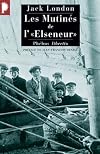
Illustré par les photos du film de Pierre Chenal.
Oct 7, 2014French
Ratings
Members
- Recently Added By
Lists

The Works of Jack London
44 works; 1 member
Author Information

1,795+ Works 81,404 Members
One of the pioneers of 20th century American literature, Jack London specialized in tales of adventure inspired by his own experiences. London was born in San Francisco in 1876. At 14, he quit school and became an "oyster pirate," robbing oyster beds to sell his booty to the bars and restaurants in Oakland. Later, he turned on his pirate show more associates and joined the local Fish Patrol, resulting in some hair-raising waterfront battles. Other youthful activities included sailing on a seal-hunting ship, traveling the United States as a railroad tramp, a jail term for vagrancy and a hazardous winter in the Klondike during the 1897 gold rush. Those experiences converted him to socialism, as he educated himself through prolific reading and began to write fiction. After a struggling apprenticeship, London hit literary paydirt by combining memories of his adventures with Darwinian and Spencerian evolutionary theory, the Nietzchean concept of the "superman" and a Kipling-influenced narrative style. "The Son of the Wolf"(1900) was his first popular success, followed by 'The Call of the Wild" (1903), "The Sea-Wolf" (1904) and "White Fang" (1906). He also wrote nonfiction, including reportage of the Russo-Japanese War and Mexican revolution, as well as "The Cruise of the Snark" (1911), an account of an eventful South Pacific sea voyage with his wife, Charmian, and a rather motley crew. London's body broke down prematurely from his rugged lifestyle and hard drinking, and he died of uremic poisoning - possibly helped along by a morphine overdose - at his California ranch in 1916. Though his massive output is uneven, his best works - particularly "The Call of the Wild" and "White Fang" - have endured because of their rich subject matter and vigorous prose. (Bowker Author Biography) show less
Some Editions
Series
Belongs to Publisher Series
Work Relationships
Common Knowledge
- Original title
- The Mutiny of the Elsinore
- Original publication date
- 1914
- Related movies
- The Mutiny of the Elsinore (1920 | IMDb); The Mutiny of the Elsinore (1937 | IMDb); Les mutinés de l'Elseneur (1936 | IMDb)
Classifications
Statistics
- Members
- 187
- Popularity
- 174,207
- Reviews
- 4
- Rating
- (3.45)
- Languages
- 11 — Czech, English, Finnish, French, German, Italian, Latin, Norwegian (Bokmål), Russian, Spanish, Swedish
- Media
- Paper, Audiobook, Ebook
- ISBNs
- 81
- ASINs
- 19