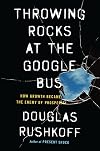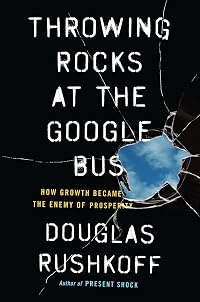
Throwing Rocks at the Google Bus
by Douglas Rushkoff
On This Page
Description
"Why doesn't the explosive growth of companies like Facebook and Uber deliver more prosperity for everyone? What is the systemic problem that sets the rich against the poor and the technologists against everybody else? When protesters shattered the windows of a bus carrying Google employees to work, their anger may have been justifiable, but it was misdirected. The true conflict of our age isn't between the unemployed and the digital elite, or even the 99 percent and the 1 percent. Rather, a show more tornado of technological improvements has spun our economic program out of control, and humanity as a whole--the protesters and the Google employees as well as the shareholders and the executives--are all trapped by the consequences. It's time to optimize our economy for the human beings it's supposed to be serving. In this groundbreaking book, acclaimed media scholar and author Douglas Rushkoff tells us how to combine the best of human nature with the best of modern technology. Tying together disparate threads--big data, the rise of robots and AI, the increasing participation of algorithms in stock market trading, the gig economy, the collapse of the Eurozone--Rushkoff provides a critical vocabulary for our economic moment and a nuanced portrait of humans and commerce at a critical crossroads."-- show lessTags
Recommendations







Member Reviews
Interesting ideas, somewhat overoptimistic and gets a bit repetitive driving home the same point over and over. Like many idealists whilst imagining the future world of plenty he assumes that everyone on the planet is as nice a person as he is. It's like those people have never seen a bell curve or experienced a prisoner's dilemma situation in real life.
This is a nitpick but it sometimes gets a bit new-agey with all those homely, artisan, hand-made, heirloom, tactile things and at the end goes off the rails pointing at the pope, the Amish and aboriginal farmers as sources of knowledge. I assume we should learn how to treat women from the Amish and how to profit from money laundering from the pope. The author's rose tinted glasses just show more don't do it for me. show less
This is a nitpick but it sometimes gets a bit new-agey with all those homely, artisan, hand-made, heirloom, tactile things and at the end goes off the rails pointing at the pope, the Amish and aboriginal farmers as sources of knowledge. I assume we should learn how to treat women from the Amish and how to profit from money laundering from the pope. The author's rose tinted glasses just show more don't do it for me. show less
Dan Dreiberg: What happened to us? What happened to the American Dream?
Edward Blake: "What happened to the American Dream?" It came true! You're lookin' at it...
- Watchmen (Allan Moore) - 1999 directed Zack Snyder.
Doug Rushkoff's premise cannot be more pertinent than now - very thought provoking , warning us of the pitfalls of technological advances which can end up becoming an existential threat to humanity itself . However the problem does not lie with technology i.e robotics , machine learning etc which is tipped at eliminating 40-50% of all jobs by 2040 affecting blue collar to executives ; but rather in the way current financial systems operate where near term profits trumps longterm sustenance .
Behemoths like amazon,facebook etc show more which started or at least claim to be forebear's of egalitarian , altruistic views of "bringing people together" eventually end up eliminating people all together and reducing them to data which can be mined by algorithms only to be sold to the highest bidder and creating a alternative economy of "likes","tweets" which do not create any value to human-life but rather perpetuate a quasi realistic realm of equality and connecting people .
I knew certain aspects like the concept of the modern day worker's alienation from production was something Marx had theorized centuries ago and eventual pathological neurosis with symptoms from apathy and lack of accountability , since the current "worker" has no real stake other than paying mortgage debts and keeping his head above water .
However Rushkoff's sites some important differences eg. how the operational model of Uber and SideCar differs and how to keep investors and general populous engaged meaningfully in the future , since we are no longer battling scarcity anymore - we have an abundance and but cannot profit from it . show less
Edward Blake: "What happened to the American Dream?" It came true! You're lookin' at it...
- Watchmen (Allan Moore) - 1999 directed Zack Snyder.
Doug Rushkoff's premise cannot be more pertinent than now - very thought provoking , warning us of the pitfalls of technological advances which can end up becoming an existential threat to humanity itself . However the problem does not lie with technology i.e robotics , machine learning etc which is tipped at eliminating 40-50% of all jobs by 2040 affecting blue collar to executives ; but rather in the way current financial systems operate where near term profits trumps longterm sustenance .
Behemoths like amazon,facebook etc show more which started or at least claim to be forebear's of egalitarian , altruistic views of "bringing people together" eventually end up eliminating people all together and reducing them to data which can be mined by algorithms only to be sold to the highest bidder and creating a alternative economy of "likes","tweets" which do not create any value to human-life but rather perpetuate a quasi realistic realm of equality and connecting people .
I knew certain aspects like the concept of the modern day worker's alienation from production was something Marx had theorized centuries ago and eventual pathological neurosis with symptoms from apathy and lack of accountability , since the current "worker" has no real stake other than paying mortgage debts and keeping his head above water .
However Rushkoff's sites some important differences eg. how the operational model of Uber and SideCar differs and how to keep investors and general populous engaged meaningfully in the future , since we are no longer battling scarcity anymore - we have an abundance and but cannot profit from it . show less
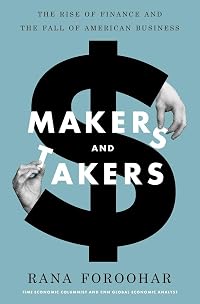
It is obvious that the economic system we have now is not working as well as it might for most. The US is an incredibly wealthy and prosperous nation that is filled with people struggling to get by today and who are uncertain about the future. In this book, Douglas Rushkoff, a professor at Queens College, CUNY, explains why. He summarizes the problem succinctly in this sentence: "People who work for a living are suffering under a system designed to favor those who make their money with money." (Page 138) This isn't a new insight. Karl Marx made it in the 19th Century. Rana Foroohar showed how it applied to today's world in [book:Makers and Takers: The Rise of Finance and the Fall of American Business|26150584].
Rushkoff proposes a new show more business model that focuses on sustaining value rather than on extracting value. This, too, has been suggested before. (See [book:The New Grand Strategy: Restoring America's Prosperity, Security, and Sustainability in the 21st Century|25663574]; [book:Saving Capitalism: For the Many, Not the Few|24338377], and [book:Capital in the Twenty-First Century|18736925].) Digital currencies and peer to peer trading facilitated by digital technology could be a part of this. (See [book:The History of Money|103226].)
As with many books on this subject, there are valid insights about the problems of our current economic system. The perpetual growth it demands is unsustainable. A system that prioritizes extraction of wealth rather than creation of value is ultimately destined to collapse. I've yet to read a book on this subject that I thought provided an achievable way out of the problem, though, this one included. Top down solutions require a far more functional (and possibly dictatorial) government than we have, and bottom up solutions rely on a seemingly impossible mass enlightenment of people who suddenly and miraculously decide it is now time to act for the common good. Call my cynical, but I doubt that's going to happen. show less
Rushkoff proposes a new show more business model that focuses on sustaining value rather than on extracting value. This, too, has been suggested before. (See [book:The New Grand Strategy: Restoring America's Prosperity, Security, and Sustainability in the 21st Century|25663574]; [book:Saving Capitalism: For the Many, Not the Few|24338377], and [book:Capital in the Twenty-First Century|18736925].) Digital currencies and peer to peer trading facilitated by digital technology could be a part of this. (See [book:The History of Money|103226].)
As with many books on this subject, there are valid insights about the problems of our current economic system. The perpetual growth it demands is unsustainable. A system that prioritizes extraction of wealth rather than creation of value is ultimately destined to collapse. I've yet to read a book on this subject that I thought provided an achievable way out of the problem, though, this one included. Top down solutions require a far more functional (and possibly dictatorial) government than we have, and bottom up solutions rely on a seemingly impossible mass enlightenment of people who suddenly and miraculously decide it is now time to act for the common good. Call my cynical, but I doubt that's going to happen. show less
This book lost me only a couple pages in. I don't like to waste my time on speculations that are based off of generalizations. Either put in the research, or narrow your focus. I was hoping this book would view growth from the lens of Google the company, but all it did was meander uselessly and speculate. Didn't even get past 100 pages.
This has some interesting points but is very hard to read. The author comes across as paranoid and smug and a conspiracy theorist. Do not recommend.
sustainability and reasonable profit over unrealistic growth objectives that largely benefit the 1%
Ratings
Members
- Recently Added By
Lists

The Hermenautic Bookshelf
111 works; 7 members
Author Information

61+ Works 4,256 Members
Douglas Rushkoff was born on February 18, 1961. After graduating from Princeton University he received an MFA in Directing from California Institute of the Arts. He has written numerous magazine columns on topics including cyberculture and has been aired on CBS Sunday Morning and NPR's All Things Considered and published in The New York Times and show more Time magazine. Rushkoff has taught at the MaybeLogic Academy, NYU's Interactive Telecommunications Program, and the Esalen Institute, and he teaches media studies at the New School University. Rushkoff lectures around the world about media, art, society, and change at conferences and universities. He consults to museums, governments, synagogues, churches, universities, and companies on new media arts and ethics. Rushkoff won the first Neil Postman award for Career Achievement in Public Intellectual Activity. He is on the Boards of the Media Ecology Association, The Center for Cognitive Liberty and Ethics, Technorealism, The National Association for Media Literacy Education, MeetUp.com, and Hyperwords. His bestselling books include graphic novels, Cyberia, Media Virus, Playing the Future, Nothing Sacred: The Truth about Judaism, Get Back in the Box: Innovation from the Inside Out, Coercion, and Life Inc. (Bowker Author Biography) show less
Common Knowledge
- Canonical title
- Throwing Rocks at the Google Bus
- Original publication date
- 2017
Classifications
- Genres
- Economics, Nonfiction, Business, Technology
- DDC/MDS
- 303.48 — Society, government, & culture Social sciences, sociology & anthropology Social processes Social change Causes of change
- LCC
- HC79 .I55 .R87 — Social sciences Economic history and conditions Economic history and conditions Special topics
- BISAC
Statistics
- Members
- 215
- Popularity
- 151,963
- Reviews
- 6
- Rating
- (3.49)
- Languages
- English
- Media
- Paper, Audiobook, Ebook
- ISBNs
- 7
- ASINs
- 4