On This Page
Description
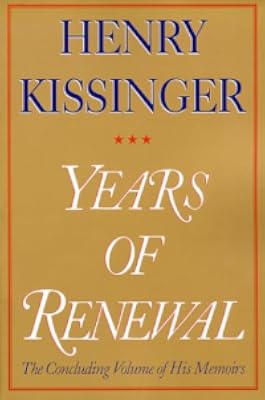
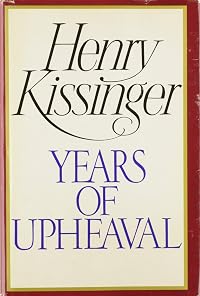
"Perhaps the best-known American diplomatist of this century, Henry Kissinger is a major figure in world history, winner of the Nobel Peace Prize, and arguably one of the most brilliant minds ever placed at the service of American foreign policy, as well as one of the shrewdest, best-informed, and most articulate figures ever to occupy a position of power in Washington." "The third and final volume of his memoirs completes a major work of contemporary history. It is at once an historical show more document and a narrative of almost Shakespearean intensity, full of startling insights, unusual (and often unsparing) candor, and a sweeping sense of history." "Above all, here are intimate, candid, and sharply intelligent portraits of world leaders, from Mao Zedong teasing Kissinger with a characteristic mixture of brutality and acerbic subtlety, to Leonid Brezhnev, confused, unwell, desperately trying to conceal the Soviet Union's growing difficulties with a facade of blustering bravado, as well as a galaxy of European, Middle Eastern, Asian, Latin American, and African leaders."--Jacket. show lessTags
Recommendations

















Member Reviews
I have to admit, the bastard can write. It's frankly a gift that we have such a clear-sighted and readable account of what went on in the mind of one of the most consequential (for good and for very bad) statesmen of the 20th century. While it didn't make me come out on Kissinger's side, it did bring home that he was very often the voice of reason in a truly scary White House. That the roots of Reagan/Bush-style neoconservatism were already present in the Nixon and Ford administrations is very clear in this volume, even if Kissinger doesn't quite address it.
Henry Kissinger wrote his final volume of memoirs, Years of Renewal, in 1999, at the cusp of the new millennium and in the final years of the Clinton Administration. Why did he wait nearly two decades to publish this volume? White House Years came out in 1979 amidst the foreign policy disasters of President Jimmy Carter. The book’s tone, coupled with its colossal size, exudes an Ivy League public intellectual’s not-so-veiled justification for his service in the Nixon Administration and its foreign policy successes. It is a classic example of using the genre of the political memoir to explain why Kissinger was on the right side of history. In the late Seventies, with the Gas Crisis, the Hostage Crisis, and an earnest, honest, utterly show more inept Georgia peanut farmer in the Oval Office, it seemed Kissinger made a compelling case.
The second volume, Years of Upheaval, arrived in 1981, ready for the bookshelves of Reagan Revolution apparatchiks. With the Gipper residing at 1600 Pennsylvania Avenue playing the greatest role of his career (not counting the movie he did with the chimp), America was ready for a change, including deregulating the banking industry and a little missiles-for-hostages do-se-do. The Nixon Crew was never well liked among the Movement Republicans, with Watergate as the Five O’clock Shadow of Executive Privilege Run Amok. Richard Nixon, the Grand Poobah of Red-baiters, poor Quaker son from Whittier, California, entered the White House on a strong platform of Law and Order, ended up dragging nearly his entire administration to the slammer in a political apocalypse of criminality, corruption, and paranoia. Kissinger gives an insider view of the slow-motion train wreck of Watergate and how the Nixon White House under siege undermined its foreign policy goals. The best bits are the conversations with the various dictators, despots, and deranged authoritarians, all comforting Henry K. by saying, “In our country, Watergate would never happen.” They should know, since they have the disappearances, mass graves, and Black Marias to prove it. But hey, at least those murderous psychopaths with absolute power weren’t Communists.
The first and second volumes each topped out with at one thousand pages (White House Years is a ludicrous 1400 pages long). Years of Renewal, by contrast, has only 1079 pages (not counting the Notes and Index). Besides the short length, Kissinger spends ninety pages summarizing Nixon’s foreign policy legacy, Nixon’s personal background, and justifying the crimes of Watergate. By all accounts, Years of Renewal comes off as rather slight.
Kissinger’s final volume recounts his years in the Ford Administration and the array of foreign policy challenges ranging from apartheid to ethnic wars and even a little piracy. The post-Nixon White House is a chronicle of a foredoomed presidency, the end of shuttle diplomacy in the Middle East, the unraveling of détente, and the rise of the neoconservatives in the Republican Party. Kissinger regales the reader with his trademark style, an admixture of academic pedantry, sly wit, and diplomatic genius.
For a much longer critique of Kissinger's shenanigans in the Ford Years, see the link below:
http://driftlessareareview.com/2012/06/25/years-of-renewal-1999-by-henry-kissing... show less
The second volume, Years of Upheaval, arrived in 1981, ready for the bookshelves of Reagan Revolution apparatchiks. With the Gipper residing at 1600 Pennsylvania Avenue playing the greatest role of his career (not counting the movie he did with the chimp), America was ready for a change, including deregulating the banking industry and a little missiles-for-hostages do-se-do. The Nixon Crew was never well liked among the Movement Republicans, with Watergate as the Five O’clock Shadow of Executive Privilege Run Amok. Richard Nixon, the Grand Poobah of Red-baiters, poor Quaker son from Whittier, California, entered the White House on a strong platform of Law and Order, ended up dragging nearly his entire administration to the slammer in a political apocalypse of criminality, corruption, and paranoia. Kissinger gives an insider view of the slow-motion train wreck of Watergate and how the Nixon White House under siege undermined its foreign policy goals. The best bits are the conversations with the various dictators, despots, and deranged authoritarians, all comforting Henry K. by saying, “In our country, Watergate would never happen.” They should know, since they have the disappearances, mass graves, and Black Marias to prove it. But hey, at least those murderous psychopaths with absolute power weren’t Communists.
The first and second volumes each topped out with at one thousand pages (White House Years is a ludicrous 1400 pages long). Years of Renewal, by contrast, has only 1079 pages (not counting the Notes and Index). Besides the short length, Kissinger spends ninety pages summarizing Nixon’s foreign policy legacy, Nixon’s personal background, and justifying the crimes of Watergate. By all accounts, Years of Renewal comes off as rather slight.
Kissinger’s final volume recounts his years in the Ford Administration and the array of foreign policy challenges ranging from apartheid to ethnic wars and even a little piracy. The post-Nixon White House is a chronicle of a foredoomed presidency, the end of shuttle diplomacy in the Middle East, the unraveling of détente, and the rise of the neoconservatives in the Republican Party. Kissinger regales the reader with his trademark style, an admixture of academic pedantry, sly wit, and diplomatic genius.
For a much longer critique of Kissinger's shenanigans in the Ford Years, see the link below:
http://driftlessareareview.com/2012/06/25/years-of-renewal-1999-by-henry-kissing... show less
香港大學歷史系
Jul 2, 2025Chinese, traditional
Ratings
Members
- Recently Added By
Published Reviews
ThingScore 100
Working from archives not yet open to historians, Kissinger has produced the memoirist's equivalent of a battleship, intimidating in appearance, heavy with armor and bristling with armaments, equipped to fire salvos at past critics while launching pre-emptive strikes against histories as yet unwritten. It is, by any standard, a remarkable achievement.
added by Shortride
Lists

Books Referenced by Khalidi's The Hundred Years' War on Palestine
181 works; 1 member

Books in the Bibliography of The Cold War by John Lewis Gaddis
192 works; 1 member
Author Information

90+ Works 9,146 Members
Former Secretary of State Henry Kissinger is the recipient of the Nobel Peace Prize, the Presidential Medal of Freedom, and the Medal of Liberty. He is the bestselling author of numerous books, including Years of Renewal and Diplomacy. Dr. Kissinger is currently the chair of Kissinger Associates, Inc., an international consulting firm. Born in show more Germany and a U.S. citizen since 1943, he lives in New York. Henry Kissinger was born in Fuerth, Germany on May 27, 1923. He came to the United States in 1938 and became a United States citizen in 1943. He served in the Army from 1943 to 1946. He graduated summa cum laude from Harvard College in 1950 and received M.A. and Ph.D. degrees from Harvard University in 1952 and 1954. From 1954 until 1969 he was a member of the faculty of Harvard University. He was the United States Secretary of State from September 22, 1973, until January 20, 1977. He also served as Assistant to the President for National Security Affairs from January 20, 1969, until November 3, 1975. He also held positions on the National Bipartisan Commission on Central America, the President's Foreign Intelligence Advisory Board, the Commission on Integrated Long-Term Strategy of the National Security Council and Defense Department, and the Defense Policy Board. He received several awards for his diplomatic work including the Nobel Peace Prize in 1973, the Presidential Medal of Freedom in 1977, and the Medal of Liberty in 1986. He has written numerous books including American Foreign Policy, A World Restored: Metternich, Castlereagh and the Problems of Peace, 1812-22, The White House Years, Years of Upheaval, Diplomacy, Years of Renewal, and On China. In 2014, his book entitled World Order was listed as a New York Times bestseller. He has also published numerous articles on United States foreign policy, international affairs and diplomatic history. He is currently the chairman of Kissinger Associates, Inc., an international consulting firm. (Bowker Author Biography) show less
Awards and Honors
Distinctions
Series

Belongs to Publisher Series
Work Relationships
Common Knowledge
- Original title
- A world restored : Metternich, Castlereagh and the problems of peace, 1812-22
- Original publication date
- 1999; 1957
- First words*
- È naturale che un'epoca minacciata dalla dsitruzione atomica guardi con nostalgia ai periodi in cui la diplomazia comportava rischi meno gravi, in cui le guerre erano limitate, e una catastrofe quasi inimmaginabile. E non st... (show all)upisce che, in tali circostanze, la pace diventasse l'obiettivo prioritario o che già il solo bisogno di pace fosse sentito come un incentivo sufficiente a raggiungerla.
INTRODUZIONE
Quando la sconfitta di Napoleone in Russia costrinse inaspettatamente l'Europa ad assumersi la responsablità di costruire un nuovo ordine internazionle, i problemi dell'Austria assunsero una qualità quasi simbolica, per mot... (show all)ivi geografici e storici. - Quotations*
- Entrambi fallirono e riuscirono a un tempo; Castlereagh nel fare dell'Inghilterra un membro permanente del concerto europeo; Metternich nel tutelare quel principio di legittimità per fondare il quale aveva così duramente l... (show all)ottato. Ma le loro conquiste non furono certo trascurabili: un periodo di pace che durò quasi cento anni, una stabilità così calibrata e diffusa da aver forse contribuito a preparare la catastrofe. Perché, nel lungo intervallo di pace, si perdette il senso del tragico; si dimenticò che gli stati potevano morire, che i rivolgimenti potevano essere irrecuperabili, che la paura poteva divenire veicolo di coesione sociale. La gioia isterica che percorse l'Europa allo scoppio dell prima guerra mondiale fu l'espressione di un'età superficiale ma anche sicura di sé. Rivelava una fede millenaristica, la speranza di un mondo che avesse tutti i vantaggi dell'età edoardiana, resi ancora più gradevoli dall'assenza di corse agli armamenti e della paura della guerra.
Dallo studio degli affari esteri - degli stati che agiscono come unità - non si possono trarre cpnclusioni significative, se non si tiene conto del contesto storico. Le società esistono, infatti, più nel tempo che nello sp... (show all)azio. A un dato momento, uno stato non è che una collezione di individui, come non si sono mai stancati di far notare gli studiosi positivisti; ma il senso della sua identità lo raggiunge attraverso la coscienza di una storia comune. Questa è la sola «esperienza» di cui dispongono le nazioni, la loro unica possibilità di imparare da se stesse. La storia è la memoria degli stati.
Certo, gli stati tendono a dimenticare. Non capita di frequente che imparino dal passato, ed è ancora più raro che ne traggano conclusioni corrette. Le lezioni dell'esperienza storica, come di quella individuale, sono contingenti: additano le conseguenze di certi atti, ma non possono costringere a riconoscere situazioni analoghe.
Un popolo può rendersi conto delle probabili conseguenze di una rivoluziione, ma questa conoscenza sarà inuitle se non sapràriconoscere una situazione rivoluzionaria. - Last words*
- (Click to show. Warning: May contain spoilers.)C'è tuttavia una differenza tra conoscenza fisica e conoscenza storica: a ogni generazione è concesso in solo atto d'astrazione; essa può tentare un'unicca interpretazione e un unico esperimento, perché è essa stessa il proprio soggetto. Questa è la sfida della storia e la sua tragedia, la forma che prende il «destino» su questa terra. E affrontarla con successo, o anche solo riconoscerla, è forse il compito più arduo dello statista.
- Original language
- English
*Some information comes from Common Knowledge in other languages. Click "Edit" for more information.
Classifications
- Genres
- Nonfiction, History, Biography & Memoir, General Nonfiction, Politics and Government
- DDC/MDS
- 973.924 — History & geography History of North America United States 1901- Cold War, Vietnam War, Digital Age (1953-2001) Richard Nixon (1969-1974) Watergate Scandal, U.S. withdrawal from Vietnam
- LCC
- E840.8 .K58 .A3 — History of the United States United States Later twentieth century, 1961-2000 Biography (General)
- BISAC
Statistics
- Members
- 420
- Popularity
- 73,916
- Reviews
- 3
- Rating
- (3.35)
- Languages
- 7 — Bulgarian, Czech, English, French, German, Italian, Portuguese
- Media
- Paper, Ebook
- ISBNs
- 16
- UPCs
- 1
- ASINs
- 5