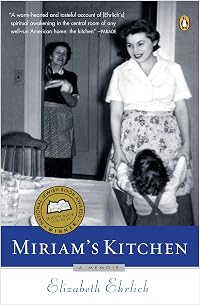
Miriam's Kitchen: A Memoir
by Elizabeth Ehrlich
On This Page
Description
Like many Jewish Americans, Elizabeth Ehrlich was ambivalent about her background. She identified with Jewish cultural attitudes, but not with the institutions; she had fond memories of her Jewish grandmothers, but she found their religious practices irrelevant to her life. It wasn't until she entered the kitchen--and world--of her mother-in-law, Miriam, a Holocaust survivor, that Ehrlich began to understand the importance of preserving the traditions of the past. As Ehrlich looks on, Miriam show more methodically and lovingly prepares countless kosher meals while relating the often painful stories of her life in Poland and her immigration to America. These stories trigger a kind of religious awakening in Ehrlich, who--as she moves tentatively toward reclaiming the heritage she rejected as a young woman--gains a new appreciation of life's possibilities, choices, and limitations. show lessTags
Recommendations

















Member Reviews
In this short and savory memoir, Ehrlich takes us through the months of the year, incorporating stories of Jewish life, her own struggles with Jewish identity, and her mother-in-law Miriam's recipes. She tells us in the introduction that she has "unwrapped a bundle of family tales, many located in or near the kitchen." In these, she writes, she "found wisdom and innovation and the fading rituals and habits of an assimilating clan." As she learns to cook traditional dishes from Miriam, she also learns to value her heritage and the grounding that comes from "preserving complicated rites." She adds her doubts and failures to the catalog, but ends up treasuring and honoring through replication the "reliable standard" of her religion. The show more recipes are incredibly simple, and the taste, as the author observes, "is not of invention, but of a moment lost, a moment recovered, a moment in time." Besides the recipes, the lessons, and the self-examination, many will delight in reminiscences of paneled basements, satin suitcase pockets, and coming-of-age trips to Paris. A lovely compilation, that you can use for a cookbook as well.
(JAF) show less
(JAF) show less
The author examines her year-long quest to "build a floor" under her children by reconnecting to her Jewish roots and keeping a kosher kitchen. The Miriam of the title is her mother-in-law, but the author's grandmothers are also inspiration for keeping a kosher kitchen. The memories of their lives and influence over the author and her family are woven throughout the book.
The book is divided up into twelve chapters, one for each month of the year, each beginning with the author's diary entry examining her struggle to lead herself and her family towards kosher living. In the beginning, she and her generation call themselves Jewish while retaining vestiges of Jewish tradition, such as lighting candles on Friday night, or saying prayers for show more the dead, but lead increasingly secular lives: celebrating Christmas, running errands on Saturday morning instead of going to shul, and eating pork.
The women in this novel are defined by their kitchens, which for the author is a reflection of their faith. A scrupulously clean, kosher kitchen is a duty of the devout Jewish women described within these pages, and the glue that holds their kosher families together. It is a difficult task. There are the separate sets of dishes, containers, sponges, and cooking utensils to keep track of. There's the unwavering examination of what goes into your belly in order to not mix meat and dairy, making eating-out an all but impossible luxury. But with the kosher kitchen comes a more devout life: attending prayer services, sending the kids to Hebrew school, observing a restful Sabbath, observing all the holy days, even visiting a mikvah (ritual bath). The values of food, faith, and family are intertwined to promote a sense of togetherness that is sought after and celebrated by the author.
Recipes of the mouth-watering food described in detail are provided in each chapter, but it is emphasized that the old Jewish comfort food of the author's grandparents' generation is a dying art that recipes cannot quite capture. Women like Miriam, who were displaced and pushed from turbulent country to turbulent country before settling in America, don't use measuring cups, food processors, or other modern kitchen accessories. They use eyes and hands, and years of experience to let them know when the mixture is just right or when the cake is done. They also cook without the modern reservations against sugar, cholesterol, and fat; no wonder their foods are so beloved by subsequent generations, who are raised on diet food and health warnings.
Through this book we journey along with the author on what is means to be Jewish in today's world, while blending traditions of the past with the demands of the modern world, and coming to a compromise that is respectful and true to Judaism, as well as to the family. In the end, there's a message of hope. The old neighborhoods may change, the close-knit communities disperse, the delis and kosher bakeries close, but as long as the culture remains alive in the next generation, there is hope. show less
The book is divided up into twelve chapters, one for each month of the year, each beginning with the author's diary entry examining her struggle to lead herself and her family towards kosher living. In the beginning, she and her generation call themselves Jewish while retaining vestiges of Jewish tradition, such as lighting candles on Friday night, or saying prayers for show more the dead, but lead increasingly secular lives: celebrating Christmas, running errands on Saturday morning instead of going to shul, and eating pork.
The women in this novel are defined by their kitchens, which for the author is a reflection of their faith. A scrupulously clean, kosher kitchen is a duty of the devout Jewish women described within these pages, and the glue that holds their kosher families together. It is a difficult task. There are the separate sets of dishes, containers, sponges, and cooking utensils to keep track of. There's the unwavering examination of what goes into your belly in order to not mix meat and dairy, making eating-out an all but impossible luxury. But with the kosher kitchen comes a more devout life: attending prayer services, sending the kids to Hebrew school, observing a restful Sabbath, observing all the holy days, even visiting a mikvah (ritual bath). The values of food, faith, and family are intertwined to promote a sense of togetherness that is sought after and celebrated by the author.
Recipes of the mouth-watering food described in detail are provided in each chapter, but it is emphasized that the old Jewish comfort food of the author's grandparents' generation is a dying art that recipes cannot quite capture. Women like Miriam, who were displaced and pushed from turbulent country to turbulent country before settling in America, don't use measuring cups, food processors, or other modern kitchen accessories. They use eyes and hands, and years of experience to let them know when the mixture is just right or when the cake is done. They also cook without the modern reservations against sugar, cholesterol, and fat; no wonder their foods are so beloved by subsequent generations, who are raised on diet food and health warnings.
Through this book we journey along with the author on what is means to be Jewish in today's world, while blending traditions of the past with the demands of the modern world, and coming to a compromise that is respectful and true to Judaism, as well as to the family. In the end, there's a message of hope. The old neighborhoods may change, the close-knit communities disperse, the delis and kosher bakeries close, but as long as the culture remains alive in the next generation, there is hope. show less
This is definitely an interesting read but I found myself trying to push myself to read certain parts of it.
The narrative is choppy and keeps jumping from her own childhood to the time she spends with Miriam, her mother in law.
The parts about Miriam was a pleasure to read and very intriguing. The other parts is a very mixed bag and I didn't care much for most of it.
Ultimately, I would still recommend this if you enjoy this genre.
The narrative is choppy and keeps jumping from her own childhood to the time she spends with Miriam, her mother in law.
The parts about Miriam was a pleasure to read and very intriguing. The other parts is a very mixed bag and I didn't care much for most of it.
Ultimately, I would still recommend this if you enjoy this genre.
A combination of a story about Miriam, the author's mother-in-law, her own gradually increasing level of observance (I empathized), and Miriam's recipes. I enjoyed reading everything, including the recipes, but was not inspired to try them.
Miriam’s Kitchen, by Elizabeth Ehrlich, is a unique memoir in its format. Alternating between recipes, the past and the present, Ehrlich presents a strong message for the Jewish kitchen, memories and familial connections.
The recipes in the book are quite detailed, from not only the cooking aspect, but the extensive preparation beforehand, that Miriam infuses into each one. Her kosher kitchen is more than that. It illuminates her life’s story, and without her ability and desire to continue her traditions, Miriam would not be the mentor she has become to Elizabeth.
Elizabeth has learned much from Miriam, and not only about cooking, but about her husband’s ancestry. The format alternates between Miriam’s kitchen and life and show more Elizabeth’s.
Elizabeth Ehrlich has brought us a unique look at Jewish life, Jewish customs and traditions, and Jewish culture and assimilation into American life within the pages of Miriam’s Kitchen. It is a book I recommend, for its look into Jewish culture and history, Jewish life and rituals, not to mention the amazing recipes included in the book. show less
The recipes in the book are quite detailed, from not only the cooking aspect, but the extensive preparation beforehand, that Miriam infuses into each one. Her kosher kitchen is more than that. It illuminates her life’s story, and without her ability and desire to continue her traditions, Miriam would not be the mentor she has become to Elizabeth.
Elizabeth has learned much from Miriam, and not only about cooking, but about her husband’s ancestry. The format alternates between Miriam’s kitchen and life and show more Elizabeth’s.
Elizabeth Ehrlich has brought us a unique look at Jewish life, Jewish customs and traditions, and Jewish culture and assimilation into American life within the pages of Miriam’s Kitchen. It is a book I recommend, for its look into Jewish culture and history, Jewish life and rituals, not to mention the amazing recipes included in the book. show less
it's not a normal book for me to read- but then i haven't been reading many of my "normal" books lately, anyways. i really enjoyed this book because the author is able to vocalize a lot of how i feel about my heritage and culture. a lot of me wishes my family was more in touch with our past and was closer to "the old country"- which ever country that is... i love the culture part of being jewish and would like to get more in touch with it...
Poignant with just a taste of vanilla.....a sweet heartfelt book of growth and experience.
Members
- Recently Added By
Author Information
2 Works 456 Members
Awards and Honors
Awards
Common Knowledge
- Original publication date
- 1997
- Dedication
- For Leonand the three who joined us
- First words
- My grandmother used to sit before her stove on a tall, four-legged stool, stirring sweet-and-sour cabbage soup in a white enamel pot, dishing out salty perceptions of life. [beginning of Introduction]
Work and house and errands and physical fitness and activities and things. The expediences of every day. This cannot be all there is. [beginning of "September"]
I write to my mother about this and that. [beginning of "A Coal Stove"] - Last words
- (Click to show. Warning: May contain spoilers.)It is as good as any soup I ever have had.
- Blurbers
- Daphne Merkin
Classifications
Statistics
- Members
- 447
- Popularity
- 68,777
- Reviews
- 10
- Rating
- (4.17)
- Languages
- English
- Media
- Paper, Ebook
- ISBNs
- 3
- ASINs
- 1