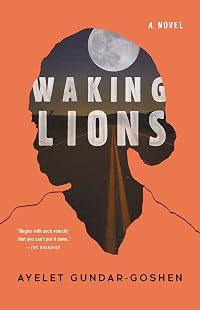
Waking Lions
by Ayelet Gundar-Goshen
On This Page
Description
After neurosurgeon Eitan Green hits and kills an African migrant while driving on a deserted road late at night, the victim's wife tracks him down and confronts him the next day, and her price for silence shatters his safe existence.Tags
Recommendations











Member Reviews
The setting of this novel is the city of Beersheba - the upscale suburb of Omer and the desert margins to its south; but much of the action takes place in the minds of its main protagonists. This is perhaps not surprising, as the author, whose second novel this is, as well as being an award-winning scriptwriter, is also trained as a clinical psychologist.
Eitan, a brain surgeon, has just moved to Omer with his policewoman wife Liat and two young children. He has been transferred to a Beersheba hospital following a dispute with his head of department in Tel Aviv. Driving his SUV at night on a desert road, trying to unwind after a long session in surgery, he hits an Eritrean immigrant and injures him fatally. Eitan, knowing that there is show more no chance that the man he has run over can survive his injuries, and with a panicked instinct for self-preservation, drives off and returns home. However, his victim’s wife has seen the accident, and shows up at Eitan’s home the next morning with his wallet, that he had dropped at the scene. With the hold she has over him, Sirkit forces Eitan into a relationship with her and the community of illegal immigrants trying to survive in the shadows of Israeli society.
This is essentially a story about the psychology of prejudice and discrimination; about how people who live on the margins of society are seen as less than people; how they are perceived as an undifferentiated group, all sharing the identical attributes, and treated accordingly. Eitan is forced to see them - in particular the woman on whose good will his future now depends - as individuals. An unlikely love triangle develops - between Eitan, his wife and the Eritrean woman - but in this novel it plays out only in the minds of the three protagonists.
The continuous exposure of the inner lives of the protagonists is exhaustive, and creates an intensity and tension to the unfolding of the plot. Eitan is a very honest man whose exile to Beersheba came about because of his refusal to countenance the less-than-honest behaviour of his Tel Aviv boss. This magnifies the guilt he feels about the hit-and-run incident with which the novel opens and about his developing feelings for Sirkit. Liat, who has learned to trust in someone only after a long and cautious trial, fights hard against the suspicions that her husband’s increasingly erratic behaviour is arousing in her. Sirkit, who has always known that the best chance of survival comes from being submissive, keeping her eyes averted from others’ gaze, is traumatised by her new self-assertiveness. The problem - if there is one - is that it is not just the principal protagonists who are subject to this analytical treatment. The details we learn about the childhood and background of several bit-players are just Too Much Information. The author’s attempt to explore in this way the mindset of Bedouin Arabs and the prejudices against them, as another marginalised part of Israeli society, is just a distraction from her main theme, and falls short.
The novel, originally written in Hebrew and masterfully translated, is unself-conscious about its Israeli/Jewish setting. Although the details are specific to Israel - the illegal immigrants are Eritreans who have made it on foot from the Horn of Africa, surviving the crossing of the Sinai with unscrupulous Bedouin people-smugglers - it could be taking place anywhere in the world. The prejudices it explores are not in this case racial - Israel is after all a multi-racial society - but are the prejudices and fears of society in relation to uninvited newcomers, which obstruct any normal tendency to know or empathise with them as people. It has much relevance for the situation that has developed in Europe over the last few years, where these same prejudices undoubtedly have played a part in fuelling populist anti-immigrant sentiment. The novel is gripping and credible, both at the level of the personal relationships between the main characters, and also at the level of the societal interactions within which these relationships are set. show less
Eitan, a brain surgeon, has just moved to Omer with his policewoman wife Liat and two young children. He has been transferred to a Beersheba hospital following a dispute with his head of department in Tel Aviv. Driving his SUV at night on a desert road, trying to unwind after a long session in surgery, he hits an Eritrean immigrant and injures him fatally. Eitan, knowing that there is show more no chance that the man he has run over can survive his injuries, and with a panicked instinct for self-preservation, drives off and returns home. However, his victim’s wife has seen the accident, and shows up at Eitan’s home the next morning with his wallet, that he had dropped at the scene. With the hold she has over him, Sirkit forces Eitan into a relationship with her and the community of illegal immigrants trying to survive in the shadows of Israeli society.
This is essentially a story about the psychology of prejudice and discrimination; about how people who live on the margins of society are seen as less than people; how they are perceived as an undifferentiated group, all sharing the identical attributes, and treated accordingly. Eitan is forced to see them - in particular the woman on whose good will his future now depends - as individuals. An unlikely love triangle develops - between Eitan, his wife and the Eritrean woman - but in this novel it plays out only in the minds of the three protagonists.
The continuous exposure of the inner lives of the protagonists is exhaustive, and creates an intensity and tension to the unfolding of the plot. Eitan is a very honest man whose exile to Beersheba came about because of his refusal to countenance the less-than-honest behaviour of his Tel Aviv boss. This magnifies the guilt he feels about the hit-and-run incident with which the novel opens and about his developing feelings for Sirkit. Liat, who has learned to trust in someone only after a long and cautious trial, fights hard against the suspicions that her husband’s increasingly erratic behaviour is arousing in her. Sirkit, who has always known that the best chance of survival comes from being submissive, keeping her eyes averted from others’ gaze, is traumatised by her new self-assertiveness. The problem - if there is one - is that it is not just the principal protagonists who are subject to this analytical treatment. The details we learn about the childhood and background of several bit-players are just Too Much Information. The author’s attempt to explore in this way the mindset of Bedouin Arabs and the prejudices against them, as another marginalised part of Israeli society, is just a distraction from her main theme, and falls short.
The novel, originally written in Hebrew and masterfully translated, is unself-conscious about its Israeli/Jewish setting. Although the details are specific to Israel - the illegal immigrants are Eritreans who have made it on foot from the Horn of Africa, surviving the crossing of the Sinai with unscrupulous Bedouin people-smugglers - it could be taking place anywhere in the world. The prejudices it explores are not in this case racial - Israel is after all a multi-racial society - but are the prejudices and fears of society in relation to uninvited newcomers, which obstruct any normal tendency to know or empathise with them as people. It has much relevance for the situation that has developed in Europe over the last few years, where these same prejudices undoubtedly have played a part in fuelling populist anti-immigrant sentiment. The novel is gripping and credible, both at the level of the personal relationships between the main characters, and also at the level of the societal interactions within which these relationships are set. show less
I found the beginning of this book making me very uncomfortable. That was not because of the hit and run accident that began the book, but it was more about Dr. Eitan Green's forced relationship to a group of poor, black, and sickly Eritrean immigrants to Israel. Eitan was a successful, married neurosurgeon and father of two boys. The character who stood out the most was a sort of a mysterious Eritrean woman named Sirkit whom we learn more about as the story advances. Extreme inequality always makes me uncomfortable, but this book set this contemporary Israeli social problem directly in front of me.
Not only did I have to deal with a doctor facing a moral dilemma in a repugnant manner, but I also had to face his attraction to a woman show more with whom he should have had no contact as well as to deal with his uncompromising arrogance. I had to keep telling myself that this was only a story in order to continue reading it!
This book was ultimately about all about lies and race. So many despicable and poor choices were made by the characters! The book hit a turning point for me about 90% of the way through it, when I had to keep turning the pages to see what would happen. Know as you read this long, involved story, that all is not as it seems at first. Then come along for the ride as I ended up feeling that this was a pretty good novel after all!
There is a long paragraph within this novel which gives voice to the idea of trying not to feel superior to a group of “others” and yet knowing guilt just because of that feeling. It was a relief to me learning before reading this novel that the author has worked for the Israel civil rights movement. show less
Not only did I have to deal with a doctor facing a moral dilemma in a repugnant manner, but I also had to face his attraction to a woman show more with whom he should have had no contact as well as to deal with his uncompromising arrogance. I had to keep telling myself that this was only a story in order to continue reading it!
This book was ultimately about all about lies and race. So many despicable and poor choices were made by the characters! The book hit a turning point for me about 90% of the way through it, when I had to keep turning the pages to see what would happen. Know as you read this long, involved story, that all is not as it seems at first. Then come along for the ride as I ended up feeling that this was a pretty good novel after all!
There is a long paragraph within this novel which gives voice to the idea of trying not to feel superior to a group of “others” and yet knowing guilt just because of that feeling. It was a relief to me learning before reading this novel that the author has worked for the Israel civil rights movement. show less
Waking Lions by Ayelet Gundar-Goshen is a literary thriller that is set in Israel. Neurosurgeon Eitan Green has a good life, married to a beautiful police officer and the father of two young boys but one night as he is coming off a long night shift at the hospital, he drives out into the desert and as he is speeding along a moonlit road, he hits someone. This one deadly mistake could ruin his life, his family and his reputation so as he gazes down upon the dying man, he makes the decision to not report the accident. This decision brings Sirkit into his life. She is the dead man’s wife who blackmails him into providing medical care to other illegal African refugees.
The story advances and we share in Eitan’s moral crisis as his guilt show more and shame engulf him. To make matters worse, his wife has been assigned to the hit and run case, and although her supervisors aren’t particularly interested in whether she finds culprit who killed an illegal immigrant, she does want to find out who did it. Eitan also can’t explain the building relationship he is developing with Sirkit, on one hand he hates her for the power she has over him, but on the other, he is struggling with the building sexual tension that arises between them.
The story is excellently written but is very dense and the pacing is quite slow. Not only are we reading of Eitan and his dilemma but also of the prejudice that exists when dealing with refugees and illegal immigrants. It’s a grim story but one that probes the complexity of our moral choices. The book is beautifully translated from Hebrew by Sondra Silverston and is a remarkable novel that deals with morality, power and prejudice. show less
The story advances and we share in Eitan’s moral crisis as his guilt show more and shame engulf him. To make matters worse, his wife has been assigned to the hit and run case, and although her supervisors aren’t particularly interested in whether she finds culprit who killed an illegal immigrant, she does want to find out who did it. Eitan also can’t explain the building relationship he is developing with Sirkit, on one hand he hates her for the power she has over him, but on the other, he is struggling with the building sexual tension that arises between them.
The story is excellently written but is very dense and the pacing is quite slow. Not only are we reading of Eitan and his dilemma but also of the prejudice that exists when dealing with refugees and illegal immigrants. It’s a grim story but one that probes the complexity of our moral choices. The book is beautifully translated from Hebrew by Sondra Silverston and is a remarkable novel that deals with morality, power and prejudice. show less
After pulling the late shift at the hospital, rather than going home to bed right away, Eitan decides spontaneously to take a joyride along a rural desert track. Lost in his enjoyment and lost in thought, he's horrified when he collides with and fatally injures a man who turns out to be an Ethiopian refugee. Fearful for his reputation and livelihood he chooses to return home without contacting the police and just pretend the accident never occurred, but the woman who appears on his doorstep the following morning isn't about to let that happen.
First, the positive: the book is very well-written. I was consciously impressed every so often by and admired particular turns of phrase. Whether it's the original writing or the translation, from show more that perspective it was a joy to read. But, alas, the negative: the biggest issue I had with the story is that the pro(ant?)agonist was unlikeable to the point where I could no longer empathize with his predicament and actually hoped he'd get caught. Some aspects of the narrative seemed a bit far-fetched; I would think a hospital would be much more concerned about missing drugs, than Eitan's hospital appeared to be, and that source of supplies would have dried up pretty rapidly. I can't recall if I rolled my eyes or whether my jaw dropped (or both?) in chapter 8 when Eitan begins fantasizing about Sirkit's "perfect body" and "gorgeous breasts." Did I pick up a dimestore romance by mistake? The objectification came out of nowhere for this type of novel and was just kind of gross, considering the circumstances. show less
First, the positive: the book is very well-written. I was consciously impressed every so often by and admired particular turns of phrase. Whether it's the original writing or the translation, from show more that perspective it was a joy to read. But, alas, the negative: the biggest issue I had with the story is that the pro(ant?)agonist was unlikeable to the point where I could no longer empathize with his predicament and actually hoped he'd get caught. Some aspects of the narrative seemed a bit far-fetched; I would think a hospital would be much more concerned about missing drugs, than Eitan's hospital appeared to be, and that source of supplies would have dried up pretty rapidly. I can't recall if I rolled my eyes or whether my jaw dropped (or both?) in chapter 8 when Eitan begins fantasizing about Sirkit's "perfect body" and "gorgeous breasts." Did I pick up a dimestore romance by mistake? The objectification came out of nowhere for this type of novel and was just kind of gross, considering the circumstances. show less
"She was wrong. He didn't want her to be a saint. All he wanted was for her to be human (and it never occurred to him that there are times when being human is a privilege)." p. 297
Really extraordinary book. Although the story takes place in Israel, and the refugees in it are from Eritrea and Sudan, the race and class issues Gundar-Goshen explores so well in Waking Lions are common to many developed countries that currently perceive themselves as being in "crisis" over refugees. The mirror the author holds up to white readers does not show a flattering reflection, and that's as it should be. Although her message is vitally important, Waking Lions is not a heavy-handed polemic. It IS shocking at times, but is also subtle, insightful, show more well-written, and engrossing as fiction. Personal, psychological, and ethical issues go hand-in-hand with the author's societal critique in a beguiling and suspenseful story. show less
Really extraordinary book. Although the story takes place in Israel, and the refugees in it are from Eritrea and Sudan, the race and class issues Gundar-Goshen explores so well in Waking Lions are common to many developed countries that currently perceive themselves as being in "crisis" over refugees. The mirror the author holds up to white readers does not show a flattering reflection, and that's as it should be. Although her message is vitally important, Waking Lions is not a heavy-handed polemic. It IS shocking at times, but is also subtle, insightful, show more well-written, and engrossing as fiction. Personal, psychological, and ethical issues go hand-in-hand with the author's societal critique in a beguiling and suspenseful story. show less
Fascinating novel and very different from other Israeli fiction I've read. A doctor in Beersheba fatally injures an Eritrean man and leaves the body. The next day, the Eritrean's wife turns up at the doctor's home and basically blackmails into providing free medical assistance to others in her refugee community. A deeply moral tale that unfolds slowly and with great complexity. Shades of The Stranger and a unique glimpse into the refugee issues in Israel.
While driving in the desert at night, distracted by the most beautiful moon he has ever seen, Dr. Eitan Green hits a man. A brain surgeon, he knows the man will not live. He makes the decision to drive on, leaving the dying man. He won't risk his career by reporting the accident.
He does not know he left behind a clue or that the dying man's wife Sirkit witnessed the accident. She blackmails the doctor: he will spend his nights at a makeshift clinic caring for her fellow Eritrean refugees.
A man who prefers to live in order, who shuns the blood and shit of human frailty, the doctor is thrust into the dirty, ugly side of life. But as he works with the tall, proud woman, he comes to admire her skill and to secretly lust for her.
Dr. show more Green's wife is a detective on the case of the hit-and-run victim. She struggles with her husband's absence, sure he is not cheating on her, yet sensing something is not right.
Waking Lions by Ayelet Gundar-Goshen, beautifully translated from the Hebrew by Sondra Silverston, is a remarkable novel that probes the complexity of our moral choices. People do bad things or good things, for bad reasons or good ones, culminating in earned or unearned outcomes. It is about power shifts, the prejudice between Israelis, Bedouins, and African Eritreans, the refugee experience, the mystery of never really knowing one another, and how the privileged class can turn away from the uncomfortable and live in a sterile world of their own making.
The story is told by an omniscient narrator who knows the thoughts of the characters, without dialogue. Twists create an unexpectedly propulsive, action, complication.
I received a free ebook from the publisher through NetGalley in exchange for a fair and unbiased review. show less
He does not know he left behind a clue or that the dying man's wife Sirkit witnessed the accident. She blackmails the doctor: he will spend his nights at a makeshift clinic caring for her fellow Eritrean refugees.
A man who prefers to live in order, who shuns the blood and shit of human frailty, the doctor is thrust into the dirty, ugly side of life. But as he works with the tall, proud woman, he comes to admire her skill and to secretly lust for her.
Dr. show more Green's wife is a detective on the case of the hit-and-run victim. She struggles with her husband's absence, sure he is not cheating on her, yet sensing something is not right.
Waking Lions by Ayelet Gundar-Goshen, beautifully translated from the Hebrew by Sondra Silverston, is a remarkable novel that probes the complexity of our moral choices. People do bad things or good things, for bad reasons or good ones, culminating in earned or unearned outcomes. It is about power shifts, the prejudice between Israelis, Bedouins, and African Eritreans, the refugee experience, the mystery of never really knowing one another, and how the privileged class can turn away from the uncomfortable and live in a sterile world of their own making.
The story is told by an omniscient narrator who knows the thoughts of the characters, without dialogue. Twists create an unexpectedly propulsive, action, complication.
I received a free ebook from the publisher through NetGalley in exchange for a fair and unbiased review. show less
Members
- Recently Added By
Lists

Jewish Books
367 works; 24 members

Books Read in 2016
4,666 works; 199 members

Best Israeli Reading
55 works; 12 members

Kirkus Starred Fiction Reviews of Books Published in 2017
412 works; 7 members

BBC World Book Club
265 works; 5 members
Author Information

6 Works 928 Members
Awards and Honors
Awards
Distinctions
Common Knowledge
- Canonical title
- Waking Lions
- Original title
- Leha’ir Arajot
- Original publication date
- 2014
- People/Characters
- Dr. Eitan Green; Liat Green; Sirkit; Semar; Ali; Aviva (show all 16); Asum; Guy Davidson; Marciano; Mussa; Sharaf; Mona; Professor Shakedi; Sayyid; Yaheli Green; Itamar Green
- Important places
- Tlalim, Israel; Beer Sheva, Israel; Israel
- Dedication
- Für Yoav
For Yoav - First words
- Und er dachte sich gerade, dies sei der schönste Mond, den er je gesehen habe, als er diesen Mann umfuhr.
He’s thinking that the moon is the most beautiful he has ever seen when he hits the man. - Quotations
- But he didn’t look bored. More like a wax figure of himself. Like in that museum in London where you stand as close as you can to John Lennon but know that there’s not even a single internal organ behind the shiny skin, a... (show all)nd if you peer inside that mouth, it will be hollow all the way down to the feet.
Because they all looked alike to him. Because he didn't know them. Because people from another planet are not really people.
Embarrassing as it was, she had to admit they all looked alike to her. It was difficult to differentiate the boy’s face from all the other faces. There was a good chance that if she met him on the street in another two mont... (show all)hs, she wouldn't recognize him and would pass him by without nodding hello.
The distance between a hungry person and a sated one is greater than the distance between here and the moon.
There it was. The lie was out, smooth and glistening, like a hippopotamus emerging from a river.
If they had anything in common, it was the name given to them by others who were of a different color. - Last words*
- (Click to show. Warning: May contain spoilers.)Wie angenehm, sich mit ihr zu drehen. Zu vergessen, dass es einmal eine andere Bahn gegeben hat. Dass eine andere Bahn im Bereich des Möglichen liegt.
- Blurbers
- Sam Sacks; Ayelet Tsabari; Maureen Corrigan; Jessica Howard
*Some information comes from Common Knowledge in other languages. Click "Edit" for more information.
Classifications
- Genres
- Fiction and Literature, General Fiction, Suspense & Thriller
- DDC/MDS
- 892.43 — Literature & rhetoric Literatures of other languages Afro-Asiatic literatures Jewish, Israeli, and Hebrew Hebrew fiction
- LCC
- PJ5055.22 .U55 .L4213 — Language and Literature Oriental languages and literatures Oriental philology and literature Hebrew Literature Individual authors and works
- BISAC
Statistics
- Members
- 453
- Popularity
- 67,422
- Reviews
- 27
- Rating
- (3.81)
- Languages
- 8 — Dutch, English, French, German, Hebrew, Italian, Portuguese (Portugal), Slovak
- Media
- Paper, Audiobook, Ebook
- ISBNs
- 27
- ASINs
- 6