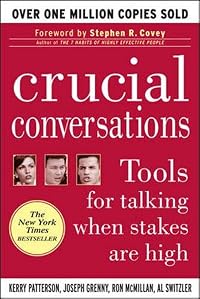
Crucial Conversations Tools for Talking When Stakes Are High, Second Edition
by Kerry Patterson, Joseph Grenny (Author), Ron McMillan (Author), Al Switzler (Author)
On This Page
Description
"Keep your cool and get the results you want when faced with crucial conversations. This New York Times bestseller and business classic has been fully updated for a world where skilled communication is more important than ever. The book that revolutionized business communications has been updated for today's workplace. Crucial Conversations provides powerful skills to ensure every conversation-especially difficult ones-leads to the results you want. Written in an engaging and witty style, show more the book teaches readers how to be persuasive rather than abrasive, how to get back to productive dialogue when others blow up or clam up, and it offers powerful skills for mastering high-stakes conversations, regardless of the topic or person. This new edition addresses issues that have arisen in recent years. You'll learn how to: Respond when someone initiates a crucial conversation with you Identify and address the lag time between identifying a problem and discussing it Communicate more effectively across digital mediums When stakes are high, opinions vary, and emotions run strong, you have three choices: Avoid a crucial conversation and suffer the consequences; handle the conversation poorly and suffer the consequences; or apply the lessons and strategies of Crucial Conversations and improve relationships and results. Whether they take place at work or at home, with your coworkers or your spouse, crucial conversations have a profound impact on your career, your happiness, and your future. With the skills you learn in this book, you'll never have to worry about the outcome of a crucial conversation again"-- show lessTags
Recommendations


Member Reviews
(11) This is the first self-help/work book that I have truly felt was 100% valuable and a satisfying read. What do you do with you are blindsided by a conversation that you have been avoiding or don't want to have? Or you know something needs to be said; and it probably needs to be said by you -- but you are so dreading it? This happens every week in both our professional and our personal life and we blow it - over and over again. We get emotionally hijacked. We tell ourselves victim or villain stories. We resort to either silence or violence. Oh yeah, this resonated for me.
This book gave practical solutions to these situations in easy to understand language with illustrative examples that felt real. The author did a great job of show more keeping their own personality out of the writing - so many books in this genre start to become more about how fabulous the author is, rather than the wisdom. (Though there were quite a few shout outs to content on their website that is inaccessible unless you sign up -- minus 1 star...) I found myself taking notes and practicing in my mind... Learn to look - are we actually in dialogue here? What is the right conversation to be having - Is it about content, a pattern, or our relationship? What do I really want and what am I acting like I want? Umm, maybe I need a time-out and have the conversation at a different time after I establish these things...
I also liked the process advice - Whoa, not safe - step out and establish mutual respect and purpose. And the STATE my path pneumonic is kinda life changing. I honestly don't know if I can do it - especially in my personal life. What I have at least been practicing though that has been working is a instituting a delay between observations --> emotion --> action. "What is the story I am telling myself?" has been a life changing internal monologue over the last few weeks. Hey, we all gotta start somewhere.
So as you can tell, I am enthusiastic about the advice in this book. Even though I am intelligent and accomplished and well-read - turns out - no one ever taught me this stuff. I've been telling my friends and colleagues that I've been reading a book about how not to be an arsehole. Ha! show less
This book gave practical solutions to these situations in easy to understand language with illustrative examples that felt real. The author did a great job of show more keeping their own personality out of the writing - so many books in this genre start to become more about how fabulous the author is, rather than the wisdom. (Though there were quite a few shout outs to content on their website that is inaccessible unless you sign up -- minus 1 star...) I found myself taking notes and practicing in my mind... Learn to look - are we actually in dialogue here? What is the right conversation to be having - Is it about content, a pattern, or our relationship? What do I really want and what am I acting like I want? Umm, maybe I need a time-out and have the conversation at a different time after I establish these things...
I also liked the process advice - Whoa, not safe - step out and establish mutual respect and purpose. And the STATE my path pneumonic is kinda life changing. I honestly don't know if I can do it - especially in my personal life. What I have at least been practicing though that has been working is a instituting a delay between observations --> emotion --> action. "What is the story I am telling myself?" has been a life changing internal monologue over the last few weeks. Hey, we all gotta start somewhere.
So as you can tell, I am enthusiastic about the advice in this book. Even though I am intelligent and accomplished and well-read - turns out - no one ever taught me this stuff. I've been telling my friends and colleagues that I've been reading a book about how not to be an arsehole. Ha! show less
"I spoke in absolutes, only pointed out facts that supported my view,..." explains a participant in a failed conversation in an example in the beginning of chapter 4. He was saying what he did wrong--why the conversation failed (though he explains that this happened because his boss provoked him first).
If you consider a book a conversation, it is one-sided. The author(s) speak to you and, with the exception of the reviews we give it, we don't get to speak back. I read this book, like many (as I noticed reading other's reviews) because it was given to me as an assignment. There's a power imbalance right there to begin with which reminds me of the earlier example about buying this book for another, saying "You'll love this, especially show more the parts that I've underlined for you." This is meant to be an obvious bad example and yet it is a common way we are introduced to this book, minus, perhaps the underlining. It is a book that speaks in absolutes and only points out arguments supporting its point of view.
Here, I imagine the author(s) following the system they propose. Like the example of the CEO trying to get employees to sign on to cost cutting when challenged with what looked like hypocrisy, admitting that the issue needs to be addressed, (this book is made up mainly of examples) the author(s) admit they were giving the program the hard sell. They apologize and explain that in addition to me there are many other readers who respond well to that approach, that their book is in fact a best seller. (More than 500,000 copies sold, boasts the blurb on the cover.) They can say that their editor(s) assure them that this aggressive self-promoting style (the first sentence is "This is a breakthrough book.") that this is one of the reasons why it was so successful. That, perhaps they lost track of what is really important--giving their readers the tools for talking when stakes are high--and instead trying to make the maximum impact on the book reading public--which, they will admit might undercut their message but, had they not done so, their important lessons would never have had the wide audience it needs to make a difference in the world. In fact, had they not done so, I probably would never have heard of it, much less be reviewing it. In the end, these proven marketing techniques, though not my personal cup of tea, are why their ideas are part of the public conversation.
After starting off like this, I was surprised to find that the rest of the book (I wrote the above only a third of the way in) was actually quite good. They really did give the tools they promised and though some were, at least to me, obvious, not all of them were. I'm glad I continued instead of abandoning this book but it could easily turned out differently. I advise you therefore to skim the first four chapters. Read their titles and enough to understand the main points. Better still, I will summarize them right here.
A crucial conversation is one in which an important decision or outcome is under discussion. Important means important to the participants. Though a large percentage of the examples are from the corporate sphere, this emphasis ultimately misleading. It probably reflects the authors' desire to sell training courses to those with deep pockets.
You have such a conversation because, either the information and expertise is distributed among several (possibly only 2) people, or because all the parties must sign on with the conclusions. That is, you want to preserve the relationships among the group in addition to coming up with results. Assuming that you can't achieve both of these goals is called the fallacy of the suckers choice (in the first edition--in the second edition, this is changed to the fool's choice. The second edition is superior in other ways as well.)
Chapter three, with the cutesy name ("Start with heart") basically says that the general plan is to start out clearly understanding your motivations and not get derailed when it becomes emotional.
Chapter four explains that in order for the conversation to stay on track, both (or all) parties need to feel safe to be able to maintain the necessary dialogue. Chapter five (I'm throwing in a bonus) explains that you need to stay aware of the emotional atmosphere at all times to assure the condition of safety and to reassert it if and when it is lost.
The rest of the book gives you techniques to do what is outlined in the initial chapters in sufficient detail that the reader feels they may actually be able to improve their ability to communicate with those who may have different agendas. Wait--I should use 'I' statements. I found the rest of the book to be mostly insightful and I say "improve" because even the book admits you're not going to be perfect even after reading it. It also lets slip that some of those with whom you speak are not going to hear you no matter what you say.
In the end, technique will only take you so far. If you don't really believe the premises of the book--e.g. that others may have better ideas than you do--and your goal is really to learn to better manipulate others to do things your way, you will probably even learn to be a better manipulator.
So, let's take as an example, those reviewing the book on goodreads. Opinions vary widely. A few reviewers frankly state they don't get why people can't just "get over it already." They have no patience for people who need to be coddled this way. They don't see their lack of patience as a problem. It's the problem of those with whom they are impatient. What could I, now that I've read the book say to these people?
"Maybe you're right and people should get over it--thing is, they're not doing it. If the conversation is actually crucial, you will need them to and dismissing them as wrong is unlikely to achieve that. Maybe the book has some suggestions for how to reach them? I mean if giving up on them is not an option?"
I'm feeling like giving up now--how can you talk to people who feel superior? They're so sure they're just right about everything. "Fix me first" says the book--It's true that I have a problem with know-it-alls. There's a part of me that's know-it-allish that feels beleaguered--afraid it's no use talking to these "others." Maybe it will help if I see them as afraid like me--threatened that there are people so different from how they are. How can I make the conversation feel safe?
"I agree that the book could be better written and that some of what they offer is obvious." (Do they feel safer that we have common ground?)
Once you're through with chapter four, I found the book readable and even useful. See what you think. show less
If you consider a book a conversation, it is one-sided. The author(s) speak to you and, with the exception of the reviews we give it, we don't get to speak back. I read this book, like many (as I noticed reading other's reviews) because it was given to me as an assignment. There's a power imbalance right there to begin with which reminds me of the earlier example about buying this book for another, saying "You'll love this, especially show more the parts that I've underlined for you." This is meant to be an obvious bad example and yet it is a common way we are introduced to this book, minus, perhaps the underlining. It is a book that speaks in absolutes and only points out arguments supporting its point of view.
Here, I imagine the author(s) following the system they propose. Like the example of the CEO trying to get employees to sign on to cost cutting when challenged with what looked like hypocrisy, admitting that the issue needs to be addressed, (this book is made up mainly of examples) the author(s) admit they were giving the program the hard sell. They apologize and explain that in addition to me there are many other readers who respond well to that approach, that their book is in fact a best seller. (More than 500,000 copies sold, boasts the blurb on the cover.) They can say that their editor(s) assure them that this aggressive self-promoting style (the first sentence is "This is a breakthrough book.") that this is one of the reasons why it was so successful. That, perhaps they lost track of what is really important--giving their readers the tools for talking when stakes are high--and instead trying to make the maximum impact on the book reading public--which, they will admit might undercut their message but, had they not done so, their important lessons would never have had the wide audience it needs to make a difference in the world. In fact, had they not done so, I probably would never have heard of it, much less be reviewing it. In the end, these proven marketing techniques, though not my personal cup of tea, are why their ideas are part of the public conversation.
After starting off like this, I was surprised to find that the rest of the book (I wrote the above only a third of the way in) was actually quite good. They really did give the tools they promised and though some were, at least to me, obvious, not all of them were. I'm glad I continued instead of abandoning this book but it could easily turned out differently. I advise you therefore to skim the first four chapters. Read their titles and enough to understand the main points. Better still, I will summarize them right here.
A crucial conversation is one in which an important decision or outcome is under discussion. Important means important to the participants. Though a large percentage of the examples are from the corporate sphere, this emphasis ultimately misleading. It probably reflects the authors' desire to sell training courses to those with deep pockets.
You have such a conversation because, either the information and expertise is distributed among several (possibly only 2) people, or because all the parties must sign on with the conclusions. That is, you want to preserve the relationships among the group in addition to coming up with results. Assuming that you can't achieve both of these goals is called the fallacy of the suckers choice (in the first edition--in the second edition, this is changed to the fool's choice. The second edition is superior in other ways as well.)
Chapter three, with the cutesy name ("Start with heart") basically says that the general plan is to start out clearly understanding your motivations and not get derailed when it becomes emotional.
Chapter four explains that in order for the conversation to stay on track, both (or all) parties need to feel safe to be able to maintain the necessary dialogue. Chapter five (I'm throwing in a bonus) explains that you need to stay aware of the emotional atmosphere at all times to assure the condition of safety and to reassert it if and when it is lost.
The rest of the book gives you techniques to do what is outlined in the initial chapters in sufficient detail that the reader feels they may actually be able to improve their ability to communicate with those who may have different agendas. Wait--I should use 'I' statements. I found the rest of the book to be mostly insightful and I say "improve" because even the book admits you're not going to be perfect even after reading it. It also lets slip that some of those with whom you speak are not going to hear you no matter what you say.
In the end, technique will only take you so far. If you don't really believe the premises of the book--e.g. that others may have better ideas than you do--and your goal is really to learn to better manipulate others to do things your way, you will probably even learn to be a better manipulator.
So, let's take as an example, those reviewing the book on goodreads. Opinions vary widely. A few reviewers frankly state they don't get why people can't just "get over it already." They have no patience for people who need to be coddled this way. They don't see their lack of patience as a problem. It's the problem of those with whom they are impatient. What could I, now that I've read the book say to these people?
"Maybe you're right and people should get over it--thing is, they're not doing it. If the conversation is actually crucial, you will need them to and dismissing them as wrong is unlikely to achieve that. Maybe the book has some suggestions for how to reach them? I mean if giving up on them is not an option?"
I'm feeling like giving up now--how can you talk to people who feel superior? They're so sure they're just right about everything. "Fix me first" says the book--It's true that I have a problem with know-it-alls. There's a part of me that's know-it-allish that feels beleaguered--afraid it's no use talking to these "others." Maybe it will help if I see them as afraid like me--threatened that there are people so different from how they are. How can I make the conversation feel safe?
"I agree that the book could be better written and that some of what they offer is obvious." (Do they feel safer that we have common ground?)
Once you're through with chapter four, I found the book readable and even useful. See what you think. show less
I first read this book in 2008. It was given to me as part of a leadership seminar I attended through work. I wasn't too fond of the book.
It's longer than it needs to be, a good portion of the book is common sense, it creates silly jargon and refers back to little trite anecdotes over, and over, and over.
I reread it a few years later, and I got the newer edition from the library and I reread it this year.
All of the downsides of this book are still there. It's still longer than it needs to be, has a good amount of information that seemingly anyone reaching adulthood would already know, they still create silly management theory jargon, and refers to Kevin and other anecdotes over and over and over.
On the other hand, ten years later, I've show more worked in more teams, and been in more types of situations. I've worked with people who certainly don't know the information in this book, and I dread working with them. Regarding length--most people can skim and read books like this faster than something dense and heavy. The silly management theory jargon is an artifact of this being part of paid leadership training--fun jargony phrases lend themselves to printouts and documentation they can share to look smart and prepared. The same goes for the anecdata aspect of this.
On the other hand, ten years later, I can unequivocally say that there is useful information in here, potentially even essential information here on how to deal with those emotional conversations where there are multiple sides and high stakes. show less
It's longer than it needs to be, a good portion of the book is common sense, it creates silly jargon and refers back to little trite anecdotes over, and over, and over.
I reread it a few years later, and I got the newer edition from the library and I reread it this year.
All of the downsides of this book are still there. It's still longer than it needs to be, has a good amount of information that seemingly anyone reaching adulthood would already know, they still create silly management theory jargon, and refers to Kevin and other anecdotes over and over and over.
On the other hand, ten years later, I've show more worked in more teams, and been in more types of situations. I've worked with people who certainly don't know the information in this book, and I dread working with them. Regarding length--most people can skim and read books like this faster than something dense and heavy. The silly management theory jargon is an artifact of this being part of paid leadership training--fun jargony phrases lend themselves to printouts and documentation they can share to look smart and prepared. The same goes for the anecdata aspect of this.
On the other hand, ten years later, I can unequivocally say that there is useful information in here, potentially even essential information here on how to deal with those emotional conversations where there are multiple sides and high stakes. show less
I'm not really certain how I feel about this one. I felt some similarities to Angela Duckworth's book "Grit" - I don't believe this needed to be an entire book and could have covered the main points in a smaller, more trimmed format.
I found myself rolling my eyes a lot at the perceived simplicity of the topic and solutions, but I must admit I did find myself relating back to previous difficult conversations with my partner, friends and family and recognize I have a lot of work to do and can do much better.
I think I am hesitant a lot of time to these kinds of books and lectures because a lot of the time it feels like a commercial, or that they're persuading the reader that "yes, this does work." I've already bought the book! I'm show more already here! Perhaps this is a proactive approach to breach listener's defenses since their initial reaction may be negative (like mine is) but I can't shake the feeling that I'm listening to a TED talk in book form, rather than reading something that requires 230 pages. show less
I found myself rolling my eyes a lot at the perceived simplicity of the topic and solutions, but I must admit I did find myself relating back to previous difficult conversations with my partner, friends and family and recognize I have a lot of work to do and can do much better.
I think I am hesitant a lot of time to these kinds of books and lectures because a lot of the time it feels like a commercial, or that they're persuading the reader that "yes, this does work." I've already bought the book! I'm show more already here! Perhaps this is a proactive approach to breach listener's defenses since their initial reaction may be negative (like mine is) but I can't shake the feeling that I'm listening to a TED talk in book form, rather than reading something that requires 230 pages. show less
I listened to the audio, then bought the book. This is a now a requirement for our homeschool graduation. EVERYONE should read this. There is no one who cannot benefit from this research and practical tools and insights to improve communication--ESPECIALLY when your emotions run high! At the end, the authors comment on the few managers they interacted with who actually made changes and improved. Change is hard! They acknowledge how difficult it is. The audio was well done, and the humor of our human gut reactions well-communicated.
Do conversations ever catch you off-guard? Do you ever feel unprepared for conversations that pop up spontaneously yet seem to matter a lot and to affect dramatically the course of our lives? These situations often occur in families and in businesses, and this book attempts to prepare us better for handling those weighty situations.
This book came recommended to me as a part of a book club at my workplace. I can see why. It takes the topic (crucial conversations) and parses it from just about every angle. Readers will not only gain self-knowledge and self-awareness; they will benefit from developing skills in handling difficult situations. This mastery will allow its adherents to handle even everyday situations and relationships with show more greater ease and skill.
It focuses on our ability to “dialogue” openly and honestly – with a free and thorough exchange of information. To some, this skill might seem obvious. For me, however, this skill is tangential to my main work at a computer screen. Relationships still are very important to my work, but I am not able to give prolonged thought to developing these over time. Conversations sort of pop up to me. The skills and concepts in this book empower me to handle those situations better – and with less anxiety.
One concept I find particularly illuminating is that we all have a tendency to either silence (passive) or violence (controlling) in the way that we react. In truth, both of these are enemies of good dialogue because they do not extend the conversation.
As the authors acknowledge, conversation for conversation’s sake seems to be not a great aim, but conversation for the sake of getting things done contains a higher aim. By learning how to work with others better, we learn how to become more effective and have greater influence. show less
This book came recommended to me as a part of a book club at my workplace. I can see why. It takes the topic (crucial conversations) and parses it from just about every angle. Readers will not only gain self-knowledge and self-awareness; they will benefit from developing skills in handling difficult situations. This mastery will allow its adherents to handle even everyday situations and relationships with show more greater ease and skill.
It focuses on our ability to “dialogue” openly and honestly – with a free and thorough exchange of information. To some, this skill might seem obvious. For me, however, this skill is tangential to my main work at a computer screen. Relationships still are very important to my work, but I am not able to give prolonged thought to developing these over time. Conversations sort of pop up to me. The skills and concepts in this book empower me to handle those situations better – and with less anxiety.
One concept I find particularly illuminating is that we all have a tendency to either silence (passive) or violence (controlling) in the way that we react. In truth, both of these are enemies of good dialogue because they do not extend the conversation.
As the authors acknowledge, conversation for conversation’s sake seems to be not a great aim, but conversation for the sake of getting things done contains a higher aim. By learning how to work with others better, we learn how to become more effective and have greater influence. show less
"Why would a reasonable and rational person behave the way X's behaving?"
It's been nearly four months since I finished this book and, sadly, I'm no longer able to lucidly explain what this book is about; i.e., 'what's it about?' is one Crucial Conversation I can't, at this time, hold. Let me say, though, that one line from the book has remained with me. It is: whenever another person offends you, puzzles you, attacks you, betrays you, surprises you, etc., ask yourself: why would a perfectly sane and rational person behave this way?
Or as Gordon Lightfoot puts it, "If you could read my mind, Love, what a tale my thoughts would tell."
I've found that asking myself this question -- i.e., "Why would a perfectly sane and rational..." -- in the show more last four months, has opened up for me whole vistas of insight into other people's experiences and motives. I've found that I don't get so upset anymore. The phrase, 'What an idiot!,' doesn't show up so much anymore in my daily transcripts. Am I glad I read CC? Yes. This book makes a great companion to both Crucial Confrontations and Anatomy of Peace. show less
It's been nearly four months since I finished this book and, sadly, I'm no longer able to lucidly explain what this book is about; i.e., 'what's it about?' is one Crucial Conversation I can't, at this time, hold. Let me say, though, that one line from the book has remained with me. It is: whenever another person offends you, puzzles you, attacks you, betrays you, surprises you, etc., ask yourself: why would a perfectly sane and rational person behave this way?
Or as Gordon Lightfoot puts it, "If you could read my mind, Love, what a tale my thoughts would tell."
I've found that asking myself this question -- i.e., "Why would a perfectly sane and rational..." -- in the show more last four months, has opened up for me whole vistas of insight into other people's experiences and motives. I've found that I don't get so upset anymore. The phrase, 'What an idiot!,' doesn't show up so much anymore in my daily transcripts. Am I glad I read CC? Yes. This book makes a great companion to both Crucial Confrontations and Anatomy of Peace. show less
Members
- Recently Added By
Lists

Recommend the 20 best books you've read in the last five years
2,168 works; 601 members

Investment News 2021 What Advisors Are Reading This Summer
16 works; 1 member

Five Star Novels
20 works; 2 members

Books Read in 2025
4,091 works; 97 members

Office Library
41 works; 1 member

Healing resources for women
588 works; 1 member
Author Information

16 Works 7,838 Members


All Editions
Work Relationships
Common Knowledge
- Canonical title*
- Heikle Gespräche. Worauf es ankommt, wenn viel auf dem Spiel steht
- Original title
- Crucial Conversations: Tools for Talking When Stakes Are High
- Original publication date
- 2002
- Dedication
- We dedicate this book to Louise, Celia, Bonnie, and Linda—whose support is abundant, whose love is nourishing, and whose patience is just shy of infinite. And to our children Christine, Rebecca, Taylor, Scott, Aislinn, Car... (show all)a, Seth, Samuel, Hyrum, Amber, Megan, Chase, Hayley, Bryn, Amber, Laura, Becca, Rachael, Benjamin, Meridith, Lindsey, Kelley, Todd who have been a wonderful source of learning.
- Quotations
- In perhaps the most revealing of all the health-related studies, a group of subjects who had contracted malignant melanoma received traditional treatment and then were divided into two groups. One group met weekly for only si... (show all)x weeks; the other did not. Facilitators taught the first group of recovering patients specific communication skills. (When it's your life that's at stake, could anything be more crucial?)
After meeting only six times and then dispersing for five years, the subjects who learned how to express themselves effectively had a higher survival rate--only 9 percent succumbed as opposed to almost 30 percent in the untrained group.
People who are skilled at dialogue do their best to make it safe for everyone to add their meaning to the shared pool—even ideas that at first glance appear controversial, wrong, or at odds with their own beliefs. Now, obvi... (show all)ously they don't agree with every idea; they simply do their best to ensure that all ideas find their way into the open.
The Pool of Shared Meaning is the birthplace of synergy
Second, clarify what you really don't want. This is the key to framing the and question. Think of what you are afraid will happen to you if you back away from your current strategy of trying to win or stay safe. What bad thin... (show all)g will happen if you stop pushing so hard? Or if you don't try to escape? What horrible outcome makes game-playing an attractive and sensible option? - Blurbers
- Ogilvie, Lloyd J.; Quinn, Robert E.; Burke, Maureen; Belasco, James; Hatch, John; Willyerd, Karie A. (show all 10); Gill, John; Hansen, Mark Victor; Covey, Stephen R.; Hancock, Dain M.
*Some information comes from Common Knowledge in other languages. Click "Edit" for more information.
Classifications
Statistics
- Members
- 5,387
- Popularity
- 2,506
- Reviews
- 55
- Rating
- (3.93)
- Languages
- 10 — Chinese, Dutch, English, Estonian, French, German, Indonesian, Norwegian (Bokmål), Portuguese, Spanish
- Media
- Paper, Audiobook, Ebook
- ISBNs
- 50
- UPCs
- 2
- ASINs
- 39