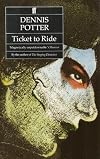
Ticket to Ride
by Dennis Potter
On This Page
Description
"John is in London; he can't remember who he is or why he is there. All he knows is that he has got a lot of money in his pocket and he has to meet someone"--Publisher's description.Tags
Recommendations






















Member Reviews
I found this a difficult read, but it makes sense since the characters seem to be going insane. The narration jumps around in place and time. A chapter morphed from one character's pov to another's and it took me a little while to figure that out.
The writing itself is pretty good and the author kept me interested enough to keep going.
I picked up the book due to a random interview I saw with Robert Pattinson. He was asked for recommendations for reading and listening. I listened to his friend's album and read this book. Both outside my comfort zone, but interesting nonetheless.
Wonder what Robert thought of both . . .
The writing itself is pretty good and the author kept me interested enough to keep going.
I picked up the book due to a random interview I saw with Robert Pattinson. He was asked for recommendations for reading and listening. I listened to his friend's album and read this book. Both outside my comfort zone, but interesting nonetheless.
Wonder what Robert thought of both . . .
This is, by far, one of the weirdest books I've ever read, but for some strange reason, I quite enjoyed it. It does a lot of jumping around and can be hard to follow at times, but if you sit back and think about it, it all makes sense, in a crazy way. Both characters are rather mad, but they're not without reason for being that way. I really did enjoy it and I hope I'll be able to buy a copy that wont cost me a fortune.
Good details of modern trains in Australia.
AMAZING use of language, Potter is a master of the psychological thriller.
Ratings
Members
- Recently Added By
Author Information

ducated at Oxford, Dennis Potter's aesthetic resonates with the strains of postmodernism proliferated by Tom Stoppard and Thomas Pynchon: a combination of the bizarre and a compelling and somehow old-fashioned narrative. Operating simultaneously with this is a wryly cynical undertone that challenges the smug conventionality of the narrative. His show more novels, Ticket to Ride and Blackeyes, are vintage slick postmodern texts, evocative of Robert Coover's or Don DeLillo's with their tricks, twists, dazzling opacity, and masterful stylized tone. Potter's most notable distinction, though, is in bringing his work to the television screen---adapting his work to an industry that was (especially in the 1960s and 1970s, when he began writing) a highly unlikely forum for his avant-garde offerings. Yet Potter can be credited with creating a stunning canon of television plays that won acclaim despite the seemingly inauspicious mix of the medium and the drama; beyond this, he has energetically expanded the reach of popular culture (from within that culture), garnering admiration for the seriousness and incisiveness of such television plays as Pennies from Heaven (1978) and The Singing Detective (1986). The latter is an autobiographically based story about a hack writer's anxieties and the relationship between text and reality. Typical of Potter's rich filmic technique, it features a visual and musical panorama brimming with seamlessly intermixed stimuli ranging from 1930s song and dance numbers to psychoanalytic probing of childhood and sexuality. (Bowker Author Biography) show less
Work Relationships
Classifications
Statistics
- Members
- 147
- Popularity
- 222,252
- Reviews
- 4
- Rating
- (3.61)
- Languages
- Danish, Dutch, English
- Media
- Paper, Audiobook
- ISBNs
- 8
- ASINs
- 1