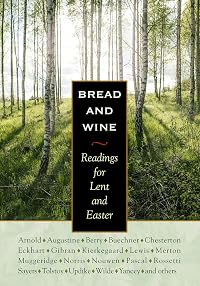
Bread and Wine: Readings for Lent and Easter
by C. S. Lewis
On This Page
Description
Though Easter (like Christmas) is often trivialized by the culture at large, it is still the high point of the religious calendar for millions of people around the world. And for most of them, there can be no Easter without Lent, the season that leads up to it. A time for self-denial, soul-searching, and spiritual preparation, Lent is traditionally observed by daily reading and reflection. This collection will satisfy the growing hunger for meaningful and accessible devotions. Culled from show more the wealth of twenty centuries, the selections in Bread and Wine are ecumenical in scope, and represent the best classic and contemporary Christian writers. Includes more than seventy Lenten and Easter readings by Alexander Stuart Baillie, Alfred Kazin, Alister E. McGrath, Amy Carmichael, Barbara Brown Taylor, Barbara Cawthorne Crafton, Blaise Pascal, Brennan Manning, C. S. Lewis, Christina Rossetti, Christoph Friedrich Blumhardt, Clarence Jordan, Dag Hammarskjöld, Dale Aukerman, Dietrich Bonhoeffer, Dorothee Soelle, Dorothy Day, Dorothy Sayers, Dylan Thomas, E. Stanley Jones, Eberhard Arnold, Edith Stein, Edna Hong, Emil Brunner, Ernesto Cardenal, Fleming Rutledge, Frederica Mathewes-Green, Frederick Buechner, Fyodor Dostoevsky, G. K. Chesterton, Geoffrey Hill, George MacDonald, Henri Nouwen, Henry Drummond, Howard Hageman, J. Heinrich Arnold, Jean-Pierre de Caussade, Johann Christoph Arnold, John Dear, John Donne, John Howard Yoder, John Masefield, John Stott, John Updike, Joyce Hollyday, Jürgen Moltmann, Kahlil Gibran, Karl Barth, Kathleen Norris, Leo Tolstoy, Madeleine L'Engle, Malcolm Muggeridge, Martin Luther, Meister Eckhart, Morton T. Kelsey, Mother Teresa, N. T. Wright, Oscar Wilde, Oswald Chambers, Paul Tillich, Peter Kreeft, Philip Berrigan, Philip Yancey, Romano Guardini, Sadhu Sundar Singh , Saint Augustine, Simone Weil, Søren Kierkegaard, Thomas à Kempis , Thomas Howard, Thomas Merton, Toyohiko Kagawa, Walter J. Ciszek, Walter Wangerin, Watchman Nee, Wendell Berry and William Willimon. show lessTags
Recommendations




Member Reviews
I stopped reading this a week after Easter, but will pick it up again next Lent. It's a grab-bag of readings. Some I found profoundly moving, beautiful, or thought-provoking. Some didn't. That's OK, it was a good warm up reading for Bible reading.
Summary A collection of 96 readings from writers throughout church history spanning the season from Ash Wednesday to Pentecost.
There are a variety of ways to approach Lenten readings. My reviews for the next three days will reflect three different approaches. Today’s approach is to collect readings from a variety of writers. This collection of readings offers one of the broadest selections of readings I’ve seen both in terms of historical reach and inclusiveness across denominational and ethnic lines. The readings offered here range from early church fathers like Ignatius of Antioch and Augustine to Brennan Manning and Tish Harrison Warren. Women are well-represented, including Fleming Rutledge, Barbara Brown Taylor, Christina show more Rosetti, and Therese of Lisieux. Then among the non-white authors are Gonzalo Baez Camargo, Sadhu Sundhar Singh, Kwong Jeong-saeng, Kahlil Gibran, Howard Thurman, Sojourner Truth, and Shusaku Endo.
The other thing about this collection is that there are ninety-six readings in this expanded edition of an earlier publication. The expansion extends the readings into Eastertide and the period up to Pentecost. All of the readings are short, taking at most a few minutes. Many, apart from poems, are extracts from longer works. One of the values, then, of this work is to whet your appetite for great Christian writers. A section giving the sources of these works is included in the end materials. The readings are organized into seven sections. I will highlight one from each, though they are all worth reading!
Invitation
In Time for Reflection,” Howard Thurman invites us to do the hard thing of slowing down and reflecting on the “dead places” in oiur lives. We want to offer selves thar are “clear, unsullied, fresh, clean.” However we can only do so if we also offer the “tainted, painful, and tragic.”
Temptation
Fleming Rutledge’s “Too Good For Jesus” relates the stories of two women. One could not worship in a church with a crucifix behind the altar with the figure of Christ hanging on it. The other, in a Passion play could not join with a crowd crying “crucify him.” Both struggled to see the depth of human sin, their sin. They were too good for the saving work of Jesus.
Passion
G.K. Chesterton, that master of paradox, observes in “God the Rebel” the extraordinary idea that in Gethsemane, God tempted God, and did not break; that at the cross, God forsook God. Thus, for at least a moment, God was the rebel, identified with our revolt. He concludes that there is “only one religion in which God seemed for an instant to be an atheist.”
Crucifixion
Many maintain that religion is about what we do, the doing of good works. “It is Done” by Watchman Nee begins with Jesus declaration “it is finished.” He argues that our first step of faith is to cease doing and trust in what was done for us by Jesus. For example, he describes a man who cannot forgive, no matter how hard he tries. Nee counsels, “Do nothing at all” maintained that in Christ, not only his sins but he, the unforgiving, was born away, and that he could trust Christ to do what he could not.
Resurrection
Gregory of Nazianzus, in “Today I Rise” ponders the wonder of moving from crucifying Christ to sharing in his glory, of being buried with Christ, and yet, in our sins being passed over, we escape Egypt and are alive. And what can we offer the one who has done this? Only ourselves.
New Life
Hannah Whittall Smith in “Monday Christians” decries the divorce between “religious life” and temporal life. Christ would work just as much in those who “keep the house and make the bargain.” Her point was Christ’s intention that we know his abiding presence in all of life, even in “the homely path of everyday duties.”
Pentecost
Kwon Jeong-saeng in “The Church I Dreamed Of” describes his vision of a church he never built in place of a struggling village church. Though poor, they prayed, and loved, served and gave and transformed a mountain village. Then, sadly, it gave way to authoritarianism, power, and status. Instead of trusting God, God became a convenient instrument. In place of dreams, The author describes his wish to live as did those poor villager, in loving service.
This is a collection for slow and repeated reading. Perhaps it will become one you return to year by year. And meanwhile, we can explore the riches of Christian reflections over the centuries in the works these readings represent. And all of this will hopefully remind us of Christ, our bread and wine!
_______________________
Disclosure of Material Connection: I received a complimentary copy of this book from the publisher for review. show less
There are a variety of ways to approach Lenten readings. My reviews for the next three days will reflect three different approaches. Today’s approach is to collect readings from a variety of writers. This collection of readings offers one of the broadest selections of readings I’ve seen both in terms of historical reach and inclusiveness across denominational and ethnic lines. The readings offered here range from early church fathers like Ignatius of Antioch and Augustine to Brennan Manning and Tish Harrison Warren. Women are well-represented, including Fleming Rutledge, Barbara Brown Taylor, Christina show more Rosetti, and Therese of Lisieux. Then among the non-white authors are Gonzalo Baez Camargo, Sadhu Sundhar Singh, Kwong Jeong-saeng, Kahlil Gibran, Howard Thurman, Sojourner Truth, and Shusaku Endo.
The other thing about this collection is that there are ninety-six readings in this expanded edition of an earlier publication. The expansion extends the readings into Eastertide and the period up to Pentecost. All of the readings are short, taking at most a few minutes. Many, apart from poems, are extracts from longer works. One of the values, then, of this work is to whet your appetite for great Christian writers. A section giving the sources of these works is included in the end materials. The readings are organized into seven sections. I will highlight one from each, though they are all worth reading!
Invitation
In Time for Reflection,” Howard Thurman invites us to do the hard thing of slowing down and reflecting on the “dead places” in oiur lives. We want to offer selves thar are “clear, unsullied, fresh, clean.” However we can only do so if we also offer the “tainted, painful, and tragic.”
Temptation
Fleming Rutledge’s “Too Good For Jesus” relates the stories of two women. One could not worship in a church with a crucifix behind the altar with the figure of Christ hanging on it. The other, in a Passion play could not join with a crowd crying “crucify him.” Both struggled to see the depth of human sin, their sin. They were too good for the saving work of Jesus.
Passion
G.K. Chesterton, that master of paradox, observes in “God the Rebel” the extraordinary idea that in Gethsemane, God tempted God, and did not break; that at the cross, God forsook God. Thus, for at least a moment, God was the rebel, identified with our revolt. He concludes that there is “only one religion in which God seemed for an instant to be an atheist.”
Crucifixion
Many maintain that religion is about what we do, the doing of good works. “It is Done” by Watchman Nee begins with Jesus declaration “it is finished.” He argues that our first step of faith is to cease doing and trust in what was done for us by Jesus. For example, he describes a man who cannot forgive, no matter how hard he tries. Nee counsels, “Do nothing at all” maintained that in Christ, not only his sins but he, the unforgiving, was born away, and that he could trust Christ to do what he could not.
Resurrection
Gregory of Nazianzus, in “Today I Rise” ponders the wonder of moving from crucifying Christ to sharing in his glory, of being buried with Christ, and yet, in our sins being passed over, we escape Egypt and are alive. And what can we offer the one who has done this? Only ourselves.
New Life
Hannah Whittall Smith in “Monday Christians” decries the divorce between “religious life” and temporal life. Christ would work just as much in those who “keep the house and make the bargain.” Her point was Christ’s intention that we know his abiding presence in all of life, even in “the homely path of everyday duties.”
Pentecost
Kwon Jeong-saeng in “The Church I Dreamed Of” describes his vision of a church he never built in place of a struggling village church. Though poor, they prayed, and loved, served and gave and transformed a mountain village. Then, sadly, it gave way to authoritarianism, power, and status. Instead of trusting God, God became a convenient instrument. In place of dreams, The author describes his wish to live as did those poor villager, in loving service.
This is a collection for slow and repeated reading. Perhaps it will become one you return to year by year. And meanwhile, we can explore the riches of Christian reflections over the centuries in the works these readings represent. And all of this will hopefully remind us of Christ, our bread and wine!
_______________________
Disclosure of Material Connection: I received a complimentary copy of this book from the publisher for review. show less
I read through this collection of brief essays every year through Lent and on to Pentecost. The great minds of Christianity are here, from Augustine to Dorothy Sayers. Most are writers, preachers, and theologians I know only through this collection.
Highly recommended for daily readings the mystery.of Lent.
Highly recommended for daily readings the mystery.of Lent.
This diverse collection of readings provides thoughtful reading for the Lent and Easter seasons. Used as day by day reading, it shifted from crucifixion to resurrection just at the right spot. Some readings were not as stimulating as others, but the collection over all is of excellent quality.
This is an excellent collection of writings to be used during Lent and Easter. It contains short excerpts from modern theologians such as N.T. Wright and Jurgen Moltmann to more historical thinkers like Pascal and Augustine. As is common with collections such as this, some readings are better than others but all in all it makes for good reflective material.
This is another newly acquired book of Lent and Easter-themed readings available in Covenant Library. This book contains short selections on themes such as temptation, crucifixion, resurrection, and new life from a wide spectrum of classic and contemporary writers, including Kahlil Gibran, Thomas Merton, Barbara Brown Taylor, Martin Luther, St. Augustine, Fyodor Dostoevsky, and Henri Nouwen. The first 46 readings cover Lent, beginning on Ash Wednesday and ending on Holy Saturday. These are followed by 13 readings on themes of resurrection and 15 readings on themes of new life. The book may be used as a guide to daily devotions or dipped into at any time during the year for spiritual reflection and challenge.
-Eric Wendorff, 2019
-Eric Wendorff, 2019
Ratings
Members
- Recently Added By
Lists

Books I've Read More Than Once
602 works; 49 members

Favourite Books
1,819 works; 309 members
Author Information

532+ Works 523,396 Members
C. S. (Clive Staples) Lewis, "Jack" to his intimates, was born on November 29, 1898 in Belfast, Ireland. His mother died when he was 10 years old and his lawyer father allowed Lewis and his brother Warren extensive freedom. The pair were extremely close and they took full advantage of this freedom, learning on their own and frequently enjoying show more games of make-believe. These early activities led to Lewis's lifelong attraction to fantasy and mythology, often reflected in his writing. He enjoyed writing about, and reading, literature of the past, publishing such works as the award-winning The Allegory of Love (1936), about the period of history known as the Middle Ages. Although at one time Lewis considered himself an atheist, he soon became fascinated with religion. He is probably best known for his books for young adults, such as his Chronicles of Narnia series. This fantasy series, as well as such works as The Screwtape Letters (a collection of letters written by the devil), is typical of the author's interest in mixing religion and mythology, evident in both his fictional works and nonfiction articles. Lewis served with the Somerset Light Infantry in World War I; for nearly 30 years he served as Fellow and tutor of Magdalen College at Oxford University. Later, he became Professor of Medieval and Renaissance English at Cambridge University. C.S. Lewis married late in life, in 1957, and his wife, writer Joy Davidman, died of cancer in 1960. He remained at Cambridge until his death on November 22, 1963. (Bowker Author Biography) show less
Common Knowledge
- Original title
- Bread & Wine: Readings for Lent and Easter
- Epigraph
- Looking at Stars
The God of curved space, the dry
God, is not going to help us, but the son
whose blood spattered
the hem of his mother's robe.
--Jane Kenyon
Classifications
- Genres
- Religion & Spirituality, Nonfiction, General Nonfiction
- DDC/MDS
- 242.34 — Religion Christian practice & observance Devotional literature Seasonal Devotions Lent
- LCC
- BV85 .B663 — Philosophy, Psychology and Religion Practical Theology Practical Theology Worship (Public and private) Times and seasons. The Church year Fasts
- BISAC
Statistics
- Members
- 657
- Popularity
- 43,872
- Reviews
- 6
- Rating
- (4.23)
- Languages
- English
- Media
- Paper
- ISBNs
- 3