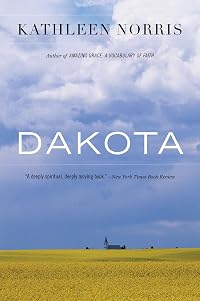
Dakota: A Spiritual Geography
by Kathleen Norris, Kathleen Norris (Author)
On This Page
Description
Norris reveals the contradictions of small town life on the Great Plains, where gracious hospitality blends with provincial wariness, local history is valued by writers, and truth and myth collide.Tags
Recommendations












Member Reviews
Only a poet could write about nature like this. This is part memoir, part regional history, part religion, part "spiritual geography. " Spiritual geography is how where you are from becomes a part of your spiritual expression. We all naturally have a spiritual geography but Norris shows how the wonder and beauty of the Great Plains- with those Great Spaces-and Big Sky -with-Thousands-of-Stars is intertwined in the lives of those who live in the West (specifically South Dakota). It must be like looking at God all the time. Norris goes from discussing the regional history to intertwining her experiences in religious life within the Protestant churches as well as a nearby monastery.
I love how she shares the perspectives of those around show more her and I love the vignettes that feel like poems. I'll say it: this is better than poetry and this is what poetry aspires to be. This remains one of the most beautiful books I've read on spirituality. I hope it becomes a classic. show less
I love how she shares the perspectives of those around show more her and I love the vignettes that feel like poems. I'll say it: this is better than poetry and this is what poetry aspires to be. This remains one of the most beautiful books I've read on spirituality. I hope it becomes a classic. show less
A lovely meditation on life on the plains, and on the prairie's special way of awakening and activating faith (I had the same experience fwiw.) I can't say i understand why Norris chose to stay in Lemmon, she seems more ill-suited to the region than I was, and I was in the "big city" of Fargo -- I made it two years. Still she tells a tale, provides context and introduces a way of approaching life that is compelling, and led me to rethink my approach to some things. A worthwhile read for those if us who prefer guided reflection to self-help.
I had been saving this book for several years because I had heard it was fantastic. I read about half the book and was very bored. Put it down. Came back a month or so later to finish. Some chapters were OK. "Is it You Again" and "Monks at Play" were an interesting exploration of monasteries.
I felt her constant comparisons of the communities of the Dakotas with monastic communities was a bit strained at times and it was irritating to have her continually mix the two. She had too many ideas she wanted to develop here:coming to terms with her families past, exploring her changing spirituality and interest in monasteries, expounding on small town society.
I felt her constant comparisons of the communities of the Dakotas with monastic communities was a bit strained at times and it was irritating to have her continually mix the two. She had too many ideas she wanted to develop here:coming to terms with her families past, exploring her changing spirituality and interest in monasteries, expounding on small town society.
It is always interesting to see how a book stands up to a re-reading. This book fared fairly well in that I think it is one of Norris's best written books. There is little narrative sequence in Norris's reflections, save the general story of moving from New York to South Dakota and through a process, South Dakota becomes home. Instead, what we have here is a series of poetic reflections on Dakota, on place, on the Benedictine monastery (Norris is an Oblate).
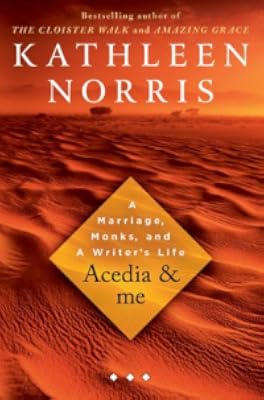
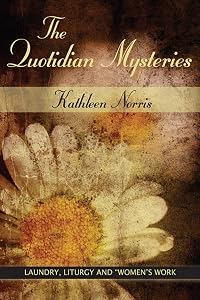
I found it interesting that many of Norris's main themes are expanded in her later writings. "The Cloistered Walk" focus on her experience with the Benedictines. "Quotidian Mysteries: Laundry, Liturgy, and 'Women's Work'" develops the theme of daily routine. Acedia & Me of course show more focuses on Acedia, but it draws together every theme that is in this book and represents a more mature reflection that is found here. It is also more honest and complete, in that Norris there shares more vulnerably about her marriage and the difficulties she had in Dakota. But there her prose there plods and wanders. Dakota was first and artfully written. Norris gets deeper but this is perhaps one of her best artistically speaking.
What Norris attempts and succeeds at here is to enter into a place, see it appreciate it and tell the truth about it. She speaks lovingly about the state and the people she came to love, but she doesn't romanticize it either. I read with interest her reflections and never once felt like moving to Dakota. show less
I found it interesting that many of Norris's main themes are expanded in her later writings. "The Cloistered Walk" focus on her experience with the Benedictines. "Quotidian Mysteries: Laundry, Liturgy, and 'Women's Work'" develops the theme of daily routine. Acedia & Me of course show more focuses on Acedia, but it draws together every theme that is in this book and represents a more mature reflection that is found here. It is also more honest and complete, in that Norris there shares more vulnerably about her marriage and the difficulties she had in Dakota. But there her prose there plods and wanders. Dakota was first and artfully written. Norris gets deeper but this is perhaps one of her best artistically speaking.
What Norris attempts and succeeds at here is to enter into a place, see it appreciate it and tell the truth about it. She speaks lovingly about the state and the people she came to love, but she doesn't romanticize it either. I read with interest her reflections and never once felt like moving to Dakota. show less
So in general I'm not a fan of books that are jus essays compiled together, but I was pleasantly surprised by this one. I didn't really connect at all with the first half which was more about the geographic space but I definitely connected more with the spiritual and religious part.
Recommended by Reece
Recommended by Reece
I found the poetry in this collection much more powerful than the essays. While Kathleen Norris is articulate, especially about her faith and conceptions of Christianity, I found most essays spun off into rabbit trails, side stories and were not cohesive. There was also a fair amount of repetition, especially about the monastic lifestyle, Benedictine tradition and an endless supply of anecdotes about her choice to move from New York to Dakota. Norris captures the spirit of the Plains when she lets herself express the natural world in her poetry, I wish there would have been a bit more of these and a bit less reflection and reportage.
This is Norris' first major book. Though a poet, she began to keep a kind of journal after she and her husband left New York City in order to take over a farm in Lemmon, South Dakota, left to her in an inheritance. Once there, her entire life began to change. Once a non-believer, she began to see the issue differently.
This book details her gradual awakening to the meaning of faith, and growing appreciation for the desolation of the plains. As she writes: "Like those monks [of the 4th century], I made a counter-cultural choice to live in what the rest of the world considers a barren waste. Like them I had to stay in this...
This book details her gradual awakening to the meaning of faith, and growing appreciation for the desolation of the plains. As she writes: "Like those monks [of the 4th century], I made a counter-cultural choice to live in what the rest of the world considers a barren waste. Like them I had to stay in this...
Members
- Recently Added By
Lists

Manning's Prairie List
5 works; 1 member

Mustich's 1000 Books to Read Before You Die: A Life Changing List
1,001 works; 20 members
Author Information

22+ Works 9,734 Members
Kathleen Norris is the award-winning author of "Amazing Grace: A Vocabulary of Faith"; "The Cloister Walk"; & the forthcoming "The Virgin of Bennington". She lives in South Dakota & Hawaii. (Bowker Author Biography)
Awards and Honors
Common Knowledge
- Canonical title
- Dakota: A Spiritual Geography
- Original title
- Dakota: A Spiritual Geography
- Original publication date
- 2001
- Important places
- North Dakota, USA; South Dakota, USA
- Epigraph
- "I think that if we examine our lives, we will find that most good has come to us from the few loyalties, and a few discoveries made many generations before we were born, which must always be made anew.There too may sometimes... (show all) appear to come by chance, but in the infinite web of things and events chance must be something different from what we think it to be. To comprehend that is not given to us, and to think of it is to recognize a mystery, and to acknowledge the necessity of faith. As I look back on the part of the mystery which is my own life, my own fable, what I am most aware of is that we receive more than we can ever give; we receive it from the past, on which we draw with every breath . . ."
--Edwin Muir, An Autobiography
"Tell me the landscape in which you live, and I will tell you who you are."
--José Ortega y Gassett - Dedication
- In memory of Kathleen Dakota and Mary Beatrice
- First words
- The High Plains, the beginning of the desert West, often act as a crucible for those who inhabit them.
- Quotations
- When these people ask, "Who will replace us?"the answer is, "who knows, maybe no one," and it's not easy to live with that truth...The challenge is to go on living graciously and thankfully, cultivating love. (p.174)
- Last words
- (Click to show. Warning: May contain spoilers.)One of the old ones was asked, "What is it necessary for the monk to be?" And he said, "According to me, alone with the Alone."
- Publisher's editor
- Spiegel, Cindy
- Blurbers
- Dillard, Annie; Stegner, Wallace
- Original language
- English
Classifications
Statistics
- Members
- 1,861
- Popularity
- 11,673
- Reviews
- 20
- Rating
- (4.03)
- Languages
- English, Italian
- Media
- Paper, Audiobook, Ebook
- ISBNs
- 8
- UPCs
- 2
- ASINs
- 11
