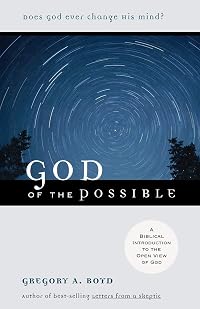
God of the Possible: A Biblical Introduction to the Open View of God
by Gregory A. Boyd
On This Page
Description
Through an examination of relevant biblical passages, this theologian-pastor presents an alternative "open view" to the classical doctrine on God's foreknowledge of the future.Tags
Recommendations
Member Reviews
When Bible Study Becomes Scary
When I was young, my parents hosted a couples’ Bible study on Sunday nights. While my parents studied in the community of believers, I listened to music and played video games in the office.
One Sunday evening, I remember my mother visibly shaken after a study. During the Bible study, one member shared with the group his personal study on the actions God cannot perform. The very thought, to my mother, seemed heretical. God is God right? God can do anything!
But the personal study held certain amounts of truth. God promised that he would never destroy the earth by flood again; the Bible tells us that God cannot lie. In both instances, God intentionally limits himself.
Despite general agreement amongst the show more Evangelical church about God’s limits, many Christians believe that the all-powerful God knows the future comprehensively. But does Scripture point to this theological belief?
In God of the Possible, theologian and pastor Gregory Boyd argues for the open view of God: a perspective that suggests God does not conclusively know the future.
The Classical View of Foreknowledge
Classically, Christianity echoes platonic sentiments which espouse a philosophy of an unchanging and limitless God. From these principles, Christians argue that God is omnipotent, omniscient, and omni-present. But Boyd questions,
“If the future is indeed exhaustively settled in God’s mind, as the classical view holds, why does the Bible repeatedly describe God changing his mind? Why does the Bible say that God frequently alters his plans, cancels prophecies in the light of changing circumstances, and speaks about the future as a ‘maybe,’ a ‘perhaps,’ or a ‘possibility’? Why does it describe God as expressing uncertainty about the future, being disappointed in the way things turn out, and even occasionally regretting the outcome of his own decisions? If the Bible is always true—and I, for one, assume that it is—how can we reconcile this way of talking about God with the notion that the future is exhaustively settled in his mind” (11)?
The Open View of God
Given these questions, Boyd proposes the open view of God: the idea that God, as illustrated in Scripture, is capable of changing his mind regarding future events. Instead of a God so set in determined actions as a micromanager, Boyd argues that God is personable, capable of being swayed, and a kind ruler. Yet despite a belief in an open future, Boyd points toward a God who remains all-powerful. He argues,
“Open theists, rather, maintain that God can and does predetermine and foreknow whatever he wants to about the future. Indeed, God is so confident in his sovereignty, we hold, he does not need to micromanage everything. He could if he wanted to, but this would demean his sovereignty. So he chooses to leave some of the future open to possibilities, allowing them to be resolved by the decisions of free agents. It takes a greater God to steer a world populated with free agents than it does to steer a world of pre-programmed automatons” (31).
In other words, Boyd maintains that God manages a world of choices within parameters that God has set in his infinite power. As an analogy, if I plan to travel to New York City, I must make choices regarding my travel plans in order to ensure successful transportation. Yet, my decisions only make sense given the assumption that New York City exists.
At its core, God of the Possible contends that Christians must rethink the way they interpret the Bible. Currently, the seemingly contradictory passages about free will and determinism are often interpreted in such a way that one set is read literally and the other figuratively. Boyd believes, however, that an open theism allows for a literal reading of both free will and deterministic passages.
A Mischaracterization of the Classical View
Although Boyd offers compelling arguments, I believe he misunderstands the central reasons for belief in an all-powerful, all-knowing, and ever-present God. While many critics believe that such a God limits free will and arbitrarily chooses those who are saved and those who are condemned, Christians who believe in determinism possess such ideas because they do not feel like humanity is capable of understanding spiritual truths by their own power.
Put differently, deterministic Christians ask, “Who are we to choose salvation? If we have the power to make this decision, are we not more powerful than God?” God must reveal himself to a Christian before a response. Wouldn’t this God know those who choose him and those who do not?
Foreknowledge: Having Your Cake and Eating It Too
Additionally, I think God of the Possible rejects determinism in order to side with free will. Despite the attempt to accept both conflicting ideas, Boyd leans toward free will. I suggest, however, that both free will and determinism can exist with an all-powerful God.
Imagine you must make a choice between two options. Supposing God is all-powerful, all-knowing, and ever-present, God would know the causal chain behind either of the choices you could make. Thus, God not only knows how the future will unfold given the choice you make, he also know the course of events from the choice you didn’t make. Expanding this principle to every choice from every person, and you have a God who knows everything that everyone will ever do while we at the same time maintain free will.
While complicated, I suggest that such an idea better describes the seemingly contradictory statements as seen in the Bible. Are there things God can’t do? Perhaps. Scripture certainly hints at ways in which God limits himself. Nevertheless, self-limitation does not mean that God is not all-powerful, all-knowing, and ever-present. With God of the Possible, Gregory Boyd asks some interesting questions. Yet, I find his arguments inconclusive. God of the Possible is worth a read, but do so with a critical eye.
Originally published at http://wherepenmeetspaper.blogspot.com show less
When I was young, my parents hosted a couples’ Bible study on Sunday nights. While my parents studied in the community of believers, I listened to music and played video games in the office.
One Sunday evening, I remember my mother visibly shaken after a study. During the Bible study, one member shared with the group his personal study on the actions God cannot perform. The very thought, to my mother, seemed heretical. God is God right? God can do anything!
But the personal study held certain amounts of truth. God promised that he would never destroy the earth by flood again; the Bible tells us that God cannot lie. In both instances, God intentionally limits himself.
Despite general agreement amongst the show more Evangelical church about God’s limits, many Christians believe that the all-powerful God knows the future comprehensively. But does Scripture point to this theological belief?
In God of the Possible, theologian and pastor Gregory Boyd argues for the open view of God: a perspective that suggests God does not conclusively know the future.
The Classical View of Foreknowledge
Classically, Christianity echoes platonic sentiments which espouse a philosophy of an unchanging and limitless God. From these principles, Christians argue that God is omnipotent, omniscient, and omni-present. But Boyd questions,
“If the future is indeed exhaustively settled in God’s mind, as the classical view holds, why does the Bible repeatedly describe God changing his mind? Why does the Bible say that God frequently alters his plans, cancels prophecies in the light of changing circumstances, and speaks about the future as a ‘maybe,’ a ‘perhaps,’ or a ‘possibility’? Why does it describe God as expressing uncertainty about the future, being disappointed in the way things turn out, and even occasionally regretting the outcome of his own decisions? If the Bible is always true—and I, for one, assume that it is—how can we reconcile this way of talking about God with the notion that the future is exhaustively settled in his mind” (11)?
The Open View of God
Given these questions, Boyd proposes the open view of God: the idea that God, as illustrated in Scripture, is capable of changing his mind regarding future events. Instead of a God so set in determined actions as a micromanager, Boyd argues that God is personable, capable of being swayed, and a kind ruler. Yet despite a belief in an open future, Boyd points toward a God who remains all-powerful. He argues,
“Open theists, rather, maintain that God can and does predetermine and foreknow whatever he wants to about the future. Indeed, God is so confident in his sovereignty, we hold, he does not need to micromanage everything. He could if he wanted to, but this would demean his sovereignty. So he chooses to leave some of the future open to possibilities, allowing them to be resolved by the decisions of free agents. It takes a greater God to steer a world populated with free agents than it does to steer a world of pre-programmed automatons” (31).
In other words, Boyd maintains that God manages a world of choices within parameters that God has set in his infinite power. As an analogy, if I plan to travel to New York City, I must make choices regarding my travel plans in order to ensure successful transportation. Yet, my decisions only make sense given the assumption that New York City exists.
At its core, God of the Possible contends that Christians must rethink the way they interpret the Bible. Currently, the seemingly contradictory passages about free will and determinism are often interpreted in such a way that one set is read literally and the other figuratively. Boyd believes, however, that an open theism allows for a literal reading of both free will and deterministic passages.
A Mischaracterization of the Classical View
Although Boyd offers compelling arguments, I believe he misunderstands the central reasons for belief in an all-powerful, all-knowing, and ever-present God. While many critics believe that such a God limits free will and arbitrarily chooses those who are saved and those who are condemned, Christians who believe in determinism possess such ideas because they do not feel like humanity is capable of understanding spiritual truths by their own power.
Put differently, deterministic Christians ask, “Who are we to choose salvation? If we have the power to make this decision, are we not more powerful than God?” God must reveal himself to a Christian before a response. Wouldn’t this God know those who choose him and those who do not?
Foreknowledge: Having Your Cake and Eating It Too
Additionally, I think God of the Possible rejects determinism in order to side with free will. Despite the attempt to accept both conflicting ideas, Boyd leans toward free will. I suggest, however, that both free will and determinism can exist with an all-powerful God.
Imagine you must make a choice between two options. Supposing God is all-powerful, all-knowing, and ever-present, God would know the causal chain behind either of the choices you could make. Thus, God not only knows how the future will unfold given the choice you make, he also know the course of events from the choice you didn’t make. Expanding this principle to every choice from every person, and you have a God who knows everything that everyone will ever do while we at the same time maintain free will.
While complicated, I suggest that such an idea better describes the seemingly contradictory statements as seen in the Bible. Are there things God can’t do? Perhaps. Scripture certainly hints at ways in which God limits himself. Nevertheless, self-limitation does not mean that God is not all-powerful, all-knowing, and ever-present. With God of the Possible, Gregory Boyd asks some interesting questions. Yet, I find his arguments inconclusive. God of the Possible is worth a read, but do so with a critical eye.
Originally published at http://wherepenmeetspaper.blogspot.com show less
Great overview of the open view from a biblical perspective. This book is not as comprehensive but that is on purpose. Boyd's intent is to clarify the open view's stance on God's foreknowledge as not denying omniscience, but denying what can be known about the future. Boyd's position is very strongly in line with Molinism. Contrary to other open theists, Boyd believes (in this book) that God perfectly knows all possible future events as well as perfectly knowing the content of every individual's character. This allows God to place where he needs them to bring about his providence. While not all open theists would describe foreknowledge of providence in this way - Boyd does a great job making his case. Agree with him or not, he has at show more least made a thorough attempt at making sense of the vast scriptures on the topic. show less
Open Theism is grossly misunderstood by many Evangelicals. They believe Open Theism greatly diminishes the sovereignty of God. This couldn't be further from the truth. In Open Theism, God still knows the beginning and the end, but not everything in between is predetermined/predestined while some things are. Think "Choose Your Own Adventure" books where the outcome is already written, but the in between stuff is for you to choose.
In a sense, to me it seems Open Theism is Arminianism on steroids (although Boyd would disagree). We have choices. We either go to the left or we go to the right. Some of these choices are predetermined, while others remain open. But, whatever path we choose, unknown to God (although He likely has an idea), He show more then operates within the parameters of the path we do choose (in us, through us, around us) in order to achieve His purpose and so that He may be glorified. This is what I believe best describes Open Theism. And, what I believe best describes the way God operates throughout eternity.
Nevertheless, Gregory Boyd does an excellent job in taking something very complex and explaining it in such a way that the average layman will understand. Opponents would be hard pressed to use Scripture to debunk the Open Theism view since a copious amount of Scripture is cited to support it. In fact, it seems to me there is more Scripture that supports Open Theism than the classical view to which Boyd attributes to the influence of Plato and western philosophy. I highly recommend this book for those who want an introduction to Open Theism. And, I highly recommend this book to those who may be skeptical of this controversial view concerning the sovereignty of God. show less
In a sense, to me it seems Open Theism is Arminianism on steroids (although Boyd would disagree). We have choices. We either go to the left or we go to the right. Some of these choices are predetermined, while others remain open. But, whatever path we choose, unknown to God (although He likely has an idea), He show more then operates within the parameters of the path we do choose (in us, through us, around us) in order to achieve His purpose and so that He may be glorified. This is what I believe best describes Open Theism. And, what I believe best describes the way God operates throughout eternity.
Nevertheless, Gregory Boyd does an excellent job in taking something very complex and explaining it in such a way that the average layman will understand. Opponents would be hard pressed to use Scripture to debunk the Open Theism view since a copious amount of Scripture is cited to support it. In fact, it seems to me there is more Scripture that supports Open Theism than the classical view to which Boyd attributes to the influence of Plato and western philosophy. I highly recommend this book for those who want an introduction to Open Theism. And, I highly recommend this book to those who may be skeptical of this controversial view concerning the sovereignty of God. show less
Refreshing introduction to "Open Theism." Boyd does a good presenting the Biblical case, happily disarming the crippling "predestinationism" implicit in classical theism.
If you're at all interested in Open Theism, start here. Boyd writes with the understanding of a theologian and the voice of a pastor. Without sacrificing scope or scholarship, God of the Possible is brief and accessible.
Ratings
Members
- Recently Added By
Author Information

32+ Works 6,299 Members
Gregory A. Boyd is an internationally recognized theologian, preacher, teacher, apologist, and author. He is the cofounder and senior pastor of Woodland Hills Church in Maplewood, Minnesota, the founder and president of ReKnew Ministries(ReKnew.org), and the author or coauthor of more than twenty books, including Crucifixion of the Warrior God and show more Cross Vision. show less
Common Knowledge
- Blurbers
- Brueggemann, Walter; Evans, C. Stephen; Olson, Roger E.; Pinnock, Clark H.; Bilezikian, Gilbert
Classifications
Statistics
- Members
- 432
- Popularity
- 71,662
- Reviews
- 5
- Rating
- (3.32)
- Languages
- English, Spanish
- Media
- Paper, Ebook
- ISBNs
- 3
- ASINs
- 1