On This Page
Description
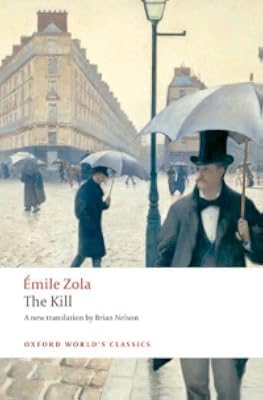
"The Kill (La Curee) is the second volume in Zola's great cycle of twenty novels, Les Rougon-Macquart, and the first to establish Paris - the capital of modernity - as the centre of Zola's narrative world. Conceived as a representation of the uncontrollable 'appetites' unleashed by the Second Empire (1852-70) and the transformation of the city by Baron Haussmann, the novel combines into a single, powerful vision the twin themes of lust for money and lust for pleasure. The all-pervading show more promiscuity of the new Paris is reflected in the dissolute and frenetic lives of an unscrupulous property speculator, Saccard, his neurotic wife Renee, and her dandified lover, Saccard's son Maxime."--Jacket. show lessTags
Recommendations















Member Recommendations
jboshears Saccard and Bel-Ami were both reprehensible, greedy guys.
Member Reviews
"Yes, yes, that's what I said, whole neighborhoods will be melted down, and gold will stick to the fingers of those who heat and stir the mortar. Poor innocent Paris! Look how enormous it is, and how easily it falls asleep! How stupid they are, those great cities! I has no idea that an army of picks will fall upon it one of these fine mornings, and some of the big houses in the Rue d'Anjou wouldn't shine so brightly in the sunset if they knew that they've only got three or four more years to live." (p. 68)
He was the first to sell his name to a shady company, one of those companies that sprouted like poisonous toadstools on the dunghill of Imperial speculation. (p. 75)
[The Kill] is about the redesign of Paris by Baron Haussmann with all show more the attendant speculation and corruption. Aristide Rougon, reinvented as the wealthy businessman Saccard, is the epitome of grasping greed. He will do anything to keep gold flowing in and out of his legendary safe, always looking for the next big windfall. He marries for money and brings his son from a previous marriage to Paris to be raised by his new young wife. Renee spends money, not so much for enjoyment, but as an appeasement to her boredom, lethargy, and growing depravity. When money ceases to give her a thrill, she turns to her stepson, Maxime, now a handsome dilettante and dandy, to fill the emptiness.
Like during the fall of Rome, Paris during the Second Empire has become an "orgy of gold and women." Speculation has created a frenzy of extravagance that is equaled only by the unchecked excesses of pleasure-seeking. Zola reflects the depraved morality of the time in the nature that is contained within the Saccard mansion's hothouse: voluptuous, moist, and smelling like sex. His depictions of nature here are very different from those in the first book, where nature has an innocence and beauty reflective of Silvère and Miette.
Another interesting aspect of this novel was the use of gender in blurring the lines between the roles played by Maxime and Renee. Maxime is depicted as girlish, pretty, effeminate, and even a hermaphrodite. Renee on the other hand is at times bold, aggressive, and dominate with him, although not in general. Their relationship is but a symptom of a larger ill, but fascinating in a microcosm.
I have ceased to start a Zola book with expectations as to whether or not I will like it, because I am always surprised at the speed with which I am swept away. Whether in the company of Eugene and his love of power or the Saccards and their greed, I cannot help rubber-necking at the disasters that befall Zola's characters. Indeed I cannot look away. show less
He was the first to sell his name to a shady company, one of those companies that sprouted like poisonous toadstools on the dunghill of Imperial speculation. (p. 75)
[The Kill] is about the redesign of Paris by Baron Haussmann with all show more the attendant speculation and corruption. Aristide Rougon, reinvented as the wealthy businessman Saccard, is the epitome of grasping greed. He will do anything to keep gold flowing in and out of his legendary safe, always looking for the next big windfall. He marries for money and brings his son from a previous marriage to Paris to be raised by his new young wife. Renee spends money, not so much for enjoyment, but as an appeasement to her boredom, lethargy, and growing depravity. When money ceases to give her a thrill, she turns to her stepson, Maxime, now a handsome dilettante and dandy, to fill the emptiness.
Like during the fall of Rome, Paris during the Second Empire has become an "orgy of gold and women." Speculation has created a frenzy of extravagance that is equaled only by the unchecked excesses of pleasure-seeking. Zola reflects the depraved morality of the time in the nature that is contained within the Saccard mansion's hothouse: voluptuous, moist, and smelling like sex. His depictions of nature here are very different from those in the first book, where nature has an innocence and beauty reflective of Silvère and Miette.
Another interesting aspect of this novel was the use of gender in blurring the lines between the roles played by Maxime and Renee. Maxime is depicted as girlish, pretty, effeminate, and even a hermaphrodite. Renee on the other hand is at times bold, aggressive, and dominate with him, although not in general. Their relationship is but a symptom of a larger ill, but fascinating in a microcosm.
I have ceased to start a Zola book with expectations as to whether or not I will like it, because I am always surprised at the speed with which I am swept away. Whether in the company of Eugene and his love of power or the Saccards and their greed, I cannot help rubber-necking at the disasters that befall Zola's characters. Indeed I cannot look away. show less
This is the 3rd novel in the recommended reading order of Zola's Rougon-Macquart series. For me, this is the one that starts feeling like Zola. It has all the lush descriptions of excess and depravity that I expect from Zola.
The novel centers around Aristide Rougon (he renames himself Aristide Saccard) who is obsessed with financial schemes to elevate himself. When his first wife dies, his sister Sidonie, finds an opportunity for him to marry a rich young woman who has been compromised by a married man. Saccard gladly marries her for her dowry. Renee and Saccard's son from a former marriage, Maxime, become lovers. Renee becomes the central character as she struggles against her need to relieve her boredom with pleasure versus her show more knowledge that what she's doing is wrong.
This is the second novel Zola wrote in this series, and though it has glimmers of his later greatest, I felt it was still a work in progress. I think the flow and pacing was a little slow and the characters less fully developed than his later characters becomes. I enjoyed it though and look forward to the next, which I'll read in March. show less
The novel centers around Aristide Rougon (he renames himself Aristide Saccard) who is obsessed with financial schemes to elevate himself. When his first wife dies, his sister Sidonie, finds an opportunity for him to marry a rich young woman who has been compromised by a married man. Saccard gladly marries her for her dowry. Renee and Saccard's son from a former marriage, Maxime, become lovers. Renee becomes the central character as she struggles against her need to relieve her boredom with pleasure versus her show more knowledge that what she's doing is wrong.
This is the second novel Zola wrote in this series, and though it has glimmers of his later greatest, I felt it was still a work in progress. I think the flow and pacing was a little slow and the characters less fully developed than his later characters becomes. I enjoyed it though and look forward to the next, which I'll read in March. show less
This is the third volume of in Zola's 20 volume Rougon-Macquart cycle of novel set against the backdrop of the rule of Napoleon III in the 1850s and 60s. It is also known as La Curée or The Kill. This was rather more memorable than the previous book, and based around the financial shenanigans and love lives of a small central group of characters - unscrupulous businessman Aristide Saccard, brother of the minister Eugene Rougon; his son Maxime; and his second wife Renée, whom he marries for opportunistic reasons but which also saves her reputation in her father's eyes after she has been raped by another man. The central development of the narrative is Renée's "incestuous" affair with her stepson Maxime (in inverted commas as the legal show more position on whether such a relationship is incest seems to vary greatly by country and time period). This takes place against the background of the financial speculation carried out as Paris is rebuilt during this period, personified by the acquisitiveness of Saccard, who "could not keep any living or inanimate object near him for any length of time without trying to sell it, or derive some profit by it." It is a city where "Vice, coming from above, flowed along the gutters, spread itself out in the sheets of ornamental water, reascended in the fountains of the public gardens to fall again on to the roofs in a fine penetrating rain." So Renée and Maxime's affair arose graphically "Amid the maddened society in which they lived, their crime had sprouted as upon a rich dung-heap full of impure juices; it had developed itself with a strange refinement amid a particular kind of debauchery." The ethos of depravity and licence permeates the novel, and would have been very controversial at the time of writing (1870s), and is still quite striking now. At the end of the story, Renée is abandoned by both men and sadly dies a year later, mourned only by her father. show less
The Kill is a feverish novel, written at a frantic pace, full of amazing images, frenetic activity and scandalous affairs.
This exhausting pace is deliberate, for this is Zola's novel of the urban renewal of Paris, a project that still remains the largest of its kind. It was part of Louis Napoleon Bonaparte's effort to establish some legitimacy for himself after staging a coup d'état and having himself crowned as Napoleon III. To carry out the design and build of his new Paris, he appointed Georges Haussman.
In his excellent introduction, Brian Nelson gives an explanation of how Haussman accomplished this work. New expropriation legislation forced property owners to sell to the government any land that was deemed needed for the great new show more boulevards. This included the land bordering these new routes. The government in turn sold its newly acquired properties on either side of its new roads to speculators. The speculators and developers built the apartments that gave Paris its new look. Uniformity was achieved by regulations for things such as height and the configuration of roof lines. It was also decreed that the new buildings would be made of stone, not brick. An excise tax was introduced on all stone coming into the city, and the proceeds were used in city financing. Bonds were floated by private groups without any regulation.
In less than twenty years, 350,000 people were displaced as their homes were demolished. Rents skyrocketed despite the construction of some 80,000 new apartment buildings. The numbers of trees and streets doubled, Gas and running water were introduced, sewers were expanded. By the time of the 1867 World Exhibition, the host city Paris "was acknowledged as the capital of luxury and fashion -- the capital, indeed, of the nineteenth century." Such a frenzy was guaranteed to attract fortune seekers and opportunists. Enter three of the Rougon siblings, outsiders from Plassans in the south of France, each intent upon "arriving" in the new Paris.
Eugène had come first, before the coup, and had worked hard to get Plassans and his family to support Louis Napoléon. As a reward for his efforts, he was now a government minister. Shortly after the coup, his brother Aristide came to Paris. Eugène found him a minor job as an assistant surveying clerk in the planning department. Unsure of Aristide, he imposed two conditions. Aristide would have to change his family name and not employ the family connection, and having found himself in city hall with all its insider information, he was to rely on his wits to put it to use and not impose on Eugène any further. The third sibling was the shadowy Madame Sidonie, "... as dry as an invoice, as cold as a protest, and at bottom as brutal and indifferent as a bailiff's assistant." Madame Sidonie was a fixer par excellence, trading in dirty secrets, someone everyone in society simultaneously needed and loathed. It was she who arranged a hasty marriage for Aristide, now Saccard, to a young lady in unfortunate circumstances, in return for enough money from her father to set Aristide on his way. Politics, money and sex were the triumvirate of this city and each sibling had mastered the uses of at least one.
Zola characterized the new Paris as the bawdy house of Europe, and Aristide's new wife Renée epitomized it. She thrived in her new world as Saccard's wife, so far removed from her bourgeois roots and convent upbringing.
Renée joined in the fray. Her pursuit was indulgence. For dedicated thrill seekers, there is no limit to the quest for diversion. Its ultimate end for Renée was the seduction of her stepson. Zola portrays Maxime as beautiful and androgynous, a youth of indeterminate gender. Renée often dominated their encounters, becoming more overtly aggressive in an inversion of the accepted gender roles. She also became more and more indiscreet and abandoned in her public behaviour. She destroyed the family, infecting this last bastion of social order with her disease, as Saccard and his ilk were destroying the diseased world around them.
Initially [The Kill] was published in serial form in La Cloche in 1871. Then the government halted further publication of the episodes, citing morality concerns. This may have been the case, but the government had political concerns as well. Zola wrote to the editor, "My aim, in this new Phaedra , was to show the terrible social breakdown that occurs when all moral standards are lost and family ties no longer exist." Commenting on Aristide, Renée and Maxime, he said, "I have tried, with these three social monstrosities, to give some idea of the social quagmire into which France was sinking." In his own Preface to the book, he called it "... a true portrait of social collapse."
Could such a breakdown have occurred so suddenly anywhere else, or did it need the hothouse that was Paris to create it? It is Zola's genius and observational skills that enable him not only to portray his characters and society so minutely and convincingly, but also to elevate them to a more universal plane, where the reader understands that such circumstances and creatures attend all great societal upheavals. show less
This exhausting pace is deliberate, for this is Zola's novel of the urban renewal of Paris, a project that still remains the largest of its kind. It was part of Louis Napoleon Bonaparte's effort to establish some legitimacy for himself after staging a coup d'état and having himself crowned as Napoleon III. To carry out the design and build of his new Paris, he appointed Georges Haussman.
In his excellent introduction, Brian Nelson gives an explanation of how Haussman accomplished this work. New expropriation legislation forced property owners to sell to the government any land that was deemed needed for the great new show more boulevards. This included the land bordering these new routes. The government in turn sold its newly acquired properties on either side of its new roads to speculators. The speculators and developers built the apartments that gave Paris its new look. Uniformity was achieved by regulations for things such as height and the configuration of roof lines. It was also decreed that the new buildings would be made of stone, not brick. An excise tax was introduced on all stone coming into the city, and the proceeds were used in city financing. Bonds were floated by private groups without any regulation.
In less than twenty years, 350,000 people were displaced as their homes were demolished. Rents skyrocketed despite the construction of some 80,000 new apartment buildings. The numbers of trees and streets doubled, Gas and running water were introduced, sewers were expanded. By the time of the 1867 World Exhibition, the host city Paris "was acknowledged as the capital of luxury and fashion -- the capital, indeed, of the nineteenth century." Such a frenzy was guaranteed to attract fortune seekers and opportunists. Enter three of the Rougon siblings, outsiders from Plassans in the south of France, each intent upon "arriving" in the new Paris.
Eugène had come first, before the coup, and had worked hard to get Plassans and his family to support Louis Napoléon. As a reward for his efforts, he was now a government minister. Shortly after the coup, his brother Aristide came to Paris. Eugène found him a minor job as an assistant surveying clerk in the planning department. Unsure of Aristide, he imposed two conditions. Aristide would have to change his family name and not employ the family connection, and having found himself in city hall with all its insider information, he was to rely on his wits to put it to use and not impose on Eugène any further. The third sibling was the shadowy Madame Sidonie, "... as dry as an invoice, as cold as a protest, and at bottom as brutal and indifferent as a bailiff's assistant." Madame Sidonie was a fixer par excellence, trading in dirty secrets, someone everyone in society simultaneously needed and loathed. It was she who arranged a hasty marriage for Aristide, now Saccard, to a young lady in unfortunate circumstances, in return for enough money from her father to set Aristide on his way. Politics, money and sex were the triumvirate of this city and each sibling had mastered the uses of at least one.
Zola characterized the new Paris as the bawdy house of Europe, and Aristide's new wife Renée epitomized it. She thrived in her new world as Saccard's wife, so far removed from her bourgeois roots and convent upbringing.
Meanwhile the Saccards' fortune seemed to be at its height. It blazed in the heart of Paris like a great bonfire. This was the time when the rush for spoils filled a corner of the forest with the yelping of hounds, the cracking of whips, the flaring of torches. The appetites let loose were satisfied at last, shamelessly, amid the sounds of crumbling neighbourhoods and fortunes made in less than six months. The city had become an orgy of gold and women. Vice, coming from on high, flowed through the gutters, spread out over the ornamental waters, shot up in the fountains of the public gardens, and fell on the roofs as fine rain. At night, when people crossed the bridges, it seemed as if the Seine drew along with it, through the sleeping city, all the refuse of the streets... (O)ne felt a growing sense of madness , the voluptuous nightmare of a city obsessed with gold and flesh.
Renée joined in the fray. Her pursuit was indulgence. For dedicated thrill seekers, there is no limit to the quest for diversion. Its ultimate end for Renée was the seduction of her stepson. Zola portrays Maxime as beautiful and androgynous, a youth of indeterminate gender. Renée often dominated their encounters, becoming more overtly aggressive in an inversion of the accepted gender roles. She also became more and more indiscreet and abandoned in her public behaviour. She destroyed the family, infecting this last bastion of social order with her disease, as Saccard and his ilk were destroying the diseased world around them.
Initially [The Kill] was published in serial form in La Cloche in 1871. Then the government halted further publication of the episodes, citing morality concerns. This may have been the case, but the government had political concerns as well. Zola wrote to the editor, "My aim, in this new Phaedra , was to show the terrible social breakdown that occurs when all moral standards are lost and family ties no longer exist." Commenting on Aristide, Renée and Maxime, he said, "I have tried, with these three social monstrosities, to give some idea of the social quagmire into which France was sinking." In his own Preface to the book, he called it "... a true portrait of social collapse."
Could such a breakdown have occurred so suddenly anywhere else, or did it need the hothouse that was Paris to create it? It is Zola's genius and observational skills that enable him not only to portray his characters and society so minutely and convincingly, but also to elevate them to a more universal plane, where the reader understands that such circumstances and creatures attend all great societal upheavals. show less
The second book in the cycle takes us to Paris, and focusses on Pierre Rougon's son Aristide, whom we last saw in Plassans, backtracking rapidly from his stance as a radical journalist when he realised that he was backing the losing side. He's now in Paris, corruptly exploiting a job as a city official in order to make a fortune in property deals off the back of Haussmann's grand demolition and reconstruction project. He's changed his name to Saccard, and has a glamorous new wife, Renée, who is only seven years older than his son from his first marriage, Maxime.
All of which, of course, gives Zola the perfect opportunity to cast Renée as an ironic Second-Empire version of the most famous heroine in French classical drama, Phédre, show more making her fall desperately and self-destructively in love with her own stepson. And where else could the big sex-scene take place in a Zola novel than under a bearskin in a tropical greenhouse containing at least five pages worth of exotic plants of a sexually suggestive nature? The greenhouse in question is attached to Aristide's glamorous millionaire-villa, which is - of course - illegally built on the edge of the Parc Monceau (one of the private parks bought for the city and rebuilt by Haussmann).
Zola's point in this frantic and complex story of financial and sexual corruption, as flagged by the hunting reference in the title, seems to be to show us that most of his characters are chasing sex or money not so much in order to get it, but mostly for the excitement of the chase. If a plot fails, tant pis - something else will come along. The people who take sex seriously, like Renée, get hurt; the people who take money seriously get boringly rich and fade out of the social circuit. Aristide is an extreme example of the "hunter", who keeps a mistress only because that goes with his self-adopted role as the daring financial wizard: they meet to have a laugh together about her other suitors, and after a decent interval he sells her on to someone else. His financial deals are so elegant, crooked and complicated that he doesn't actually seem to make any money out of them for himself when they succeed. They extend his reputation as a good credit risk, and that's all that matters.
There are a lot of glorious set-piece scenes in the book, especially the grand climax of the story at Aristide's costume-ball, where Zola sets up a scene of positively operatic opulence and complexity, with different groups of characters moving in and out of the spotlight, and dancers, music, plants (again!) and tableaux-vivant all working the symbolism like there's no tomorrow.
In among the general depravity there's a surprising amount of LGBT interest - mostly unfavourable and designed to reinforce our idea of how very corrupt this world is. Maxime is at least gender-uncertain and likes to be treated as one of the girls and talk hair and fashion with them; there's a couple of aristocratic friends of Renée who are widely rumoured to be more interested in each other than in their husbands; there's a valet-de-chambre who likes to have his wicked way with the grooms and coachmen, etc., etc. All a lot more explicit than the things that Trollope sometimes hints at! show less
All of which, of course, gives Zola the perfect opportunity to cast Renée as an ironic Second-Empire version of the most famous heroine in French classical drama, Phédre, show more making her fall desperately and self-destructively in love with her own stepson. And where else could the big sex-scene take place in a Zola novel than under a bearskin in a tropical greenhouse containing at least five pages worth of exotic plants of a sexually suggestive nature? The greenhouse in question is attached to Aristide's glamorous millionaire-villa, which is - of course - illegally built on the edge of the Parc Monceau (one of the private parks bought for the city and rebuilt by Haussmann).
Zola's point in this frantic and complex story of financial and sexual corruption, as flagged by the hunting reference in the title, seems to be to show us that most of his characters are chasing sex or money not so much in order to get it, but mostly for the excitement of the chase. If a plot fails, tant pis - something else will come along. The people who take sex seriously, like Renée, get hurt; the people who take money seriously get boringly rich and fade out of the social circuit. Aristide is an extreme example of the "hunter", who keeps a mistress only because that goes with his self-adopted role as the daring financial wizard: they meet to have a laugh together about her other suitors, and after a decent interval he sells her on to someone else. His financial deals are so elegant, crooked and complicated that he doesn't actually seem to make any money out of them for himself when they succeed. They extend his reputation as a good credit risk, and that's all that matters.
There are a lot of glorious set-piece scenes in the book, especially the grand climax of the story at Aristide's costume-ball, where Zola sets up a scene of positively operatic opulence and complexity, with different groups of characters moving in and out of the spotlight, and dancers, music, plants (again!) and tableaux-vivant all working the symbolism like there's no tomorrow.
In among the general depravity there's a surprising amount of LGBT interest - mostly unfavourable and designed to reinforce our idea of how very corrupt this world is. Maxime is at least gender-uncertain and likes to be treated as one of the girls and talk hair and fashion with them; there's a couple of aristocratic friends of Renée who are widely rumoured to be more interested in each other than in their husbands; there's a valet-de-chambre who likes to have his wicked way with the grooms and coachmen, etc., etc. All a lot more explicit than the things that Trollope sometimes hints at! show less
I quite enjoyed this 2nd book in Zola’s Les Rougon-Macquart series. This installment follows a period in the life of Aristide Rougon (later Aristide Saccard) as he moves to Paris during the age of the Second Empire (1852-1870). This story occurs after the events of the first novel in which members of the Rougon family exploit intelligence from connections that lead them to back the winning side in the 1851 French coup d’état. Aristide moves to Paris and uses a low level office position to learn about city development plans as Paris is remade under Napoleon III. He buys up properties in the path of destruction, inflates the value of the buildings, and then commands a profit over his investment when the city buys back the property show more rights.
The story focuses on Aristide’s second wife, the young Renée, whose social standing he “rescues” via marriage after her social standing was damaged by a rape that she endured. Of course, the marriage is not for love or beneficence but for financial leverage from the dowry and property Renée owns.
Renée and Maxime (Aristide’s son from his first marriage) lead lives of opulence and wealth that Zola describes in great detail, to highlight its magnificence and excess. But Renée and Maxime are unhappy. They have money, given as allowances, to meet their needs but they still experience unfulfilled desire for something beyond the boredom of excess. Renée and Maxime find it in an illicit love affair. They become consumed by their desire, ratcheting forward to new pleasures and risks and deceptions day by day, eventually losing much of their sense of dignity. Their behavior is paralleled by Aristide’s increasingly risky and exploitative real estate ventures. All of their lives threaten to fall apart while pursuing their desires on the knife’s edge.
Chapter VI brings so many of the themes into focus and is a highlight of the book. The centerpiece is the tableau theatrical staging of Narcissus and Echo that includes many of the novel’s characters, mostly wives and lovers and children of the property speculators. Maxime plays the role of Narcissus and Renée plays Echo. In addition to the topical similarity with the novel and the foreshadowing that it provides, the best part is the scene that immediately follows the tableau. In that scene, a spread of drinks and cold cuts are laid out at buffet tables (mirroring the theatrical tableau). When guests are let into the room, the food tables are mobbed by the guests and the food and drink is hastily devoured with guests elbowing for position. It’s a disturbing scene reminiscent of a pack of animals feeding on prey. As I see it, the scene reflects back on the tableau, a spread of actors whose love, attention, dignity, and senses of self are devoured by their desires, by their lifestyles, by all the people who use them to get ahead. This theme of devouring and the way it mixes violence and desire and animal satisfaction shows up in other Zola books, and I find it disturbing and arresting each time.
Les Rougon-Macquart continues to be an engaging, gritty, realistic novel series. I read a few books out of order at first, but now I’m trying to go in the order that the book were written. Ostensibly, the books are chronicling the fates of two families: the Rougons who are “well born” and wealthy and the Macquarts who are “lower born” and whose members are subject to vices. The series asks how much of a person’s character derives from their family and their inherited nature and how much comes from the environment. As far as I have seen, Zola seems to argue that being “well born” does not assure the Rougons of any virtuous or ethical standing any more than the diminished means and vices of the Macquarts deny their descendants the ability to be dignified and upstanding. The Rougons that I have met have demonstrated that it easy is to bend the law to behave selfishly and exploitatively within one’s rights in a capitalist system. Likewise the Macquarts have demonstrated that it is possible to have dignity but difficult to keep it in a system that grinds them to pulp. show less
The story focuses on Aristide’s second wife, the young Renée, whose social standing he “rescues” via marriage after her social standing was damaged by a rape that she endured. Of course, the marriage is not for love or beneficence but for financial leverage from the dowry and property Renée owns.
Renée and Maxime (Aristide’s son from his first marriage) lead lives of opulence and wealth that Zola describes in great detail, to highlight its magnificence and excess. But Renée and Maxime are unhappy. They have money, given as allowances, to meet their needs but they still experience unfulfilled desire for something beyond the boredom of excess. Renée and Maxime find it in an illicit love affair. They become consumed by their desire, ratcheting forward to new pleasures and risks and deceptions day by day, eventually losing much of their sense of dignity. Their behavior is paralleled by Aristide’s increasingly risky and exploitative real estate ventures. All of their lives threaten to fall apart while pursuing their desires on the knife’s edge.
Chapter VI brings so many of the themes into focus and is a highlight of the book. The centerpiece is the tableau theatrical staging of Narcissus and Echo that includes many of the novel’s characters, mostly wives and lovers and children of the property speculators. Maxime plays the role of Narcissus and Renée plays Echo. In addition to the topical similarity with the novel and the foreshadowing that it provides, the best part is the scene that immediately follows the tableau. In that scene, a spread of drinks and cold cuts are laid out at buffet tables (mirroring the theatrical tableau). When guests are let into the room, the food tables are mobbed by the guests and the food and drink is hastily devoured with guests elbowing for position. It’s a disturbing scene reminiscent of a pack of animals feeding on prey. As I see it, the scene reflects back on the tableau, a spread of actors whose love, attention, dignity, and senses of self are devoured by their desires, by their lifestyles, by all the people who use them to get ahead. This theme of devouring and the way it mixes violence and desire and animal satisfaction shows up in other Zola books, and I find it disturbing and arresting each time.
Les Rougon-Macquart continues to be an engaging, gritty, realistic novel series. I read a few books out of order at first, but now I’m trying to go in the order that the book were written. Ostensibly, the books are chronicling the fates of two families: the Rougons who are “well born” and wealthy and the Macquarts who are “lower born” and whose members are subject to vices. The series asks how much of a person’s character derives from their family and their inherited nature and how much comes from the environment. As far as I have seen, Zola seems to argue that being “well born” does not assure the Rougons of any virtuous or ethical standing any more than the diminished means and vices of the Macquarts deny their descendants the ability to be dignified and upstanding. The Rougons that I have met have demonstrated that it easy is to bend the law to behave selfishly and exploitatively within one’s rights in a capitalist system. Likewise the Macquarts have demonstrated that it is possible to have dignity but difficult to keep it in a system that grinds them to pulp. show less
"Sin ought to be an exquisite thing, my dear."
A scathing indictment of Paris during the rise of the Second Empire, Zola here centres his novel around a man driven by power and a woman driven by insatiable desires with a refusal to self-analyse (shades of His Excellency Eugene Rougon). The gorgeous descriptions, running multiple pages at a time, of palatial estates springing up across the city create a banquet so rich it spoils. Zola consciously overwhelms our senses as he examines how the twinned greed of Saccard and Renee exemplifies the grotesque abundance that characterised this era. (Strange, in a way, to imagine him writing this in the period immediately following the Empire.)
As usual with Zola, symbolism is rich and plentiful. show more The houses are decorated in images of life: fruit and flowers and plants, but which are made of stone, images only of the nature from which they are removed. (At book's end, one character will weep "at not having listened to the voices of the trees".) The "kill" referred to in the novel's title is that which is killed by dogs during a hunt. For each of the main characters, there is a desire to claim that kill - whether it be pleasure, power, money, or something else entirely - but such a goal requires a great sacrifice of one's self.
Zola's obsession with the idea that characteristics and traits are passed down perhaps becomes a bit of a distraction during this novel, especially with the son Maxime who displays worrying (read: bisexual or at least epicene) traits which one feels that the author disdains. And his evident desire to write a novel of the moment, one set in a world with which contemporary readers were familiar, means this novel stretches the brain a little more than, say, The Fortune of the Rougons where only a few footnotes are required to assist with the powerful atmosphere. Here, one gets the sense that the supporting characters are all strongly recognisable types or even direct references - roman a clef - that do not resonate 150 years on.
But that's the dismissive part out of the way. This is an engaging chapter in the ongoing Rougon-Macquart series. The best part is that there was plenty of symbolism even without the author. The boulevards that went up and the complete reconstruction of Paris under the Second Empire were directly political acts. (In Zola, perhaps everything is political.) As Brian Nelson notes in his excellent introduction for the recent Oxford World's Classics edition, they were acts of power - ripping through districts of the poor or disenfranchised, and creating easy avenues for troops to be deployed in the event of an uprising. They were also very much acts of capitalism, both in the way the rich fattened themselves on the spoils, and also in the Paris they created, so much better prepared for the age of "gold and flesh" Zola reflects upon.
Fun fun. show less
A scathing indictment of Paris during the rise of the Second Empire, Zola here centres his novel around a man driven by power and a woman driven by insatiable desires with a refusal to self-analyse (shades of His Excellency Eugene Rougon). The gorgeous descriptions, running multiple pages at a time, of palatial estates springing up across the city create a banquet so rich it spoils. Zola consciously overwhelms our senses as he examines how the twinned greed of Saccard and Renee exemplifies the grotesque abundance that characterised this era. (Strange, in a way, to imagine him writing this in the period immediately following the Empire.)
As usual with Zola, symbolism is rich and plentiful. show more The houses are decorated in images of life: fruit and flowers and plants, but which are made of stone, images only of the nature from which they are removed. (At book's end, one character will weep "at not having listened to the voices of the trees".) The "kill" referred to in the novel's title is that which is killed by dogs during a hunt. For each of the main characters, there is a desire to claim that kill - whether it be pleasure, power, money, or something else entirely - but such a goal requires a great sacrifice of one's self.
Zola's obsession with the idea that characteristics and traits are passed down perhaps becomes a bit of a distraction during this novel, especially with the son Maxime who displays worrying (read: bisexual or at least epicene) traits which one feels that the author disdains. And his evident desire to write a novel of the moment, one set in a world with which contemporary readers were familiar, means this novel stretches the brain a little more than, say, The Fortune of the Rougons where only a few footnotes are required to assist with the powerful atmosphere. Here, one gets the sense that the supporting characters are all strongly recognisable types or even direct references - roman a clef - that do not resonate 150 years on.
But that's the dismissive part out of the way. This is an engaging chapter in the ongoing Rougon-Macquart series. The best part is that there was plenty of symbolism even without the author. The boulevards that went up and the complete reconstruction of Paris under the Second Empire were directly political acts. (In Zola, perhaps everything is political.) As Brian Nelson notes in his excellent introduction for the recent Oxford World's Classics edition, they were acts of power - ripping through districts of the poor or disenfranchised, and creating easy avenues for troops to be deployed in the event of an uprising. They were also very much acts of capitalism, both in the way the rich fattened themselves on the spoils, and also in the Paris they created, so much better prepared for the age of "gold and flesh" Zola reflects upon.
Fun fun. show less
Members
- Recently Added By
Lists

Books You Read During High School (For School)
301 works; 53 members

Books Read in 2022
5,226 works; 115 members
Talk Discussions
Past Discussions
January 2025 The Kill Preface, Notes, Introduction, Chapter 1 in Emile Zola Group Read (January 2025)
The Kill by Zola in Author Theme Reads (August 2013)
Author Information

705+ Works 35,872 Members
Zola was the spokesperson for the naturalist novel in France and the leader of a school that championed the infusion of literature with new scientific theories of human development drawn from Charles Darwin (see Vol. 5) and various social philosophers. The theoretical claims for such an approach, which are considered simplistic today, were show more outlined by Zola in his Le Roman Experimental (The Experimental Novel, 1880). He was the author of the series of 20 novels called The Rougon-Macquart, in which he attempted to trace scientifically the effects of heredity through five generations of the Rougon and Macquart families. Three of the outstanding volumes are L'Assommoir (1877), a study of alcoholism and the working class; Nana (1880), a story of a prostitute who is a femme fatale; and Germinal (1885), a study of a strike at a coal mine. All gave scope to Zola's gift for portraying crowds in turmoil. Today Zola's novels have been appreciated by critics for their epic scope and their visionary and mythical qualities. He continues to be immensely popular with French readers. His newspaper article "J'Accuse," written in defense of Alfred Dreyfus, launched Zola into the public limelight and made him the political conscience of his country. (Bowker Author Biography) show less
Some Editions
Awards and Honors
Notable Lists
Torchlight List (#136)
Series

Les Rougon-Macquart (publication order)
21 works (2)

Les Rougon-Macquart (Zola's recommended reading order)
20 works (3)
Belongs to Publisher Series
Work Relationships
Common Knowledge
- Canonical title
- The Kill
- Original title
- La Curée
- Alternate titles
- The Rush for the Spoils
- Original publication date
- 1871
- People/Characters
- Aristide Saccard; Maxime Saccard; Eugene Rougon; Sidonie Rougon
- Important places
- Paris, France
- Related movies*
- The Game Is Over (1966 | IMDb)
- First words
- On the drive home, the barouche was reduced to a crawl by the long line of carriages returning by the side of the lake.
- Original language
- French
- Disambiguation notice
- The Bantam Giant edition of The Kill is an abridgement. Do not combine with the main work.
*Some information comes from Common Knowledge in other languages. Click "Edit" for more information.
Classifications
Statistics
- Members
- 1,091
- Popularity
- 23,435
- Reviews
- 30
- Rating
- (3.80)
- Languages
- 10 — Dutch, English, French, German, Hungarian, Italian, Serbian, Spanish, Swedish, Turkish
- Media
- Paper, Audiobook, Ebook
- ISBNs
- 85
- ASINs
- 44