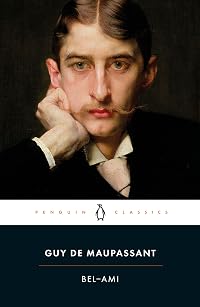
Bel-Ami
by Guy de Maupassant
On This Page
Description
Fiction. Literature. Guy de Maupassant is revered for his naturalistic fiction, which brilliantly captures flesh-and-blood characters as it evokes the most telling details of everyday life. Considered one of the finest French novels ever written, Bel Ami follows journalist Georges Duroy and his increasing stature among the Paris elite. With an immense thirst for power, Georges is not above an almost gleeful use of wealthy mistresses to achieve his ends.Tags
Recommendations









































Member Recommendations


Princess_Hana Very similar contexts
Member Reviews
Le monde est une mascarade où le succès va de préférence aux crapules. La réussite, les honneurs, les femmes et le pouvoir: le monde n'a guère changé. On rencontre toujours - moins les moustaches - dans les salles de rédaction ou ailleurs, de ces jeunes aventuriers de l'arrivisme et du sexe. Comme Flaubert, mais en riant, Maupassant disait de son personnage, l'odieux Duroy : " Bel-Ami, c'est moi." Et pour le cynisme, la fureur sensuelle, l'athéisme, la peur de la mort, ils se ressemblaient assez. Mais Bel-Ami ne savait pas écrire, et devenait l'amant et le négrier d'une femme talentueuse et brillante. Maupassant, lui, était un immense écrivain. Universel, déjà, mais par son réalisme, ses obsessions et ses névroses, show more encore vivant aujourd'hui. show less
De Maupassant's classic remains shocking today, almost 130 years after publication, and is shockingly contemporary in some ways. What's shocking in this tale of a young man on the make is the complete amorality of the central character, and, indeed, of most of the characters in the book. And what's contemporary is the same thing. The ways and means of chasing success have changed since de Maupassant's time, but the compulsion to succeed -- at any cost to any one -- remains very much in place.
"Bel Ami" traces the career of Georges Duroy, an ex-solider from the provinces who comes to Paris to make his fortune. At first, he has no contacts and no skills, but he does have a handsome face and a quick mind. Through an accidental meeting with show more an old comrade-in-arms, he gets a chance at a newspaper job, and the friend's wife helps him clinch the job with a well written article. From there on in it it's onward and upward, as Georges uses his attractiveness to women to advance himself socially and professionally. When a women ceases to be useful, he ends the connection and moves on to the next, until, at the end of the novel --- well, no spoilers here.
Duroy never suffers any qualms of conscience about the women he seduces (and abandons) or the men he cuckolds. Where a reader looks for some effort at self-justification, there is a deafening silence. For example, remember Gordon Gecko's "Greed is Good"? Duroy doesn't even argue that his doings are OK, he just does them. Most of the other characters are equally amoral. They use their professional positions, their social contacts, and their lovers to get them more money and more power. And most don't seem to think the worse of anyone else for acting this way: indeed, they expect it.
As to the book's surprisingly contemporary echoes, it's about ambition. The electronic world has replaced the social world as a route to quick-time fame and fortune (think reality TV) and the roles of men and women are much less differentiated than they were. But individual ambition that becomes its own justification, and takes no account of the damage it has done, remains very much with us.
As a novel, this one works like a charm. The story keeps pulling the reader along, as -- even though it is hard to like any of the characters very much -- you get very curious about what will happen to them. Historically, it provides a vivid look at Third Republic Paris, full of glamor, glitter, and what de Maupassant called a "rather smutty elegance". (The book has no overt sex, but there is a lot going on just offstage-- one sees why the 19th century English found the 19th century French so shocking). An excellent novel, and an enjoyable read despite its age. show less
"Bel Ami" traces the career of Georges Duroy, an ex-solider from the provinces who comes to Paris to make his fortune. At first, he has no contacts and no skills, but he does have a handsome face and a quick mind. Through an accidental meeting with show more an old comrade-in-arms, he gets a chance at a newspaper job, and the friend's wife helps him clinch the job with a well written article. From there on in it it's onward and upward, as Georges uses his attractiveness to women to advance himself socially and professionally. When a women ceases to be useful, he ends the connection and moves on to the next, until, at the end of the novel --- well, no spoilers here.
Duroy never suffers any qualms of conscience about the women he seduces (and abandons) or the men he cuckolds. Where a reader looks for some effort at self-justification, there is a deafening silence. For example, remember Gordon Gecko's "Greed is Good"? Duroy doesn't even argue that his doings are OK, he just does them. Most of the other characters are equally amoral. They use their professional positions, their social contacts, and their lovers to get them more money and more power. And most don't seem to think the worse of anyone else for acting this way: indeed, they expect it.
As to the book's surprisingly contemporary echoes, it's about ambition. The electronic world has replaced the social world as a route to quick-time fame and fortune (think reality TV) and the roles of men and women are much less differentiated than they were. But individual ambition that becomes its own justification, and takes no account of the damage it has done, remains very much with us.
As a novel, this one works like a charm. The story keeps pulling the reader along, as -- even though it is hard to like any of the characters very much -- you get very curious about what will happen to them. Historically, it provides a vivid look at Third Republic Paris, full of glamor, glitter, and what de Maupassant called a "rather smutty elegance". (The book has no overt sex, but there is a lot going on just offstage-- one sees why the 19th century English found the 19th century French so shocking). An excellent novel, and an enjoyable read despite its age. show less
George Duroy, better known to his friends as Bel Ami because of his pleasing appearance to women, has very few redeeming qualities. But the genius of this Maupassant novel is that one is utterly fascinated by this man who starts from nothing, as a penniless soldier returned from service in Algeria, and then proceeds to climb up the ladder of Paris society. His success is largely based on a bit of luck, a lot of cunning and a great willingness to use his sexual appeal to play the game of love with those women he knows will help him rise in power and riches. He initially runs into an old friend who works at a newspaper called La Vie Française, and accepts a humble position as a reporter, even though he's never in his life written an show more article before. (Spoiler) Before long, the friend dies and he proposes marriage to his widow right besides to corpse of the deceased, before it's even had time to cool. (End of spoiler.) The novel moves swiftly along and we are privy to Bel Ami's cynical inner workings as he plots each move to advance himself, with utter disregard for his victims who are blinded by his charm and his moustache, which is practically a character unto itself to sometimes hilarious effect. As another LTer, Nathalie (Deern) observed in her own review, this novel transcends it's belle époque setting and remains all too relevant to contemporary readers—save for the moustache of course, which for all we know might eventually make a comeback. show less
Bel Ami by Guy de Maupassant is set in Paris and depicts the belle epoque era as it tells the story of Georges Duroy, an opportunistic young man who grows more and more corrupted as the book advances. Georges is a user of people and doesn’t seem to care much if he is taking advantage of a male or a female. As he rises to success in the field of journalism, he does so on the backs of the people that have helped him achieve his position.
At the beginning of the book, George is a handsome young man who is penniless and without prospects. At this point in the story it is possible to feel some sympathy for him but that quickly disappears as he begins to covet wealth and influence and climbs the social ladder by using his cunning, wit and show more his built-in appeal to rich and powerful women. It is all about what they can do for him. His nickname is Bel Ami which means beautiful friend, but his beauty is only skin-deep and his friendship is only for himself.
Although peopled, for the most part, with selfish and soulless characters, I enjoyed this very short book. The Parisian setting showed a lively and pleasure seeking society, and the narcissist rake, George Duroy, was fascinating to read about. show less
At the beginning of the book, George is a handsome young man who is penniless and without prospects. At this point in the story it is possible to feel some sympathy for him but that quickly disappears as he begins to covet wealth and influence and climbs the social ladder by using his cunning, wit and show more his built-in appeal to rich and powerful women. It is all about what they can do for him. His nickname is Bel Ami which means beautiful friend, but his beauty is only skin-deep and his friendship is only for himself.
Although peopled, for the most part, with selfish and soulless characters, I enjoyed this very short book. The Parisian setting showed a lively and pleasure seeking society, and the narcissist rake, George Duroy, was fascinating to read about. show less
This is the first novel by Maupassant I’ve read and I found it heady stuff. As ever, I’m glad I read the introduction last, as it analyses the whole thing to death. It was interesting to read afterwards, though. As was the translator’s note, in which Mauldon comments that she struggled at times to get the tone right, as it is a very male-oriented, misogynist novel. I did feel at times that the original French was surely more voluptuous than what I was reading. Then again, it is tricky to retain a particular air when translating fiction, something Alberto Manguel wrote thoughtfully about. This translation certainly achieved a singular beauty and I greatly enjoyed it.
Duroy, or Bel-Ami, is a fascinating character. He can be described show more as ambitious, opportunistic, weak in some ways, cruel at times, materialistic, not terribly self-aware, cunning, and vain. Although I disliked him, I found his perspective fascinating. His social climbing showcases fin de siecle Paris in all its hypocrisy, venality, and immorality. The minutiae of life are omnipresent - prices, foodstuffs, hobbies, and furnishings. I loved these details, which are then periodically thrown into contrast with the stark reality of short human life and inevitable death. Norbert de Varenne’s monologue on this subject is absolutely chilling.
To my mind, the most sympathetic and interesting character is Madeleine, a cool, collected, and very clever woman. She is evidently a talented journalist, although she writes via men. Unlike the other female characters, who tends towards the histrionic and infantilised, Madeleine is allowed an air of dignity. Bel-Ami’s interactions with women in general reminded me of [b:Dangerous Liaisons|49540|Les Liaisons dangereuses|Pierre-Ambroise Choderlos de Laclos|https://images.gr-assets.com/books/1298425654s/49540.jpg|3280025], albeit with an interesting historical contrast. The 18th century world of Liaisons was one of idle pleasure-seeking, whereas the 19th century of Bel-Ami is rife with restless political ambition. The novel presents a very ambivalent picture of social mobility. Duroy’s rise from poverty (although he was never amongst les misérables; his parents ran a rural tavern) seemed to demonstrate that to achieve success you had to be amoral and unscrupulous. Bel-Ami felt at times like a Greek tragedy in the making, but perhaps the tragedy is that hubris is rewarded rather than punished. I definitely found it pessimistic overall, but sparklingly well written. Actually, in that respect it reminded me slightly of [b:The Great Gatsby|4671|The Great Gatsby|F. Scott Fitzgerald|https://images.gr-assets.com/books/1438728255s/4671.jpg|245494]. show less
Duroy, or Bel-Ami, is a fascinating character. He can be described show more as ambitious, opportunistic, weak in some ways, cruel at times, materialistic, not terribly self-aware, cunning, and vain. Although I disliked him, I found his perspective fascinating. His social climbing showcases fin de siecle Paris in all its hypocrisy, venality, and immorality. The minutiae of life are omnipresent - prices, foodstuffs, hobbies, and furnishings. I loved these details, which are then periodically thrown into contrast with the stark reality of short human life and inevitable death. Norbert de Varenne’s monologue on this subject is absolutely chilling.
To my mind, the most sympathetic and interesting character is Madeleine, a cool, collected, and very clever woman. She is evidently a talented journalist, although she writes via men. Unlike the other female characters, who tends towards the histrionic and infantilised, Madeleine is allowed an air of dignity. Bel-Ami’s interactions with women in general reminded me of [b:Dangerous Liaisons|49540|Les Liaisons dangereuses|Pierre-Ambroise Choderlos de Laclos|https://images.gr-assets.com/books/1298425654s/49540.jpg|3280025], albeit with an interesting historical contrast. The 18th century world of Liaisons was one of idle pleasure-seeking, whereas the 19th century of Bel-Ami is rife with restless political ambition. The novel presents a very ambivalent picture of social mobility. Duroy’s rise from poverty (although he was never amongst les misérables; his parents ran a rural tavern) seemed to demonstrate that to achieve success you had to be amoral and unscrupulous. Bel-Ami felt at times like a Greek tragedy in the making, but perhaps the tragedy is that hubris is rewarded rather than punished. I definitely found it pessimistic overall, but sparklingly well written. Actually, in that respect it reminded me slightly of [b:The Great Gatsby|4671|The Great Gatsby|F. Scott Fitzgerald|https://images.gr-assets.com/books/1438728255s/4671.jpg|245494]. show less
Georges Duroy, an ex-soldier down on his luck meets a former comrade, who offers him a job as a journalist. Georges starts to make his way up 1880s French society by manipulating and seducing a series of women.
Even allowing for the differences between views of women then and now, Georges is a nasty piece of work as he uses and discards the women he seduces. I kept waiting for him to get his comeuppance but of course nothing stops his irresistible rise. Despite my dislike of him, I felt unable to look away, which is I suppose a tribute to de Maupassant's writing.
Even allowing for the differences between views of women then and now, Georges is a nasty piece of work as he uses and discards the women he seduces. I kept waiting for him to get his comeuppance but of course nothing stops his irresistible rise. Despite my dislike of him, I felt unable to look away, which is I suppose a tribute to de Maupassant's writing.
A Viking - or technically speaking a Norman - of the salons & boulevards: When everything around you is degeneracy, social entropy, & decline, all that remains is to become the boldest, most tactically dazzling, or least scrupulous at taking possession of it.
Members
- Recently Added By
Published Reviews
35 livres cultes à lire au moins une fois dans sa vie
Quels sont les romans qu'il faut avoir lu absolument ? Un livre culte qui transcende, fait réfléchir, frissonner, rire ou pleurer… La littérature est indéniablement créatrice d’émotions. Si vous êtes adeptes des classiques, ces titres devraient vous plaire.
De temps en temps, il n'y a vraiment rien de mieux que de se poser devant show more un bon bouquin, et d'oublier un instant le monde réel. Mais si vous êtes une grosse lectrice ou un gros lecteur, et que vous avez épuisé le stock de votre bibliothèque personnelle, laissez-vous tenter par ces quelques classiques de la littérature. show less
Quels sont les romans qu'il faut avoir lu absolument ? Un livre culte qui transcende, fait réfléchir, frissonner, rire ou pleurer… La littérature est indéniablement créatrice d’émotions. Si vous êtes adeptes des classiques, ces titres devraient vous plaire.
De temps en temps, il n'y a vraiment rien de mieux que de se poser devant show more un bon bouquin, et d'oublier un instant le monde réel. Mais si vous êtes une grosse lectrice ou un gros lecteur, et que vous avez épuisé le stock de votre bibliothèque personnelle, laissez-vous tenter par ces quelques classiques de la littérature. show less
added by Joop-le-philosophe
Lists

The Guardian's 1000 Novels Everyone Must Read
1,005 works; 549 members

Best of French Literature
138 works; 27 members

1001 Books You Must Read Before You Die
1,448 works; 1,137 members

Favourite 19th century fiction
257 works; 60 members

The Top Ten: Writers Pick Their Favorite Books
240 works; 33 members

Favourite Books
1,820 works; 308 members

French Books
102 works; 15 members

Top Five Books of 2017
757 works; 230 members
LibraryThingers' 1001 Books You Must Read Before You Die
442 works; 30 members

Western World's Greatest Books - Project Gutenberg
295 works; 15 members
Blue Pyramid 1,276 Best Books of All Time
1,248 works; 32 members

A High School Trip to France
57 works; 5 members

Authors from France
23 works; 2 members

1,001 BYMRBYD Concensus
723 works; 27 members
Paris, City of Lights
103 works; 17 members

Books Read in 2016
4,666 works; 199 members

19th Century
190 works; 16 members

Tagged 19th Century
104 works; 7 members

Books I recommend to everyone
29 works; 1 member

Class mobility in fiction
18 works; 1 member

Books Read in 2026
2,134 works; 70 members
Author Information

Henry-René-Albert-Guy de Maupassant was born on August 5, 1850 in France. He was schooled at a seminary in Yvetot and Le Harve. He fought in the Franco-German War, then held civil service posts with the Ministry of the Navy and the Ministry of Public Instruction. He also worked with Gustave Flaubert, who helped him develop his writing talent and show more introduced him to many literary greats. During his lifetime, he wrote six novels, three travel books, one book of verse, and over 300 short stories. He is considered one of the fathers of the modern short story. His works include The Necklace, A Piece of String, Mademoiselle Fifi, Miss Harriet, My Uncle Jules, Found on a Drowned Man, and The Wreck. He suffered from mental illness in his later years and attempted suicide on January 2, 1892. He was committed to a private asylum in Paris, where he died on July 6, 1893. (Bowker Author Biography) show less
Some Editions
Awards and Honors
Distinctions
Notable Lists
Series
Belongs to Publisher Series
's Werelds meest geliefde boeken (dl. 61)
Amstelboeken (56-57)
GF Flammarion (1356)
Medallion Penguin Classics (L115)
Le livre de poche (0619)
A tot vent (199)
insel taschenbuch (0280)
dtv (12934)
Penguin Classics (L115)
Gallimard, Folio (471-865)
Work Relationships
Is contained in
Has as a commentary on the text
Has as a student's study guide
Common Knowledge
- Canonical title*
- Bel-ami
- Original title
- Bel-Ami
- Alternate titles*
- Vrindje; De strever; Adonis
- Original publication date
- 1885
- People/Characters
- Georges Duroy, later Baron Georges du Roy de Cantel, "Bel-Ami"; Clotilde de Marelle; Madeleine Forestier; Charles Forestier; M. Walter; Virginie Walter
- Important places
- Paris, France; Cannes, Alpes-Maritimes, Provence-Alpes-Côte d'Azur, France; Canteleu, Normandy, France
- Related movies
- The Private Affairs of Bel Ami (1947 | IMDb); Bel Ami (2011 | IMDb)
- First words
- Quand la caissière lui eut rendu la monnaie de sa pièce de cent sous, Georges Duroy sortit du restaurant.
After changing his five-franc piece Georges Duroy left the restaurant. - Last words
- (Click to show. Warning: May contain spoilers.)Mais il ne les voyait point; sa pensée maintenant revenait en arrière, et devant ses yeux éblouis par l'éclatant soleil flottait l'image de Mme de Marelle rajustant en face de la glace les petits cheveux frisés de ses tempes, toujours défaits au sortir du lit.
(Click to show. Warning: May contain spoilers.)Leisurely they descended the steps between two rows of spectators, but Georges did not see them; his thoughts had returned to the past, and before his eyes, dazzled by the bright sunlight, floated the image of Mme. de Marelle, rearranging the curly locks upon her temples before the mirror in their apartments. - Original language
- French
- Disambiguation notice*
- Nederlandse ed. ook verschenen o.d.t.: Vrindje, De strever, Adonis
*Some information comes from Common Knowledge in other languages. Click "Edit" for more information.
Classifications
Statistics
- Members
- 3,606
- Popularity
- 4,542
- Reviews
- 70
- Rating
- (3.86)
- Languages
- 27 — Arabic, Bulgarian, Catalan, Czech, Danish, Dutch, English, Estonian, Finnish, French, German, Greek, Hebrew, Hungarian, Italian, Korean, Lithuanian, Polish, Portuguese, Romanian, Russian, Croatian, Slovenian, Spanish, Swedish, Turkish, Yiddish
- Media
- Paper, Audiobook, Ebook
- ISBNs
- 339
- UPCs
- 1
- ASINs
- 125