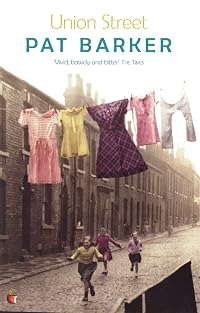
Union Street
by Pat Barker
On This Page
Description
Vivid, bawdy and bitter' (The Times), Pat Barker's first novel shows the women of Union Street, young and old, meeting the harsh challeges of poverty and survival in a precarious world. There's Kelly, at eleven, neglected and independent, dealing with a squalid rape; Dinah, knocking on sixty and still on the game; Joanne, not yet twenty, not yet married, and already pregnant; Old Alice, welcoming her impending death; Muriel helplessly watching the decline of her stoical husband. And linking show more them all, watching over them all, mother to half the street, is fiery, indomitable Iris. show lessTags
Recommendations




















Member Reviews
Union Street is absolute gold. Wikipedia says that Pat Barker shopped this novel around to publishers for 10 years and was rejected by all until she finally sent it to Virago Press who knew the value of an honest book about women. I think the other publishers rejected it because the women and girls in these inter connected stories don't act the way publishers assume we want them to act. A case in point is Iris, who I guess is the character on whom the movie Stanley and Iris is based, but very loosely. This is one tough cookie. She has a couple of the most quotable lines in the book. First comes this one when she finds she can earn her own money instead of relying on her pig of a husband But that first pay packet, it was wonderful. They show more needn't starve, now. Whatever Ted did there would be some money in the house. 'You think on it,' she'd said to her two older girls when they got married. 'It's nice to have a good husband but it's a hell of a lot nicer to have your own money. A fiver you've earned is worth ten of anybody else's. You can do what you want with it."
and regarding her habit of helping those in need
All this was meat and drink to her. She loved life. She loved to feel life bubbling and quickening all around her, and took it for granted that life included old age, suffering and death. Lest that make her sound like the Jane Fonda Iris character, I assure you she's not. She has a strong violent side. In fact Iris; Kelly Brown, the young girl who starts the book; and Blonde Dinah, the old prostitute and Alice Bell who provides the perfect ending are probably the reason publishers didn't want to take a chance on these harsh, surprising and realistic stories. Mothers don't always mother in the way Norman Rockwell says they should, children don't always appreciate them, husbands can be cruel, caring men can be discarded, life is not a bed of roses on Union Street. show less
and regarding her habit of helping those in need
All this was meat and drink to her. She loved life. She loved to feel life bubbling and quickening all around her, and took it for granted that life included old age, suffering and death. Lest that make her sound like the Jane Fonda Iris character, I assure you she's not. She has a strong violent side. In fact Iris; Kelly Brown, the young girl who starts the book; and Blonde Dinah, the old prostitute and Alice Bell who provides the perfect ending are probably the reason publishers didn't want to take a chance on these harsh, surprising and realistic stories. Mothers don't always mother in the way Norman Rockwell says they should, children don't always appreciate them, husbands can be cruel, caring men can be discarded, life is not a bed of roses on Union Street. show less
A collection of vignettes about the residents of a northern street in the 1970s - very well written, but also incredibly bleak. I love Pat Barker's style, though she doesn't shy away from the darker, coarser elements of life, and yet I found myself laughing at the dialogue as well as cringing from some of the harsher descriptions. The chapters, focusing on the lives of seven different women, involve rape, teenage pregnancy, a young mother living in poverty, terminal illness and bereavement, abortion, prostitution and old age. Not exactly a light read!
That said, Pat Barker really does have a way with words, even more so for me because her stories are set in the north of England. In a couple of the stories - Joanne and Iris - there is a show more character called Mrs Harrison, who collects used condoms so she can burn them in the furnace at church. My mind boggled, but it's a very funny piece of dialogue. The language of Muriel Scaife's suffering and loss are equally powerful, but in a raw and tragic sense.
I think what makes Pat Barker's narratives work so well is the reality of the setting and the dialogue, which makes the events of each story all the more shocking, because of the reader's familiarity (and occasional sympathy) with the characters. I would hate to live in a place like Union Street, yet strong female characters always inspire me, whatever their background, and the sense of community in this novel is a welcome consequence of all the hardship and violence.
On a side note, the American film version of Iris' story - Stanley and Iris - sounds so very 'loosely based' on the novel that I wouldn't have recognised the film's origin from content alone! I had that adaptation confused with Mike Leigh's Vera Drake, which is more fitting, until I looked them both up. show less
That said, Pat Barker really does have a way with words, even more so for me because her stories are set in the north of England. In a couple of the stories - Joanne and Iris - there is a show more character called Mrs Harrison, who collects used condoms so she can burn them in the furnace at church. My mind boggled, but it's a very funny piece of dialogue. The language of Muriel Scaife's suffering and loss are equally powerful, but in a raw and tragic sense.
I think what makes Pat Barker's narratives work so well is the reality of the setting and the dialogue, which makes the events of each story all the more shocking, because of the reader's familiarity (and occasional sympathy) with the characters. I would hate to live in a place like Union Street, yet strong female characters always inspire me, whatever their background, and the sense of community in this novel is a welcome consequence of all the hardship and violence.
On a side note, the American film version of Iris' story - Stanley and Iris - sounds so very 'loosely based' on the novel that I wouldn't have recognised the film's origin from content alone! I had that adaptation confused with Mike Leigh's Vera Drake, which is more fitting, until I looked them both up. show less
Uncompromising, unbelievably sad and harsh, ‘Union Street’ by Pat Barker does not hide the uncomfortable truths of poverty in North-East industrial England. This is the story of eight women who live on Union Street from teenager Kelly Brown to Alice Bell in her eighties and though each story is told individually, like the lives of the women, the stories interweave. An honest book about women struggling to hold life, family and home together, while retaining pride and some of their own individuality. Some succeed in this, others don’t.
This is not a book about idealised motherhood. It is about putting bread on the table for your children no matter how you do it; including beating your husband to get his pay packet before he spends show more it on booze. These women are tough because they have to be; the choices are the cake factory, charring, and prostitution. Many marry young to feckless husbands because they are pregnant. This is not a light read; it features scenes of rape and backstreet abortion that somehow make the prostitution a lighter route. The language is often strong and some of the descriptions are difficult to read; but it is an honest book, bleak and realistic.
The spine throughout the book is Iris King, she appears in each story and is the one most aware of other women’s lives and offers support and a word of kindness when needed. But Iris is the toughest woman in the street. Three weeks after marrying Ted, he knocks her around because she is ironing his shirts when he gets home from work when he was expecting his supper. “After he’d gone, she sat down and took stock… When he came back she was waiting for him behind the door with the meat chopper in her hand. The blow glanced off him, though there was enough blood around to scare the pair of them stiff. It didn’t stop him hitting her again, but it did free her from the fear. She never lost her self-respect.” It is that self-respect which separates Iris from the other women.
This is the first novel by Booker Prize winner Barker, but such is the excellence of the prose you would never know. The ending is raw and sad, it cannot fail to touch you.
Read more of my book reviews at http://www.sandradanby.com/book-reviews-a-z/ show less
This is not a book about idealised motherhood. It is about putting bread on the table for your children no matter how you do it; including beating your husband to get his pay packet before he spends show more it on booze. These women are tough because they have to be; the choices are the cake factory, charring, and prostitution. Many marry young to feckless husbands because they are pregnant. This is not a light read; it features scenes of rape and backstreet abortion that somehow make the prostitution a lighter route. The language is often strong and some of the descriptions are difficult to read; but it is an honest book, bleak and realistic.
The spine throughout the book is Iris King, she appears in each story and is the one most aware of other women’s lives and offers support and a word of kindness when needed. But Iris is the toughest woman in the street. Three weeks after marrying Ted, he knocks her around because she is ironing his shirts when he gets home from work when he was expecting his supper. “After he’d gone, she sat down and took stock… When he came back she was waiting for him behind the door with the meat chopper in her hand. The blow glanced off him, though there was enough blood around to scare the pair of them stiff. It didn’t stop him hitting her again, but it did free her from the fear. She never lost her self-respect.” It is that self-respect which separates Iris from the other women.
This is the first novel by Booker Prize winner Barker, but such is the excellence of the prose you would never know. The ending is raw and sad, it cannot fail to touch you.
Read more of my book reviews at http://www.sandradanby.com/book-reviews-a-z/ show less
I think of Pat Barker as writing about the effects of war, and primarily about men - since the first books of hers I read were the Regeneration Trilogy, set during WWI and concerning men affected by shell-shock (or post-traumatic stress as we might call it today) and the doctor trying to treat them. More recently I've read Life Class which is also set during WWI and is about artists working out how to respond to war - this one does feature women as well as men as the main protagonists.
But Union Street, Pat Barker's first novel is very different from these, and is almost entirely about women, and not at all about war. It's a gritty, honest, uncompromising look at the lives of ordinary working-class women who all live on the same street show more in an unnamed town in the North East of England around the late 1960s or early 1970s. It's almost a collection of short stories rather than a novel, as there are seven chapters, each focusing on a different woman. But as the women all live on the same street at the same time, and know each other to varying degrees, the chapters are interlinked and held together by their common address on Union Street, so that the main character in one chapter may reappear in a minor role in several others. There is a different kind of unity too, in that each chapter deals with a woman who is older and at a later stage in life than the previous one, from the eleven-year-old girl in the first chapter to the old woman close to death in the final chapter. Thus the book as a whole is a kind of 'seven ages of woman'. Yet these are very far from being archetypes. They are earthy, flawed, unpredictable, real women, whose lives are circumscribed by poverty and lack of opportunity - work in the deafening cake-baking factory and/or pregnancy, face-saving marriage and repeated child-bearing seem to be the only options. And while this is not a book about war, it is certainly about dealing with trauma: rape, unwanted pregnancy, domestic violence, unemployment, sickness, bereavement, bungled abortion, and neglected old-age are the every-day realities faced by these women. It sounds grim, and is certainly not cheerful reading; but each chapter ends with some kind of upturn, a note of hope or maybe acceptance or the making of a positive choice, however limited the options - women making the best of the often bad lot they have been given, in the best way they know how - and this for me made the book bearable without denying the harsh realities.
Apparently it took Barker 10 years to find a publisher willing to accept this book - in the end it was the feminist Virago Press who took it on as one of their Modern Classics in 1982. I'm not surprised the mainstream publishers were reluctant - her un-sentimental, un-romantic way of writing about ordinary women's lives clearly did not fit the stereotypical expectations of the time, and it was viewed as too bleak and depressing. Barker was actually writing from her own experience of growing up in a similar environment, surrounded by women like these. When she started writing, at first she tried to be 'a sensitive lady novelist' but without success; her first three novels remain unpublished and rightly so she believes; the success and positive acclaim for Union Street when eventually it was published show that she had found her true voice. Her next couple of books continue to explore similar territory; but when she began to feel boxed in as a 'northern, regional, feminist writer' she decided to try something different in the Regeneration trilogy, to show that she could 'do men' as well. She did them so well that I guess many people, like me until reading Union Street, would be surprised to discover that she 'does women' very well too!
I'm therefore looking forward to reading Liza's England (formerly published as The Century's Daughter), one of her other early novels published by Virago, which I have waiting on my TBR pile.
Recommended if you are not feeling too depressed or trapped by grim circumstances to start with! show less
But Union Street, Pat Barker's first novel is very different from these, and is almost entirely about women, and not at all about war. It's a gritty, honest, uncompromising look at the lives of ordinary working-class women who all live on the same street show more in an unnamed town in the North East of England around the late 1960s or early 1970s. It's almost a collection of short stories rather than a novel, as there are seven chapters, each focusing on a different woman. But as the women all live on the same street at the same time, and know each other to varying degrees, the chapters are interlinked and held together by their common address on Union Street, so that the main character in one chapter may reappear in a minor role in several others. There is a different kind of unity too, in that each chapter deals with a woman who is older and at a later stage in life than the previous one, from the eleven-year-old girl in the first chapter to the old woman close to death in the final chapter. Thus the book as a whole is a kind of 'seven ages of woman'. Yet these are very far from being archetypes. They are earthy, flawed, unpredictable, real women, whose lives are circumscribed by poverty and lack of opportunity - work in the deafening cake-baking factory and/or pregnancy, face-saving marriage and repeated child-bearing seem to be the only options. And while this is not a book about war, it is certainly about dealing with trauma: rape, unwanted pregnancy, domestic violence, unemployment, sickness, bereavement, bungled abortion, and neglected old-age are the every-day realities faced by these women. It sounds grim, and is certainly not cheerful reading; but each chapter ends with some kind of upturn, a note of hope or maybe acceptance or the making of a positive choice, however limited the options - women making the best of the often bad lot they have been given, in the best way they know how - and this for me made the book bearable without denying the harsh realities.
Apparently it took Barker 10 years to find a publisher willing to accept this book - in the end it was the feminist Virago Press who took it on as one of their Modern Classics in 1982. I'm not surprised the mainstream publishers were reluctant - her un-sentimental, un-romantic way of writing about ordinary women's lives clearly did not fit the stereotypical expectations of the time, and it was viewed as too bleak and depressing. Barker was actually writing from her own experience of growing up in a similar environment, surrounded by women like these. When she started writing, at first she tried to be 'a sensitive lady novelist' but without success; her first three novels remain unpublished and rightly so she believes; the success and positive acclaim for Union Street when eventually it was published show that she had found her true voice. Her next couple of books continue to explore similar territory; but when she began to feel boxed in as a 'northern, regional, feminist writer' she decided to try something different in the Regeneration trilogy, to show that she could 'do men' as well. She did them so well that I guess many people, like me until reading Union Street, would be surprised to discover that she 'does women' very well too!
I'm therefore looking forward to reading Liza's England (formerly published as The Century's Daughter), one of her other early novels published by Virago, which I have waiting on my TBR pile.
Recommended if you are not feeling too depressed or trapped by grim circumstances to start with! show less
Barker's book looks at the lives of women in a working-class neighborhood in northern England. Seven episodes examine the lives of women at every stage of life, from childhood to old age. It offers an unflinching look at the struggles of poverty and unrelenting work.
Sexuality is often dangerous, and the women of Union Street are subjected to sexual, physical, and emotional abuse. Their lives revolve around trying to take care of families and stretch resources. Each story is compelling, and I was touched by the stories of women barely holding body and soul together. This is a book that makes the reader feel deeply, feel thankful, and recognize much about women's lives, feelings, fears, and responsibilities. Through these stories the show more reader sees the sum total of a life- the hopes and fears, the pains and celebrations. This is a deeply moving book, and one that is well-worth reading. show less
Sexuality is often dangerous, and the women of Union Street are subjected to sexual, physical, and emotional abuse. Their lives revolve around trying to take care of families and stretch resources. Each story is compelling, and I was touched by the stories of women barely holding body and soul together. This is a book that makes the reader feel deeply, feel thankful, and recognize much about women's lives, feelings, fears, and responsibilities. Through these stories the show more reader sees the sum total of a life- the hopes and fears, the pains and celebrations. This is a deeply moving book, and one that is well-worth reading. show less
In kind of interlinked short stories, the author introduces us to women living a life of unremitting bleakness in the North East.
From the neglected 11 year old, raped as she plays near derelict buildings, through to the old woman living in squalor and waiting to be taken to an old people's home...and every age in between. Women with violent, hard drinking men, money worries, pregnancy and difficult children, prostitution...
Very strong writing.
From the neglected 11 year old, raped as she plays near derelict buildings, through to the old woman living in squalor and waiting to be taken to an old people's home...and every age in between. Women with violent, hard drinking men, money worries, pregnancy and difficult children, prostitution...
Very strong writing.
Another one from my Contemporary Women’s Writing module. This book is horrible but really really good. If that makes sense. It reads more like a collection of short stories than a novel, but it’s about a group of working class women in the 1970s, and they all have really grim lives and horrible things happen to them. Not a cheery book by any stretch of the world, but it’s really compelling.
Members
- Recently Added By
Published Reviews
ThingScore 100
Miss Barker skillfully employs the factory setting to touch on matters like automation, race prejudice, feeblemindedness and the sheer human hardship experienced by some of those trapped on the assembly line. . . Pat Barker gives the sense of a writer who has enormous power that she has scarcely had to tap to write a first-rate first novel.
added by christiguc
Lists

Books Read in 2014
2,343 works; 86 members

Fiction about the Working Class
74 works; 10 members

Books Read in 2012
816 works; 34 members
Author Information

31+ Works 21,416 Members
Pat Barker's most recent novel is Another World (FSG, 1999). She is also the author of the highly acclaimed Regeneration trilogy: Regeneration; The Eye in the Door, winner of the 1993 Guardian Fiction Prize; and The Ghost Road, winner of the 1996 Booker Prize. She lives in England. (Bowker Author Biography)
Some Editions
Awards and Honors
Awards
Series
Belongs to Publisher Series
Work Relationships
Is contained in
Has the adaptation
Common Knowledge
- Canonical title
- Union Street
- Original title
- Union Street
- Alternate titles*
- Airisu eno tegami
- Original publication date
- 1982
- People/Characters
- Kelly Brown; Joanne Wilson; Lisa Goddard; Muriel Scaife; Iris King; Blonde Dinah (show all 7); Alice Bell
- Important places
- Noord-Engeland; North-East England
- Related movies
- Stanley & Iris (1990 | IMDb)
- First words
- There was a square of cardboard in the window where the glass had been smashed.
- Last words
- (Click to show. Warning: May contain spoilers.)So that in the end there were only the birds, soaring, swooping, gliding, moving in a never-ending spiral about withered and unwithering tree.
- Original language*
- Engels
*Some information comes from Common Knowledge in other languages. Click "Edit" for more information.
Classifications
Statistics
- Members
- 460
- Popularity
- 66,258
- Reviews
- 15
- Rating
- (3.81)
- Languages
- 10 — Catalan, Danish, Dutch, English, French, German, Italian, Japanese, Spanish, Swedish
- Media
- Paper, Ebook
- ISBNs
- 26
- ASINs
- 9