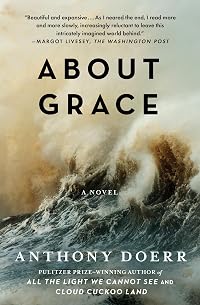
About Grace
by Anthony Doerr
On This Page
Description
The first novel by Anthony Doerr, the highly acclaimed, multiple award-winning author of Cloud Cuckoo Land, and the Pulitzer Prize-winning #1 New York Times bestseller All the Light We Cannot See, one of the most beautiful, wise, and compelling debuts of recent times.David Winkler begins life in Anchorage, Alaska, a quiet boy drawn to the volatility of weather and obsessed with snow. Sometimes he sees things before they happen—a man carrying a hatbox will be hit by a bus; Winkler will show more fall in love with a woman in a supermarket. When David dreams that his infant daughter will drown in a flood as he tries to save her, he comes undone. He travels thousands of miles, fleeing family, home, and the future itself, to deny the dream.
On a Caribbean island, destitute, alone, and unsure if his child has survived or his wife can forgive him, David is sheltered by a couple with a daughter of their own. Ultimately it is she who will pull him back into the world, to search for the people he left behind.
Doerr's characters are full of grief and longing, but also replete with grace. His compassion for human frailty is extraordinarily moving. In luminous prose, he writes about the power and beauty of nature and about the tiny miracles that transform our lives. About Grace is heartbreaking, radiant, and astonishingly accomplished. show less
Tags
Recommendations








































Member Reviews
I loved it, then I dreaded it, then I came to love it again. Doerr explores predestination/fate's interplay with free will with scientific ideas such as atomic structure and chaos theory. However, it's an intensely human story, simply built on that structure. All the Light and Cloud Cuckoo both have darkness, but that darkness showcases the light. In About Grace, we're really in the darkness, living with it, feeling in, for a good long time - almost more than I could bear. I didn't give up on this book because Doerr's other books that I'd read had been SO rewarding, and the beauty in this book was really quite beautiful. And when I got to the end, I was glad I stuck with it.
I had never heard of author Anthony Doerr until I was seduced by his magnificent Pulitzer Prize winning novel All the Light We Cannot See. So when I happened upon a worn copy of his earlier novel About Grace at a used bookstore I had to snatch it up and dive in at my first opportunity. Remarkably, while Doerr has written a number of short stories, this is his only previous novel and it was published a full decade before All the Light We Cannot See. It is surprising that a first novel of such style and complexity did not attract far more attention, for it certainly earned it. I assiduously avoid spoilers in my fiction reviews, but that is all but impossible for About Grace, so if you want to avoid these stop reading now and buy the book. show more For the rest: read on!
About Grace is comprised of three distinct parts. After a prologue chapter that introduces the main character as a fifty-nine year old, the essence of the novel opens decades earlier as protagonist David Winkler, a colorless loner living in Anchorage who is a trained hydrologist – the science of water – dreams of a girl dropping a magazine in a shop and then subsequently happens into that scene in real life. He relentlessly pursues that girl – a bank teller trapped in a childless, uninspiring marriage – until he surprisingly wins Sandy away from her banker husband Herman and they suddenly flee to Ohio, where he goes to work as a meteorologist and a pregnant Sandy quietly pursues a welding hobby that David has encouraged. In the course of the narrative, the reader learns that David’s dream that anticipates his encounter with Sandy is not a singular experience. He has had strikingly prescient dreams before, with sometimes horrific results, including one in his childhood that predicted a man being struck by a bus, which he later witnessed. It does not happen frequently, but sometimes David really can predict the future through his dreams, and the next incidence serves as the pivot point for the rest of the novel.
David dreams that their new infant daughter Grace is caught up in a flood; in the dream sequence David attempts to save Grace, but in the course of his actions instead inadvertently ensures that she is drowned. When an actual flood ensues, David removes his family to a motel for safety, but is so haunted by his foresight and the agony of Grace’s impending doom that in a desperate attempt to protect her from his flawed foretold interference he takes flight to destinations unknown, finally landing up penniless and disoriented on the Caribbean isle of St. Vincent – as part two of the novel is engaged – where he is sheltered by a colorful family of Chilean refugees. Later, David desperately seeks to learn the fate of his daughter. Sandy appears to have returned to her ex-husband and angered at his abandonment wants nothing to do with David. The fate of Grace remains undisclosed and thus unknown.
Here the pace of the novel slows considerably. David finds work as a laborer for a hotel and bonds with Naaliyah, the young daughter of the family that takes him in. In some significant ways, Naaliyah serves as a substitute for Grace as David nurtures her and encourages her curiosity and her intellect in a way her own father cannot. Some two decades slip by uneventfully and the narrative drags to some degree. Then David is again visited by frightening dreams, this time of the now fully grown Naaliyah drowning in a boating accident. His intervention and its result pave the way for part three of the novel, as David takes his leave from the tropics and returns to the states – and finally to Alaska – seeking to determine once and for all the fate of Grace and his own existential meaning in the random events of his troubled life.
Throughout the story, the reader may grow exasperated with David’s character. He is, after all, a frustratingly complacent individual frequently tossed upon the waves of the sea of life, often without the ambition to chart a course or even steady himself adequately to avoid going under. In many ways, he is somewhat reminiscent of the stubbornly passive male protagonist of a Murakami novel, who is surprised to have found that his wife has left him even while yet too unmotivated to unravel the cause for the break. Again and again, David takes the long way around to get the answers he craves, writing letters instead of calling, hitchhiking instead of flying, running in place rather than seizing the day. Yet, there is an unmistakable beauty to the prose in this work and an attractive metaphorical element to the main character and his quest that finally become so irresistible that even the weaknesses of the novel are shunted aside as the epic nature of both David’s questions and the tantalizing potential answers fully consume the reader’s interest. Along the way – as in All the Light We Cannot See – there is a good deal of science to lend strength to the novel’s framework, in this case hydrology and meteorology, as well as the study of entomology in an arctic environment, and the formation of snowflake crystals. Hydrology is not incidental, by the way; water, both real and allegorical, could be said to be the real main character in this multilayered tale. When all is said and done, both the conclusion of the book and the route to reach the finish line turn out to be rewarding. While there are indeed moments however brief in these pages that produce yawns the author might not have intended, perseverance pays off. About Grace is indeed a fine novel and I would, warts and all, recommend it without hesitation.
My review of: About Grace, by Anthony Doerr is live on my book blog http://wp.me/p5Hb6f-4i show less
About Grace is comprised of three distinct parts. After a prologue chapter that introduces the main character as a fifty-nine year old, the essence of the novel opens decades earlier as protagonist David Winkler, a colorless loner living in Anchorage who is a trained hydrologist – the science of water – dreams of a girl dropping a magazine in a shop and then subsequently happens into that scene in real life. He relentlessly pursues that girl – a bank teller trapped in a childless, uninspiring marriage – until he surprisingly wins Sandy away from her banker husband Herman and they suddenly flee to Ohio, where he goes to work as a meteorologist and a pregnant Sandy quietly pursues a welding hobby that David has encouraged. In the course of the narrative, the reader learns that David’s dream that anticipates his encounter with Sandy is not a singular experience. He has had strikingly prescient dreams before, with sometimes horrific results, including one in his childhood that predicted a man being struck by a bus, which he later witnessed. It does not happen frequently, but sometimes David really can predict the future through his dreams, and the next incidence serves as the pivot point for the rest of the novel.
David dreams that their new infant daughter Grace is caught up in a flood; in the dream sequence David attempts to save Grace, but in the course of his actions instead inadvertently ensures that she is drowned. When an actual flood ensues, David removes his family to a motel for safety, but is so haunted by his foresight and the agony of Grace’s impending doom that in a desperate attempt to protect her from his flawed foretold interference he takes flight to destinations unknown, finally landing up penniless and disoriented on the Caribbean isle of St. Vincent – as part two of the novel is engaged – where he is sheltered by a colorful family of Chilean refugees. Later, David desperately seeks to learn the fate of his daughter. Sandy appears to have returned to her ex-husband and angered at his abandonment wants nothing to do with David. The fate of Grace remains undisclosed and thus unknown.
Here the pace of the novel slows considerably. David finds work as a laborer for a hotel and bonds with Naaliyah, the young daughter of the family that takes him in. In some significant ways, Naaliyah serves as a substitute for Grace as David nurtures her and encourages her curiosity and her intellect in a way her own father cannot. Some two decades slip by uneventfully and the narrative drags to some degree. Then David is again visited by frightening dreams, this time of the now fully grown Naaliyah drowning in a boating accident. His intervention and its result pave the way for part three of the novel, as David takes his leave from the tropics and returns to the states – and finally to Alaska – seeking to determine once and for all the fate of Grace and his own existential meaning in the random events of his troubled life.
Throughout the story, the reader may grow exasperated with David’s character. He is, after all, a frustratingly complacent individual frequently tossed upon the waves of the sea of life, often without the ambition to chart a course or even steady himself adequately to avoid going under. In many ways, he is somewhat reminiscent of the stubbornly passive male protagonist of a Murakami novel, who is surprised to have found that his wife has left him even while yet too unmotivated to unravel the cause for the break. Again and again, David takes the long way around to get the answers he craves, writing letters instead of calling, hitchhiking instead of flying, running in place rather than seizing the day. Yet, there is an unmistakable beauty to the prose in this work and an attractive metaphorical element to the main character and his quest that finally become so irresistible that even the weaknesses of the novel are shunted aside as the epic nature of both David’s questions and the tantalizing potential answers fully consume the reader’s interest. Along the way – as in All the Light We Cannot See – there is a good deal of science to lend strength to the novel’s framework, in this case hydrology and meteorology, as well as the study of entomology in an arctic environment, and the formation of snowflake crystals. Hydrology is not incidental, by the way; water, both real and allegorical, could be said to be the real main character in this multilayered tale. When all is said and done, both the conclusion of the book and the route to reach the finish line turn out to be rewarding. While there are indeed moments however brief in these pages that produce yawns the author might not have intended, perseverance pays off. About Grace is indeed a fine novel and I would, warts and all, recommend it without hesitation.
My review of: About Grace, by Anthony Doerr is live on my book blog http://wp.me/p5Hb6f-4i show less
Languid. This is a languid book requiring the reader to lower their metabolism to match the flow of the page. If the reader can do this, if the reader can build patience, then a world of graceful prose will be the reward.
The mythology of the Great Flood still lives in our heads. The fear and awe of water and waves and violent whitecaps. "We live in the beds of ancient oceans." Water and its transformation into snowflakes form the basis of this novel. The water in each of us that longs to return to the sea, from whence it came. The main protagonist transforms also, even though it can be hard on the reader. We want to push him, force him to make an effort, DO SOMETHING!
As I continued reading, I thought of Joyce:
All day I hear the noise show more of waters making moan,
Sad as the sea-bird is when, going forth alone,
He hears the winds cry to the water's monotone.
The grey winds, the cold winds are blowing where I go.
I hear the noise of many waters far below.
All day, all night, I hear them flowing
To and fro.
But David Winkler is trapped by his dreams. He runs from them and stays away until his transformation is completed. Like a snowflake. "To enter a world of shadows is to leave this world for another." Yet we stay patient and we read on, because now we are attached to David Winkler. He is a refugee. We all are, in one way or another. His travels from Alaska to Ohio to the Caribbean involve us more and more, even as we barely notice other major characters enter the book.
I truly enjoyed this novel, even though I fought it. The author dictates the character's pace, so it's my job as the reader to adjust my expectations and adapt to the protagonist. I was justly rewarded.
Book Season = Winter (brew some herbal tea) show less
The mythology of the Great Flood still lives in our heads. The fear and awe of water and waves and violent whitecaps. "We live in the beds of ancient oceans." Water and its transformation into snowflakes form the basis of this novel. The water in each of us that longs to return to the sea, from whence it came. The main protagonist transforms also, even though it can be hard on the reader. We want to push him, force him to make an effort, DO SOMETHING!
As I continued reading, I thought of Joyce:
All day I hear the noise show more of waters making moan,
Sad as the sea-bird is when, going forth alone,
He hears the winds cry to the water's monotone.
The grey winds, the cold winds are blowing where I go.
I hear the noise of many waters far below.
All day, all night, I hear them flowing
To and fro.
But David Winkler is trapped by his dreams. He runs from them and stays away until his transformation is completed. Like a snowflake. "To enter a world of shadows is to leave this world for another." Yet we stay patient and we read on, because now we are attached to David Winkler. He is a refugee. We all are, in one way or another. His travels from Alaska to Ohio to the Caribbean involve us more and more, even as we barely notice other major characters enter the book.
I truly enjoyed this novel, even though I fought it. The author dictates the character's pace, so it's my job as the reader to adjust my expectations and adapt to the protagonist. I was justly rewarded.
Book Season = Winter (brew some herbal tea) show less
A stunning novel about family, love, physical and mental health, the environment, and discovery. Doerr has created a phenomenal character with David Winkler who is transformed after dreaming a premonition about a traumatic accident which occurs shortly after. He takes these dream premonitions very seriously, focusing on them in a way that causes his behavior to become bizarre.
A naturally quiet, gentle man he is fey, and sees and senses incredible details of the physical world around him whether it is a rain drop, or a snow flake, or a leaf, or a footstep, etc. Despite his periodic strange actions, and his inability to articulate his thoughts and feelings clearly, there are many kind and caring people around him. They take the time to show more speak with him and get to know him, and get a sense of his beautiful inner soul. His mother understood and loved him deeply and inspired him.
I believe that the most dramatic life-changing action he took happened because someone who should have understood him did not. If her behavior had been loving and supportive instead of critical and sharp, he would not have experienced a terrifying premonition so deeply. He possibly would not have left his home and family in Ohio.
But he does ends up in the Caribbean, spending the next 25 years finding himself. Hiding from the terror of his premonition, and very slowly healing with help from Soma, Felix and their children.
When the next awful premonition comes, he tries warning people but they don't fully understand him. He realizes its up to him to act and prevent a tragedy. And once again this event is life-changing but in a much more positive way.
So much feeling, love, kindness, soul, science, learning in David and in this gorgeous book.
(Re-reading my review of Doerr's All the Light We Cannot Sea, I realized how similar David and Frederick are. Both having brilliant minds above the superficiality of the world because they see so much deeper. ) show less
A naturally quiet, gentle man he is fey, and sees and senses incredible details of the physical world around him whether it is a rain drop, or a snow flake, or a leaf, or a footstep, etc. Despite his periodic strange actions, and his inability to articulate his thoughts and feelings clearly, there are many kind and caring people around him. They take the time to show more speak with him and get to know him, and get a sense of his beautiful inner soul. His mother understood and loved him deeply and inspired him.
I believe that the most dramatic life-changing action he took happened because someone who should have understood him did not. If her behavior had been loving and supportive instead of critical and sharp, he would not have experienced a terrifying premonition so deeply. He possibly would not have left his home and family in Ohio.
But he does ends up in the Caribbean, spending the next 25 years finding himself. Hiding from the terror of his premonition, and very slowly healing with help from Soma, Felix and their children.
When the next awful premonition comes, he tries warning people but they don't fully understand him. He realizes its up to him to act and prevent a tragedy. And once again this event is life-changing but in a much more positive way.
So much feeling, love, kindness, soul, science, learning in David and in this gorgeous book.
(Re-reading my review of Doerr's All the Light We Cannot Sea, I realized how similar David and Frederick are. Both having brilliant minds above the superficiality of the world because they see so much deeper. ) show less
About Grace, by Anthony Doerr, is the story of David Winkler, a scientist and a man with an unusual gift; prophetic dreams. The story starts out as Winkler (as he is consistently referred to in the book) flies to Alaska to determine the fate of his daughter, Grace. Twenty-five years earlier, having dreamt that Grace died in a flood while his was trying to rescue her, he abandoned his wife and infant daughter, fleeing to a remote Caribbean Island in an attempt to prevent the dream from coming true. What ensues is the story of his life as he seeks to come to terms with his actions, never quite certain whether they saved his daughter’s life or not.
Doerr’s prose is languid and evocative. The pace is leisurely and contemplative and the show more detail almost overwhelming at times. There are beautiful descriptions and explanations of snowflakes, shells, stars and insect habitation, as well as the settings of Alaska, Ohio and the Caribbean that place the reader firmly in Winkler’s world. However I did not find David Winkler to be a likeable character. His angst and indecision throughout the book, his unwillingness to help himself, combined with his social ineptness and his unerring ability to do the wrong thing was frustrating, and I did not feel myself empathetic towards him. While the story comes around in an arc to a satisfying conclusion, I was left feeling that Winkler’s was a life wasted, not by circumstance, although that was the inciting incident, but by his own character.
Review first published on my blog. To see this and other reviews go to http://sonyaspreenbates.wordpress.com . show less
Doerr’s prose is languid and evocative. The pace is leisurely and contemplative and the show more detail almost overwhelming at times. There are beautiful descriptions and explanations of snowflakes, shells, stars and insect habitation, as well as the settings of Alaska, Ohio and the Caribbean that place the reader firmly in Winkler’s world. However I did not find David Winkler to be a likeable character. His angst and indecision throughout the book, his unwillingness to help himself, combined with his social ineptness and his unerring ability to do the wrong thing was frustrating, and I did not feel myself empathetic towards him. While the story comes around in an arc to a satisfying conclusion, I was left feeling that Winkler’s was a life wasted, not by circumstance, although that was the inciting incident, but by his own character.
Review first published on my blog. To see this and other reviews go to http://sonyaspreenbates.wordpress.com . show less
His entire life, David Winkler is blessed (cursed?) with premonitions and when he has recurring visions of accidentally drowning his daughter he flees, hoping that will stop the accident happening. He winds up on a small island in the Caribbean, where he works at a resort for tourists for twenty-five years before finally deciding to find his wife and daughter. After struggling to return to the States (he didn’t leave the country in an exactly ‘legal’ way) he discovers his estranged wife no longer lives where he left her. He doesn’t find that surprising, but he is determined to find out what happened and if his vision came to pass or if his choice to leave was for nothing.
His journey takes him across several states and eventually show more back to Alaska, where he spends time photographing snowflakes in order to capture the fleeting beauty and perfection of what nature can produce. By profession he’s a hydrologist—a person who studies the nature of water and all the forms it takes, and it’s almost a secondary character. Between temperate seas to raging storms to the not-as-barren-as-you’d-think beauty of the last outpost in the Alaskan tundra water shapes the lives of the characters in myriad ways.
Doerr weaves a convincing and affecting story of what a man will do to protect the ones he loves—even if it means abandoning them—and how he redeems himself the best way he is able. show less
His journey takes him across several states and eventually show more back to Alaska, where he spends time photographing snowflakes in order to capture the fleeting beauty and perfection of what nature can produce. By profession he’s a hydrologist—a person who studies the nature of water and all the forms it takes, and it’s almost a secondary character. Between temperate seas to raging storms to the not-as-barren-as-you’d-think beauty of the last outpost in the Alaskan tundra water shapes the lives of the characters in myriad ways.
Doerr weaves a convincing and affecting story of what a man will do to protect the ones he loves—even if it means abandoning them—and how he redeems himself the best way he is able. show less
When my friend Jen loaned me this book, she was very unsure if I'd like it. A major piece of the book involves danger to a small child, and she's always nervous that I will hate any book in which kids are hurt.
OK - sometimes that feels true - I can't help but project a "What If" onto my own kids - but I told her that if I have some connection to at least one of the characters - I can make it through just about anything. I don't even have to like the character - I just need some reason to hang in there through the end of the book.
I don't know if I liked the main character of "About Grace". David Winkler is one of the most disconnected human beings I've ever read about. He seems able to study and show interest in pieces of the natural show more world (water, snowflakes, cold) but when it comes to relating to other people - he seems almost a total loss. He proves to be a very interesting combination of tireless worker - he can do any sort of mindless labor for hours on end - and total drifter. In most of the major stages of his life - he is unable to make choices for himself - he lets other people, sometimes total strangers, make decisions for him.
He can't seem to connect completely to his wife, his child, his best friends...and yet he'll stay in the homes of strangers, listen to intimate details of their lives. He cannot seem to find any sort of balance - any "normal" way to prioritize relationships or tasks.
When he fears he may let something happen to his baby daughter (premonitions) - he removes himself from her life...for 23 years. He's not even sure she's still alive and worries endlessly about it - but doesn't take even the most rudimentary steps to find out.
After 23 years, when he finally manages to get to a place in his life (or maybe his mind) where he can actually take some action to find out if Grace is dead or alive, he deludes himself into thinking it will be easy to be a part of her life again, that he will be welcomed with open arms.
"Along those miles, and the miles to come, he crossed and recrossed a thousand reinventions of his daughter. Grace as a housewife, apron lashed to her hips, biscuit dough drying on her fingers. Maybe a tiny granddaughter, polite, madly pleased, some pureed squash smeared across her cheeks, pushing back from the table. Grandfather, she would say, and curtsey, and giggle. Grandfather, like a father who had succeeded so long and so long he'd been promoted."
I found myself shaking my head at the idea that a father who had never really been a part of his child's life would think he'd be hailed as a conquering hero when he finally decided to make contact.
And then...his inability to handle the smallest details. "He bent, and drank, and drank again. Lightning touched a tree not a half mile from him, and it made a profound popping like the sound of water being poured into a deep-fryer. When he finally pulled back from the river, kneeling on the bank, he realized his glasses had been taken from his face."
He drifts through the world for weeks, unable to see, and when he finally gets new glasses (through no action of his own) he in childishly delighted. "To see again - to discern a tree or face or cloud with an acceptable level of clarity - was the smallest kind of revival, a tiny breakthrough, but enough to start happiness in his heart - the joy of recognizing things, an improvement in his relationship with the world."
So I don't know if I liked this frustrating man...but I did form a connection with him. Maybe it was just my desire to see him repair what he could of the disjointedness of his life...maybe it was the small pieces in time when he seemed to show (or at least experience) emotion towards those he professed to love.
"...Winkler had been grateful all his life that he had been given that moment with her (his mother), maybe one or two complete minutes, he and the animals and his mother, the only person who had ever really understood him, and he imagined he could see the animals taking her with them, solemnly and delicately, escorting the life out of her, something gauzy and illuminated, like a jar full of fireflies, or the flame of a candle behind a curtain, her soul, perhaps, or something beyond words, and carrying it with them back into the walls of the building, heading for the roof."
Now that I read that, though, he seems only to experience people in terms of nature. The same again when he is standing at the gravestone of a woman he loved.
"A ladybug scaled the D in her name. Her life represented in a two-inch etched hyphen. A breeze came up and passed over the stones and spirit houses and ascended the hillside into the spruce, and pushed higher still, to the patches of tundra, and the still-melting fields of snow, stirring the tiny new blooms of avens and saxifrage, tucked into the highest rocks, starting their summer yellows and purples."
While still very detached, the writing is at times lovely. The descriptions of anything found in nature are both detailed and evocative. Doerr's descriptions of snow and snowflakes paint incredibly beautiful pictures...at times I could practically smell the snow in the air.
There was not enough to make me like Winkler...but I suppose at the end, what I felt for this incredibly flawed character, was pity.
"Winkler was sixty years old. He wore oversized glasses; he had liver spots on the back of his hands. He had been a gardener at a two-star inn for twenty-five years and now he worked at a Lens Crafters in the Fifth Avenue Mall, making $7.65 an hour."
A sad book, about an almost wasted life. One worth reading about, even if understanding is impossible. show less
OK - sometimes that feels true - I can't help but project a "What If" onto my own kids - but I told her that if I have some connection to at least one of the characters - I can make it through just about anything. I don't even have to like the character - I just need some reason to hang in there through the end of the book.
I don't know if I liked the main character of "About Grace". David Winkler is one of the most disconnected human beings I've ever read about. He seems able to study and show interest in pieces of the natural show more world (water, snowflakes, cold) but when it comes to relating to other people - he seems almost a total loss. He proves to be a very interesting combination of tireless worker - he can do any sort of mindless labor for hours on end - and total drifter. In most of the major stages of his life - he is unable to make choices for himself - he lets other people, sometimes total strangers, make decisions for him.
He can't seem to connect completely to his wife, his child, his best friends...and yet he'll stay in the homes of strangers, listen to intimate details of their lives. He cannot seem to find any sort of balance - any "normal" way to prioritize relationships or tasks.
When he fears he may let something happen to his baby daughter (premonitions) - he removes himself from her life...for 23 years. He's not even sure she's still alive and worries endlessly about it - but doesn't take even the most rudimentary steps to find out.
After 23 years, when he finally manages to get to a place in his life (or maybe his mind) where he can actually take some action to find out if Grace is dead or alive, he deludes himself into thinking it will be easy to be a part of her life again, that he will be welcomed with open arms.
"Along those miles, and the miles to come, he crossed and recrossed a thousand reinventions of his daughter. Grace as a housewife, apron lashed to her hips, biscuit dough drying on her fingers. Maybe a tiny granddaughter, polite, madly pleased, some pureed squash smeared across her cheeks, pushing back from the table. Grandfather, she would say, and curtsey, and giggle. Grandfather, like a father who had succeeded so long and so long he'd been promoted."
I found myself shaking my head at the idea that a father who had never really been a part of his child's life would think he'd be hailed as a conquering hero when he finally decided to make contact.
And then...his inability to handle the smallest details. "He bent, and drank, and drank again. Lightning touched a tree not a half mile from him, and it made a profound popping like the sound of water being poured into a deep-fryer. When he finally pulled back from the river, kneeling on the bank, he realized his glasses had been taken from his face."
He drifts through the world for weeks, unable to see, and when he finally gets new glasses (through no action of his own) he in childishly delighted. "To see again - to discern a tree or face or cloud with an acceptable level of clarity - was the smallest kind of revival, a tiny breakthrough, but enough to start happiness in his heart - the joy of recognizing things, an improvement in his relationship with the world."
So I don't know if I liked this frustrating man...but I did form a connection with him. Maybe it was just my desire to see him repair what he could of the disjointedness of his life...maybe it was the small pieces in time when he seemed to show (or at least experience) emotion towards those he professed to love.
"...Winkler had been grateful all his life that he had been given that moment with her (his mother), maybe one or two complete minutes, he and the animals and his mother, the only person who had ever really understood him, and he imagined he could see the animals taking her with them, solemnly and delicately, escorting the life out of her, something gauzy and illuminated, like a jar full of fireflies, or the flame of a candle behind a curtain, her soul, perhaps, or something beyond words, and carrying it with them back into the walls of the building, heading for the roof."
Now that I read that, though, he seems only to experience people in terms of nature. The same again when he is standing at the gravestone of a woman he loved.
"A ladybug scaled the D in her name. Her life represented in a two-inch etched hyphen. A breeze came up and passed over the stones and spirit houses and ascended the hillside into the spruce, and pushed higher still, to the patches of tundra, and the still-melting fields of snow, stirring the tiny new blooms of avens and saxifrage, tucked into the highest rocks, starting their summer yellows and purples."
While still very detached, the writing is at times lovely. The descriptions of anything found in nature are both detailed and evocative. Doerr's descriptions of snow and snowflakes paint incredibly beautiful pictures...at times I could practically smell the snow in the air.
There was not enough to make me like Winkler...but I suppose at the end, what I felt for this incredibly flawed character, was pity.
"Winkler was sixty years old. He wore oversized glasses; he had liver spots on the back of his hands. He had been a gardener at a two-star inn for twenty-five years and now he worked at a Lens Crafters in the Fifth Avenue Mall, making $7.65 an hour."
A sad book, about an almost wasted life. One worth reading about, even if understanding is impossible. show less
Members
- Recently Added By
Published Reviews
ThingScore 63
About Grace is about David Winkler, a man crippled and made fearful by the accuracy of his dreamed premonitions — a man who foresees future events and who is then constrained to watch them unfold.
added by stephmo
Wouldn't it be useful to see the future when making choices about finance, marriage or the job market? But David Winkler, a meteorologist from Alaska, is completely crippled by his prophetic dreams.
added by stephmo
In his first novel, ''About Grace,'' Anthony Doerr drags his protagonist, David Winkler, over a fair few hot coals: 25 years of exile as a dogsbody in a new hotel in St. Vincent in the Caribbean, a near-drowning experience, malnutrition, a clinically debilitating journey in a clapped-out Datsun across the vastness of America, an Alaskan winter in an unheated shed, gradual loss of eyesight, an show more alienated daughter he abandoned when she was a few months old. The comparisons with Lear are flickering and fugitive but inevitable. show less
added by stephmo
Lists

I Can't Finish This Book
189 works; 22 members
Author Information

17+ Works 34,448 Members
Anthony Doerr was born on October 27, 1973 in Cleveland, Ohio. He is the author of The Shell Collector, About Grace, Four Seasons in Rome, Memory Wall, and All the Light We Cannot See. His fiction has won four O. Henry Prizes and has been anthologized in several anthologies. He has won the Barnes and Noble Discover Prize, the Rome Prize, the New show more York Public Library's Young Lions Award, the National Magazine Award for Fiction, three Pushcart Prizes, two Pacific Northwest Book Award, three Ohioana Book Awards, the 2010 Story Prize, which is considered the most prestigious prize in the U.S. for a collection of short stories, and the Sunday Times EFG Short Story Award, which is the largest prize in the world for a single short story. His novel, All the Light We Cannot See, won the Adult Fiction Award for the Indies Choice Book Awards in 2015, the International Book of the Year at the ABIA Awards and the Pulitzer Prizes for Fiction in 2015. Anthony Doerr also won the 2015 Andrew Carnegie Medal for Excellence in Fiction for this same title. (Bowker Author Biography) show less
Awards and Honors
Awards
Work Relationships
Common Knowledge
- Canonical title
- About Grace
- Original title
- About Grace
- Important places
- USA; Alaska, USA
- Epigraph
- There must be some definite cause why, whenever snow begins to fall, its initial formation invariably displays the shape of a six-cornered starlet. For if it happens by chance, why do they not fall just as well with five corn... (show all)ers or with seven? . . .Who carved the nucleus, before it fell, into six horns of ice?
-From "On the The Six-cornered Snowflake,"
by Johannes Kepler, 1610 - Dedication
- for my mother and father
- First words
- He made his way through the concourse and stopped by a window to watch a man with two orange wands wave a jet into its gate.
- Last words
- (Click to show. Warning: May contain spoilers.)Snow fell in the city; ice reached across the ponds; the sea groaned as it collapsed, again and again, onto the wharf.
Classifications
Statistics
- Members
- 1,456
- Popularity
- 16,077
- Reviews
- 43
- Rating
- (3.50)
- Languages
- 10 — Czech, Danish, Dutch, English, Finnish, French, German, Italian, Spanish, Swedish
- Media
- Paper, Audiobook, Ebook
- ISBNs
- 44
- ASINs
- 12