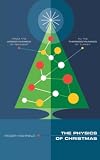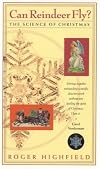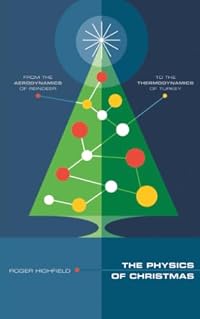
The Physics of Christmas: From the Aerodynamics of Reindeer to the Thermodynamics of Turkey
by Roger Highfield
On This Page
Description
Why might Rudolph's nose have been red? Why do we actually give Christmas gifts? Why has smell become an important component in the Christmas shopping experience? Roger Highfield, science editor of London's Daily Telegraph and co-author of the highly acclaimed The Arrow of Time, has taken a long-overdue look at our most cherished holiday from the rigorous (but highly entertaining) viewpoint of a scientist. What are the thermodynamics involved in cooking a turkey? What are the likely show more celestial candidates for the Star of Bethlehem? Is the concept of a virgin birth scientifically feasible? What happens to us physically when we overindulge in alcohol? How does snow form? Why are we always depressed after Christmas? How does Santa manage to deliver all those presents in one night? (He has, in fact, little over two ten- thousands of a second to get between each of the 842 million households he must visit.) The Physics of Christmas is that rare science book that manages to be as delightful as it is informative. show lessTags
Recommendations

























Member Reviews
i obtained this a few Xmases ago, but put off reading it thinking it would be cheesy. it is actually quite good and the author puts off the most ridiculous topics like mach 6500 santa and flying quadrapeds for the final two chapters. before that is much science and most not physics. "The Science of Christmas" would be a more appropriate title. this includes the chemistry of cooking, brewing and its medical effects and much history including the role Coca-Cola had in shaping the appearance of Santa Claus. while the familiar contradictions are explored such as Christ most certainly not born on Christmas and early Puritans disdainful of the holiday's pagan roots, this work covers others. This includes the myth of a yuletide suicide uptick, show more it being markedly lower, and that a religious life is demonstrable through studies as healthier. the latter is emphasized in an appendix. show less
Only my sister, my lifelong partner in crime, could find a book that addresses my love of all things Christmas & physics! What a laugh we all had until she said open it, read the opening of a chapter. I immediately did so looking for a Chapter page. If I recall, it explained the aerodynamics of how reindeer fly. The book wasn't quite the gag I thought, it was a relatively legitimate research paper explaining various traditions from a scientific perspective. A great gift for Closet Christmas nerds!
I didn't expect I'd like the book as much as I did. Reading it was a great pleasure for me, a perfect light read for the Christmas season.
Everything you could ever want to know (and more) about possible identities for the Star of Bethlehem, mechanisms for virgin birth, the psychology of giving, the properties of snow and many other Christmas related subjects.
I guess I wasn't really in the mood for a science book, so I skimmed through it, stopping to read a few of the more interesting looking chapters such as those on the theoretical possibility of a virgin birth, the psychology of gift giving and the properties of snow. I can't say that I found the theories about the best way to cook a turkey and speculation on why Santa is so fat, terribly interesting.
I guess I wasn't really in the mood for a science book, so I skimmed through it, stopping to read a few of the more interesting looking chapters such as those on the theoretical possibility of a virgin birth, the psychology of gift giving and the properties of snow. I can't say that I found the theories about the best way to cook a turkey and speculation on why Santa is so fat, terribly interesting.
Some sections were stronger than others. I wish it weren't titled 'The Physics of' because there's a lot of biology and pschology etc. in there, too. A lot of speculation, too. Interesting, though, mostly. No narrative to keep it flowing - read it in the bits it's structured into for best effect.
Imagine a collection of journal abstracts collected along loosely associated theme lines and you have the making of this book. In other words - a great collection of factoids but not much of a story. This book is broken up into 12 chapters and two appendices (which seem to have been tacked on arbitrarily). Each chapter supposedly focuses on a Christmas related element e.g. The Bethlehem Star, Miracle, Snow (which touched on a pet peeve of mine i.e. while USA, Europe, China and Russia are freezing their butts off in December us folks down South are in the midst of Summer - but this distinction never seems to cross this and many other author's minds). In any event while each chapter does cover material related to it's title, the author show more also takes extreme poetic licence to cover just about anything else there after (which isn’t covered in any of the other chapters) e.g. in the Giving and Shopping chapter he goes on a self confessed diversion about the theory of lost socks! Towards the end of the book you can hardly turn a page without seeing a reference to at least one academic institute, two papers and three researchers (and perhaps the odd lab mouse/rat/worm) which leads to very tedious reading. That said however, I did learn some interesting things but wouldn't recommend this book for your casual reading list. show less
From the aerodynamics of Reindieer to the Thermodynamics of Turkey
A spoof but also some real science
A spoof but also some real science
Members
- Recently Added By
Author Information

14+ Works 2,595 Members
Roger Highfield is science editor of The Daily Telegraph and a regular broadcaster on the BBC. He lives in London.
Some Editions
Common Knowledge
- Original publication date
- 1998
- Epigraph
- There seems a magic in the very name of Christmas.
Charles Dickens, Sketches by Boz - Dedication
- In memory of my father
- First words
- Christmas is a time for the crunch of snow, spiced wine, and tinseled trees.
- Last words
- (Click to show. Warning: May contain spoilers.)You can't beat a traditional Christmas.
Classifications
- Genres
- Science & Nature, Nonfiction, General Nonfiction
- DDC/MDS
- 394.2663 — Society, government, & culture Customs, etiquette & folklore General customs Special Occasions Holidays Christian holidays Christmas
- LCC
- GT4985 .H53 — Geography, Anthropology and Recreation Manners and customs (General) Manners and customs (General) Customs relative to public and social life
- BISAC
Statistics
- Members
- 554
- Popularity
- 53,286
- Reviews
- 10
- Rating
- (3.59)
- Languages
- English, German
- Media
- Paper, Audiobook, Ebook
- ISBNs
- 12
- ASINs
- 7