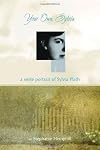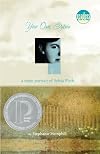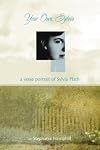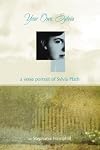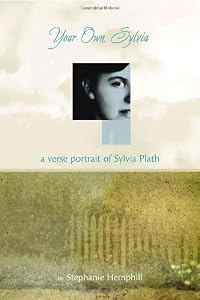
Your Own, Sylvia: A Verse Portrait of Sylvia Plath
by Stephanie Hemphill
On This Page
Description
The author interprets the people, events, influences and art that made up the brief life of Sylvia Plath.Tags
Recommendations

Member Reviews
That was unexpected.
I spent the first half of the book bemoaning the fact that I was reading yet another book in verse when I know that books in verse are really, really not my thing. It's true. I hate them. They just don't speak to me. But then I started the second half of the book, and while I still wish it hadn't been in verse, I found myself connecting rather strongly with the story.
I find myself kind of...enraged...on behalf of Sylvia Plath. I realize that she suffered from depression, the really dark, bad kind, and probably would have no matter what. But it's hard to believe that she wouldn't have been better in a more modern society, where a woman academic, a poet, a scholar wouldn't have been seen as "unfeminine." Where she show more wouldn't have been encouraged to abandon her own talents, her own career, to be a wife, housekeeper, and mother. Where she wouldn't have felt pressured to be everything to everyone, jamming her art into stolen moments. Where she wouldn't have had to manage a home, two children, her husband's effing career (and why couldn't he manage this himself? HE wasn't raising two children and keeping house...), and trying to build her own career on top of that.
Which brings me to Ted Hughes. I'm trying really hard to be fair to this man. It cannot have been easy living with a mentally ill wife. It must have been impossible. BUT NO ONE IN THE WORLD COULD HAVE HANDLED IT AS BADLY AS HE DID. He soaks up her youthful adulation, watching as this beautiful young poet who he claimed to admire sacrificed her poetry to be his little wife and cheerleader. Watching as she juggled their two children and her poetry, marveling that it was possible as he gallivants around, not offering much support. And once all that she had to give had been wrung out of her, once she was tired and sinking into isolation and depression, once she was no longer fun, he left her. And he didn't just leave her. Oh, no. He smacked her around emotionally. He had an affair. He left without warning or any hint of where he had gone. He stopped seeing the children. He told her that he had never even wanted children. So why would he accept any responsibility for them? Right? RIGHT?? He said that he had never grown tired of living in London, as he previously told her. He had just grown tired of living there with her. This woman, who he knew suffered from depression, was decimated. And he should have known. I have never in my life read about a bigger ass. I have sympathy for Sylvia. I'm not sure she could have been saved, but it feels like Ted Hughes killed her. And worse, this book even details a conversation he had with his pregnant, married mistress, where they casually wondered if Sylvia would kill herself. RAGE. ALL THE RAGE IN THE WORLD.
It's also worth mentioning that the aforementioned mistress also killed herself when Ted reportedly left her for another woman. She also killed their daughter. This dude was a winner. And to add insult to injury, when posthumously publishing Sylvia's final poems, he rearranged them to suit his fancy, burying the poems she considered most important and her finest work in the middle of the book instead of anchoring it as she intended.
A sad story. Very, very sad. show less
I spent the first half of the book bemoaning the fact that I was reading yet another book in verse when I know that books in verse are really, really not my thing. It's true. I hate them. They just don't speak to me. But then I started the second half of the book, and while I still wish it hadn't been in verse, I found myself connecting rather strongly with the story.
I find myself kind of...enraged...on behalf of Sylvia Plath. I realize that she suffered from depression, the really dark, bad kind, and probably would have no matter what. But it's hard to believe that she wouldn't have been better in a more modern society, where a woman academic, a poet, a scholar wouldn't have been seen as "unfeminine." Where she show more wouldn't have been encouraged to abandon her own talents, her own career, to be a wife, housekeeper, and mother. Where she wouldn't have felt pressured to be everything to everyone, jamming her art into stolen moments. Where she wouldn't have had to manage a home, two children, her husband's effing career (and why couldn't he manage this himself? HE wasn't raising two children and keeping house...), and trying to build her own career on top of that.
Which brings me to Ted Hughes. I'm trying really hard to be fair to this man. It cannot have been easy living with a mentally ill wife. It must have been impossible. BUT NO ONE IN THE WORLD COULD HAVE HANDLED IT AS BADLY AS HE DID. He soaks up her youthful adulation, watching as this beautiful young poet who he claimed to admire sacrificed her poetry to be his little wife and cheerleader. Watching as she juggled their two children and her poetry, marveling that it was possible as he gallivants around, not offering much support. And once all that she had to give had been wrung out of her, once she was tired and sinking into isolation and depression, once she was no longer fun, he left her. And he didn't just leave her. Oh, no. He smacked her around emotionally. He had an affair. He left without warning or any hint of where he had gone. He stopped seeing the children. He told her that he had never even wanted children. So why would he accept any responsibility for them? Right? RIGHT?? He said that he had never grown tired of living in London, as he previously told her. He had just grown tired of living there with her. This woman, who he knew suffered from depression, was decimated. And he should have known. I have never in my life read about a bigger ass. I have sympathy for Sylvia. I'm not sure she could have been saved, but it feels like Ted Hughes killed her. And worse, this book even details a conversation he had with his pregnant, married mistress, where they casually wondered if Sylvia would kill herself. RAGE. ALL THE RAGE IN THE WORLD.
It's also worth mentioning that the aforementioned mistress also killed herself when Ted reportedly left her for another woman. She also killed their daughter. This dude was a winner. And to add insult to injury, when posthumously publishing Sylvia's final poems, he rearranged them to suit his fancy, burying the poems she considered most important and her finest work in the middle of the book instead of anchoring it as she intended.
A sad story. Very, very sad. show less
This is a delightful book. For the intimately acquainted or the passerby stranger, "Your Own, Sylvia" is a smart look at the life of Sylvia Plath through poetry and footnotes. In many of the poems, author Stephanie Hemphill mimics the style of Plath's most famous works. The work clever and interesting. Most interesting is the depiction of her father's life and death, and then Plath's ensuing relations with men thereafter. In one poem titled, "Boy Crazy," written in Ruth Freeman's voice--a long time childhood friend, Ruth explains, "Between reading her novels/Sylvia dreams boys, drifts/down a river of crushes./Each week she paddles/somewhere new (19)."
Sylvia Plath is an enigma that I've spent a (probably) unhealthy amount of time trying to understand. Like many women and teens who've read her work, I feel a strong sense of kinship to Plath that fuels my curiosity, and I found Stephanie Hemphill's Your Own, Sylvia to be a welcome and engaging read which offered both interesting information and the emotion of poetry.
It surprised me how much I learned while reading Your Own, Sylvia. Many of the poems mimic poems written by Plath in style or form and were informed by the reports or writings of those who knew her. It's clear that the poems are fictional accounts created by Hemphill, but, for me, each had a clear ring of truth and feasibility. It's clear Hemphill spent much time show more researching Plath and those in her life before composing the poems that make up the novel. Some of them are better than others, that is, some felt more aesthetically pleasing, but they all contributed in an important way to the overall narrative.
After each poem, Hemphill added factual information or a short explanation of the poem. Given the personal nature of the poetry, the information included often had a personal tone as well. I never felt that I was being force fed dry bits of factual information, rather, each fact gave additional depth and meaning to Hemphill's poems and created a more vivid portrait of Plath.
I highly recommend Your Own, Sylvia to readers with a particular interest in Plath, as well as those who generally enjoy poetry and verse novels. Hemphill's novel is unique in that it focuses on a real person and weaves facts into the verse novel format, offering readers something new and notable. I'm looking forward to Hemphill's upcoming verse portrait, Hideous Love: The Story of the Girl Who Wrote Frankenstein. This novel, which focuses on author Mary Shelley, is scheduled for an October 2013 release. show less
It surprised me how much I learned while reading Your Own, Sylvia. Many of the poems mimic poems written by Plath in style or form and were informed by the reports or writings of those who knew her. It's clear that the poems are fictional accounts created by Hemphill, but, for me, each had a clear ring of truth and feasibility. It's clear Hemphill spent much time show more researching Plath and those in her life before composing the poems that make up the novel. Some of them are better than others, that is, some felt more aesthetically pleasing, but they all contributed in an important way to the overall narrative.
After each poem, Hemphill added factual information or a short explanation of the poem. Given the personal nature of the poetry, the information included often had a personal tone as well. I never felt that I was being force fed dry bits of factual information, rather, each fact gave additional depth and meaning to Hemphill's poems and created a more vivid portrait of Plath.
I highly recommend Your Own, Sylvia to readers with a particular interest in Plath, as well as those who generally enjoy poetry and verse novels. Hemphill's novel is unique in that it focuses on a real person and weaves facts into the verse novel format, offering readers something new and notable. I'm looking forward to Hemphill's upcoming verse portrait, Hideous Love: The Story of the Girl Who Wrote Frankenstein. This novel, which focuses on author Mary Shelley, is scheduled for an October 2013 release. show less
Sylvia Plath stuck her head in an oven and died, but how she lived is less well known. Perhaps the best way to describe this gifted poet is with brilliant verse. Each year teens write poems and essays that flirt with death. Many know and read The Bell Jar not because they must but because Plath gives voice to many of the same fears. Fears of not being adequate, fears of being rejected, fears that we don't quite fit in properly. Many teens speak in glowing terms of Sylvia Plath despite the fact that they have neither read nor heard of most (if not all) of Plath's writings. They do, however, know of her death and know that she is a writer.
This book, filled with fabulous poems, tells a story that not only describes the details of Plath's show more life, but recreates this poet in, perhaps, the single best form--poetry. We hear from her mother, friends, other poets, husband Ted Hughes, and other people who share links with Plath. These voices speak in poems that evoke a mood based on careful and thorough research into Plath's life. Conveyed in footnotes, the research adds richness to the poems without annoying or distracting the reader. Unflinchingly honest, the poems guide us through Plath's life all the way through her suicide. While the poems often pay homage to and mirror poems by Plath, they don't merely parrot back the same words and ideas. This book is that biography to give to the student who hates biography. This book is that poetry book to give to the student who doesn't like poetry. The sum of its parts is far more significant than isolating the individual elements of the book. From the first poem (from a reader that could be us) through poems by family, friends, cast off lovers, fellow poets, her husband, and more; to "Your Own, Sylvia" we have a book that respects Plath's place in history, preserves and adds to her legacy, and makes her a flesh and blood person with whom teens and adults will commune. The joy of this book is that we feel like we have a relationship with Plath without ever feeling like she is someone we completely understand. She becomes so much more than a mere icon of death. Highly recommended for all high school libraries. This is a book that may show up on the Printz table this January; it is that good! show less
This book, filled with fabulous poems, tells a story that not only describes the details of Plath's show more life, but recreates this poet in, perhaps, the single best form--poetry. We hear from her mother, friends, other poets, husband Ted Hughes, and other people who share links with Plath. These voices speak in poems that evoke a mood based on careful and thorough research into Plath's life. Conveyed in footnotes, the research adds richness to the poems without annoying or distracting the reader. Unflinchingly honest, the poems guide us through Plath's life all the way through her suicide. While the poems often pay homage to and mirror poems by Plath, they don't merely parrot back the same words and ideas. This book is that biography to give to the student who hates biography. This book is that poetry book to give to the student who doesn't like poetry. The sum of its parts is far more significant than isolating the individual elements of the book. From the first poem (from a reader that could be us) through poems by family, friends, cast off lovers, fellow poets, her husband, and more; to "Your Own, Sylvia" we have a book that respects Plath's place in history, preserves and adds to her legacy, and makes her a flesh and blood person with whom teens and adults will commune. The joy of this book is that we feel like we have a relationship with Plath without ever feeling like she is someone we completely understand. She becomes so much more than a mere icon of death. Highly recommended for all high school libraries. This is a book that may show up on the Printz table this January; it is that good! show less
At first I found the footnotes distracting but they ended up being a useful addenda and clarification for the poems. I am not a Plath fan but the book intrigued me enough to want to learn more about her life and personality. An absorbing read for Plath fans and motivated readers who are not too familiar with her.
10/6/16 I picked this up after reading about it in Michael Cart's "Young Adult Literature: From Romance to Realism" and realized I had already read it! But I read it again anyway and now I am really interested in learning more about Sylvia Plath's life. Source notes in the back list titles for further reading and research. What a talented but troubled woman!
10/6/16 I picked this up after reading about it in Michael Cart's "Young Adult Literature: From Romance to Realism" and realized I had already read it! But I read it again anyway and now I am really interested in learning more about Sylvia Plath's life. Source notes in the back list titles for further reading and research. What a talented but troubled woman!
Your Own, Sylvia is a uniquely-told biographical work told in the style of poetry mimicking Sylvia Plath’s own poetry. Interspersed among the author’s own poetry is Plath’s own poetry; after every poem is a snippet of biographical information told in chronological order. Each poem focuses on a different viewpoint of a person important in Plath’s life: Sylvia herself, her mother, her brother, her sister, her boyfriends, her college friends, and her husband, Ted Hughes. There are also poems told from the viewpoint of various persons who were witness to or privy to important information in her life, such as various editors and neighbors.
Hemphill cautions that “although [this book is] based on real events and real people, [it] is show more first and foremost a work of fiction.” Her own poetry “[takes] liberties imagining conversations and descriptions and interpreting the feelings of the real people speaking in these poems.” Yet, that does not stop Hemphill from portraying a unique chronological timeline of Plath’s life, hitting on the peaks and valleys of Plath’s tumultuous existence. While Hemphill’s poetry is nowhere near as refined as Plath’s, and the juxtaposition is jarring at times, Hemphill does a fair job of detailing what happened and what she thinks happened, painting a fine picture of biographical details.
“She’s a wee bit different
From the other girls,
Cuts her eggs into squares.”
- American Girl, 105
“We discipline ourselves to a life
Of poetry.”
- Benidorm, 124
“Without poetry she would crumble
Like a dried-out lemon cake,
Stale and inedible. She talks
Bright, but something in her has hardened.”
- Routine, 173
“She says, ‘When you give someone
Your whole heart
And he doesn’t want it, you cannot
Take it back.
It’s gone forever.’”
- Sylvia Begins to Tell the Truth, 189 show less
Hemphill cautions that “although [this book is] based on real events and real people, [it] is show more first and foremost a work of fiction.” Her own poetry “[takes] liberties imagining conversations and descriptions and interpreting the feelings of the real people speaking in these poems.” Yet, that does not stop Hemphill from portraying a unique chronological timeline of Plath’s life, hitting on the peaks and valleys of Plath’s tumultuous existence. While Hemphill’s poetry is nowhere near as refined as Plath’s, and the juxtaposition is jarring at times, Hemphill does a fair job of detailing what happened and what she thinks happened, painting a fine picture of biographical details.
“She’s a wee bit different
From the other girls,
Cuts her eggs into squares.”
- American Girl, 105
“We discipline ourselves to a life
Of poetry.”
- Benidorm, 124
“Without poetry she would crumble
Like a dried-out lemon cake,
Stale and inedible. She talks
Bright, but something in her has hardened.”
- Routine, 173
“She says, ‘When you give someone
Your whole heart
And he doesn’t want it, you cannot
Take it back.
It’s gone forever.’”
- Sylvia Begins to Tell the Truth, 189 show less
This is a book of poetry inspired by the life of Sylvia Plath. I was a little surprised to find it on audiobook until I got the hang of listening to it. The poems are told from the perspective of people who knew Sylvia; mother, siblings, boyfriends, doctors, friends and acquaintances. For each poem there is a brief introduction regarding who is speaking and then the poem. Afterwards the author reads any foot notes regarding the time of Sylvia's life or the person speaking. I actually found this a little confusing. That information comes across as though it should be part of the introductory info and I kept getting confused about who and sometimes what the next poem was going to be about.
It was definitely an interesting way to tell the show more story of Sylvia's life. I found the poems telling the story from someone's point of view more interesting then the poems that were just written "in the style of" specific poems by Sylvia. Sometimes the "in the style" poems felt jarring b/c they weren't entirely contributing to the ongoing narrative. show less
It was definitely an interesting way to tell the show more story of Sylvia's life. I found the poems telling the story from someone's point of view more interesting then the poems that were just written "in the style of" specific poems by Sylvia. Sometimes the "in the style" poems felt jarring b/c they weren't entirely contributing to the ongoing narrative. show less
Members
- Recently Added By
Author Information

8 Works 1,515 Members
Awards and Honors
Awards
Distinctions
Common Knowledge
- Original publication date
- 2007
Classifications
Statistics
- Members
- 370
- Popularity
- 84,439
- Reviews
- 27
- Rating
- (3.83)
- Languages
- English
- Media
- Paper, Audiobook, Ebook
- ISBNs
- 8
- ASINs
- 3