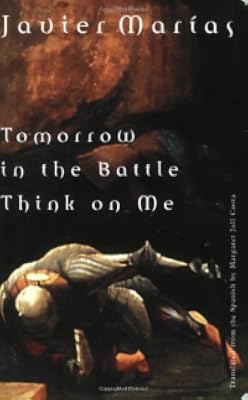
Tomorrow in the Battle Think on Me
by Javier Marías
On This Page
Description
"Tomorrow in the Battle Think on Me" is a riveting novel of infidelity and a man trapped by a terrible secret. Marta has only just met Victor when she invites him to dinner at her Madrid apartment while her husband is away on business. When her two-year-old son finally falls asleep, Marta and Victor retreat to the bedroom. Undressing, she feels suddenly ill; and in his arms, inexplicably, she dies. What should Victor do? Remove the compromising tape from the answering machine? Leave food for show more the child for breakfast? These are just his first steps, but he soon takes matters further; unable to bear the shadows and the unknowing, Victor plunges into dark waters. And Javier Marias, Europe's master of secrets, of what lies reveal and truth may conceal, is on sure ground in this profound, quirky, and marvelous novel. show lessTags
Recommendations






















Member Recommendations
Member Reviews
Il mio primo Javier Marìas, e credo proprio che sia l’inizio di una passione perché questo “Domani nella battaglia pensa a me” è un romanzo strepitoso. È un romanzo che si svolge praticamente tutto dentro la testa del protagonista: i dialoghi sono pochissimi, ma la lettura scorre che è un piacere; lo stile è strano, onirico, quasi psichedelico. Sono stata letteralmente trascinata nel vortice dei pensieri del protagonista, nei suoi lunghi monologhi interiori sulla vita e sulla morte, sull’essenza delle nostre esistenze, su come è facile e rapido essere dimenticati, non lasciare traccia. Certo, non è per tutti, e mi viene da pensare che il romanzo non possa piacere un po’: o lo adori o ti fa arrabbiare. Ci sono interi show more brani che si ripetono con le stesse parole in punti diversi della narrazione, ma ogni volta trovano un posto, il posto giusto; e queste ripetizioni non hanno fatto che accentuare il senso di straniamento che mi ha accompagnata durante tutta la lettura. Uno stile che ho trovato innovativo ed intelligente, mi ha spiazzata e mi ha coinvolta, mi ha lasciata senza fiato. Non sono dispiaciuta che il romanzo sia finito, non è uno di quei romanzi che ti lasciano con la curiosità di sapere che cosa accadrà dopo ai protagonisti, ma alla fine si compie in un devo andare non detto. Uno dei romanzi più belli che io abbia mai letto. show less
M. è uno scrittore per fanatici. O piace, o lo odi. Perchè non si puo' pensare di seguire una frase senza punti per 50-60 righe. Perchè di tutta l'ipnosi verbale che lo scrittore induce non c'e' bisogno: bisogna sceneggiare, far procedere la storia. Non possiamo andare avanti 50 pagine ed essere sempre li' ad aspettare che Marta muoia. Muori, cazzo...!Pero', se si da la pazienza al narrare di entrare nella nostra attenzione labile si percepisce la maestria di M. nel costruire un romanzo che non ha eguali: nelle citazioni, nei rimandi, nell'intelligenza, nella capacità di evocare sentimenti e paure - sono stato in pena per Victor, davvero, ho avuto un senso di timore in alcuni punti del libro - nella sceneggiatura, nella definizione show more degli ambienti e dei personaggi. E' bellissimo ovunque, ad ogni modo. Un capolavoro letterario e visivo. show less
I don't know, maybe it was Marías fatigue, or maybe I took too long to read it, but this one didn't work for me. Not like the others anyway. Marías himself admits that his working method doesn't always work, that it can have "disastrous" results. While I wouldn't call this a disaster, I'm not sure how well it worked. We have all the usual Marías tropes and images (time, memory, spying, the back of the neck, the face, names, death, storytelling), but somehow they don't gel, not like in A Heart So White. Or maybe it's that the "random" stories that happen between the main story aren't as interesting as they were in A Heart So White (interesting to me anyway).
Here the book ends with a story told not by the narrator but by another show more character. But instead of the narrator finishing the story for us (as in All Souls), we realize that his own story (told in the preceding pages) was contaminated by this story, which he is finally telling us, having delayed it with other stories, with too many thoughts, too much thinking actually. And in the end, maybe that's why the book fails (for me); the inner thoughts, the inner paranoias, that useless whirring that our brains do sometimes, overrode the storytelling, the flow, the magic...
P.S. OK, I think I have an answer to the paradox I mentioned in my review of A Heart So White: haunting. Marías is haunting. His narrators are haunted (as they themselves claim), but so are we. A spell is cast upon us, we are mesmerized and enchanted, despite the meanderings, the spiraling and looping, the "what the hell are you doing??" moments, the flaws... or it's precisely because of those things...Is this perhaps why in my least favorite of the 3 books I just read I have placed the most bookmarks? show less
Here the book ends with a story told not by the narrator but by another show more character. But instead of the narrator finishing the story for us (as in All Souls), we realize that his own story (told in the preceding pages) was contaminated by this story, which he is finally telling us, having delayed it with other stories, with too many thoughts, too much thinking actually. And in the end, maybe that's why the book fails (for me); the inner thoughts, the inner paranoias, that useless whirring that our brains do sometimes, overrode the storytelling, the flow, the magic...
P.S. OK, I think I have an answer to the paradox I mentioned in my review of A Heart So White: haunting. Marías is haunting. His narrators are haunted (as they themselves claim), but so are we. A spell is cast upon us, we are mesmerized and enchanted, despite the meanderings, the spiraling and looping, the "what the hell are you doing??" moments, the flaws... or it's precisely because of those things...Is this perhaps why in my least favorite of the 3 books I just read I have placed the most bookmarks? show less
Para mi esta novela tiene tres partes principales, con cierta cantidad de tejido conectivo uniendolos: primero, los dos capítulos iniciales, que no necesitan introducción ni explicación por mi parte; segundo, los dos capítulos digresivos que tratan de la ex-esposa del narrador; y después el antepenúltimo y último juntos, en los cuales Marías en muy poco tiempo tira toda la fachada que sostenía hasta entonces toda la trama del libro para desarrollar de manera chocante los conflictos que siempre supimos que iban a venir. Todas estas secciones, y cada capítulo entre ellos, funciona como cuento corto muy competente en si, pero el mayor parte del poder de la novela viene de la vuelta obsesiva a frases, temas, y humores que une todo show more lo descrito. Cada detalle inicial tiene sus reverberaciones en el largo de la novela, y por eso es imposible olvidar qué es que desencadenó toda la historia. Raras veces he leído un libro que explora tan pocas temas con tanta profundidad mientras todavía tiene un trama que va desde un giro genuinamente inesperada a otro. No pare con las revelaciones hasta la última página. Aún sin mencionar el lenguaje, que es excelente en su manera lenta y serpenteando, y sin ir a analizar cómo trata de sus temas secundarias del machismo, de la complicidad, y de las mentiras auto-protectivas que inventamos todos, podría recomendar ésta como una de las mejores novelas contemporáneas que he leído, y una que merece ser más conocido fuera de España. show less
Uncomfortable in its subject-matter — Marías seems to have a rather nasty fascination with killing off his women characters — but beautifully subtle in its writing. I found it hard to like this one (something many other readers seem to find) but it was definitely a rewarding read. The digressions did seem to be the most interesting parts of the book, though. I especially enjoyed the palace scene, where Marías gets to have a lot of fun with Shakespeare, without once mentioning his name.
The English translation must have presented quite some challenges, but it comes off very well.
The English translation must have presented quite some challenges, but it comes off very well.
My first clue to the structure of this novel, or the first one that I twigged to, was the recurrent untied shoelace. Untied shoelaces kept popping up, for no apparent reason. What is the significance of untied shoelaces that appear on pages 38, 80, 88, 112, 113, 131, 132, 136, 230, 238? I still don’t know, except that they prompted me to start reading the book in an entirely different way.
The narrator is a ghostwriter, who ghosts for another ghostwriter, and he is often invisible or strives to disappear from consciousness of others, even if it just in an awkward social setting (“discreet to the point of invisibility”). Ghostly themes haunt the book, beginning with the first line in which a woman dies in his arms, and in the show more repeated memories and stories of that event and its sequelae, blending in with the motifs of the “Richard III” quotes and references permeating the book.
But he is a storyteller and as he repeatedly tells us throughout, the storyteller gets to decide how to tell his story, how to convince and persuade, and the world depends on its storytellers. “It is the person telling the story who decides to tell it or even impose it on another, the person who opts for revelation or betrayal, the person who decides when to tell, and that usually happens when the weariness brought on by the silence and the shadow becomes too great, sometimes it is the only thing that drives people to recount facts that no one has asked for and that no one expects….” Variations on this passage are repeated throughout the novel, some of it verbatim, some altered slightly (pp 154, 228, 235, 236, 249, 301, 308, at least).
The weariness of the shadows (249, 252, 284) and the state of enchantment (66, 67,135, 162, 195, 242, 253, 284, 294 and more). “Travelling towards dissolution”, inaugurated on p 18 (“…everything travelling towards its own dissolution with the passing of the days and even the seconds that appear to sustain things but, in fact, suppress them…”) appears at least 11 times.
There are numerous small little repetitions that seem inconsequential or minor and yet are conspicuous by their reappearances. The shoelaces. “Inside-out” sleeves on the arms or caught on the wrists (pp 64, 152, 160, 199,242, 310). “Slippery as compacted snow” — an interesting description, for ‘compacted’ is not quite the word one would expect, but those three words are repeated in some form in at least 5 spots throughout. “When you first get hold of a telephone number, you always feel tempted to dial it at once.” Reading that the first time produced a tiny note of recognition, so it stood out in its own very small way. Then it reappears at least 3 more times. There are the “kisses of the one who is leaving” (p 18, 49, 300).
“The mother believes she was born to be a mother and the spinster to be single, the murderer to be a murderer and the victim a victim, just as the leader believes that his steps led him from the very beginning to hold sway over other people’s wills…” (P129). Later, p 228, “…we end up seeing our life in the light of the latest or most recent event, the mother believes that she was born to be a mother and the spinster to be single, the murderer to be a murderer and the victim a victim, and the adulteress an adulteress if she realizes, in the middle of an adulterous act, that she is dying…” And again this shows up on p 288 with another slight variation.
I gradually realise that these echoes are carrying the novel, they are part of the structure, forming an intricate web. There are so many once they are noticed. They are breathing through the novel.
This was my first Marias novel, so I didn’t appreciate that this is his style. He discusses this technique in a wonderful interview in the Paris Review: “In my novels there is what I call a system of echoes or resonances. A sentence reappears, sometimes with a variation. I try not to make it just a repetition but an illumination of the previous occasion in which it appeared. If I foresee that something will be used again in the book, then I write the page where it appeared.” (http://www.theparisreview.org/interviews/5680/the-art-of-fiction-no-190-javier-marias) I loved the intricacy and reverberations that result from this — reading the book becomes a more active and dynamic process. It engages the inner OCD, looking for all the echoes! He says, “If I close a book and there are no echoes, that is very frustrating. I like books that aren’t only witty or ingenious. I prefer something that leaves a resonance, an atmosphere behind.” (That Paris Review interview is strewn with many similar pearls — highly recommended).
It is a demanding novel, but in a simple and direct way: “Give me your attention, pay attention, you will be rewarded.” In the Paris Review interview, Marias says, “ I try the reader’s patience on purpose but not gratuitously.” The reward at the end is of a thundering cascade of echoes.
Thanks to Goodreads friends Fionnuala and Karen for recommending this book, I would never have discovered it otherwise.
This was one of the best books of the year. show less
The narrator is a ghostwriter, who ghosts for another ghostwriter, and he is often invisible or strives to disappear from consciousness of others, even if it just in an awkward social setting (“discreet to the point of invisibility”). Ghostly themes haunt the book, beginning with the first line in which a woman dies in his arms, and in the show more repeated memories and stories of that event and its sequelae, blending in with the motifs of the “Richard III” quotes and references permeating the book.
But he is a storyteller and as he repeatedly tells us throughout, the storyteller gets to decide how to tell his story, how to convince and persuade, and the world depends on its storytellers. “It is the person telling the story who decides to tell it or even impose it on another, the person who opts for revelation or betrayal, the person who decides when to tell, and that usually happens when the weariness brought on by the silence and the shadow becomes too great, sometimes it is the only thing that drives people to recount facts that no one has asked for and that no one expects….” Variations on this passage are repeated throughout the novel, some of it verbatim, some altered slightly (pp 154, 228, 235, 236, 249, 301, 308, at least).
The weariness of the shadows (249, 252, 284) and the state of enchantment (66, 67,135, 162, 195, 242, 253, 284, 294 and more). “Travelling towards dissolution”, inaugurated on p 18 (“…everything travelling towards its own dissolution with the passing of the days and even the seconds that appear to sustain things but, in fact, suppress them…”) appears at least 11 times.
There are numerous small little repetitions that seem inconsequential or minor and yet are conspicuous by their reappearances. The shoelaces. “Inside-out” sleeves on the arms or caught on the wrists (pp 64, 152, 160, 199,242, 310). “Slippery as compacted snow” — an interesting description, for ‘compacted’ is not quite the word one would expect, but those three words are repeated in some form in at least 5 spots throughout. “When you first get hold of a telephone number, you always feel tempted to dial it at once.” Reading that the first time produced a tiny note of recognition, so it stood out in its own very small way. Then it reappears at least 3 more times. There are the “kisses of the one who is leaving” (p 18, 49, 300).
“The mother believes she was born to be a mother and the spinster to be single, the murderer to be a murderer and the victim a victim, just as the leader believes that his steps led him from the very beginning to hold sway over other people’s wills…” (P129). Later, p 228, “…we end up seeing our life in the light of the latest or most recent event, the mother believes that she was born to be a mother and the spinster to be single, the murderer to be a murderer and the victim a victim, and the adulteress an adulteress if she realizes, in the middle of an adulterous act, that she is dying…” And again this shows up on p 288 with another slight variation.
I gradually realise that these echoes are carrying the novel, they are part of the structure, forming an intricate web. There are so many once they are noticed. They are breathing through the novel.
This was my first Marias novel, so I didn’t appreciate that this is his style. He discusses this technique in a wonderful interview in the Paris Review: “In my novels there is what I call a system of echoes or resonances. A sentence reappears, sometimes with a variation. I try not to make it just a repetition but an illumination of the previous occasion in which it appeared. If I foresee that something will be used again in the book, then I write the page where it appeared.” (http://www.theparisreview.org/interviews/5680/the-art-of-fiction-no-190-javier-marias) I loved the intricacy and reverberations that result from this — reading the book becomes a more active and dynamic process. It engages the inner OCD, looking for all the echoes! He says, “If I close a book and there are no echoes, that is very frustrating. I like books that aren’t only witty or ingenious. I prefer something that leaves a resonance, an atmosphere behind.” (That Paris Review interview is strewn with many similar pearls — highly recommended).
It is a demanding novel, but in a simple and direct way: “Give me your attention, pay attention, you will be rewarded.” In the Paris Review interview, Marias says, “ I try the reader’s patience on purpose but not gratuitously.” The reward at the end is of a thundering cascade of echoes.
Thanks to Goodreads friends Fionnuala and Karen for recommending this book, I would never have discovered it otherwise.
This was one of the best books of the year. show less
ecco, avete presente una molla, no?
sì, lo so che il termine esatto per quella figura geometrica lì (se il termine giusto è figura) sarebbe spirale.. ma a me 'sto termine mi ricorda di più quella specie di chiocciola che faceva disegnare la prof. di educazione tecnica alle medie.. che poi sarebbe tipo la molla guardata dal buco.. e non è quella che mi serve.
quindi teniamo presente una molla... tipo quella delle penne a scatto.
ecco, per me la vita è un po' come una di quelle molle lì.
che ha un punto di inizio.. una fine.. e nel mezzo: gira, gira, gira, gira, gira, gira, gira... che se si potesse essere un puntino e farsi quel percorso lì sembrerebbe di girare sempre in tondo uguale.. e invece no!
perché un pochino si sposta show more sempre.
inesorabilmente.
in avanti.
e noi quasi non ce ne accorgiamo.
ogni giro è un giorno.
l'idea della vita come una molla mi è venuta per la prima volta proprio quando ho letto questo libro.
forse perché il modo di scrivere di marías è un po' così.
i fatti si evolvono, ma non sono la cosa importante.
se cercate una storia intrigante, questo libro non fa per voi.
ma se c'è una cosa che quest'uomo sa raccontare veramente bene sono gli stati d'animo.. ti fa proprio un'indagine sui sentimenti e sulle loro evoluzioni, che se non si legge non si può capire.
il puntino sulla molla gira.
ogni giro un giorno.
sembra sempre uguale.
o quasi.
perché noi cambiamo.
dentro di noi ci spostiamo, ogni giorno, lentamente, inesorabilmente, in avanti. show less
sì, lo so che il termine esatto per quella figura geometrica lì (se il termine giusto è figura) sarebbe spirale.. ma a me 'sto termine mi ricorda di più quella specie di chiocciola che faceva disegnare la prof. di educazione tecnica alle medie.. che poi sarebbe tipo la molla guardata dal buco.. e non è quella che mi serve.
quindi teniamo presente una molla... tipo quella delle penne a scatto.
ecco, per me la vita è un po' come una di quelle molle lì.
che ha un punto di inizio.. una fine.. e nel mezzo: gira, gira, gira, gira, gira, gira, gira... che se si potesse essere un puntino e farsi quel percorso lì sembrerebbe di girare sempre in tondo uguale.. e invece no!
perché un pochino si sposta show more sempre.
inesorabilmente.
in avanti.
e noi quasi non ce ne accorgiamo.
ogni giro è un giorno.
l'idea della vita come una molla mi è venuta per la prima volta proprio quando ho letto questo libro.
forse perché il modo di scrivere di marías è un po' così.
i fatti si evolvono, ma non sono la cosa importante.
se cercate una storia intrigante, questo libro non fa per voi.
ma se c'è una cosa che quest'uomo sa raccontare veramente bene sono gli stati d'animo.. ti fa proprio un'indagine sui sentimenti e sulle loro evoluzioni, che se non si legge non si può capire.
il puntino sulla molla gira.
ogni giro un giorno.
sembra sempre uguale.
o quasi.
perché noi cambiamo.
dentro di noi ci spostiamo, ogni giorno, lentamente, inesorabilmente, in avanti. show less
Members
- Recently Added By
Lists

1001 Books You Must Read Before You Die
1,448 works; 1,134 members

Recommend the 20 best books you've read in the last five years
2,168 works; 606 members

1990s
309 works; 17 members

Books Read in 2022
5,168 works; 114 members

Shakespeare Quote Titles
112 works; 12 members
Author Information

156+ Works 13,300 Members
Javier Marias, a literary phenomenon worldwide, is still in the process of being discovered in America. Among his awards are the Premio Ciudad de Barcelona, The Spanish Critics' Award, the Prix L'Oeil et la Lettre, the Premio Mondello, the Premio Internacional de Novela Romulo Gallegos, the Prix Femina Etranger, the Nelly-Sachs Prize, and the show more Dublin International IMPAC Award. He is also King Xavier I of Redonda. show less
Some Editions
Awards and Honors
Distinctions
Notable Lists
Series
Belongs to Publisher Series
Alfaguara Bolsillo (22)
Narrativas hispánicas (158)
ET Tascabili [Einaudi] (692)
Harvill (222)
Gallimard, Folio (5006)
Common Knowledge
- Canonical title
- Tomorrow in the Battle Think on Me
- Original title
- Mañana en la batalla piensa en mí
- Original publication date
- 1994 (original Spanish) (original Spanish); 1994; 1996 (English translation) (English translation)
- People/Characters*
- Victor Francés; Marta Téllez
- Important places
- Madrid, Spain
- Dedication*
- Per Mercedes López-Ballesteros, che mi ha sentito dire la frase di Bakio e ha conservato per me le mie righe.
- First words
- No one ever expects that they might some day find themselves with a dead woman in their arms, a woman whose face they will never see again, but whose name they will remember.
- Quotations*
- Sembra un dato di fatto che l'uomo - e forse la donna ancora di più - abbia bisogno di una certa dose di finzione, vale a dire, abbia bisogno dell'immaginario oltre che dell'accaduto e del reale. Non mi spingerei fino al pun... (show all)to di usare espressioni che trovo risapute o kitsch, come affermare che l'essere umano ha biosgno di "sognare" o di "evadere" (un verbo, quest'ultimo, molto mal visto negli anni settanta, sia detto en passant. Preferisco dire che ha bisogno di conoscere il possibile oltre che il vero, le congetture e le ipotesi e i fallimenti oltre ai fatti, ciò che è stato tralasciato e ciò che avrebbe potuto essere oltre a quello che è stato. Qiando si parla della vita di un uomo o di una donna, quando se ne traccia una ricapitolazione o un riassunto, quando se ne racconta la storia o la biografia, in un dizionario o in una enciclopedia o in una cronaca chiacchierando tra amici, si è soliti raccontare ciò che quella persona ha portato a compimento e ciò che è effettivamente accaduto. In fondo, tutti abbiamo la stessa tendenza, vale a dire quella di vederci nelle diverse fasi della nostra vita come risultato e compendio di ciò che è accaduto e di ciò che abbiamo ottenuto e di ciò che abbiamo realizzato, come se fosse soltanto questo che costituisce la nostra esistenza. E dimentichiamo che quasi sempre le vite delle persone non sono soltanto questo: ogni percorso si compone anche delle nostre perdite e dei nostri rifiuti, delle nostre omissioni e dei nostri desideri insoddisfatti, di ciò che una volta abbiamo tralasciato o non abbiamo scelto o non abbiamo ottenuto, delle numerose possibilità che nella maggior parte dei casi non sono giunte a realizzarsi - tutte tranne una, alla fin fine -, delle nostre esitazioni e dei nostri sogni, dei progetti falliti e delle aspirazioni false e deboli, delle paure che ci hanno paralizzato, di ciò che abbiamo abbandonato e di ciò che ci ha abbandonati. Insomma, noi persone forse consistiamo tanto in ciò che siamo quanto in ciò che siamo stati, tanto in cio che è verificabile e quantificabile quanto in ciò che è più incerto, indeciso e sfumato, forse siamo fatti in egual misura di ciò che è stato e di ciò che avrebbe potuto essere.
(Epilogo: Quello che succede e quello che non succede) - Last words*
- (Click to show. Warning: May contain spoilers.)E quanto poco rimane di ogni individuo nel tempo inutile come neve scivolosa, di quanto poco rimane traccia, e di quel poco tanto si tace, e di quello che non si tace si ricorda dopo soltanto una parte minima, e per poco tempo: mentre viaggiamo verso il nostro sfumare lentamente per transitare soltanto alla schiena o al rovescio di quel tempo, dove non si può continuare a pensare se non si può continuare a prendere commiato: "Addio risate e addio oltreggi. Non vi vedrò più né voi mi vedrete. E addio ardore, addio ricordi.".
(Click to show. Warning: May contain spoilers.)Quando starò scrivendo il prossimo romanzo, e di tanto in tanto farò una pausa e alzerò lo sguardo e mi estranierò dall'immaginario che mi avrà assorbito per un lungo momento, potrò pensare che, contrariamente alle mie previsini e apprensioni, una volta, molto lontano dal mio paese, vi sono stati lettori generosi e attenti che non soltanto condividono la lingua in cui mi esprimo ma che hanno voluto interessarsi a ciò che ho inventato e aggiunto al cumulo interminabile di ciò che allo stesso tempo non succede e succede o, ed è la stessa cosa, di ciò che avrebbe potuto e può essere.
(Epilogo: Quello che succede e quello che non succede) - Blurbers
- Reich-Ranicki, Marcel
- Original language
- Spanish
*Some information comes from Common Knowledge in other languages. Click "Edit" for more information.
Classifications
Statistics
- Members
- 1,307
- Popularity
- 18,535
- Reviews
- 48
- Rating
- (4.03)
- Languages
- 14 — Czech, Danish, Dutch, English, French, German, Greek, Italian, Polish, Romanian, Russian, Spanish, Swedish, Portuguese (Portugal)
- Media
- Paper, Audiobook, Ebook
- ISBNs
- 59
- ASINs
- 15