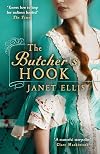
The Butcher's Hook
by Janet Ellis
On This Page
Description
In the wake of the death of her infant brother in eighteenth-century London, nineteen-year-old Anne Jaccob is determined to marry a butcher's apprentice, no matter what her ailing mother and uncaring father think.Tags
Recommendations







Member Reviews
It's clear from the beginning: one might long for escape from this narrative, might opt for a bloody end rather than endure more misery.
"No one but a fool could look so happy in a miserable house, could they? The mice here probably throw themselves on the traps for a quicker end."
But Anne Jaccob's life in 1763 London is sketched with external details designed to assemble interior worlds, dark and uncomfortable places.
We are meant to understand something elementary about our heroine, when Janet Ellis determines to spend more time describing the butcher's shop than many other locales in the novel.
"Creatures that could never in life have shared the same field, for they would have fought or cowered, have had no choice but to jostle close show more together in sullen deathly silence. The smell is so strong that it is almost visible, a great sour reek, pricked with a sharp rang. Gobbets of blood stick to the sawdust on the floor; they look solid enough to thread on a ribbon like beads."
In the beginning, substantial narrative is devoted to characterization, backstory and atmosphere, but the novel's second half is more scenic and plot-driven.
Less of this: "I am describing the passage of some two years, I suppose, but there were few anniversaries to punctuate the passing months."
And more long reflective passages like this: "'Do not let Fub love that girl,' I say to my plaster companions, those several saints. 'How can she be to him what I am? Her button mouth would not open wide and take in his bone to suck at it for the marrow. She would not let his finger go inside her or his tongue either. She would be as solid and smooth below as china.'
This excerpt illustrates the use of direct language which feels more contemporary than many works of fiction set in Georgian England (there is also, for instance, much talk of menstruation, which fits with the bloody themes).
There is a wickedly playful note to the tale. "We sound playful. We are not playing."
There is something vicious about it, too. "He must intend Onions to be my wedding present. He would make an oddly-shaped parcel. I should not be able to keep from shrieking in horror when I undid the ribbons and discovered him inside."
Some themes feel remarkably modern. Like the approval of a parent: "It is the moat of my father’s constant disapproval that I try and avoid, for it wets so much and stinks when it dries." Or first love (first lust): "He has said my name. I wish it had more syllables to keep it in his mouth for longer."
But all the overt parallels with the lives of modern readers only serve to emphasize Anne Jaccob's unpleasantness. "Sudden as a lightning strike, I have the thought that if they all died, together, I would not mourn. My father, Evelyn, even my mother, every last one of them, I would see them set sail in a ship that I knew would sink or watch them fall into a hold that droped them down to the earth’s molten core and not mind. A plague could ravage or a stampede of mad bulls flatten them, it would be all the same to me. I wait for guilt to nibble at these thoughts and make me regret them, but it does not come."
And the story, too, is uncomfortable: The Butcher's Hook depends upon misunderstandings and misrepresentations. "How strangely easy it is to lie. Like a parasite on its host, my falsehoods take their nourishment from being believed and gain more strength."
Anne is not the only dissatisfied woman in the tale.
“Love grows where it will and as it wants.”
“If you feed it, it does. It’ll latch on like a parasite and be all the more difficult to remove.” Jane sounds so sour that I have to look at her to make sure she is not replaced by an imposter. “I’ve said enough,” she says. “You know the truth of what I say.”
Parasites and imposters, sour reeks and sharp rangs, hooks and blades: these accumulate throughout the pages of The Butcher's Hook but ultimately Janet Ellis is aiming to leave readers with a particular taste in their mouths.
"Artists lie about our last moments, painting them decorous and noble. The daintily speared leak only drops of blood and the elderly drift into a peaceful sleep. It is no wonder that they depict it thus, the truth is so much uglier. From what I’ve seen, Death come with suppuration, protestation and no grace. It makes a great deal of noise, too, and this man’s last breaths are loud, sputtering coughs and squeaks. There is a strange odour coming off him: he is already rotting."
Though drenched in the visceral, Anne's story feels like a bloody romp a good deal of the time, although the swell of sensory detail as the novel progresses might nudge some readers into abandonment.
I hear there is a quicker end if one but throws herself upon the trap. (See: we were warned.)
This review originally appeared here, on BuriedInPrint. show less
"No one but a fool could look so happy in a miserable house, could they? The mice here probably throw themselves on the traps for a quicker end."
But Anne Jaccob's life in 1763 London is sketched with external details designed to assemble interior worlds, dark and uncomfortable places.
We are meant to understand something elementary about our heroine, when Janet Ellis determines to spend more time describing the butcher's shop than many other locales in the novel.
"Creatures that could never in life have shared the same field, for they would have fought or cowered, have had no choice but to jostle close show more together in sullen deathly silence. The smell is so strong that it is almost visible, a great sour reek, pricked with a sharp rang. Gobbets of blood stick to the sawdust on the floor; they look solid enough to thread on a ribbon like beads."
In the beginning, substantial narrative is devoted to characterization, backstory and atmosphere, but the novel's second half is more scenic and plot-driven.
Less of this: "I am describing the passage of some two years, I suppose, but there were few anniversaries to punctuate the passing months."
And more long reflective passages like this: "'Do not let Fub love that girl,' I say to my plaster companions, those several saints. 'How can she be to him what I am? Her button mouth would not open wide and take in his bone to suck at it for the marrow. She would not let his finger go inside her or his tongue either. She would be as solid and smooth below as china.'
This excerpt illustrates the use of direct language which feels more contemporary than many works of fiction set in Georgian England (there is also, for instance, much talk of menstruation, which fits with the bloody themes).
There is a wickedly playful note to the tale. "We sound playful. We are not playing."
There is something vicious about it, too. "He must intend Onions to be my wedding present. He would make an oddly-shaped parcel. I should not be able to keep from shrieking in horror when I undid the ribbons and discovered him inside."
Some themes feel remarkably modern. Like the approval of a parent: "It is the moat of my father’s constant disapproval that I try and avoid, for it wets so much and stinks when it dries." Or first love (first lust): "He has said my name. I wish it had more syllables to keep it in his mouth for longer."
But all the overt parallels with the lives of modern readers only serve to emphasize Anne Jaccob's unpleasantness. "Sudden as a lightning strike, I have the thought that if they all died, together, I would not mourn. My father, Evelyn, even my mother, every last one of them, I would see them set sail in a ship that I knew would sink or watch them fall into a hold that droped them down to the earth’s molten core and not mind. A plague could ravage or a stampede of mad bulls flatten them, it would be all the same to me. I wait for guilt to nibble at these thoughts and make me regret them, but it does not come."
And the story, too, is uncomfortable: The Butcher's Hook depends upon misunderstandings and misrepresentations. "How strangely easy it is to lie. Like a parasite on its host, my falsehoods take their nourishment from being believed and gain more strength."
Anne is not the only dissatisfied woman in the tale.
“Love grows where it will and as it wants.”
“If you feed it, it does. It’ll latch on like a parasite and be all the more difficult to remove.” Jane sounds so sour that I have to look at her to make sure she is not replaced by an imposter. “I’ve said enough,” she says. “You know the truth of what I say.”
Parasites and imposters, sour reeks and sharp rangs, hooks and blades: these accumulate throughout the pages of The Butcher's Hook but ultimately Janet Ellis is aiming to leave readers with a particular taste in their mouths.
"Artists lie about our last moments, painting them decorous and noble. The daintily speared leak only drops of blood and the elderly drift into a peaceful sleep. It is no wonder that they depict it thus, the truth is so much uglier. From what I’ve seen, Death come with suppuration, protestation and no grace. It makes a great deal of noise, too, and this man’s last breaths are loud, sputtering coughs and squeaks. There is a strange odour coming off him: he is already rotting."
Though drenched in the visceral, Anne's story feels like a bloody romp a good deal of the time, although the swell of sensory detail as the novel progresses might nudge some readers into abandonment.
I hear there is a quicker end if one but throws herself upon the trap. (See: we were warned.)
This review originally appeared here, on BuriedInPrint. show less
Originally posted here
''We do not need pretty rainbows, Fub and I. We will not brush hands at a dance or exchange covert glances in the back of a carriage. That is a sugary romance, collapsing in brittle shards when you bite. Ours is as chewy as glue."
Set in Georgian London in 1763, nineteen year old Anne Jaccobs leads quite a dull life. Cloistered by her family she has no friends and rarely leaves the house. The butcher's boy, Fub delivers meat to the household one day and inadvertently meets Anne, both their lives will never be the same.
I was really surprised by The Butcher's Hook. Part of me was expecting a typical historical fiction with a heavy dose of sugary forbidden love, but the story was much grittier and darker than I ever show more could have imagined. The romance between Fub and Anne is just typical of first-love obsession and it didn't unfold exactly like how I expected.
Anne's London is a disgusting place, full of bodily secretions, foul odours and suspect stains. I felt utterly revolted by the vivid description of the filth of the time period but it really helped to bring 1763 London to life. Illness and death are recurring themes throughout this book that really illustrate how precarious and short life was during that time.
Anne is the exact kind of character I love, she is morally grey and selfish but also tenacious. Anne is a character that knows what she wants and what she needs to do in order to get it. Anne is also an unreliable narrator and I often wondered how other character's viewpoints would differ. I really enjoy unlikeable characters and reading about Anne's dysfunctional home life fascinated me.
The ending was abrupt, random and left me feeling unsatisfied but overall I loved this book. I would highly recommend The Butcher's Hook to readers who enjoy page-turning gritty historical fiction with a dash of the macabre. show less
A deeply disturbing, yet fascinating, study of a woman's descent into madness and immorality. Highly reminiscent of Charlotte Perkins Gilman's short story The Yellow Wallpaper and William Oldroyd's period drama Lady Macbeth.
"To my mind, we carry all that we need to survive, indeed to live well, in our heads and our hearts from birth. We must decide our own paths accordingly and individually. There is precious little other instruction available."
"To my mind, we carry all that we need to survive, indeed to live well, in our heads and our hearts from birth. We must decide our own paths accordingly and individually. There is precious little other instruction available."
This book is a rather twisted tale, but I felt that the portrayal of the protagonist was lacking in some depth. I just didn’t feel what was driving her to the actions she took. Maybe she was just a psychopath, but I didn’t get that from the text either. Otherwise, this was well written and entertaining. 3.5 ⭐️
An interesting book, I liked the writing and setting but didn't really like the main character
Following Amazon's purchase of GoodReads, I no longer post my reviews here.
If you would like to read my thoughts on this book, you can view them in the following places:
BuriedInPrint
BookLikes
LibraryThing
Posting these links does not constitute permission to duplicate these thoughts anywhere, including corporate-owned sites.
If you read/liked/clicked through to see this review here on GR, many thanks.
If you would like to read my thoughts on this book, you can view them in the following places:
BuriedInPrint
BookLikes
LibraryThing
Posting these links does not constitute permission to duplicate these thoughts anywhere, including corporate-owned sites.
If you read/liked/clicked through to see this review here on GR, many thanks.
Ratings
Members
- Recently Added By
Published Reviews
ThingScore 75
[Ellis] has a sharp eye and a sharper wit. More importantly still, she possesses a subtle and compassionate understanding of the human heart.
added by Nevov
Author Information

2+ Works 202 Members
Awards and Honors
Awards
Common Knowledge
- Original publication date
- 2016-10-06
- People/Characters
- Anne Jaccob; Frederick "Fub" Warner; Dr Edwards; Simeon Onions; Mr Jaccob; Mrs Jaccob (show all 8); Titus Levener; Jane Bradshaw
- Important places
- London, England, UK
- Epigraph
- 'It is not from the benevolence of the butcher, the brewer or the baker that we expect our meal, but from their regard to their own interest.'
Adam Smith, The Wealth of Nations, Book I - Dedication
- To my darlings.
And for my mother. - Blurbers
- Kent, Hannah; Rentzenbrink, Cathy; Hodgson, Antonia; Kelly, Erin
Classifications
Statistics
- Members
- 191
- Popularity
- 171,540
- Reviews
- 6
- Rating
- (3.31)
- Languages
- English
- Media
- Paper, Audiobook, Ebook
- ISBNs
- 12
- ASINs
- 5