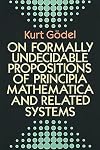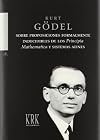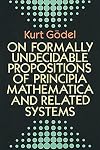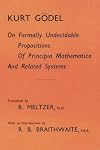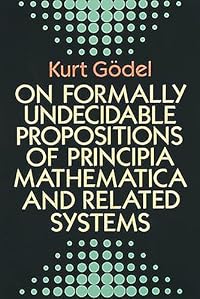
On Formally Undecidable Propositions of Principia Mathematica and Related Systems
by Kurt Gödel
On This Page
Description
In 1931, a young Austrian mathematician published an epoch-making paper containing one of the most revolutionary ideas in logic since Aristotle. Kurt Giidel maintained, and offered detailed proof, that in any arithmetic system, even in elementary parts of arithmetic, there are propositions which cannot be proved or disproved within the system. It is thus uncertain that the basic axioms of arithmetic will not give rise to contradictions. The repercussions of this discovery are still being show more felt and debated in 20th-century mathematics. The present volume reprints the first English translation of Giidel's far-reaching work. Not only does it make the argument more intelligible, but the introduction contributed by Professor R. B. Braithwaite (Cambridge University}, an excellent work of scholarship in its own right, illuminates it by paraphrasing the major part of the argument. This Dover edition thus makes widely available a superb edition of a classic work of original thought, one that will be of profound interest to mathematicians, logicians and anyone interested in the history of attempts to establish axioms that would provide a rigorous basis for all mathematics. Translated by B. Meltzer, University of Edinburgh. Preface. Introduction by R. B. Braithwaite. show lessTags
Recommendations












Member Reviews
I thought it was quite interesting, but I don't feel I have the necessary background in math to completely appreciate this work. Gödel makes up his own notations, but follows some standards for mathematical logic. It helped that the book had references to what it was talking about in the book itself though, and it is also extensively footnoted. I though it was a very interesting paper, but like I said, I need a more thorough grounding in logic to fully appreciate it.
I will be reading this again when I can understand it better. Five out of five for turning the establishment on it's head though. Before this paper, mathematicians assumed it was possible to go and explain everything in math. But you can't explain everything in math using show more math, so there are some things that are just unexplainable. I probably didn't really get that right, but it matters not. show less
I will be reading this again when I can understand it better. Five out of five for turning the establishment on it's head though. Before this paper, mathematicians assumed it was possible to go and explain everything in math. But you can't explain everything in math using show more math, so there are some things that are just unexplainable. I probably didn't really get that right, but it matters not. show less
Ratings
Members
- Recently Added By
Lists

Books in the bibliography of Godel, Escher, Bach by Douglas Hofstadter
97 works; 3 members
Author Information

47+ Works 851 Members
Kurt Godel was probably the most outstanding logician of the first half of the twentieth century. Born in Czechoslovakia, Godel studied and taught in Vienna and then came to the United States in 1940 as a member of the Institute for Advanced Study at Princeton University. In 1953 he was made a professor at the institute, where he remained until show more his death in 1978. Godel is especially well known for his studies of the completeness of logic, the incompleteness of number theory, the consistency of the axiom of choice and the continuum hypothesis. Godel is also known for his work on constructivity, the decision problem, and the foundations of computation theory, as well as his views on the philosophy of mathematics; especially his support of a strong form of Platonism in mathematics. (Bowker Author Biography) show less
Series
Belongs to Publisher Series
Work Relationships
Is a reply to
Common Knowledge
- Canonical title
- On Formally Undecidable Propositions of Principia Mathematica and Related Systems
- Original title
- Über formal unentscheidbare Sätze der Principia Mathematica und verwandter Systeme I
- Original publication date
- 1931 (original German) (original German); 1962 (English translation) (English translation)
- Dedication
- to Christopher Fernau in gratitude
- First words
- The development of mathematics in the direction of greater exactness has—as is well known—led to large tracts of it becoming formalized, so that proofs can be carried out according to a few mechanical rules.
Classifications
Statistics
- Members
- 443
- Popularity
- 68,877
- Reviews
- 1
- Rating
- (4.40)
- Languages
- English, Spanish
- Media
- Paper, Ebook
- ISBNs
- 5
- UPCs
- 2
- ASINs
- 6