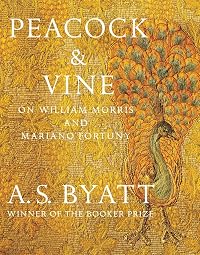
Peacock & Vine: On William Morris and Mariano Fortuny
by A. S. Byatt
On This Page
Description
"A meditation on the British designers William Morris and Mariano Fortuny, with color illustrations"--Tags
Recommendations


















Member Reviews
I'm still waiting for my invitation to visit Venice, but in the meantime, I can luxuriate in the prose and illustrations of Ms. Byatt's fine art biography. With a mix of criticism and history, she takes the familiar, William Morris, and the less familiar, Mariano Fortuny, and highlights their lives and work with the interpolation of beautiful illustrations. This was a pleasingly informative short excursion into the world of art. The quotes from Ruskin and Proust were an added delight.
Review is of the uncorrected proof, received as a giveaway (thanks!).
Not a biography, nor a proper monograph (especially true for the uncorrected proof, which lacks full size plates and color, which is a shame sense the author's perception of color is a central concern), the intent of this extended essay is somewhat unclear; none-the-less, it is a good introduction to both figures, with a personal touch revealing what it is about each man that appeals to the author:
"E.M. Forster once remarked sagaciously that novelists do not give work the importance it has in real life, not as much as love and death. And here I had not one but two obsessive workers, endlessly inventive, endlessly rigorous, endlessly beautiful. They both made the show more place where they lived identical with the place where they worked. They were both hands-on, with the dyeing and pleating, with the block-printing, with research about how to do things differently or better. They both invented new colours and resurrected old and discarded ones, using vegetable dyes not aniline ones (on the whole). They researched their subject with passion, and had large libraries, specialist and general."
The book is spare and precise both in observations and in language. The structure is deceptively casual as well, with each man's residences, spouses, muses, motifs, personal geography, and so on forming brief chapters, usually as a means of comparison - the points of intersection, and divergence always illuminating. There are many specific works discussed, but always with equal measures of focus and brevity.
I came away from the book with a renewed appreciation for textiles as works of art, and a deeper appreciation of Morris, especially as a writer, but also as a person - of particular resonance was his commitment to every endeavor he laid his hand to, despite his admitted shortcomings therein (his initial mediocrity as a draftsman, as an equestrian/explorer, as a polyglot, etc. didn't stop him from engaging in activities that demanded these skills). show less
Not a biography, nor a proper monograph (especially true for the uncorrected proof, which lacks full size plates and color, which is a shame sense the author's perception of color is a central concern), the intent of this extended essay is somewhat unclear; none-the-less, it is a good introduction to both figures, with a personal touch revealing what it is about each man that appeals to the author:
"E.M. Forster once remarked sagaciously that novelists do not give work the importance it has in real life, not as much as love and death. And here I had not one but two obsessive workers, endlessly inventive, endlessly rigorous, endlessly beautiful. They both made the show more place where they lived identical with the place where they worked. They were both hands-on, with the dyeing and pleating, with the block-printing, with research about how to do things differently or better. They both invented new colours and resurrected old and discarded ones, using vegetable dyes not aniline ones (on the whole). They researched their subject with passion, and had large libraries, specialist and general."
The book is spare and precise both in observations and in language. The structure is deceptively casual as well, with each man's residences, spouses, muses, motifs, personal geography, and so on forming brief chapters, usually as a means of comparison - the points of intersection, and divergence always illuminating. There are many specific works discussed, but always with equal measures of focus and brevity.
I came away from the book with a renewed appreciation for textiles as works of art, and a deeper appreciation of Morris, especially as a writer, but also as a person - of particular resonance was his commitment to every endeavor he laid his hand to, despite his admitted shortcomings therein (his initial mediocrity as a draftsman, as an equestrian/explorer, as a polyglot, etc. didn't stop him from engaging in activities that demanded these skills). show less
A fascinating mix of art history and art criticism comparing and contrasting two artists. My only quibble was that the captions for the illustrations and photographs were in a separate appendix/index, which made for a bot of page flipping.
‘Peacock & Vine’ is a long essay in which the author compares and contrasts Morris and Fortuny and their art. Both men were polymaths who were designers and artists who worked in several media. Fortuny is best known today for his ingeniously permanently pleated dresses that were totally different from the fashions of his day; Morris is known as a pre-Raphaelite who set about to bring beauty to the homes of everyone with beautiful rugs, wallpaper, and fabrics. Both also painted and had amazing energy. The never interacted; they lived a generation apart and in different countries, but they shared a work ethic and love for beauty.
This work does not go deep enough to be a duel biography; it’s more about how the work of these men show more affected Byatt. She admits that their art made her think deeply about making an artistic mark upon the world.
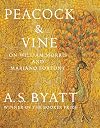
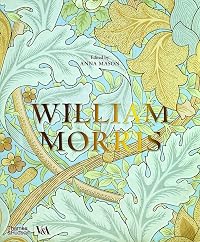
This is a little jewel box of a book; the front of the dust jacket is a Morris tapestry (with peacock) in warm umbers and golds while the back is a painting of Fortuny’s studio. A huge number of photographs illuminate the text. And, as always, Byatt’s writing is lush and beautiful.
There is one odd spot; in the section “Pomegranate” (a motif used by both Morris and Fortuny quite a lot) she states that Morris’s first attempt at painting pomegranates didn’t turn out well; they look more like lemons. The piece in question actually *does* have pomegranates, in the upper right hand corner; below that are, indeed, lemons-you can tell not just by the shape & color but by the thorns on the branch; in the lower left are peaches, and in the upper left are oranges. I find it odd that the author didn’t catch that. show less
This work does not go deep enough to be a duel biography; it’s more about how the work of these men show more affected Byatt. She admits that their art made her think deeply about making an artistic mark upon the world.
This is a little jewel box of a book; the front of the dust jacket is a Morris tapestry (with peacock) in warm umbers and golds while the back is a painting of Fortuny’s studio. A huge number of photographs illuminate the text. And, as always, Byatt’s writing is lush and beautiful.
There is one odd spot; in the section “Pomegranate” (a motif used by both Morris and Fortuny quite a lot) she states that Morris’s first attempt at painting pomegranates didn’t turn out well; they look more like lemons. The piece in question actually *does* have pomegranates, in the upper right hand corner; below that are, indeed, lemons-you can tell not just by the shape & color but by the thorns on the branch; in the lower left are peaches, and in the upper left are oranges. I find it odd that the author didn’t catch that. show less
I picked this up secondhand at a bookfair because I have an interest in Morris, Venice and A.S Byatt's writing. It is also a gorgeously produced little book.
I was spurred onto read it because there is a gorgeous Pre-Raphelite exhibition at the National Gallery of Australia and it seemed like a good time to read it.
It did give me a taste of all those things plus I learnt a little about Fortuny's textile art. There are also some quotes of Ruskin and Proust that were interesting.
Really needed more depth for a higher rating but it was good none the less.
I was spurred onto read it because there is a gorgeous Pre-Raphelite exhibition at the National Gallery of Australia and it seemed like a good time to read it.
It did give me a taste of all those things plus I learnt a little about Fortuny's textile art. There are also some quotes of Ruskin and Proust that were interesting.
Really needed more depth for a higher rating but it was good none the less.
A thin essay with way too much description of visuals and not nearly enough pictures. Not rigorous enough to be academic, and not interesting enough for trade. No true central thesis that I could find. Very disappointing offering from one of my favorite writers of fiction.
I WANTED TO LIKE THIS MORE. THE TOPIC INTERESTS ME. THERE WERE WONDERFUL PICTURES. BUT I DIDN'T LEARN MUCH.
Members
- Recently Added By
Author Information

83+ Works 38,317 Members
A.S. Byatt was born on August 24, 1936 in Sheffield, England. She received a B.A. from Newnham College, Cambridge in 1957, did graduate study at Bryn Mawr College from 1957-58, and attended Somerville College, Oxford from 1958-59. She was a staff member in the extra-mural department at the University of London from 1962-71. From 1968-69, she was show more also a part-time lecturer in the liberal studies department of the Central School of Art and Design, London. She was a lecturer at University College from 1972-80 and then senior lecturer from 1981-83. She became a full-time writer in 1983. Her works include The Biographer's Tale, The Virgin in the Garden, Babel Tower, A Whistling Woman, and The Children's Book. She also wrote numerous collections of short stories including Sugar and Other Stories, The Matisse Stories, The Djinn in the Nightingale's Eye, Elementals, and Little Black Book of Stories. Byatt received the English Speaking Union fellowship in 1957-58, the Fellow of the Royal Society of Literature in 1983, the Silver Pen Award for Still Life, and the Booker Prize for Possession: A Romance in 1990. (Bowker Author Biography) show less
Common Knowledge
- Original publication date
- 2016
- People/Characters
- William Morris; Mariano Fortuny
- Quotations
- I like looking at colors, just for the sake of looking at colors. It is always surprising how people don’t really look at things. I was once in a gallery where there was an exhibition of Monet’s paintings of Ro... (show all)uen Cathedral. I sat on a bench to look at them, in bright painted sunlight, in shadow, in simple daylight. A steady stream of people walked, without stopping, between me and the paintings, turning their heads briefly to note each one. What did they see, what did they remember?
Classifications
Statistics
- Members
- 211
- Popularity
- 155,253
- Reviews
- 8
- Rating
- (3.74)
- Languages
- Dutch, English, Italian
- Media
- Paper, Ebook
- ISBNs
- 7
- ASINs
- 3