On This Page
Description
In Lonely on the Mountain, Louis L’Amour’s solitary wandering Sackett brothers make a stand together—to save one of their own.The rare letters Tell Sackett received always had trouble inside. And the terse note from his cousin Logan is no exception. Logan faces starvation or a hanging if Tell can’t drive a herd of cattle from Kansas to British Columbia before winter. To get to Logan, he must brave prairie fires, buffalo stampedes, and Sioux war parties. But worse trouble waits, for show more a mysterious enemy shadows Sackett’s every move across the Dakotas and the Canadian Rockies. Tell Sackett has never abandoned another Sackett in need. He will bring aid to Logan—or die trying. show less
Tags
Recommendations













Member Reviews
This review is written with a GPL 4.0 license and the rights contained therein shall supersede all TOS by any and all websites in regards to copying and sharing without proper authorization and permissions. Crossposted at WordPress, Blogspot & Librarything by Bookstooge’s Exalted Permission
Title: Lonely on the Mountain
Series: Sacketts #17
Author: Louis L'Amour
Rating: 3 of 5 Stars
Genre: Western
Pages: 224
Format: Digital Edition
Synopsis:
Tell, Orrin and Tyrell Sackett get a note from their cousin Logan that he needs a herd of cattle driven to some place or other and that if the herd isn't delivered before the snow falls he'll hang. The Sackett brothers begin.
They gather a herd, realize they have enemies to deal with and have adventures. show more The herd gets scattered in a stampede, a girl is seeking her brother and no one has heard from Logan again.
The Sackett brothers overcome all, find Logan and rescue a small group of settlers that are being starved out by desperadoes searching for gold.
My Thoughts:
Well, this was the final Sacketts book written by L'Amour, chronologically speaking. I enjoyed my time reading this book but it did rather meander, much like a cattle drive and the ending was so quick that I blinked and whammo, I was done the book.
That is ok because it gives me more room to talk about this series as a whole in wrapping things up.
I started reading the Sacketts almost 3 years ago with Sackett's Land. More of a historical fiction than western, it set the tone for Clan Sackett. Loyalty, responsibility, a high regard for education and the written word, a love of honor and all things Right, a respect for the Law even when you thought it was wrong. The Sackets also did whatever they set their minds to. They didn't give up or allow their circumstances to dictate their actions. They were what Real Men want to be. Personally, while I would love to emulate men like those portrayed in the series, I'd be ok with a little less gun play and a LOT less fisticuffs. I'm just too pretty ;-)
I think L'Amour used this series to showcase how great he thought America was. He didn't believe it was perfect or had sprung forth full grown, immaculately conceived. The birth of America was a bloody and dirty event and it's growing up years were just as tumultuous. But it was glorious (!!) and L'Amour wanted to show that glory in the examples of the best of the men and women who forged this country. In many ways this series was a Love Letter to America. It was also a reminder to the up and coming generation that everything they had was built on the backs of men of character and what their forefathers had sweated blood for they, the current generation, better not take for granted. Yes, these stories were romanticized, but what do we all dream of that isn't? We dream for a reason, because reality is gritty and full of failure and despair. We dream because we know in our very souls that there MUST BE something better.
On a less salubrious note, this series also showcased all of L'Amours strengths AND his weaknesses. He was a franchise writer and he had deadlines and he'd recycle story lines and not worry about keeping things completely straight. If a character was going to get married at the end of one book, L'Amour saw that as no impediment to making said character be single in a later book. There was very little cohesive narrative beyond Names. I might be reading my own meloncholia into things but sometimes it felt like L'Amour was foretelling the fall of America. If men stopped being men of character, then the whole country would suffer.
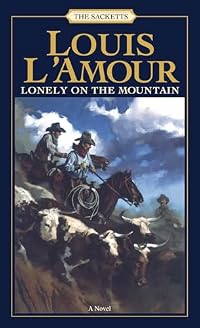
The other thing I'd like to talk about, for just a sentence or two, is the covers. Since these started out in the 60's and finished up in the 80's, with multiple re-releases and the latest installment coming out in ebook in the early '10's, they showcase the era in which each was published. It is an education to look at various publications to see what was expected from a western novel throughout the decades.
Overall, while I never rated these above 3.5, I still enjoyed the time I spent reading. Ride the River would probably be my pick of the litter if I had to choose one to elevate above all the others. I just checked though and I gave Lando 4 stars. Mainly for the macho boxing fight at the end. I'd still recommend Ride the River in general, as mano-a-mano isn't for everyone.
★★★☆☆ show less
Title: Lonely on the Mountain
Series: Sacketts #17
Author: Louis L'Amour
Rating: 3 of 5 Stars
Genre: Western
Pages: 224
Format: Digital Edition
Synopsis:
Tell, Orrin and Tyrell Sackett get a note from their cousin Logan that he needs a herd of cattle driven to some place or other and that if the herd isn't delivered before the snow falls he'll hang. The Sackett brothers begin.
They gather a herd, realize they have enemies to deal with and have adventures. show more The herd gets scattered in a stampede, a girl is seeking her brother and no one has heard from Logan again.
The Sackett brothers overcome all, find Logan and rescue a small group of settlers that are being starved out by desperadoes searching for gold.
My Thoughts:
Well, this was the final Sacketts book written by L'Amour, chronologically speaking. I enjoyed my time reading this book but it did rather meander, much like a cattle drive and the ending was so quick that I blinked and whammo, I was done the book.
That is ok because it gives me more room to talk about this series as a whole in wrapping things up.
I started reading the Sacketts almost 3 years ago with Sackett's Land. More of a historical fiction than western, it set the tone for Clan Sackett. Loyalty, responsibility, a high regard for education and the written word, a love of honor and all things Right, a respect for the Law even when you thought it was wrong. The Sackets also did whatever they set their minds to. They didn't give up or allow their circumstances to dictate their actions. They were what Real Men want to be. Personally, while I would love to emulate men like those portrayed in the series, I'd be ok with a little less gun play and a LOT less fisticuffs. I'm just too pretty ;-)
I think L'Amour used this series to showcase how great he thought America was. He didn't believe it was perfect or had sprung forth full grown, immaculately conceived. The birth of America was a bloody and dirty event and it's growing up years were just as tumultuous. But it was glorious (!!) and L'Amour wanted to show that glory in the examples of the best of the men and women who forged this country. In many ways this series was a Love Letter to America. It was also a reminder to the up and coming generation that everything they had was built on the backs of men of character and what their forefathers had sweated blood for they, the current generation, better not take for granted. Yes, these stories were romanticized, but what do we all dream of that isn't? We dream for a reason, because reality is gritty and full of failure and despair. We dream because we know in our very souls that there MUST BE something better.
On a less salubrious note, this series also showcased all of L'Amours strengths AND his weaknesses. He was a franchise writer and he had deadlines and he'd recycle story lines and not worry about keeping things completely straight. If a character was going to get married at the end of one book, L'Amour saw that as no impediment to making said character be single in a later book. There was very little cohesive narrative beyond Names. I might be reading my own meloncholia into things but sometimes it felt like L'Amour was foretelling the fall of America. If men stopped being men of character, then the whole country would suffer.
The other thing I'd like to talk about, for just a sentence or two, is the covers. Since these started out in the 60's and finished up in the 80's, with multiple re-releases and the latest installment coming out in ebook in the early '10's, they showcase the era in which each was published. It is an education to look at various publications to see what was expected from a western novel throughout the decades.
Overall, while I never rated these above 3.5, I still enjoyed the time I spent reading. Ride the River would probably be my pick of the litter if I had to choose one to elevate above all the others. I just checked though and I gave Lando 4 stars. Mainly for the macho boxing fight at the end. I'd still recommend Ride the River in general, as mano-a-mano isn't for everyone.
★★★☆☆ show less
When one Sackett is in trouble, they all come "a running", that's the family tradition. So when Logan gets a message to his cousins that he needs cattle in a mining camp, they assemble a herd and head into Canada, towards British Columbia. But someone doesn't want them to succeed.
It's a good story, and about my favorite Sackett, William Tell. Sorry it's the last in the series.
It's a good story, and about my favorite Sackett, William Tell. Sorry it's the last in the series.
This final novel (chronologically) in the Sackett series kept me turning pages until the end. It reunites Tell, Tye, and Orrin Sackett who are coming to the rescue of Logan Sackett. The cattle drive part was interesting as was the intrigue that threatened the success of the drive.
I like the description of the land and the details about the drive. My only regret is that there are no more books in the series to read. I thought there was more story to tell.
If you like Westerns, then you will like this book. If you are a fan of the Sackett series, then this is a must read.
I like the description of the land and the details about the drive. My only regret is that there are no more books in the series to read. I thought there was more story to tell.
If you like Westerns, then you will like this book. If you are a fan of the Sackett series, then this is a must read.
Members
- Recently Added By
Author Information

870+ Works 99,457 Members
Born in Jamestown, North Dakota on March 22, 1908, Louis L'Amour's adventurous life could have been the subject of one of his novels. Striking out on his own in 1923, at age 15, L'Amour began a peripatetic existence, taking whatever jobs were available, from skinning dead cattle to being a sailor. L'Amour knew early in life that he wanted to be a show more writer, and the experiences of those years serve as background for some of his later fiction. During the 1930s he published short stories and poetry; his career was interrupted by army service in World War II. After the war, L'Amour began writing for western pulp magazines and wrote several books in the Hopalong Cassidy series using the pseudonym Tex Burns. His first novel, Westward the Tide (1950), serves as an example of L'Amour's frontier fiction, for it is an action-packed adventure story containing the themes and motifs that he uses throughout his career. His fascination with history and his belief in the inevitability of manifest destiny are clear. Also present and typical of L'Amour's work are the strong, capable, beautiful heroine who is immediately attracted to the equally capable hero; a clear moral split between good and evil; reflections on the Native Americans, whose land and ways of life are being disrupted; and a happy ending. Although his work is somewhat less violent than that of other western writers, L'Amour's novels all contain their fair share of action, usually in the form of gunfights or fistfights. L'Amour's major contribution to the western genre is his attempt to create, in 40 or more books, the stories of three families whose histories intertwine as the generations advance across the American frontier. The novels of the Irish Chantry, English Sackett, and French Talon families are L'Amour's most ambitious project, and sadly were left unfinished at his death. Although L'Amour did not complete all of the novels, enough of the series exists to demonstrate his vision. L'Amour's strongest attribute is his ability to tell a compelling story; readers do not mind if the story is similar to one they have read before, for in the telling, L'Amour adds enough small twists of plot and detail to make it worth the reader's while. L'Amour fans also enjoy the bits of information he includes about everything from wilderness survival skills to finding the right person to marry. These lessons give readers the sense that they are getting their money's worth, that there is more to a L'Amour novel than sheer escapism. With over 200 million copies of his books in print worldwide, L'Amour must be counted as one of the most influential writers of westerns in this century. He died from lung cancer on June 10, 1988. (Bowker Author Biography) Louis L'Amour, truly America's favorite storyteller, was the first fiction writer ever to receive the Congressional Gold Medal from the United States Congress in honor of his life's work, & was also awarded the Medal of Freedom. There are over 260 million copies of his books in print worldwide. (Publisher Provided) show less
Series


Work Relationships
Is contained in
Common Knowledge
- Canonical title
- Lonely on the Mountain
- Original publication date
- 1980
- People/Characters
- William "Tell" Sackett; Orrin Sackett; Tyrell Sackett; Logan Sackett; Kyle Gavin; Kyle Shanty (show all 23); Cougar; Laurie GAvin; George Stamper; Perry Stamper; Douglas Molrone; Devnet "Nettie" Molrone; John Fentrell; Mary McCann; lin; Cap Roundtree; Isom Brand; Ox; Gilcrist; High-Bached Bull; Louis Riel; Baptiste; Highpockets Haney
- Important places
- North Dakota, USA; South Dakota, USA; Fort Carlton, Western Canada; Minnesota, USA; Dease Lake, Western Canada
- Epigraph
- [None]
- Dedication
- To Lou Satz
- First words
- There will come a time when you believe everything is finished.
- Last words
- (Click to show. Warning: May contain spoilers.)Shorty was a good man, and he'd come a far piece, and I hoped he wouldn't be lonely on the mountain.
Classifications
Statistics
- Members
- 1,020
- Popularity
- 25,367
- Reviews
- 4
- Rating
- (3.73)
- Languages
- Czech, English, Norwegian (Bokmål)
- Media
- Paper, Audiobook, Ebook
- ISBNs
- 23
- ASINs
- 16