On This Page
Description
Goldfinger by Ian Fleming features the global icon, legendary spy James Bond/007. Who is Auric Goldfinger? The Bank of England wants to know and they're also curious to find out what he's done with the huge stock of gold he's been collecting since the war. James Bond is put on the trail. This isn't the first time 007 has come across the enigmatic millionaire, and he quickly discovers that Goldfinger never forgets and never forgives. Bond is drawn inexorably into the most ambitious heist of show more the century and finds himself the only defense against Goldfinger's murderous mania for gold. show lessTags
Recommendations























Member Reviews
It's okay if a James Bond adventure starts with a low-key escapade where Bond discovers the villain cheats at cards-- even if Fleming already pulled this one in Moonraker, he's good at it. It's also okay if a James Bond adventure starts with a low-key escapade where Bond discovers the villain cheats at golf-- though even Fleming struggles to make golf exciting. What's not okay is having 143 pages of your 354-page novel taken up by Bond rooting out cheaters. It's decidedly low stakes stuff, like the old Superman story where he stops someone from fixing up Ivy League football matches. I guess it oughtn't surprise me, though, because this James Bond novel is more about Bond versus people who violate English social norms than most: in show more addition to people who cheat at gentlemanly pursuits, this book is Fleming's most racist yet, with some really awful stuff about Koreans, plus Bond "cures" a lesbian, and Bond blames the death of one woman (in this book, two "Bond girls" die which seems a pretty poor showing; actually are they the first women to die in the series since Vesper?) on the fact that she wouldn't listen to him, and the fact that she wouldn't listen to him on the women's suffrage, which masculinized women and feminized men.
I found this to be a less satisfying Bond novel on the whole; in addition to the languid opening, Bond feels like a bystander for too much of the story, even if we do learn that behind the scenes, something he did caused contingencies to be put into motion that saved the day. The best part of the novel is the long car chase where Bond tales Goldfinger from England to Switzerland; as he usually does, Fleming makes something that could be dull in other hands quite tense through his explication of minute details. If the rest of the book had been this good, it would have been great. As it is, alas. I am still looking forward to the film.
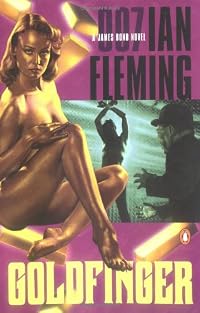
(I was surprised that the story's most famous image, death by gold paint, doesn't actually appear on the page; Bond is just told it has happened by the victim's sister. It's on the cover and of course in the movie regardless.) show less
I found this to be a less satisfying Bond novel on the whole; in addition to the languid opening, Bond feels like a bystander for too much of the story, even if we do learn that behind the scenes, something he did caused contingencies to be put into motion that saved the day. The best part of the novel is the long car chase where Bond tales Goldfinger from England to Switzerland; as he usually does, Fleming makes something that could be dull in other hands quite tense through his explication of minute details. If the rest of the book had been this good, it would have been great. As it is, alas. I am still looking forward to the film.
(I was surprised that the story's most famous image, death by gold paint, doesn't actually appear on the page; Bond is just told it has happened by the victim's sister. It's on the cover and of course in the movie regardless.) show less
Lots of fun. This book had some of the things I look for in a Bond story including an eccentric villain with a great, unique henchman, and an imaginative ending, but lacked a couple things like more exotic locations, excellent quips, gun fights, car chases, there's also no Q-branch or trinkets.
About 20% of the book was a stroke-by-stroke narrative of an 18-hole game of golf (kill me now!!)
One of Goldfinger's accomplices (Pussy Galore) is a lesbian, but not after sharing one or two quick words with James Bond. To quote a late 90's SNL sketch "...we all know it would just take a real man to turn her around." I mention this along with the quote because they both illustrate similar (in my mind humorous) ignorance of homosexuality.
About 20% of the book was a stroke-by-stroke narrative of an 18-hole game of golf (kill me now!!)
One of Goldfinger's accomplices (Pussy Galore) is a lesbian, but not after sharing one or two quick words with James Bond. To quote a late 90's SNL sketch "...we all know it would just take a real man to turn her around." I mention this along with the quote because they both illustrate similar (in my mind humorous) ignorance of homosexuality.
The movie bored me, so I wasn't looking too forward to this particular installment of Bond, however I was very pleasantly surprised! World-building was phenomenal. I particularly liked the character development of Goldfinger himself. He started off as something of a sympathetic character - it was hard for me to see him as being a "bad" guy simply because he wishes to reap the full benefits of his own endeavors. As a huge endorser of First-Sale Doctrine, I felt it was his right to what he chose with his own gold that he had lawfully purchased. To me, his morals became exceptionally questionable when the incident with the cat occurred (I won't spoil it, but...poor kitty...). He then became thoroughly reprehensible once we find out what show more happened to his assistant Jill. Finally, he become irrevocably hell-bound once his ultimate plans are revealed. It was a gradual, brilliant unfolding. I was very pleased.
My favorite part of the novel was when James believed he was dying/dead and starts pondering what heaven would be like - how would the various dead Bond girls feel about each other once they had James with them in heaven? It was rather amusing.
And finally - Yay! Felix to the rescue!!! show less
My favorite part of the novel was when James believed he was dying/dead and starts pondering what heaven would be like - how would the various dead Bond girls feel about each other once they had James with them in heaven? It was rather amusing.
And finally - Yay! Felix to the rescue!!! show less
Starts off almost identically to Moonraker, with Bond asked to figure out how a billionaire is cheating at cards. In addition to the third terribly boring card game of the series, we also get an excruciating play-by-play account of a round of golf. The supervillian trope is evolved further, with Goldfinger smashing right through the barrier of credulity, combining the sliminess of Hugo Drax (Moonraker) with the intelligence of Dr. No, complete with minions. The plot is also pretty much a mashup of those two books as well, with the sinister influence of Smersh lingering behind the scenes.
As is his wont, Bond manages to get his sidekick killed (two this time, and sisters at that ), and also gets himself captured and tortured. If he wasn't show more such a psychopath (imminent danger calms him down and heightens his mental and physical prowess), he'd be really bad at his job. He also continues to be shaken by every life he takes, which fuels his alcoholism. This dude seriously needs some therapy.
To make things worse, just when you think that Bond couldn't possibly get any more racist than his adventures in Harlem, he encounters some Koreans. It's not pretty. There's also a particularly nasty misogynistic and homophobic rant, even by the low standards of the previous books. Although disquieting, it's a sign of how far we've come since the 1950's, views that were then considered mainstream and socially acceptable are now [mostly] considered vile and extreme.
On the plus side, the Aston Martin DB3 makes its debut, as does the outrageously monikered Pussy Galore. show less
As is his wont, Bond manages to get his sidekick killed (
To make things worse, just when you think that Bond couldn't possibly get any more racist than his adventures in Harlem, he encounters some Koreans. It's not pretty. There's also a particularly nasty misogynistic and homophobic rant, even by the low standards of the previous books. Although disquieting, it's a sign of how far we've come since the 1950's, views that were then considered mainstream and socially acceptable are now [mostly] considered vile and extreme.
On the plus side, the Aston Martin DB3 makes its debut, as does the outrageously monikered Pussy Galore. show less
The plot of Goldfinger is excellent and has many challenges that Bond must puzzle his way out of. Goldfinger himself is one of the most interesting Bond villains so far.
Having said that, I also think that the movie version is the only one so far that improves on the book. The ending is much cleaner in the movie and improves on some minor plot details.
Like all Bond books, this one contains sexism and, in this book, some racism against Asians. This is also the first book with gay characters and there are some passages that haven't aged well with regard to that.
Overall, the Bond of Goldfinger is a harder, less vulnerable, and more stereotypically masculine secret agent than that of Dr. No, which happens to be my favorite book so far.
I also show more want to touch on the female characters of Bond. As I've commented in previous reviews, I find it interesting that yet another female character has a history of sexual assault or rape. That's at least 3 out of 7 books so far that use this as a way of characterizing women and explaining their reluctance around men.
I've come to think that Fleming uses that as a way to "prove" Bond's virility. To Bond, women are a conquest and if he can convert a lesbian or convince a woman who has been assaulted to let down her guard, then he has accomplished quite a feat. As Ms. Galore said, "I'd never met a man before", until Bond, that is. show less
Having said that, I also think that the movie version is the only one so far that improves on the book. The ending is much cleaner in the movie and improves on some minor plot details.
Like all Bond books, this one contains sexism and, in this book, some racism against Asians. This is also the first book with gay characters and there are some passages that haven't aged well with regard to that.
Overall, the Bond of Goldfinger is a harder, less vulnerable, and more stereotypically masculine secret agent than that of Dr. No, which happens to be my favorite book so far.
I also show more want to touch on the female characters of Bond. As I've commented in previous reviews, I find it interesting that yet another female character has a history of sexual assault or rape. That's at least 3 out of 7 books so far that use this as a way of characterizing women and explaining their reluctance around men.
I've come to think that Fleming uses that as a way to "prove" Bond's virility. To Bond, women are a conquest and if he can convert a lesbian or convince a woman who has been assaulted to let down her guard, then he has accomplished quite a feat. As Ms. Galore said, "I'd never met a man before", until Bond, that is. show less
Auric Goldfinger is perhaps the quintessential Bond villain: Wealthy beyond compare; menacing calmness personified and patient to the extreme (unnecessarily so in the case of the most lethal of his enemies: "Perhaps I should have killed you Mr Bond when I had the chance..."); a cheat at Canasta and golf; evidently asexual - unless his conquest is first painted head-to-toe in liquid gold. He drives (or rather is driven in) an almost anachronistic and armour-plated yellow Rolls Royce Silver Ghost; is a chauvinistic xenophobe who likes to employ foreign servants and bodyguards by the dozen. His evil plans know no bounds. Even all the bullion in Fort Knox isn't safe.
Bond on the other hand is made of sterner British stuff. At least that's show more what Fleming will have you believe. Despite the corny characterisation I was mildly shocked at the steady stream of questionable and racially charged quippery that emanates from 007. His homophobic rant towards the story's end - directed in his own mind at the charming 'Lesbian' crime boss named Ms Pussy Galore, and his dismissive judgement that an Italian mafia boss' swarthiness meant that he would "...probably HAVE to shave every three or four hours..." {my capitals} made me arch an eyebrow in true Roger-Moore-as-Bond fashion. The traps that Bond falls into would surely have him failing the modern-day MI6's entry requirement at an early opportunity (I hope!), but he is devilishly dashing and so somehow gets away with it.
Nice to see one or two scattered references by Fleming to Bond's earlier escapades - a table partner at the Baccarat table in Casino Royale, and his former love Vesper Lynd from that same mission - illustrating a depth of character that is usually absent from the film adaptations. The usual glamorous locations are to be found of course: Miami {this is 1959 don't forget!), the French countryside, Geneva, Kent's finest stately homes and golf clubs, and, er, an East River warehouse in New York...
I wanted a change of pace and flavour - and that's what I got. Fleming's books are a lot of fun and really quite silly, but he does manage to instill a sense of urgency and excitement through his thrillers. Recommended for those seeking a page-turner that'll make you laugh at all the bits you're not supposed to. show less
Bond on the other hand is made of sterner British stuff. At least that's show more what Fleming will have you believe. Despite the corny characterisation I was mildly shocked at the steady stream of questionable and racially charged quippery that emanates from 007. His homophobic rant towards the story's end - directed in his own mind at the charming 'Lesbian' crime boss named Ms Pussy Galore, and his dismissive judgement that an Italian mafia boss' swarthiness meant that he would "...probably HAVE to shave every three or four hours..." {my capitals} made me arch an eyebrow in true Roger-Moore-as-Bond fashion. The traps that Bond falls into would surely have him failing the modern-day MI6's entry requirement at an early opportunity (I hope!), but he is devilishly dashing and so somehow gets away with it.
Nice to see one or two scattered references by Fleming to Bond's earlier escapades - a table partner at the Baccarat table in Casino Royale, and his former love Vesper Lynd from that same mission - illustrating a depth of character that is usually absent from the film adaptations. The usual glamorous locations are to be found of course: Miami {this is 1959 don't forget!), the French countryside, Geneva, Kent's finest stately homes and golf clubs, and, er, an East River warehouse in New York...
I wanted a change of pace and flavour - and that's what I got. Fleming's books are a lot of fun and really quite silly, but he does manage to instill a sense of urgency and excitement through his thrillers. Recommended for those seeking a page-turner that'll make you laugh at all the bits you're not supposed to. show less
Goldfinger (1959) (Bond #7) by Ian Fleming. Here we meet another red-headed German (actually he is a Baltic native) as Bond’s foe, although he doesn’t know the true nationality of the man. And again this enemy is brought to Bond’s attention because he cheats at cards. The first was Hugo Drax, evil mastermind behind the Moonraker threat to England. Now it is Auric Goldfinger, ready to steal America’s gold supply stashed at Fort Knox. And the book is different than the movie in some ways, although if you only know this title from the excellent movie version, you are not far from what had been written.
Bond, on his way back from a mission in Mexico, is waylaid by a fellow who saw him play cards against Le Chiffre from the Casino show more Royale novel. This Mr. Du Pont feels he is being cheated at cards and induces Bond to be his guest at his fabulous Miami Beach hotel, all expenses paid, in order to size up the opposition player and, if he is cheating, put a stop to it.
The cheater is Goldfinger and you probably know the rest of the story.
What you don’t know is just how inept Bond is in this book. Several times he should be on his guard, or trust another, or just open his eyes and use his well tuned “spy” intuition to guide him, but he stumbles through blindly. He rescues a girl from Goldfinger’s clutches, then brazenly sends her back to him. He stops another from shooting Goldfinger outright which precipitates all types of trouble for the both of them unnecessarily.
The novel doesn’t have a laser to be found, but there is something just as terrifying on hand for Bond. There is no horse farm in Kentucky, but there is Pussy Galore, only she doesn’t fly. Instead she is the crime boss of a New York lesbian gang, invited to participate in the assault on fort Knox.
Several of the set pieces found in the movie are here, and the cast of characters is very similar. Odd Job is even more daunting in the novel, and his demise is far different than the movie version.
One of the most fascinating hallmarks of all the Bond books is the grand methods Mr. Fleming used to make the games played by Bond and his adversaries as intriguing as any other part of the novel. If broadcasters could make golf as interesting as depicted herein, I might watch it. It seems the favorite motto for Goldfinger is “If you’re not cheating, you’re not really putting your all into it.”
Unfortunately there is a lot of discrimination on view throughout the novel. You name the group and there is probably a disparaging remark or ten tossed at them. Reading this book today you might be offended, but recall that this writing reflects, positively and negatively, the time it was written, namely the early 1950’s. WWII was lest than a decade past and a lot of hatred towards the Oriental was common among those who had been in the British military during the fight. Not that that excuses the written words. Anger is hard to disperse with in our little lives.
And the views of what makes a man a “Man” and a woman a “Woman” are so antiquated as to be almost, but not quite, laughable.
Despite all the negatives to the tale, this is a fast paced and exciting read, and you can understand why the movie version of this story is one of, if not the top Bond film of all time. Higher recommended, despite all it’s faults. show less
Bond, on his way back from a mission in Mexico, is waylaid by a fellow who saw him play cards against Le Chiffre from the Casino show more Royale novel. This Mr. Du Pont feels he is being cheated at cards and induces Bond to be his guest at his fabulous Miami Beach hotel, all expenses paid, in order to size up the opposition player and, if he is cheating, put a stop to it.
The cheater is Goldfinger and you probably know the rest of the story.
What you don’t know is just how inept Bond is in this book. Several times he should be on his guard, or trust another, or just open his eyes and use his well tuned “spy” intuition to guide him, but he stumbles through blindly. He rescues a girl from Goldfinger’s clutches, then brazenly sends her back to him. He stops another from shooting Goldfinger outright which precipitates all types of trouble for the both of them unnecessarily.
The novel doesn’t have a laser to be found, but there is something just as terrifying on hand for Bond. There is no horse farm in Kentucky, but there is Pussy Galore, only she doesn’t fly. Instead she is the crime boss of a New York lesbian gang, invited to participate in the assault on fort Knox.
Several of the set pieces found in the movie are here, and the cast of characters is very similar. Odd Job is even more daunting in the novel, and his demise is far different than the movie version.
One of the most fascinating hallmarks of all the Bond books is the grand methods Mr. Fleming used to make the games played by Bond and his adversaries as intriguing as any other part of the novel. If broadcasters could make golf as interesting as depicted herein, I might watch it. It seems the favorite motto for Goldfinger is “If you’re not cheating, you’re not really putting your all into it.”
Unfortunately there is a lot of discrimination on view throughout the novel. You name the group and there is probably a disparaging remark or ten tossed at them. Reading this book today you might be offended, but recall that this writing reflects, positively and negatively, the time it was written, namely the early 1950’s. WWII was lest than a decade past and a lot of hatred towards the Oriental was common among those who had been in the British military during the fight. Not that that excuses the written words. Anger is hard to disperse with in our little lives.
And the views of what makes a man a “Man” and a woman a “Woman” are so antiquated as to be almost, but not quite, laughable.
Despite all the negatives to the tale, this is a fast paced and exciting read, and you can understand why the movie version of this story is one of, if not the top Bond film of all time. Higher recommended, despite all it’s faults. show less
Members
- Recently Added By
Lists

Best of British Literature
226 works; 41 members

The Guardian's 1000 Novels Everyone Must Read
1,005 works; 549 members

NPRs your picks: top 100 Killer Thrillers
100 works; 17 members

The League of Extraordinary Gentlemen
87 works; 4 members

Books Read in 2015
3,298 works; 126 members

Books I need to read
20 works; 1 member

Elevenses
316 works; 88 members

Read the book and saw the movie
1,170 works; 195 members

Movie Adaptations
111 works; 4 members

Anthony Burgess 99 Post War Novels
99 works; 7 members

Books Read in 2022
5,164 works; 111 members

Best Spy Fiction
156 works; 103 members

Stealth- and Posthumously- Edited Books
15 works; 1 member
Author Information

253+ Works 56,041 Members
Ian Lancaster Fleming was born on May 28, 1908, in London, England. He attended Eton College and then the Royal Military College at Sandhurst. He left there after a year to go study languages in Munich and Geneva. Fleming served as the Moscow correspondent for the Reuters News Agency from 1929 till 1933. he then became a banker and a stockholder show more in London until the beginning of World War II. When the war began, Fleming became the personal assistant to the Director of British Naval Intelligence, where he learned most of his espionage terms. When the war was over, he worked as the foreign manager of The Sunday Times in London. Fleming wrote twelve James Bond novels, nearly all of which were made into Motion Pictures. His works included: Casino Royale, Live and Let Die, Moonraker, Diamonds Are Forever, Dr. No, Goldfinger, Thunderball, Chitty-Chitty-Bang-Bang, and For Your eyes Only. He of died of a heart attack on August 12, 1964. (Bowker Author Biography) show less

Ian Fleming has a Legacy Library. Legacy libraries are the personal libraries of famous readers, entered by LibraryThing members from the Legacy Libraries group.
Some Editions
Awards and Honors
Series

Belongs to Publisher Series
Work Relationships
Is contained in
Casino Royale / Live and Let Die / Diamonds Are Forever / From Russia with Love / Dr. No / Goldfinger by Ian Fleming
Casino Royale / Live and Let Die / Diamonds Are Forever / From Russia with Love / Goldfinger by Ian Fleming
Ian Fleming's James Bond: Dr. No / Moonraker / Thunderball / From Russia with Love / On Her Majesty's Secret Service / Goldfinger by Ian Fleming
Casino Royale / Live and Let Die / Moonraker / Diamonds Are Forever / From Russia with Love / Dr. No / Goldfinger / For Your Eyes Only / Thunderball / The Spy Who Loved Me / On Her Majesty's Secret Service / You Only Live Twice / The Man with the Golden Gun / Octopussy and The Living Daylights by Ian Fleming
Contains
Has the adaptation
Is abridged in
Has as a student's study guide
Common Knowledge
- Canonical title
- Goldfinger
- Original title
- Goldfinger
- Alternate titles*
- Goldfinger
- Original publication date
- 1959-03-23
- People/Characters
- James Bond; Auric Goldfinger; Felix Leiter; Pussy Galore; Oddjob; Jill Masterton
- Important places
- Miami, Florida, USA; London, England, UK; Geneva, Geneva, Switzerland; Fort Knox, Kentucky, USA
- Related movies
- Goldfinger (1964 | IMDb)
- Epigraph
- Goldfinger said, 'Mr Bond, they have a saying in Chicago: "Once is happenstance. Twice is coincidence. The third time it's enemy action."'
- Dedication
- To
my gentle Reader
William Plomer - First words
- James Bond, with two double bourbons inside him, sat in the final departure lounge of Miami Airport and thought about life and death.
- Last words
- (Click to show. Warning: May contain spoilers.)His mouth came ruthlessly down on hers.
- Original language*
- Engels
*Some information comes from Common Knowledge in other languages. Click "Edit" for more information.
Classifications
Statistics
- Members
- 3,816
- Popularity
- 4,127
- Reviews
- 71
- Rating
- (3.59)
- Languages
- 15 — Catalan, Czech, Danish, Dutch, English, Finnish, French, German, Italian, Norwegian (Bokmål), Polish, Portuguese, Spanish, Swedish, Ukrainian
- Media
- Paper, Audiobook, Ebook
- ISBNs
- 146
- ASINs
- 113