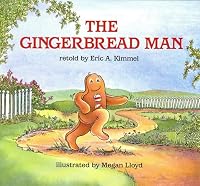
The Gingerbread Man
by Eric A. Kimmel
On This Page
Description
A freshly baked gingerbread man escapes when he is taken out of the oven and eludes a number of animals until he meets a clever fox.Tags
Recommendations







Member Reviews
Prolific children's author Eric A. Kimmel retells that classic of Euro-American folklore in this amusing picture-book about the (mis)adventures of a newly baked gingerbread man. Escaping from the woman and man who created him, the Gingerbread Man goes running merrily down the road, eluding a number of animals along the way, and singing his merry song: "I'll run and run as fast as I can. / You can't catch me, I'm the gingerbread man!." Eventually he meets a crafty fox, and accepting a ride across the river, meets his end...
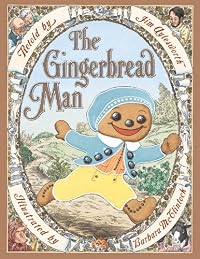
Although there are many older variants of this tale of a runaway pastry to be found in European folklore - the Norwegian Pannekaken, from Asbjørnsen and Moe's Norwegian Folktales, the story of Kolobok, found in many show more Slavic traditions - this New England version from the United States first appeared in print in 1875, in the children's periodical St. Nicholas Magazine, and was related to the author by a storyteller in Maine. Leaving aside the question of cultural origin, Kimmel's retelling of the tale is sprightly and amusing, and his text reads well. The accompanying artwork from illustrator Megan Lloyd is colorful and cute, and the inclusion of a recipe for gingerbread men at the back of the book adds a nice touch. This isn't my favorite retelling of this tale - that honor belongs to Jim Aylesworth and Barbara McClintock's The Gingerbread Man - but it is still quite appealing, and is one I would recommend to anyone seeking a good, solid picture-book presentation of what has become an American childhood classic. show less
Although there are many older variants of this tale of a runaway pastry to be found in European folklore - the Norwegian Pannekaken, from Asbjørnsen and Moe's Norwegian Folktales, the story of Kolobok, found in many show more Slavic traditions - this New England version from the United States first appeared in print in 1875, in the children's periodical St. Nicholas Magazine, and was related to the author by a storyteller in Maine. Leaving aside the question of cultural origin, Kimmel's retelling of the tale is sprightly and amusing, and his text reads well. The accompanying artwork from illustrator Megan Lloyd is colorful and cute, and the inclusion of a recipe for gingerbread men at the back of the book adds a nice touch. This isn't my favorite retelling of this tale - that honor belongs to Jim Aylesworth and Barbara McClintock's The Gingerbread Man - but it is still quite appealing, and is one I would recommend to anyone seeking a good, solid picture-book presentation of what has become an American childhood classic. show less
I liked this book because of the pattern in the story and the illustrations. However, I didn’t like the end because it was surprisingly sad. I loved how the illustrations followed the story of the gingerbread man running away. For example, the beginning of the book shows the gingerbread man being baked entirely on the left page, with the text on the right page. Then, as the gingerbread man starts running away, the illustrations follow his actions by progressively merging onto the next page. Later on in the story when the gingerbread meets the fox, the turning point of the story, the left page begins to lose color where the right page is completely filled. This is a clever way to include a connect between the illustrations and the show more text. Secondly, the pattern of the story is repetitive. For example, as the gingerbread runs past a new animal, the story recaps all of the animals that the gingerbread has gotten passed. I like this repetition because it emphasizes the amount of times the gingerbread man has gotten away. This pattern also allowed me to predict what will happen before reading the next page. For instance, I predicted that the gingerbread man would be able to run past all of the animals in the farm. I didn’t like the ending of the book because, although the ending was “happy”, I perceived it as sad and unexpected. For example, as the fox was about to eat the gingerbread man, I expected the gingerbread man to be able to run away just as he did with the others. Instead, the gingerbread man was eaten and the ending attempted to make up for this, by saying that there are always more gingerbread men to be made. The big Idea of the story is to be careful about who you trust. The gingerbread man, unfortunately, trusted the wrong animal to carry him across the water to safety, but instead the fox ate him. show less
I initially picked this particular book because the picture made me quite interested in the book. I know that one should not judge, or in this case pick, a book by its cover, but I'm glad I did. I think this book is very comical and has a deeper meaning that kids can interpret in a variety of ways. For instance, when the ginger bread man ran from the old woman who baked him, and then kept running from every animal he encountered at the barn. The animals kept telling the gingerbread man that they wanted to tell him something , Yet he would not listen, he just kept on running. I feel like some readers may think that everyone was trying to eat him. Yet I feel like other readers may perceive everyone running after the ginger bread man to show more mean that they're trying to inform him of something. There is one thing i learned from this story. I learned that at times people can be to weary of others to genuinely listen. I also learned that sometimes as humans we can become more stubborn and not listen to people who care about us. I thought about this because the ginger bread man kept running and not listening to anyone, which hurt him in the end. show less
This was a cute little version of this well-known tale. The baker and his wife chase after the gingerbread man. The gingerbread man encounters animals like a pig, a horse, a cow, and a dog. They all chase after him claiming they want to talk to him. He finally runs into a "sly wolf'. The wolf claims he wants to help the cookie. So, he jumps on the fox's tail to get across the river. The fox eventually gets him to hop on the snout of the fox, and the wolf eats him. I liked everything about this story except the ending. I was really kind of sad that the gingerbread man died, but I guess that's how the story goes.
The Gingerbread Man is a classic folklore that I heard growing up. The language in the book is lively and follows the oral tradition I grew up hearing. When the gingerbread man was created he ran away from everyone who wanted him.One theme is that one may not always get what they want. Another theme is to not always trust everyone you meet. The story demonstrates this when the fox tricked the gingerbread man and ate him instead of helping like the fox promised.
The old man and the old woman experience a surprise leap off of the cooking tray, when they see a gingerbread man run out the door. The gingerbread man travels past many different homelands and animals, where he says his famous to line to all of them, "I'll run and run as fast as I can. You can't catch me, I'm the gingerbread man!" As the gingerbread man continued to run, he had the old couple, the horse, the cow, and the sow running after him. When he reached the end of the river, he met Fox who offered to help him cross the river, or so he thought. The book ends with the main gingerbread being eaten by fox, but brings happiness to the end with a full cooking tray of gingerbread men, expressing the existence of gingerbread men lives on show more forever the more you bake them. This is an adorable story retold by Eric A. Kimmel. There are a few god stopping points for readers to make predictions, to ask questions, and to discuss with their peers. I would recommend this book as a fun and enjoyable read for a class. I also believe this is book teaches a valuable lesson to not trust strangers, as well as to be humble and to never be too overconfident. show less
This classic story is about a gingerbread man. An old woman and man make the gingerbread man and shortly after being baked in the oven, he gets up and runs. He runs from the woman and man, from a sow and a dog, and from a horse and a cow. But when he reaches a river, he accepts help from a sly fox to get across. The fox ends up eating the gingerbread man, but the story ends explaining that whenever gingerbread is made, there will be more gingerbread men.
This is a cute little story. I think it shows that you cannot run away from everything; sooner or later you will be caught! I haven’t read this to my daughter yet, but I can already imagine her reciting the repeated phrase, “you can’t catch me, I’m the gingerbread man.” I like show more the pictures, too. I think children’s books with big colorful pictures are perfect for the younger readers. Although I have heard of the gingerbread man, I never actually heard the whole story so I am glad to have bought this book for my children.
A very easy extension would be to have the students make their own gingerbread men with lots of different available materials and crafts, i.e. construction paper, cotton balls, glitter, buttons, fabrics, etc. I could also discuss with the class the idea behind the story. Is it about not being able to run from everything or is it about being good at one thing does not mean you are good at everything (fast runner but not very smart)? After the children express their opinions, they could write a different ending to the story, beginning with the gingerbread making it across the river. Who would end up catching him? How else could the gingerbread man be caught? show less
This is a cute little story. I think it shows that you cannot run away from everything; sooner or later you will be caught! I haven’t read this to my daughter yet, but I can already imagine her reciting the repeated phrase, “you can’t catch me, I’m the gingerbread man.” I like show more the pictures, too. I think children’s books with big colorful pictures are perfect for the younger readers. Although I have heard of the gingerbread man, I never actually heard the whole story so I am glad to have bought this book for my children.
A very easy extension would be to have the students make their own gingerbread men with lots of different available materials and crafts, i.e. construction paper, cotton balls, glitter, buttons, fabrics, etc. I could also discuss with the class the idea behind the story. Is it about not being able to run from everything or is it about being good at one thing does not mean you are good at everything (fast runner but not very smart)? After the children express their opinions, they could write a different ending to the story, beginning with the gingerbread making it across the river. Who would end up catching him? How else could the gingerbread man be caught? show less
Members
- Recently Added By
Author Information

142+ Works 16,826 Members
Eric Kimmel was born in Brooklyn, NY in 1946. He received a bachelor's degree in English Literature from Lafayette College. He also has a Ph.D. in Education from the University of Illinois. He was an elementary school teacher and college professor before becoming a full-time writer. He has published over fifty titles, many of which have won state show more and national awards. His titles "Hershel and the Hanukkah Goblins" won the Caldecott Honor Medal, "The Chanukkah Guest" and "Gershon's Monster" won the Sydney Taylor Picture Book Award and "Anansi and the Talking Melon" won the Utah Children's Choice Award. Kimmel travels nationally and internationally visiting schools and talking about his books and telling stories. (Bowker Author Biography) show less
Some Editions
Classifications
- Genres
- Picture Books, Children's Books
- DDC/MDS
- 398.21 — Social sciences Customs, etiquette & folklore Folklore Folk literature Tales and lore of paranatural beings of human and semihuman form
- LCC
- PZ8 .K527 .G — Language and Literature Fiction and juvenile belles lettres Fiction and juvenile belles lettres Juvenile belles lettres
- BISAC
Statistics
- Members
- 427
- Popularity
- 71,828
- Reviews
- 31
- Rating
- (3.77)
- Languages
- English, French
- Media
- Paper, Audiobook, Ebook
- ISBNs
- 22
- ASINs
- 5