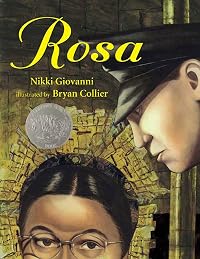
Rosa
by Nikki Giovanni
On This Page
Description
The story of Rosa Parks and her courageous act of defiance. Provides the story of the young black woman who refused to give up her seat to a white passenger in Alabama, setting in motion all the events of the Civil Rights Movements that resulted in the end of the segregated south, gave equality to blacks throughout the nation, and forever changed the country in which we all live today. She had not sought this moment but she was ready for it. When the policeman bent down to ask "Auntie, are show more you going to move?" all the strength of all the people through all those many years joined in her. She said, "No." An inspiring account of an event that shaped American history. Fifty years after her refusal to give up her seat on a Montgomery, Alabama, city bus, Mrs. Rosa Parks is still one of the most important figures in the American civil rights movement. This picture-book tribute to Mrs. Parks is a celebration of her courageous action and the events that followed. Award-winning poet, writer, and activist Nikki Giovanni's evocative text combines with Bryan Collier's striking cut-paper images to retell the story of this historic event from a wholly unique and original perspective. show lessTags
Recommendations


Member Reviews
This Caldecott-winning book, written by Nikki Giovanni and illustrated by Bryan Collier, is absolutely beautiful.
The art is paper cut style/collage and adds to the layers and textures of this book. And the fold-out pages are a great feature to show the full scenes and journeys.
This is the story of Rosa Parks and her historic decisions that changed history. This book adds so many details and personifies the story in a way that makes the reader connect more. Nikki Giovanni's poetic nature is seen on every page as she tells this story we all know, but don't necessarily know all the details of. She gives us Rosa's background, her current plight, and her thoughts as she makes this tough decision. "She had not sought this moment but she was show more ready for it. When the policeman bent down to ask “Auntie, are you going to move?” all the strength of all the people through all those many years joined in her. She said, “No.”" This line really captures the situation and the importance of it.
After this, the author shares the aftermath, the bus protests, and others who were involved along the way. This book explores this famous historical event and the changes made because of it, all with beautifully moving art that adds so much to it. show less
The art is paper cut style/collage and adds to the layers and textures of this book. And the fold-out pages are a great feature to show the full scenes and journeys.
This is the story of Rosa Parks and her historic decisions that changed history. This book adds so many details and personifies the story in a way that makes the reader connect more. Nikki Giovanni's poetic nature is seen on every page as she tells this story we all know, but don't necessarily know all the details of. She gives us Rosa's background, her current plight, and her thoughts as she makes this tough decision. "She had not sought this moment but she was show more ready for it. When the policeman bent down to ask “Auntie, are you going to move?” all the strength of all the people through all those many years joined in her. She said, “No.”" This line really captures the situation and the importance of it.
After this, the author shares the aftermath, the bus protests, and others who were involved along the way. This book explores this famous historical event and the changes made because of it, all with beautifully moving art that adds so much to it. show less
Marvelous illustrations by Bryan Collier accompanied this incredible story. Nikki Giovanni writes of the historic moment when Rosa Parks refused to give up her seat and the movement this action ignited. I loved the background that was set, telling of injustice and racism in simple words and also of the broader movement and the individuals and groups that came together in a stand against oppression.
A brilliant children's book that has a lot teach everyone.
A brilliant children's book that has a lot teach everyone.
Rosa is a lovely rendering of Rosa Parks' courageous act in a picture book format that is accessible to younger readers. I think most people are familiar with Mrs. Parks refusal to move to the back of the bus which sparked a huge wave in the civil rights movement, but author, Nikki Giovanni, gives the reader a little more information about the before and after. She begins by giving a bit of background on Rosa Parks which even educated me. I didn't realize that she was married, caring for an elderly mother and worked as a seamstress. Ms. Giovanni continues by detailing Mrs. Parks act of civil disobedience which led to her arrest. I was a little disappointed that she didn't tell any more about Mrs. Parks herself following that event. show more Instead the author finishes up by explaining how Rosa Parks' actions sparked a whole movement which eventually led to the Supreme Court ruling against segregation.
Artist Bryan Collier's illustrations are a lovely compliment to the text. I really felt like he captured Rosa Parks' essence in the pictures of her and the details are amazing. The textures and patterns of the clothing and accessories as well as some other items were very realistic looking, almost more like a photograph than a painting. Each one also has a kind of pieced-together look. I spent quite a while perusing each one, trying to figure out how Mr. Collier accomplished this. It wasn't until I read on his website that he incorporates watercolors and collage that is started to make sense. All in all, some very impressive artistic work.
Rosa was the winner of both the Coretta Scott King award and a Caldecott Honor Book, both of which I think are well-deserved. Overall, it was a lovely book that would be a great tool for teaching younger children about Rosa Parks and this particular chapter in the civil rights movement. show less
Artist Bryan Collier's illustrations are a lovely compliment to the text. I really felt like he captured Rosa Parks' essence in the pictures of her and the details are amazing. The textures and patterns of the clothing and accessories as well as some other items were very realistic looking, almost more like a photograph than a painting. Each one also has a kind of pieced-together look. I spent quite a while perusing each one, trying to figure out how Mr. Collier accomplished this. It wasn't until I read on his website that he incorporates watercolors and collage that is started to make sense. All in all, some very impressive artistic work.
Rosa was the winner of both the Coretta Scott King award and a Caldecott Honor Book, both of which I think are well-deserved. Overall, it was a lovely book that would be a great tool for teaching younger children about Rosa Parks and this particular chapter in the civil rights movement. show less
Books about Rosa Parks abound, but this one stands out among the rest. In the post- Civil Rights era, Rosa Parks has become symbol of the movement, sometimes to the exclusion of her humanity. Giovanni’s lyrical prose succeeds in making her a real person to readers, with a sick mother and a husband to make dinner for. The book also connects Rosa Parks to the larger events surrounding her decision to remain in her seat; readers see the link between not only her decision and the bus boycott that followed, but also Brown vs. Board of Education and the lynching of Emmett Till. Collier’s illustrations are somewhere between collage and stained glass, and a halo-like light surrounds the heads of Rosa Parks and Martin Luther King Jr. at show more critical junctures in the story. Rosa is welcome during Black History Month of course, but it would be a shame to confine a book of such caliber and importance to one month of the year. The only thing missing is an afterward giving information about Rosa Parks’ life after the bus boycott, and sources for further information. Readers will want to learn more after reading this book, and it would have been nice if Rosa gave suggestions for resources to do so. Apart for that caveat, I recommend this book highly. show less
We all know the story: Rosa Parks refused to give up her seat on a bus just because she was black and the other person white. This act of civil disobedience sparked a citywide bus boycott and eventually led to a Supreme Court case banning yet another form of segregation.
Except we don't all know the story. For children still learning about the world and its history, it's important that they learn about the civil rights movement and understand the (ongoing) history of racism in the United States. So this book aims to show a little slice of that, beginning with Rosa staying put on her seat, moving right along to the Women's Political Council who start the boycott and then to Martin Luther King's speeches and nonviolent marches, and ending show more with the Supreme Court case. While at first it seemed like this book was just plunging right into the story without giving young readers some backdrop, it does then do a good job of setting Rosa's actions in historical context.
Except that it sort of doesn't. My big grip with the book is that it misrepresents the motivations for Parks's action. The book portrays Parks as a woman concerned only with personal family and work affairs, who is daydreaming on the bus about preparing her husband's dinner that night (yeah, not kidding, that's an actual line in this book. try not to eye roll.) when she suddenly out of the blue decides she's tired of giving up her seat to other people just because of the color of her skin. The historical Rosa Parks was a very active member of the NAACP and very much had the intention of refusing to give up her seat so that a court case could come out of her arrest; it was not a spur-of-the-moment action of one fed-up woman, it was the planned move on the part of those groups fighting for civil rights. If the aim of a book is to teach children something about a historical figure, it should not give a misleading report of that person's background and choices.
Still, overall, this book does a decent job of talking about the civil rights movement succinctly while showing the toll that segregation took on personal lives. I think this book is useful for classroom or home discussions if teachers and parents are there to explain more about the historical events mentioned in the book and are willing to open up a discussion on racism today and things we can do to brighten the future, just like Rosa Parks did, albeit probably in much smaller ways! show less
Except we don't all know the story. For children still learning about the world and its history, it's important that they learn about the civil rights movement and understand the (ongoing) history of racism in the United States. So this book aims to show a little slice of that, beginning with Rosa staying put on her seat, moving right along to the Women's Political Council who start the boycott and then to Martin Luther King's speeches and nonviolent marches, and ending show more with the Supreme Court case. While at first it seemed like this book was just plunging right into the story without giving young readers some backdrop, it does then do a good job of setting Rosa's actions in historical context.
Except that it sort of doesn't. My big grip with the book is that it misrepresents the motivations for Parks's action. The book portrays Parks as a woman concerned only with personal family and work affairs, who is daydreaming on the bus about preparing her husband's dinner that night (yeah, not kidding, that's an actual line in this book. try not to eye roll.) when she suddenly out of the blue decides she's tired of giving up her seat to other people just because of the color of her skin. The historical Rosa Parks was a very active member of the NAACP and very much had the intention of refusing to give up her seat so that a court case could come out of her arrest; it was not a spur-of-the-moment action of one fed-up woman, it was the planned move on the part of those groups fighting for civil rights. If the aim of a book is to teach children something about a historical figure, it should not give a misleading report of that person's background and choices.
Still, overall, this book does a decent job of talking about the civil rights movement succinctly while showing the toll that segregation took on personal lives. I think this book is useful for classroom or home discussions if teachers and parents are there to explain more about the historical events mentioned in the book and are willing to open up a discussion on racism today and things we can do to brighten the future, just like Rosa Parks did, albeit probably in much smaller ways! show less
The key strengths of this book are a) it's absolutely important message and b) it's stunning illustrations, which seem to be a combination of collage and painting. Rosa more than lived up to its promise in both categories.
But...I'm not entirely sure who the audience is for this book. That probably has a lot to do with the fact that I'm white. To me, most of the story seems to geared toward kids about 5 to 7--they need to be able to sit for longer reading sections and they need to understand some bigger words and concepts. But then Giovanni brings up Emmett Till, lynching (not defined in the text), and his open-casket funeral. So we've gone from the kind of harassments that kids might be familiar with from bullies (the implied "get out show more of my seat" and "you don't belong here", as well as Giovanni's ominously vague "potential for ugliness") to some incredibly dark territory, including words and events that adults will have to explain. (I believe there is now or soon will be a picture book about Emmett Till's mother.) This is a book-long story about Rosa Parks, but I feel like that one paragraph about Emmett Till would probably spark the most and most difficult conversations.
From that point on, as the story gets larger than just Rosa, it also has a couple sidetracks: in addition to the paragraph about Emmett Till, there is, for some reason, an entire paragraph about using a stencil-making machine. Giovanni also drops in the NAACP, "the nonviolent movement", "segregation" (not previously defined) and the doozy of a phrase, "makes no provision for second-class citizenship." All of these are important things, of course, but they mean that you need a kid who's a) old enough to either sit all the way through a longer reading or read this book for themselves and b) old enough to ask for more information instead of just getting bored when they don't understand something. That age probably varies by child.
I appreciate Giovanni's efforts to add in a few feminist comments, such as Rosa Park's thought that men take up more space than women. There's a parallel there with white people demanding that black people give them more space. Then Mrs.-Robinson-who's-actually-Dr.-Robinson has to make dinner, clean, put children to bed, and kiss her husband goodbye before she can go organize the bus boycott. To me, the critique is obvious--why the heck is an important woman doing all these chores without her husband helping when there's important work to be done? However, neither of these situations have any indication that this is not the way things have to be. In Rosa's mind, "Men take up more space." Period. Fact. To Dr. Mrs. Robinson, there's no annoyance or alternative. For both of them, it seems like this is just the way it is. If they can protest their treatment at the hands of white people, why do they let men walk all over them?
There also isn't really a conclusion to Rosa Parks' own story. We know she was arrested. How long was she in jail? How did she get out? Did she go to court? Did she ever get on a bus again? For a book called Rosa, this one doesn't stay focused on Rosa more than about halfway.
Gosh I feel like I'm being a grump about this award-winning, absolutely beautifully illustrated book. It addresses a lot of the annoying myths that white people like to say: that Rosa didn't stand up because she was tired from working (Giovanni spins this word out brilliantly) and that her protest ended segregation and that black people and white people all lived happily ever after. I'd love to talk to a teacher who uses this book in their curriculum to hear how they use it, what books they use as supplements, and what their conversations are like. Of course, these days this book is probably being banned from classrooms, because [sarcasm] how dare we teach children that progress is possible if doing so makes white people look bad? [end sarcasm]
Finally, about that amazing art: it's a little thing, but I love that Collier gets a little space for an illustrator's note. Ever since I started reading the historical notes in the back of American Girl books, I've loved reading everything that authors and illustrators can tell us about their work. show less
But...I'm not entirely sure who the audience is for this book. That probably has a lot to do with the fact that I'm white. To me, most of the story seems to geared toward kids about 5 to 7--they need to be able to sit for longer reading sections and they need to understand some bigger words and concepts. But then Giovanni brings up Emmett Till, lynching (not defined in the text), and his open-casket funeral. So we've gone from the kind of harassments that kids might be familiar with from bullies (the implied "get out show more of my seat" and "you don't belong here", as well as Giovanni's ominously vague "potential for ugliness") to some incredibly dark territory, including words and events that adults will have to explain. (I believe there is now or soon will be a picture book about Emmett Till's mother.) This is a book-long story about Rosa Parks, but I feel like that one paragraph about Emmett Till would probably spark the most and most difficult conversations.
From that point on, as the story gets larger than just Rosa, it also has a couple sidetracks: in addition to the paragraph about Emmett Till, there is, for some reason, an entire paragraph about using a stencil-making machine. Giovanni also drops in the NAACP, "the nonviolent movement", "segregation" (not previously defined) and the doozy of a phrase, "makes no provision for second-class citizenship." All of these are important things, of course, but they mean that you need a kid who's a) old enough to either sit all the way through a longer reading or read this book for themselves and b) old enough to ask for more information instead of just getting bored when they don't understand something. That age probably varies by child.
I appreciate Giovanni's efforts to add in a few feminist comments, such as Rosa Park's thought that men take up more space than women. There's a parallel there with white people demanding that black people give them more space. Then Mrs.-Robinson-who's-actually-Dr.-Robinson has to make dinner, clean, put children to bed, and kiss her husband goodbye before she can go organize the bus boycott. To me, the critique is obvious--why the heck is an important woman doing all these chores without her husband helping when there's important work to be done? However, neither of these situations have any indication that this is not the way things have to be. In Rosa's mind, "Men take up more space." Period. Fact. To Dr. Mrs. Robinson, there's no annoyance or alternative. For both of them, it seems like this is just the way it is. If they can protest their treatment at the hands of white people, why do they let men walk all over them?
There also isn't really a conclusion to Rosa Parks' own story. We know she was arrested. How long was she in jail? How did she get out? Did she go to court? Did she ever get on a bus again? For a book called Rosa, this one doesn't stay focused on Rosa more than about halfway.
Gosh I feel like I'm being a grump about this award-winning, absolutely beautifully illustrated book. It addresses a lot of the annoying myths that white people like to say: that Rosa didn't stand up because she was tired from working (Giovanni spins this word out brilliantly) and that her protest ended segregation and that black people and white people all lived happily ever after. I'd love to talk to a teacher who uses this book in their curriculum to hear how they use it, what books they use as supplements, and what their conversations are like. Of course, these days this book is probably being banned from classrooms, because [sarcasm] how dare we teach children that progress is possible if doing so makes white people look bad? [end sarcasm]
Finally, about that amazing art: it's a little thing, but I love that Collier gets a little space for an illustrator's note. Ever since I started reading the historical notes in the back of American Girl books, I've loved reading everything that authors and illustrators can tell us about their work. show less
This picture book is one I have assigned for my Children’s Literature course. Nikki Giovanni, the author, is relatively well-known for her poetry and her children’s writings – particularly for her focus on African American history and culture – and here she has treated the subject of Rosa Parks’ famous moment on the bus with characteristic directness and respect. I think the watercolor and cut-paper collage illustrations – by Bryan Collier – give the historical moment a very personal feel, meshing neatly with Giovanni’s obvious desire to connect the reader with Rosa on a very human, individual level – the book’s first page, for example, begins in Rosa’s kitchen and depicts a warm family scene of the start of an show more ordinary day. I appreciate the touches of ordinary that this book includes – heroes of all shapes and moments must, above all, be relatable, and Rosa Parks here seems far more personable than the dry figure so briefly acknowledged by history textbooks – and, overall, I found this to be a great introduction to not only Rosa Parks, but also her significance to American history. It is truly only an introduction, however – Giovanni does seem to assume, in leaving several holes in the narrative and in the logic of the reactions to Parks, that this book will be just a piece in any child’s experience with this historical moment. I think it is a fair assumption to make, but parents and teachers who read this book with their kids should be prepared to provide some context and answer some questions. show less
Members
- Recently Added By
Published Reviews
ThingScore 100
"A cooling breeze on a sweltering day; a sun-dried quilt in fall; the enchantment of snowflakes extending the horizon; the promise of renewal at spring" (Giovanni, 2005, p. 4). This is how the author, the first recipient of the Rosa L. Parks Woman of Courage Award, describes the heroine of her book. Young readers will surely be inspired by the story of a remarkable woman whose act of civil show more disobedience precipitated the Montgomery bus boycott.
The story begins with the description of a rather routine day: Rosa's mother recovering from the flu; her husband, a barber, working at the Air Force base; and Rosa hurriedly leaving her job as a seamstress as she thinks about preparing a meatloaf for dinner. These ordinary events make her extraordinary act of courage in standing against injustice even more remarkable. The events on the bus are described in detail, and her quiet refusal to give in to the demand that she give up her seat to a White passenger is in sharp contrast with the behavior of the bus driver who yelled, "I said give me those seats!" (p. 14) and the passengers who demanded that she be arrested. The story closes as groups of people who share her mission, including the Women's Political Council and the NAACP, mobilize to organize a bus boycott. Ultimately, the courage of these heroes, named and unnamed, led to the Supreme Court ruling that declared segregation to be unconstitutional.
The rich watercolor and collage illustrations are captivating. The fold out pages that show those who walked, instead of riding the bus, and those who marched, capture how a number of people from all walks of life came together for the cause of Civil Rights. Many readers will notice how effectively Rosa is portrayed as the gentle hero of this story. In the illustrator's note, Bryan Collier writes, "to me, she is like a radiant chandelier, an elegant light that illuminates all our many pathways" (p. 4).
In an interview about her book, Giovanni said,
I've always liked the hero … I always liked the people that stood up, and Mrs. Parks had a particular stand that said, "You can make a difference. What you do can make a difference." And you do it with no expectation. And she always said that. Again, in my book, I'm not overly stressing that, but she always said she didn't know who, if anyone, would stand with her. She just knew that it was time for her to stand. (http: // www.readingrockets.org)
Giovanni's statement reminds readers of the value of standing up for what is right even when we are unsure about the support we will receive from others. Rosa Park's dignified resolve continues to inspire and to set an example for future generations. show less
The story begins with the description of a rather routine day: Rosa's mother recovering from the flu; her husband, a barber, working at the Air Force base; and Rosa hurriedly leaving her job as a seamstress as she thinks about preparing a meatloaf for dinner. These ordinary events make her extraordinary act of courage in standing against injustice even more remarkable. The events on the bus are described in detail, and her quiet refusal to give in to the demand that she give up her seat to a White passenger is in sharp contrast with the behavior of the bus driver who yelled, "I said give me those seats!" (p. 14) and the passengers who demanded that she be arrested. The story closes as groups of people who share her mission, including the Women's Political Council and the NAACP, mobilize to organize a bus boycott. Ultimately, the courage of these heroes, named and unnamed, led to the Supreme Court ruling that declared segregation to be unconstitutional.
The rich watercolor and collage illustrations are captivating. The fold out pages that show those who walked, instead of riding the bus, and those who marched, capture how a number of people from all walks of life came together for the cause of Civil Rights. Many readers will notice how effectively Rosa is portrayed as the gentle hero of this story. In the illustrator's note, Bryan Collier writes, "to me, she is like a radiant chandelier, an elegant light that illuminates all our many pathways" (p. 4).
In an interview about her book, Giovanni said,
I've always liked the hero … I always liked the people that stood up, and Mrs. Parks had a particular stand that said, "You can make a difference. What you do can make a difference." And you do it with no expectation. And she always said that. Again, in my book, I'm not overly stressing that, but she always said she didn't know who, if anyone, would stand with her. She just knew that it was time for her to stand. (http: // www.readingrockets.org)
Giovanni's statement reminds readers of the value of standing up for what is right even when we are unsure about the support we will receive from others. Rosa Park's dignified resolve continues to inspire and to set an example for future generations. show less
added by ReneHohls
Rosa Parks sat. “She had not sought this moment, but she was ready for it.” When she refused to move out of the neutral section of her bus to make way for white passengers, she sparked the Montgomery bus boycott. She was tired of putting white people first. Giovanni’s lyrical text and Collier’s watercolor-and-collage illustrations combine for a powerful portrayal of a pivotal moment in show more the civil-rights movement. The art complements and extends the text, with visual references to Emmett Till, the Edmund Pettus Bridge and Martin Luther King, Jr. The yellowish hue of the illustrations represents the Alabama heat, the light emanating from Rosa Parks’s face a shining beacon to all who would stand up for what’s right. A dramatic foldout mural will make this important work even more memorable. An essential volume for classrooms and libraries. (Picture book. 5+) show less
added by ReneHohls
The text is accessible to young readers, but without sacrificing the complexity of the story, and the paint/collage illustrations by Bryan Collier are radiant.
added by g33kgrrl
Lists

Picture Books About Civil Rights
51 works; 4 members

Caldecott Honor Books
296 works; 23 members

Books Read in 2023
5,638 works; 147 members
Author Information

83+ Works 8,708 Members
Nikki Giovanni is one of the most prominent black poets of her generation. Born on June 7, 1943, in Knoxville, Tenn., she graduated from Fisk University and later studied at Columbia University. Giovanni creates strongly written poems to convey messages of love, frustration, alienation, and the black experience. She gained national fame with the show more publication of Black Feeling, Black Talk, Black Judgement in 1970. Full of the spirit of the black community during this era, her works captured the anger and frustration of many of its members. Giovanni has been the recipient of grants from both the National Endowment for the Arts and the Ford Foundation. She has taught English at Rutgers University, Ohio State University, and Queens College and has given frequent poetry readings. She is also known for several sound recordings of her poetry, including Truth Is On Its Way. She has also been a Professor of English at the Virginia Polytechnic Institute and State University. (Bowker Author Biography) show less
All Editions
Awards and Honors
Awards
Distinctions
Work Relationships
Has as a student's study guide
Common Knowledge
- Original publication date
- 2005
- People/Characters
- Rosa Parks
- Important places
- Montgomery, Alabama, USA; USA; Alabama, USA
- Important events
- Montgomery Bus Boycott
- Dedication
- To Gary Ann, my sister, courageously facing down lung cancer --N. G.
I am steeped in humble appreciation and gratitude to the men and women, both seen and unseen, involved in the civil rights movement. We are all indebted to Mrs. Rosa Parks and her dear friend Johnnie Carr, as well as Dr. Mar... (show all)tin Luther King, Jr., and many others, for their amazing strength and push for change. --B. C. - First words
- Mrs. Parks was having a good day.
- Last words
- (Click to show. Warning: May contain spoilers.)The integrity, the dignity, the quiet strength of Rosa Parks turned her no into a YES for change.
Classifications
Statistics
- Members
- 2,558
- Popularity
- 7,495
- Reviews
- 171
- Rating
- (4.22)
- Languages
- English
- Media
- Paper, Audiobook, Ebook
- ISBNs
- 28
- UPCs
- 1
- ASINs
- 8