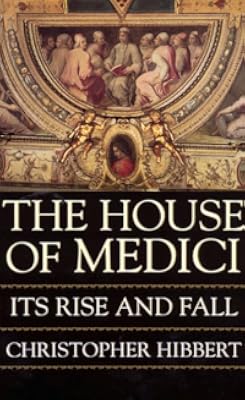
The House of Medici: Its Rise and Fall
by Christopher Hibbert
On This Page
Description
At its height, Renaissance Florence was a center of enormous wealth, power, and influence. A republican city-state funded by trade and banking, its often bloody political scene was dominated by rich mercantile families, the most famous of which were the Medici. This enthralling book charts the family's huge influence on the political, economic and cultural history of Florence. Beginning in the early 1430s with the rise of the dynasty under the near-legendary Cosimo de Medici, it moves show more through their golden era as patrons of some of the most remarkable artists and architects of the Renaissance, to the era of the Medici Popes and Grand Dukes, Florence's slide into decay and bankruptcy, and the end, in 1737, of the Medici line. show lessTags
Recommendations


















Member Recommendations
Member Reviews
I bought this book at the gift shop of the Medici Palace in 2022 while visiting Florence. Published in 1974, Hibbert tells the story of the rise and fall of the Medicis with style and compelling facts. The contrast between the early Medicis - focused on running their bank and quietly exerting influence - and the corrupt, indulgent later Medicis - is striking. It seems like the later Medicis largely coasted on their family reputation with little talent for business or affairs of state.
I also enjoyed reading about how Medici interacted with some of the great people of history like Galileo, Machiavelli, and many great artists like Michelangelo.
The book is filled with so many colourful stories that one almost imagines it is a story. The show more Papacy comes off in a poor light in this book in particular. Numerous Popes seem to be entirely concerned with personal glory, military conquest and making their relatives rich.
The book also added helpful context to the story of Henry VIII of England. I knew that he refused Henry's request mainly for political reasons (i.e. that Henry's wife Catherine was related to the Holy Roman Emperor). However, Hibbert points out that Italy - and Rome itself - had recently been saved by war. In the aftermath of that conflict, it's easy to see why the Pope (and others around him) would not have wanted to give another excuse for foreign show less
I also enjoyed reading about how Medici interacted with some of the great people of history like Galileo, Machiavelli, and many great artists like Michelangelo.
The book is filled with so many colourful stories that one almost imagines it is a story. The show more Papacy comes off in a poor light in this book in particular. Numerous Popes seem to be entirely concerned with personal glory, military conquest and making their relatives rich.
The book also added helpful context to the story of Henry VIII of England. I knew that he refused Henry's request mainly for political reasons (i.e. that Henry's wife Catherine was related to the Holy Roman Emperor). However, Hibbert points out that Italy - and Rome itself - had recently been saved by war. In the aftermath of that conflict, it's easy to see why the Pope (and others around him) would not have wanted to give another excuse for foreign show less
This is a fairly detailed political and personal history of the famous and colourful Medici family, who dominated the history of Florence and central Italy, and indeed more widely, for most of a 300 year period between the early 15th and early 18th centuries. Rising from the merchant class they came to dominate the republic's government and become effectively a hereditary monarchy, though for a long time Florence continued to preserve a republican constitution, in which people from the merchant class were chosen by lot to form the city government, the Signoria. The course of this book is very unbalanced in terms of chronological coverage, with the first of the three centuries of Medici dominance covering five sixths of the narrative; show more but this is mostly justified in terms of the wider importance and sheer drama of the events involved. There are some fascinating characters in the form of Cosimo the Elder, Lorenzo the Magnificent, the fanatical priest Savonarola who held power for a few years after a French invasion, and the two Medici popes, Giovanni (Leo X) and Giulio (Clement VII, the Pope who declined to agree Henry VIII's divorce from Catherine of Aragon). After this period, the remaining two centuries are dealt with in just 50 pages. I would have liked to read more about Grand Duke Cosimo's terrible siege of Siena (my favourite Italian city), in which so many inhabitants starved, and the dramatic and murderous events surrounding his immediate heirs Francesco and Ferdinando, but these were covered quite briefly (they also formed the backdrop to an excellent novel I read recently, The Shepherdess of Siena). The later Grand Dukes were much less interesting and the line more or less fizzled out in gluttony and indolence in the 1730s (though their life spans were much longer than those of the earlier Medici rulers, who rarely lived beyond their 40s, even when they didn't die violently). Overall this was a mostly fascinating and colourful read, though I thought the referencing could have been better - there were detailed footnotes on art and architecture, but no specific sources for other stuff, including some of the more lurid anecdotes of sybaritic excess and violence. Very useful to have genealogical tables and a map showing the complex divisions of the Italian peninsula at the height of Medici power. show less
All dynasties must be astonishing, I suppose. Certainly the Medici were. Florence too, and also Italy itself. A fascinating glimpse of all these things. Hibbert has his favourites (you can tell because those Medici he favours he describes as children), and there is much he must gloss over or even omit, given that this book considers about 400 years of a single ruling family in only 300 or so pages. But it fleshes out the rich history behind the name, and helps any lover of Florence, or Italy, understand the place a little better.
This is a history of an iconic Italian noble family. The Medici are probably the most famous and infamous family you'll ever read about. The book has everything: romance, intrigue, revenge, and power. All this is set against the backdrop of Florence. We start with Cosimo de' Medici and make our way through to the extinction of the family. Well known members, such as Catherine de' Medici, are barely mentioned. However, this book is extremely readable and presents the information in an interesting and intriguing way.
Good reading and a good introduction to the House of Medici.
Good reading and a good introduction to the House of Medici.
The family that greeds together, stays together. The Medici were such an amazing clan, a group that did much to influence history. Though Italians, they also changed the culture of France, when Caterina de Medici became the Queen of France and brought Italian epicurean standards to the still-Gothic French.
If this family existed today, they would be all over the tabloids and probably have their own sitcom, but they were THE standard bearers for the Renaissance, so their successes and challenges changed history. It was hard to put this book down, due to the excellent biographies of each family member. The book is not overly long, thus making it a suitable companion for a weekend jaunt.
Book Season = Spring
If this family existed today, they would be all over the tabloids and probably have their own sitcom, but they were THE standard bearers for the Renaissance, so their successes and challenges changed history. It was hard to put this book down, due to the excellent biographies of each family member. The book is not overly long, thus making it a suitable companion for a weekend jaunt.
Book Season = Spring
I really enjoyed reading this account of the Medici clan. There are so many fascinating characters in the family and among their contemporaries, that each one could have a stand-alone biography.
Intrigue, betrayal, love, hate, murder and an enormous flowering of the arts for several generations, all provide for a wonderful account.
Intrigue, betrayal, love, hate, murder and an enormous flowering of the arts for several generations, all provide for a wonderful account.
While it didn't necessarily provide an exceptional amount of art history information, Hibbert certainly brought the characters to life in a way I've yet to enjoy in other historical non-fiction books. I greatly enjoyed the first three parts, but by the final part, either I was bored or the author chose to run through the "Fall" part of the family's history rather quickly and dryly. Altogether phenomenal, I think.
Members
- Recently Added By
Lists

Books set in Firenze (Florence, Italy)
35 works; 1 member

Which house?
423 works; 16 members

In Our Time books
4,934 works; 2 members
Author Information

80+ Works 14,007 Members
Christopher Hibbert: March 5, 1924 -- December 21, 2008 Historian Christopher Hibbert was born as Arthur Raymond Hibbert in Enderby, England in 1924. He dropped out of Oriel College to join the Army. He served with the London Irish Rifles and won the Military Cross. He earned a degree in history in 1948. Before becoming a full-time nonfiction show more writer, he worked as a real estate agent and a television critic for Truth magazine. He wrote more than 60 books throughout his lifetime including The Road to Tyburn (1957), Il Duce: The Life of Benito Mussolini(1962), George IV: Prince of Wales, 1762-1811 (1972), and George IV: Regent and King, 1812-1830 (1973). Hibbert was awarded the Heinemann Award for Literature in 1962 for The Destruction of Lord Raglan. He was a Fellow of the Royal Society of Literature and the Royal Geographical Society, and was awarded an Honorary Doctorate in Literature by the University of Leicester. He died from bronchial pneumonia on December 21, 2008 at the age of 84. (Bowker Author Biography) show less
All Editions
Awards and Honors
Distinctions
Series
Belongs to Publisher Series
DIT - MEDICI (1974)
Common Knowledge
- Canonical title
- The House of Medici: Its Rise and Fall
- Original title
- The Rise and Fall of the House of Medici
- Original publication date
- 1974
- People/Characters
- Cosimo de' Medici, the Elder; Contessina de' Bardi; Lucrezia Tornabuoni de' Medici; Lorenzo de' Medici; Giuliano de' Medici; Cosimo I de' Medici, Grand Duke of Tuscany (show all 11); Eleonora of Toledo; Eleonora de' Medici, Duchess of Mantua; Cosimo III de' Medici, Grand Duke of Tuscany; Gian Gastone de' Medici, Grand Duke of Tuscany; Anna Maria Luisa de' Medici, Electress Palatine
- Important places
- Florence, Tuscany, Italy; Palazzo Medici-Riccardi, Florence, Italy; Palazzo Pitti, Florence, Italy; Boboli Gardens, Florence, Italy
- Dedication
- FOR EVE WEISS AND IN MEMORY OF ROBERTO
- First words
- One September morning in 1433, a thin man with a hooked nose and sallow skin could have been seen walking towards the steps of the Palazzo della Signoria in Florence. His name was Cosimo de' Medici; and he was said to be one... (show all) of the richest men in the world.
- Quotations
- 'A Florentine who is not a merchant.....enjoys no esteem whatever'
Classifications
Statistics
- Members
- 1,927
- Popularity
- 11,061
- Reviews
- 29
- Rating
- (3.70)
- Languages
- 10 — Chinese, Czech, Dutch, English, Hungarian, Italian, Korean, Polish, Portuguese, Spanish
- Media
- Paper, Audiobook, Ebook
- ISBNs
- 24
- ASINs
- 28