On This Page
Description
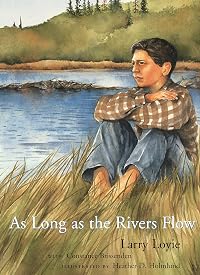
Winner of the Norma Fleck Award for Canadian Children's Non-FictionFrom the mid-1800s to the late 1990s, the education of Indigenous children was taken on by various churches in government-sponsored residential schools. More than 150,000 children were forcibly taken from their families in order to erase their traditional languages and cultures.
As Long as the Rivers Flow is the story of Larry Loyie's last traditional summer before entering residential school. It is a time of adventure show more and learning from his Elders. He cares for an abandoned baby owl, watches his kokom (grandmother) make winter moccasins, and helps his family prepare for summer camp, where he will pick berries, fish and swim. While searching for medicine plants in the bush with Kokom, he encounters a giant grizzly bear. Gently but truthfully written, the book captivates its readers and reveals a hidden history.
Correlates to the Common Core State Standards in English Language Arts:
CCSS.ELA-LITERACY.RL.3.7
Explain how specific aspects of a text's illustrations contribute to what is conveyed by the words in a story (e.g., create mood, emphasize aspects of a character or setting)
CCSS.ELA-LITERACY.RL.4.3
Describe in depth a character, setting, or event in a story or drama, drawing on specific details in the text (e.g., a character's thoughts, words, or actions).
CCSS.ELA-LITERACY.RL.5.5
Explain how a series of chapters, scenes, or stanzas fits together to provide the overall structure of a particular story, drama, or poem.
. show less
Tags
Recommendations




Member Reviews
"As Long as the Rivers Flow" tells the true story of a young Cree boy and the last summer with his family before he and his siblings were forced into boarding school. In many ways, it is a coming of age story, as Lawrence goes through many new exciting experiences and trials to earning the name Oskiniko- "Young Man." The story opens with Lawrence's father giving him and his siblings an baby owl to care for until it is able to fly away on its own, and from there goes into the preparations made to leave for the summer camp. The reader experiences summer camp life alongside Lawrence, as he tries to prove to his father that he is ready to hunt with the adults, helps with chores and berry picking, learns about medicines from his grandmother, show more and encountering a grizzly bear as he is on a trial with her. On the return home, there is a celebration and many stories shared, cementing the bonds between family and the love they share for each other. This peak into Lawrence's life makes it all the more heart breaking as his mother tearfully admits to her children that they are being taken away from the family by the government.
On the day they are spirited away, the reader can see and feel the overwhelming loss that takes place through the simple words and complex illustrations: the grandmother's despondent face, the father's anger and helplessness expressed in a clenched fist, the mother and children's tears as they are separated by white men who "look like crows."
An afterwords gives a brief description of the life at boarding school by the children, with black and white photos of them at their schools. Though written in a format more so for an older audience, this afterword gives us valuable information about the conditions of the boarding schools, where the children were mistreated and did more labor than learning. Once he left the schools, Lawrence felt disconnected from his family and culture, lost between two worlds. I'm left wanting to read a more in depth account of the those years within the schools and his path after leaving them, but in a second book rather than in this one itself. This book is well paced and executed in terms of storytelling, as it leaves us with the impacting uncertainty and loss the families felt as they were separated. show less
On the day they are spirited away, the reader can see and feel the overwhelming loss that takes place through the simple words and complex illustrations: the grandmother's despondent face, the father's anger and helplessness expressed in a clenched fist, the mother and children's tears as they are separated by white men who "look like crows."
An afterwords gives a brief description of the life at boarding school by the children, with black and white photos of them at their schools. Though written in a format more so for an older audience, this afterword gives us valuable information about the conditions of the boarding schools, where the children were mistreated and did more labor than learning. Once he left the schools, Lawrence felt disconnected from his family and culture, lost between two worlds. I'm left wanting to read a more in depth account of the those years within the schools and his path after leaving them, but in a second book rather than in this one itself. This book is well paced and executed in terms of storytelling, as it leaves us with the impacting uncertainty and loss the families felt as they were separated. show less
This is the story of one glorious summer, when 10 year old Lawrence spends time with his family – raising an orphaned owl with his siblings, proving his patience and endurance by tricking beavers, and confronting a grizzly bear with his grandmother. Throughout the story, the routines and little details of his family's daily life provide a rich realism to Lawrence's experiences. The family's complex relationship with nature is described throughout – as a source of food, entertainment, and beauty. While rumour that Lawrence and his siblings will be taken away to residential school overshadows the story, it is only in the final pages that this becomes the focus. I enjoyed tasting the richness and joy of Lawrence's life before he was show more taken – and it made the ending very poignant.
The story is autobiographical, and an epilogue briefly describes Lawrence's stay at school. There are wonderful black and white photographs showing different members of Lawrence's family.
The pictures are realistic and detailed watercolours, the faces of individuals are full of personality. You can see that people's faces have been copied from photographs. The animals and plants are also drawn with keen attention to detail.
The book has pictures on every page, but it divided into chapters, it is a read-aloud book, or for kids just starting chapter books. show less
The story is autobiographical, and an epilogue briefly describes Lawrence's stay at school. There are wonderful black and white photographs showing different members of Lawrence's family.
The pictures are realistic and detailed watercolours, the faces of individuals are full of personality. You can see that people's faces have been copied from photographs. The animals and plants are also drawn with keen attention to detail.
The book has pictures on every page, but it divided into chapters, it is a read-aloud book, or for kids just starting chapter books. show less
This sad and beautiful picture book tells a fictionalized story about the days before the author and his siblings were taken away to residential schools for Native American children. It feels like the author is using the story to try to recapture a time of freedom, innocence, family, and community that he lost when he was taken away. My 11yo said he liked it but that the ending was abrupt.
Being at a community school I am always looking for First Nations content. This is a great story to introduce residential schools. The beautiful watercolours create a harmonious feel about the life before being taken from his family, looking after an owl, the killing of a great grizzly and spending time at the river. The fact that it is based on true event and has photos at the back reinforces what happened in this darker part of our history.
Beautiful book about the last summer before being taken away to a residential school. Moving, sad. Picture book format, but also chapters/high text.
Ratings
Members
- Recently Added By
Lists

Top 100 books by Indigenous Masters
134 works; 7 members

Childhood: Books for or about children in different cultures around the wor
345 works; 18 members

Native American / Indigenous Literature
172 works; 100 members

GraceCollection TBR NDN OV
9 works; 1 member
Author Information
8 Works 269 Members
Larry Loyie was born on November 4, 1933 in Slave Lake, Alberta, Canada. He lived a traditional Cree life until he was eight years old. From the age of eight to 14, he attended St. Bernard Mission residential school in Grouard, Alberta. At the age of 14, he entered the work force, fighting fires, working in an oil camp and a mountain sawmill. He show more turned his life experiences into children's books. His works include The Moon Speaks Cree, Goodbye Buffalo Bay, When the Spirits Dance: A Cree Boy's Search for the Meaning of War, The Gathering Tree, and Residential Schools: With the Words and Images of Survivors. As Long as the Rivers Flow won the Norma Fleck Award for Canadian Children's Non-Fiction and the First Nation Communities Read award. With his partner, writer and editor Constance Brissenden, he launched Living Traditions Writers Group in 1993 to encourage Aboriginal writing. He died on April 18, 2016 at the age of 82. (Bowker Author Biography) show less
18+ Works 217 Members
All Editions
Awards and Honors
Awards
Notable Lists
Series

Common Knowledge
- Alternate titles
- As Long as the Rivers Flow: A Last Summer Before Residential School
- People/Characters
- Larry Loyie
- Important places
- Alberta, Canada
- Dedication
- To my family and all young people who seek to know about a way of life that is fast disappearing.
- First words
- The baby owl linked its round yellow eyes at Lawrence, and the boy blinked back.
- Last words
- (Click to show. Warning: May contain spoilers.)As the truck pulled away, all Lawrence could see was the sky.
Classifications
Statistics
- Members
- 163
- Popularity
- 200,981
- Reviews
- 5
- Rating
- (4.29)
- Languages
- English, French
- Media
- Paper, Audiobook, Ebook
- ISBNs
- 6