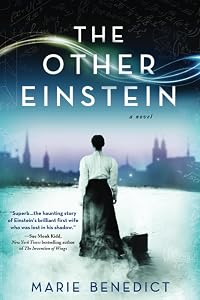
The Other Einstein
by Marie Benedict
On This Page
Description
The Other Einstein offers us a window into a brilliant, fascinating woman whose light was lost in Einstein's enormous shadow. It is the story of Einstein's wife, a brilliant physicist in her own right, whose contribution to the special theory of relativity is hotly debated and may have been inspired by her own profound and very personal insight. Mitza Maric has always been a little different from other girls. Most twenty-year-olds are wives by now, not studying physics at an elite Zurich show more university with only male students trying to outdo her clever calculations. But Mitza is smart enough to know that, for her, math is an easier path than marriage. And then fellow student Albert Einstein takes an interest in her, and the world turns sideways. Theirs becomes a partnership of the mind and of the heart, but there might not be room for more than one genius in a marriage. show lessTags
Recommendations





















Member Reviews
This poignant story, with its vivid, well-developed characters, is wonderfully compelling. I was deeply moved as I read about Mileva and Albert’s relationship, from the early days of their courtship to the gradual deterioration of their marriage. It’s a fine story, but still I wonder how much of it is true. We may never know to what extent Mileva contributed to her husband’s work. It is certainly difficult to read about the cruelties of a popular celebrity, and while I hope that Albert Einstein wasn’t as selfish as he is portrayed here, I know that it’s a possibility. A thought-provoking story that leaves me wanting to know more.
Though this is a work of fiction, it may nevertheless alter your concept of Albert Einstein. He was a great scientist, but certainly less than wonderful when dealing with people, espcecially with his first wife and his children. Mileva was sought out by Albert, badgered and wooed by him, and then, after giving in to him, gradually dismissed and discarded. In this book, the reader is introduced to a wife who is brilliant in her her right, but whose insights were incorporated into her husband’s work without acknowledgement. We see a public Albert who is quite a bit different from the private one. And we begin to understand the shock and disappointment that Meleva comes to accept when she realizes that Albert has, in essence, not only show more lied to her about what their lives would be like, but also betrayed her when he was unfaithful. Well-written and fascinating, this is novel is more than just a rendition of the lives of the Einsteins: it is a cautionary tale of what sometimes happens when two brilliant people become involved and one is not trustworthy. show less
I was inspired to start this book from an episode of Legends of Tomorrow where Mileva plays a central role. I had never heard of this woman before and was fascinated to learn that she might have played such a central role in Einstein's theories and fame. Books about obscure historical figures, especially female ones, always interest me. I was excited to start this one.
The heart of this novel is this amazing woman who had so much potential yet got lost to history. I feel she's a prime example of how women have gotten lost in the shuffle of possible famous historical figures, smothered in the achievements of the men in their lives. She had so much to give and unfortunately was not given the credit she was due.
Yet part of the problem I show more feel was her. I don't know if historically her personality had any basis in fact. However as portrayed in this work, I can see why history forgot her. She started out strong, with dreams as large as the world and the guts to pursue those dreams with all of her being. She faced down family condemnation, societal blocks, and physical limitations to pursue a degree and a dream of making a name for herself in the intellectual world.
Once she hooked up with Albert romantically however, it seems like her dreams, personality, and needs became subsumed by his. It didn't happen all at once but gradually. By the time we approached the end of the book, she finally drew the line in the sand and struck out on her own.
However, the journey to that decision was painful. I watched this woman I had grown to admire make herself subservient and a second-class citizen to her own husband. She put his needs above her own so many times that she lost track of what she actually wanted. She put her trust in him again and again, never learning the lesson once he betrayed her over and over. At least by the end, she found her spine and stood up to Albert once his demands reached a certain unbelievable level. By the books send, I admired her again.
Now Albert... that's a figure that's interesting in this book, whether it's in the fashion of an admirable figure in science or a douche bag on the level of Hitler is up to the individual reader. If even a quarter of what he did in this book really happened, I have to question the level of admiration given to him by history.
I do know for a fact that the list presented to Mileva at the end of the book did happen; that alone makes me distain him as a human being. But throughout the entire book he treats Mileva horribly. He steals her ideas, cheats on her, physically and emotionally abuses her, and threaten the lives of her and his children for his ego. At least I can say the author shows her skill at characterization by making such an icon of scientific history so ultimately flawed as a human.
I think that’s what can be taken away from this book and what makes it such a gem. The author’s skill at making her characters so flawed and unlikable yet making us root for them all the same takes serious characterization chops. Even though I hate Albert as a person, his brilliance and charisma still stand out. And Mileva… the crap that woman went through, partly what she allowed herself to go through, shaped her into a person that at the end I could admire and root for. The character journeys portrayed in this book are its heart and soul.
To me, this book was about Mileva as a person and historical figure. I feel the world lost out on a treasure once she hooked up with Mr. Douche-bag. The author takes the reader on emotional character journeys that leave you gasping and heart-wrenched. Whether you grow to love or hate Mileva and Albert, at least through this work, they still touch you in a deeply emotional way, right to your soul. I highly recommend this work to anyone looking for an incredible character journey or who enjoy obscure historical figures. show less
The heart of this novel is this amazing woman who had so much potential yet got lost to history. I feel she's a prime example of how women have gotten lost in the shuffle of possible famous historical figures, smothered in the achievements of the men in their lives. She had so much to give and unfortunately was not given the credit she was due.
Yet part of the problem I show more feel was her. I don't know if historically her personality had any basis in fact. However as portrayed in this work, I can see why history forgot her. She started out strong, with dreams as large as the world and the guts to pursue those dreams with all of her being. She faced down family condemnation, societal blocks, and physical limitations to pursue a degree and a dream of making a name for herself in the intellectual world.
Once she hooked up with Albert romantically however, it seems like her dreams, personality, and needs became subsumed by his. It didn't happen all at once but gradually. By the time we approached the end of the book, she finally drew the line in the sand and struck out on her own.
However, the journey to that decision was painful. I watched this woman I had grown to admire make herself subservient and a second-class citizen to her own husband. She put his needs above her own so many times that she lost track of what she actually wanted. She put her trust in him again and again, never learning the lesson once he betrayed her over and over. At least by the end, she found her spine and stood up to Albert once his demands reached a certain unbelievable level. By the books send, I admired her again.
Now Albert... that's a figure that's interesting in this book, whether it's in the fashion of an admirable figure in science or a douche bag on the level of Hitler is up to the individual reader. If even a quarter of what he did in this book really happened, I have to question the level of admiration given to him by history.
I do know for a fact that the list presented to Mileva at the end of the book did happen; that alone makes me distain him as a human being. But throughout the entire book he treats Mileva horribly. He steals her ideas, cheats on her, physically and emotionally abuses her, and threaten the lives of her and his children for his ego. At least I can say the author shows her skill at characterization by making such an icon of scientific history so ultimately flawed as a human.
I think that’s what can be taken away from this book and what makes it such a gem. The author’s skill at making her characters so flawed and unlikable yet making us root for them all the same takes serious characterization chops. Even though I hate Albert as a person, his brilliance and charisma still stand out. And Mileva… the crap that woman went through, partly what she allowed herself to go through, shaped her into a person that at the end I could admire and root for. The character journeys portrayed in this book are its heart and soul.
To me, this book was about Mileva as a person and historical figure. I feel the world lost out on a treasure once she hooked up with Mr. Douche-bag. The author takes the reader on emotional character journeys that leave you gasping and heart-wrenched. Whether you grow to love or hate Mileva and Albert, at least through this work, they still touch you in a deeply emotional way, right to your soul. I highly recommend this work to anyone looking for an incredible character journey or who enjoy obscure historical figures. show less
The Other Einstein offers us a window into a brilliant, fascinating woman whose light was lost in Einstein's enormous shadow. This novel resurrects Einstein's wife, a brilliant physicist in her own right, whose contribution to the special theory of relativity is hotly debated. Was she simply Einstein's sounding board, an assistant performing complex mathematical equations? Or did she contribute something more?
Mitza Maric has always been a little different from other girls. Most twenty-year-olds are wives by now, not studying physics at an elite Zurich university with only male students trying to outdo her clever calculations. But Mitza is smart enough to know that, for her, math is an easier path than marriage. Then fellow student show more Albert Einstein takes an interest in her, and the world turns sideways. Theirs becomes a partnership of the mind and of the heart, but there might not be room for more than one genius in a marriage.
Marie Benedict illuminates one pioneering woman in STEM, returning her to the forefront of history's most famous scientists. show less
Mitza Maric has always been a little different from other girls. Most twenty-year-olds are wives by now, not studying physics at an elite Zurich university with only male students trying to outdo her clever calculations. But Mitza is smart enough to know that, for her, math is an easier path than marriage. Then fellow student show more Albert Einstein takes an interest in her, and the world turns sideways. Theirs becomes a partnership of the mind and of the heart, but there might not be room for more than one genius in a marriage.
Marie Benedict illuminates one pioneering woman in STEM, returning her to the forefront of history's most famous scientists. show less
I love these books on the women behind famous men. All throughout history their voices were silent. But many of them were as strong, if not stronger, than the men they helped make famous. And in Albert Einstein’s case, he definitely was helped by his first wife, Mileva “Mitza” Maric.
It was 1896 and Mitza knew she was not like other women. She fought hard for her place at the Swiss Federal Polytechnic – the only woman in her class. She was determined to master physics and mathematics – and that she did. She was brilliant! Having been born with a lame foot, she had grown up thinking that marriage was not an option for her so she had to have a career.
Also studying at the Swiss Federal Polytechnic was Albert Einstein, and they show more soon became a couple. They shared a “scientific language” and worked together on scientific theories. But she soon was betrayed by Albert. When she became pregnant prior to their marriage, he did not support her. As her little girl lay dying, Albert resented her time tending to her daughter. Once they were married she discovered that he had other relationships. And probably his worst betrayal was publishing their scientific theories under solely his name, thus denying recognition of her talents.
Once very idealistic, she began to realize that she could not be a mother to their two sons and maintain a professional life. This belief was reinforced by Albert – and society, in general. Fortunately she was able to express her frustration with her close friend Helene. She also met Marie Curie who was very open about how supportive her husband was in her career.
This book definitely changed how I view Albert Einstein, and made me angry. This brilliant woman was unable to fully explore her potential due to the societal mores of the time. Thank you to Marie Benedict for being Mitza’s voice now.
*I received a free copy from Net Galley in exchange for an honest review. show less
It was 1896 and Mitza knew she was not like other women. She fought hard for her place at the Swiss Federal Polytechnic – the only woman in her class. She was determined to master physics and mathematics – and that she did. She was brilliant! Having been born with a lame foot, she had grown up thinking that marriage was not an option for her so she had to have a career.
Also studying at the Swiss Federal Polytechnic was Albert Einstein, and they show more soon became a couple. They shared a “scientific language” and worked together on scientific theories. But she soon was betrayed by Albert. When she became pregnant prior to their marriage, he did not support her. As her little girl lay dying, Albert resented her time tending to her daughter. Once they were married she discovered that he had other relationships. And probably his worst betrayal was publishing their scientific theories under solely his name, thus denying recognition of her talents.
Once very idealistic, she began to realize that she could not be a mother to their two sons and maintain a professional life. This belief was reinforced by Albert – and society, in general. Fortunately she was able to express her frustration with her close friend Helene. She also met Marie Curie who was very open about how supportive her husband was in her career.
This book definitely changed how I view Albert Einstein, and made me angry. This brilliant woman was unable to fully explore her potential due to the societal mores of the time. Thank you to Marie Benedict for being Mitza’s voice now.
*I received a free copy from Net Galley in exchange for an honest review. show less
**This book was reviewed for the Manhattan and Seattle Book Reviews, and Netgalley**
The Other Einstein, by Marie Benedict, is a look at lost dreams, failing hopes, and 'what ifs’. What if Mileva, little known first wife of Albert Einstein, had never forsaken her path, and graduated with a physics degree as she had planned? What if she had collaborated equally with her husband?
This extraordinary woman had the misfortune to be born into a world reluctant to allow women university education, especially in the 'hard’ sciences of mathematics, physics, and chemistry. Mileva had to fight for the chance, with everything working against her. She was a female of Eastern European descent who walked with a pronounced limp, and was subject to show more open and veiled scorn alike.
Mileva met Albert at university in Zurich. He was the first in her small class to be welcoming, and soon enough managed to sneak under her guard and into her affections. This proved her undoing, in more ways than one. A pregnancy and birth out of wedlock led to Mileva failing her final work towards her physics degree, and never going back to finish. Instead, she married Einstein, and had two more children by him. Sadly, only the middle child survived, though by that point, Mileva was separated from the renowned physicist.
This work is one of historical fiction, speculating on the relationship between Mileva and Albert, including the notion that she helped him develop the theory of relativity we know him for today. Of course, we cannot know all of the truth today, but it's a fascinating look behind the scenes of the famed physicist’s life, and an even more fascinating look at this sharp-minded woman determined to go against conventionalities. History is as relative as time; it is the story written by the victor of an engagement, especially in absence of strong compelling evidence to the contrary.
Benedict’s book is astounding. I breezed through it in a few quick hours, secluding myself from family so as to better sink into the story world. There is nothing worse than being abruptly torn from a truly engrossing story, leaving one momentarily dazed and confused by the shift, especially for mere trivialities. The writing was beautiful, always engaging, often drawing tears and melancholy. What could Mileva have accomplished, had she stayed her own course? As a bonus, the cover art is quite magnificent.
🎻🎻🎻🎻🎻 Highly recommended show less
The Other Einstein, by Marie Benedict, is a look at lost dreams, failing hopes, and 'what ifs’. What if Mileva, little known first wife of Albert Einstein, had never forsaken her path, and graduated with a physics degree as she had planned? What if she had collaborated equally with her husband?
This extraordinary woman had the misfortune to be born into a world reluctant to allow women university education, especially in the 'hard’ sciences of mathematics, physics, and chemistry. Mileva had to fight for the chance, with everything working against her. She was a female of Eastern European descent who walked with a pronounced limp, and was subject to show more open and veiled scorn alike.
Mileva met Albert at university in Zurich. He was the first in her small class to be welcoming, and soon enough managed to sneak under her guard and into her affections. This proved her undoing, in more ways than one. A pregnancy and birth out of wedlock led to Mileva failing her final work towards her physics degree, and never going back to finish. Instead, she married Einstein, and had two more children by him. Sadly, only the middle child survived, though by that point, Mileva was separated from the renowned physicist.
This work is one of historical fiction, speculating on the relationship between Mileva and Albert, including the notion that she helped him develop the theory of relativity we know him for today. Of course, we cannot know all of the truth today, but it's a fascinating look behind the scenes of the famed physicist’s life, and an even more fascinating look at this sharp-minded woman determined to go against conventionalities. History is as relative as time; it is the story written by the victor of an engagement, especially in absence of strong compelling evidence to the contrary.
Benedict’s book is astounding. I breezed through it in a few quick hours, secluding myself from family so as to better sink into the story world. There is nothing worse than being abruptly torn from a truly engrossing story, leaving one momentarily dazed and confused by the shift, especially for mere trivialities. The writing was beautiful, always engaging, often drawing tears and melancholy. What could Mileva have accomplished, had she stayed her own course? As a bonus, the cover art is quite magnificent.
🎻🎻🎻🎻🎻 Highly recommended show less
The Other Einstein by Marie Benedict
Source: Netgalley
My Rating: 4/5 stars
My Review:
"I want to know God's thoughts, the rest are details.”
- Albert Einstein
If the research is to be believed, it wasn’t Albert Einstein at all who was interested in God’s thoughts, but his wife, Mitza certainly was. In fact, Mitza was certain that within the male-dominated world of physics, she would not only produce ground-breaking research but discover God’s thoughts. So, why in the world do we still know Einstein’s name and know virtually nothing about Mitza?
By 1896, Mitza Marić was yet again an oddity. What is known about Mitza (and there is very little known) is that she was and incredibly bright child whose father encouraged her education at show more every turn. Because Mitza was a woman, she and her father spent a great deal of time and effort lobbying for her inclusion into higher education institutions. When Mitza met Albert Einstein, she had already accomplished more than most women anywhere the world could ever dream of accomplishing. She was a new student in the physics program at Zürich, an outcast among her classmates except for Einstein who saw her for what she was, a brilliant mind with insights and knowledge that should not be ignored.
Over the course of their long and incredibly troubled courtship and then marriage, Mitza and Einstein constantly found solace in their work. When physics and mathematics were the topics of conversation, the bond between them strengthened. However, when the topic of conversation was their lives together as a couple, things became far more strained. Though Einstein apparently wanted Mitza in his life, he only wanted her when it was a convenience to him or they were working on a new project. For Mitza’s part, Einstein and their growing family eventually become her whole world and she did most anything to ensure her husband’s happiness. What most anything entails are some of the saddest moments of Mitza’s life.
The Bottom Line: While The Other Einstein is slow starter, I found it to be well worth the wait. What one must remember when diving into this read is that it is historical fiction and there is no way to prove or disprove the theories posited by Benedict. With that being said, what Benedict does posit is absolutely intriguing and wrapped in a story that is ultimately about loss. Quite literally from birth, Mitza Marić was at a distinct disadvantage that never, ever left her. Over the course of her life, she experienced only a few moments of true happiness and those were always overshadowed by long spans of extreme unhappiness, tragedy, and loss. There never seems to be a moment when Mitza isn’t dealing with some sort of turmoil in either her personal and/or professional life. Unfortunately, a fair number of those incidents involved the man she loved beyond reason, Albert Einstein. Benedict’s story does not paint Einstein in a positive light at all yet pulls from the reader a great sense of sympathy for his long-suffering first wife. In the end, The Other Einstein is the story of one woman’s loss of her sense of self, loss of love, love of the little independence she was allowed, loss of her family, and loss of the little control she had over her life. For the modern world, the loss may be just as profound if you consider the loss of a brilliant mind who may have been just as integral to our understanding of physics as Albert Einstein certainly was. show less
Source: Netgalley
My Rating: 4/5 stars
My Review:
"I want to know God's thoughts, the rest are details.”
- Albert Einstein
If the research is to be believed, it wasn’t Albert Einstein at all who was interested in God’s thoughts, but his wife, Mitza certainly was. In fact, Mitza was certain that within the male-dominated world of physics, she would not only produce ground-breaking research but discover God’s thoughts. So, why in the world do we still know Einstein’s name and know virtually nothing about Mitza?
By 1896, Mitza Marić was yet again an oddity. What is known about Mitza (and there is very little known) is that she was and incredibly bright child whose father encouraged her education at show more every turn. Because Mitza was a woman, she and her father spent a great deal of time and effort lobbying for her inclusion into higher education institutions. When Mitza met Albert Einstein, she had already accomplished more than most women anywhere the world could ever dream of accomplishing. She was a new student in the physics program at Zürich, an outcast among her classmates except for Einstein who saw her for what she was, a brilliant mind with insights and knowledge that should not be ignored.
Over the course of their long and incredibly troubled courtship and then marriage, Mitza and Einstein constantly found solace in their work. When physics and mathematics were the topics of conversation, the bond between them strengthened. However, when the topic of conversation was their lives together as a couple, things became far more strained. Though Einstein apparently wanted Mitza in his life, he only wanted her when it was a convenience to him or they were working on a new project. For Mitza’s part, Einstein and their growing family eventually become her whole world and she did most anything to ensure her husband’s happiness. What most anything entails are some of the saddest moments of Mitza’s life.
The Bottom Line: While The Other Einstein is slow starter, I found it to be well worth the wait. What one must remember when diving into this read is that it is historical fiction and there is no way to prove or disprove the theories posited by Benedict. With that being said, what Benedict does posit is absolutely intriguing and wrapped in a story that is ultimately about loss. Quite literally from birth, Mitza Marić was at a distinct disadvantage that never, ever left her. Over the course of her life, she experienced only a few moments of true happiness and those were always overshadowed by long spans of extreme unhappiness, tragedy, and loss. There never seems to be a moment when Mitza isn’t dealing with some sort of turmoil in either her personal and/or professional life. Unfortunately, a fair number of those incidents involved the man she loved beyond reason, Albert Einstein. Benedict’s story does not paint Einstein in a positive light at all yet pulls from the reader a great sense of sympathy for his long-suffering first wife. In the end, The Other Einstein is the story of one woman’s loss of her sense of self, loss of love, love of the little independence she was allowed, loss of her family, and loss of the little control she had over her life. For the modern world, the loss may be just as profound if you consider the loss of a brilliant mind who may have been just as integral to our understanding of physics as Albert Einstein certainly was. show less
Members
- Recently Added By
Lists

Best Historical Fiction
620 works; 261 members

Best Historical Fiction authors
41 works; 9 members

International Dublin Literary Award Longlist 2018
22 works; 2 members

Books Read in 2017
4,249 works; 130 members

Reading Glasses Podcast
410 works; 3 members
Author Information

25+ Works 14,436 Members
Marie Benedict is a well established lawyer at two of the country's premier law firms. She graduated magna cum laude from Boston College with a focus on Art History and History. She is also a cum laude graduate of Boston University School of Law. Marie had a passion for unearthing the hidden historical stories of women. She followed this passion show more and began her writing career. Her first historical novel was "The Other Einstein", which recounts the story of Albert Einstein's first wife, a physicist, and the role she may have played in his theories.The other novels in this series include Carnegie's Maid, and The Only Woman in the Room. She also writes historical novels as Heather Terrell. Those titles include: The Chrysalis, The Map Thief, and Brigid of Kildare. (Bowker Author Biography) show less
Some Editions
Awards and Honors
Awards
Notable Lists
Series
Belongs to Publisher Series
Work Relationships
Is contained in
Common Knowledge
- Canonical title
- The Other Einstein
- Original title
- The Other Einstein
- Original publication date
- 2016-10-18
- People/Characters
- Mileva Marić; Albert Einstein
- Important places
- Zürich, Zürich, Switzerland
- Dedication
- For Jim, Jack, and Ben
- First words
- August 4, 1948 62 Huttenstrasse Zurich, Switzerland The end is near.
- Quotations
- Loneliness outweighed any incandescence of thought brought about by Lenard's kinetic theory of gases and his experiments on the speed at which oxygen molecules travel.
In her usual shrewd way, Helene laid her finger on the source of my unease. My ill mood did not emanate solely from the fog or even my loneliness but on the burden that this term away might place upon my career path.
Like a deck of cards, he spread the rejection letters out across the cafe table.
She looked me up and down, sizing me up as dispassionately as Mama would assess a side of beef at the market, and said, "Your father is proud of you, Mrs. Einstein. A physics degree, a successful husband, and a nice life in S... (show all)witzerland. What father wouldn't be proud?"
The train car, although brimming with our belongings and ornately decorated in red velvet, felt strangely empty. Was something missing? Our trunks and luggage were stored safely in our racks over our heads, and our handbags a... (show all)nd backpacks sat nearby on the benches. It couldn't be the absence of Albert; the boys and I had grown accustomed to traveling without him, to living without him, really. What was the source of this sensation then? Could the missing something be Lieserl? No, she was here with me, the guiding shadow in my life, absent yet somehow always present. Perhaps the something unaccounted for was the old self I was leaving behind. For the first time in a very long time, I felt like Mitza again. - Last words
- (Click to show. Warning: May contain spoilers.)I see my Lieserl. Mitza
- Blurbers
- Shapiro, B.A.; Cantor, Jillian; Robuck, Erika; Nesting, Vicki; O'Connor, Nuala; Tessaro, Kathleen
- Original language
- English
Classifications
Statistics
- Members
- 1,790
- Popularity
- 12,226
- Reviews
- 100
- Rating
- (3.61)
- Languages
- 10 — English, Finnish, French, German, Indonesian, Italian, Polish, Portuguese, Spanish, Turkish
- Media
- Paper, Audiobook, Ebook
- ISBNs
- 35
- UPCs
- 2
- ASINs
- 8